Your air conditioner is fighting a battle it cannot win on its own. Every hour the summer sun beats down on your south and west-facing walls, it is pumping heat directly into your living spaces, forcing your AC to run longer and harder. The Department of Energy estimates that shade from strategically placed trees can reduce residential cooling costs by 15 to 25%, and some studies push that figure even higher for homes in hot, sunny climates.
The good news is that nature already invented the perfect solution: trees, shrubs, and vines that intercept solar radiation before it ever reaches your home’s envelope. Unlike mechanical upgrades, landscaping improves over time, increases your property value, and provides habitat, beauty, and air quality benefits on top of the energy savings. A single well-placed shade tree can do the work of several window AC units over its lifetime.
This post walks you through the building science behind landscape shading, how to identify exactly where to plant for maximum impact, and two practical approaches whether you want to start small this weekend or invest in a comprehensive shading plan that pays dividends for decades.
What You’ll Need
Click on an item below to shop for the recommended items for this recipe on Amazon.
As an Amazon Associate, we earn from qualifying purchases.
How to Do It
- Identify your home’s west and southwest walls by standing outside at 3 to 5 PM and noting which surfaces are in direct sun. These are your highest-priority targets.
- Install a simple trellis system on west-facing walls using 2×4 lumber or prefabricated metal panels, positioned 6 to 12 inches away from the siding to allow airflow and prevent moisture buildup.
- Plant fast-growing annual or perennial vines at the trellis base. Climbing hydrangea, Virginia creeper, and trumpet vine are hardy perennials. Morning glory and hyacinth bean are fast annual options for results this season.
- Plant dense deciduous shrubs 3 to 4 feet from west and southwest windows, choosing varieties that will reach at least window-sill height within two growing seasons. Arrowwood viburnum and native serviceberry are excellent options in most US climates.
- Lay 3 to 4 inches of wood chip mulch in a 4-foot radius around each planting to retain moisture, reduce ground-level heat radiation, and give plants the best chance of rapid establishment.
- Water new plantings deeply twice per week for the first season. Well-established plants shade better and require less maintenance.
- Map your home’s orientation using a compass or smartphone app. Mark north, south, east, and west on a simple sketch of your property, including window and door locations.
- Call 811 (the national dig-safe hotline) at least three business days before planting to have underground utilities marked at no cost. This is legally required in most states.
- For west-facing walls and windows, select a deciduous tree with a mature spread of 25 to 40 feet and plan to plant it 15 to 20 feet from the house. Good performers include red maple, thornless honeylocust, and native oaks depending on your region.
- For south-facing walls, plant trees further from the house (20 to 30 feet) or choose smaller ornamental trees so winter sun at a lower angle can still reach the home. Crabapples and serviceberry work well here.
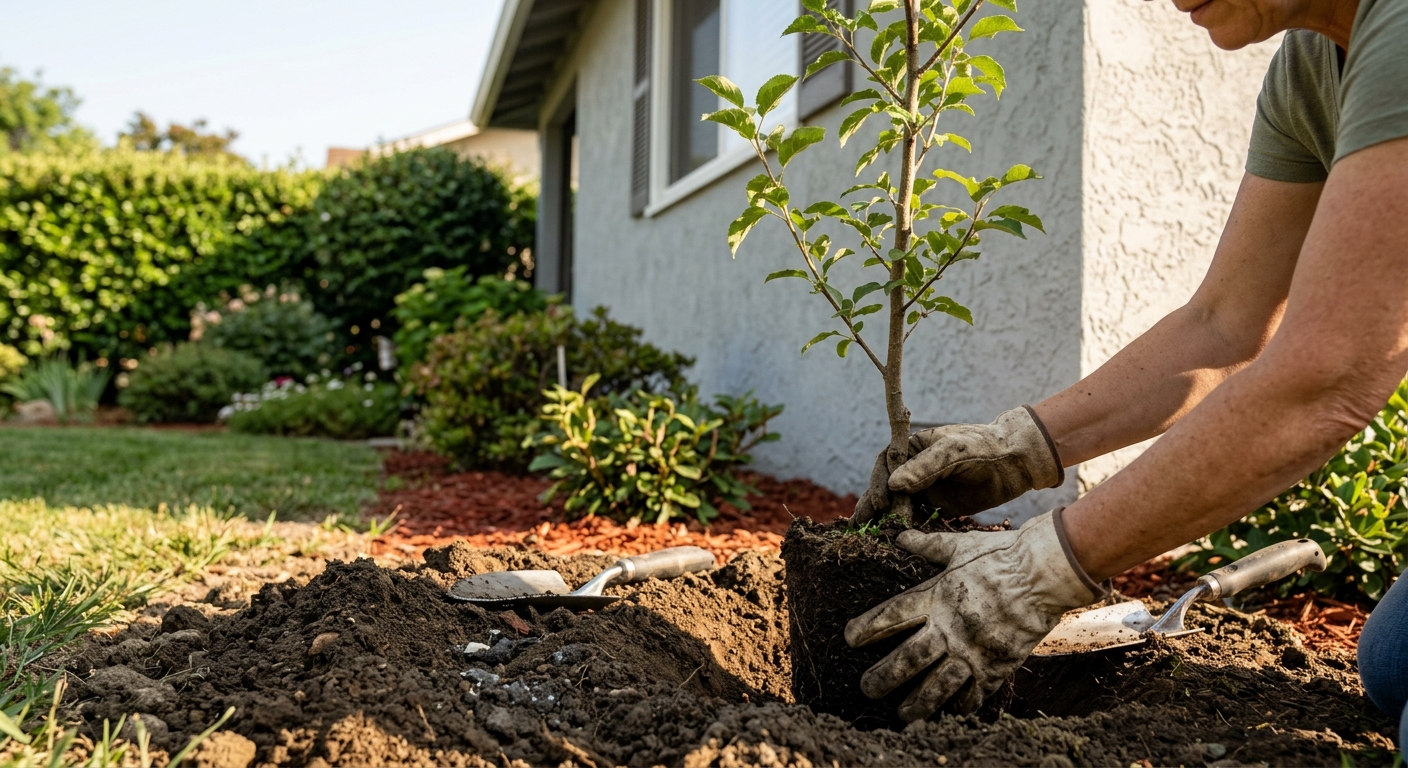
- Dig planting holes two to three times wider than the root ball but only as deep as the root ball height. Flaring the sides of the hole encourages lateral root growth and prevents the tree from sinking.
- Mulch each tree with a 3-inch ring extending to the drip line, keeping mulch 2 to 3 inches away from the trunk to prevent rot. Water deeply once per week for the first two growing seasons.
- Install a temporary shade structure or outdoor shade sail on the west side while waiting for trees to mature. These $50 to $150 solutions provide immediate relief and can be removed once canopy develops.
- Hire a certified arborist or landscape architect with energy-efficiency experience. Ask specifically about solar shading analysis and request references from energy-focused projects.
- Request a solar site analysis, which uses compass orientation, roof pitch, and seasonal sun angle data to calculate exactly where shade will fall at different times of day throughout the year.
- Ask about any existing trees that may be shading solar panels, blocking beneficial winter sun, or that could be pruned to redirect shade more effectively before adding new plantings.
- Have the designer specify native species suited to your USDA hardiness zone, local soil type, and rainfall patterns. Native trees establish 30 to 50% faster than ornamentals and require significantly less irrigation.
- Request a phased planting schedule prioritizing the west side first, then southwest, then south, spreading costs over two to three planting seasons while delivering early savings on the highest-impact areas.
- After implementation, compare your utility bills for two full summers against your pre-planting baseline. Most utilities offer free energy usage history for exactly this kind of comparison.
Why It Works: The Benefits
DOE research documents cooling cost reductions of 15 to 25% from strategic landscape shading, translating to $150 to $400 per year for a typical home spending $1,500 annually on electricity in a hot climate.
Shading can lower peak indoor temperatures by 4 to 8 degrees Fahrenheit, meaning your AC compressor cycles less frequently and reaches its cooling setpoint faster, extending equipment lifespan by reducing total operating hours.
Mature landscaping adds 5 to 15% to home resale value according to multiple appraisal studies, meaning a $500 to $1,500 investment in trees and shrubs can return $10,000 or more when you sell.
Properly placed deciduous trees shade summer sun but drop their leaves to allow 60 to 70% of available winter sunlight through, passively warming your home during heating season and reducing total annual energy costs.
Shaded patios and driveways can be 20 to 45 degrees Fahrenheit cooler than exposed surfaces on a hot day, making outdoor living areas usable and reducing the radiant heat load on adjacent walls and windows.
💰 Savings Impact by Action
DOE research shows strategically placed shade trees reduce annual residential cooling costs by 15 to 25% by intercepting solar radiation before it reaches walls and windows.
Dense vine coverage on west-facing walls reduces surface temperature of the underlying wall by up to 30 degrees Fahrenheit, cutting conducted heat gain through that assembly by roughly 12%.
Shading the outdoor AC condenser unit improves its operating efficiency by 5 to 10% on peak summer days by reducing the temperature of air it pulls through the coil.
Replacing bare soil or concrete near the home with mulch or low plantings reduces ground-level radiant heat re-emission, lowering ambient temperature around the foundation by up to 7%.
Mature trees cooling surrounding air through evapotranspiration can reduce the ambient temperature your AC intake draws from by 3 to 9 degrees Fahrenheit, cutting compressor energy use by approximately 9%.
🏠 Key Concepts Explained
The Science Behind It
The physics here come down to one principle: it is far cheaper to block solar radiation than to remove the heat it creates. Every square foot of unshaded south or west-facing wall is absorbing roughly 150 to 300 BTUs of solar energy per hour on a clear summer afternoon. That energy conducts through your wall assembly, raises interior surface temperatures, and forces your AC to run longer. A tree intercepts that radiation first, converting it to evapotranspiration and reflected diffuse light instead of direct heat gain.
Deciduous trees are particularly elegant from an energy standpoint because their behavior aligns with seasonal need. In summer, a full leafy canopy blocks 60 to 90% of incoming solar radiation. In winter, after leaf drop, that same tree transmits 60 to 70% of available sunlight, providing passive solar warming exactly when you want it. This seasonal switching happens automatically, with no thermostat required. Properly placed deciduous trees are one of the few home improvements that reduce both your cooling and heating bills simultaneously.
The evapotranspiration effect is often underestimated. A single mature tree can release 100 gallons of water per day through its leaves, and the energy required to convert that liquid water to vapor comes directly from the surrounding air, cooling it measurably. Studies in urban heat island research show that neighborhoods with mature tree canopy can be 3 to 9 degrees Fahrenheit cooler than treeless blocks on hot days. For your AC, pulling outdoor air that is 5 degrees cooler can reduce compressor energy use by 5 to 8% on its own, on top of any direct shading benefits.
Frequently Asked Questions
▼ How many years before I actually see savings on my electric bill from planting trees?
Fast-growing deciduous trees like red maple or honeylocust planted as 1.5-inch caliper nursery stock typically reach meaningful shading height in 5 to 7 years. However, if you install shade sails or vines in the interim, you can capture savings within the first summer. Shrubs and vines planted directly at window level often provide measurable shading within 2 to 3 growing seasons, so a layered approach gets you early results while trees mature.
▼ My HOA restricts tree planting near property lines. What can I still do?
Focus on plantings close to the home itself, which are usually within your control. Trellised vines on west-facing walls, window boxes with tall plantings, and container-grown small trees or large shrubs on a west-facing patio are all typically HOA-permissible. A 5-foot arborvitae or bamboo screen in a large planter on a west patio can shade a sliding glass door effectively without touching the ground or violating setback rules.
▼ Will planting trees near my house damage the foundation or pipes?
Root intrusion risk depends heavily on species and distance. Keep large trees at least 15 to 20 feet from the foundation, and avoid water-hungry trees like willows, silver maples, and cottonwoods within 30 feet of any plumbing. Oaks, elms, and hornbeams are much safer choices near structures. If you have clay soil, which heaves more than sandy soil, err toward the larger distance for any tree with a projected mature spread over 30 feet.
▼ I live in a wildfire zone. Can I still use landscaping to reduce cooling costs?
Yes, but your plant selection and placement must comply with local defensible space requirements, which typically require a 0 to 5 foot non-combustible zone immediately around the home and a managed zone from 5 to 30 feet out. In this context, focus on fire-resistant ground covers and low-growing shrubs close to the house, and place larger trees at the outer edge of the 30-foot zone or beyond. Your local fire department or county extension office can provide a free site-specific consultation.
▼ Can shading my AC condenser unit really make a difference, or is that a myth?
It is real but modest. Research from the Florida Solar Energy Center found that shading a condenser unit can improve its efficiency by 5 to 10% on the hottest days when the unit works hardest. The key is maintaining a minimum 2 to 3 foot clearance on all sides for airflow. Dense shrubs like yew or boxwood planted in an open U-shape around the unit on the south and west sides provide shade without restricting airflow, and some homeowners see a 3 to 8% reduction in AC energy use from this step alone.
Quick Tips
- West and southwest exposures are your top priority. Late afternoon sun is both the most intense and arrives when outdoor temperatures are already at their daily peak, creating a compounding cooling load.
- Choose trees native to your region whenever possible. They establish faster, survive drought better, and will not require the irrigation that negates some of your energy savings.
- If you rent or have a small yard, a large patio umbrella or shade sail over a west-facing window or patio can deliver immediate cooling relief for $50 to $150 while you plan a longer-term planting strategy.
- Photograph your home from the west side on a hot afternoon to document current sun exposure. Repeat the photo each year from the same spot to track shading progress as plants establish.
Variations for Your Situation
- Apartment or Rental: Renters cannot plant trees but can place large potted plants or small ornamental trees (like dwarf Japanese maples in 15-gallon containers) on a west-facing balcony or patio. Bamboo in a 20-inch pot can reach 6 to 8 feet in one season, shading a glass door effectively. Exterior window film is another renter-safe option costing $20 to $80 per window that blocks 40 to 70% of solar heat gain without any structural changes.
- Tight Budget (under $50): Start with free or low-cost seeds for fast annual vines like morning glory or hyacinth bean, a $5 bag of mulch for ground-level heat reduction, and a $30 to $50 shade sail for your most problematic west-facing window. Many municipalities also offer free or deeply discounted native trees through urban forestry programs. Check your city or county parks department website for annual giveaway events.
- Older Home (pre-1980): Older homes typically have less wall and window insulation, meaning solar heat gain has an even larger proportional impact on interior temperatures. Prioritize shading large single-pane or older double-pane windows first since they have the worst solar heat gain coefficients. Pair landscape shading with low-e window film on west-facing glass for compounding savings, as the two strategies together can cut west-facing solar heat gain by 60 to 80% at modest total cost.