Insulation is one of the highest-return investments a homeowner can make, with the EPA estimating that air sealing and insulation together can cut heating and cooling costs by up to 15%. But walk into any home improvement store and you will find a dizzying array of products, from fiberglass batts to spray foam cans to blown cellulose bags, each suited to very different situations. The challenge is knowing which projects belong on your weekend to-do list and which ones belong on a contractor’s invoice.
The stakes are real. A DIY attic insulation job done well can pay for itself in under three years. Done poorly, by blocking soffit vents or leaving air gaps, it can trap moisture, grow mold, and actually increase your energy bills. On the other end, homeowners sometimes pay thousands for professional spray foam in spaces where $40 of foam backer rod and caulk would have solved 80% of the problem.
This post gives you a clear framework: the quick fixes any homeowner can knock out in an afternoon, the intermediate DIY jobs worth doing with the right prep, and the projects where professional equipment and expertise are non-negotiable. We will cover real costs, realistic payback periods, and the building science behind why each decision matters.
What You’ll Need
Click on an item below to shop for the recommended items for this recipe on Amazon.
As an Amazon Associate, we earn from qualifying purchases.
How to Do It
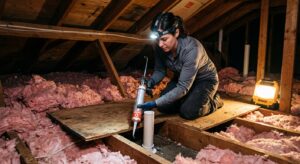
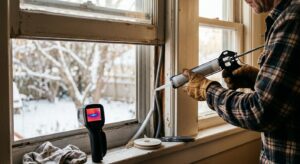
- Buy a can of low-expanding spray foam (for gaps up to 1 inch) and a tube of paintable acrylic latex caulk. These two products handle 90% of common air leaks.
- Seal around all electrical outlets and switch plates on exterior walls using foam gaskets available at hardware stores for about $5 per pack of 10.
- Apply foam backer rod into gaps larger than half an inch around plumbing pipes, wiring penetrations, and HVAC lines where they pass through floors or exterior walls. Follow with a bead of caulk or foam.
- Check your attic hatch or pull-down attic stairs. If it has no insulation on the back and no weatherstripping around the frame, add both. A pre-cut attic hatch cover kit costs $30 to $60 and installs in 20 minutes.
- Add door sweeps to exterior doors with visible daylight at the bottom. Compression sweeps cost $10 to $20 and require only a screwdriver.
- Replace old single-pane interior window trim caulk where it has cracked away from the frame. This seals one of the most overlooked air pathways in older homes.
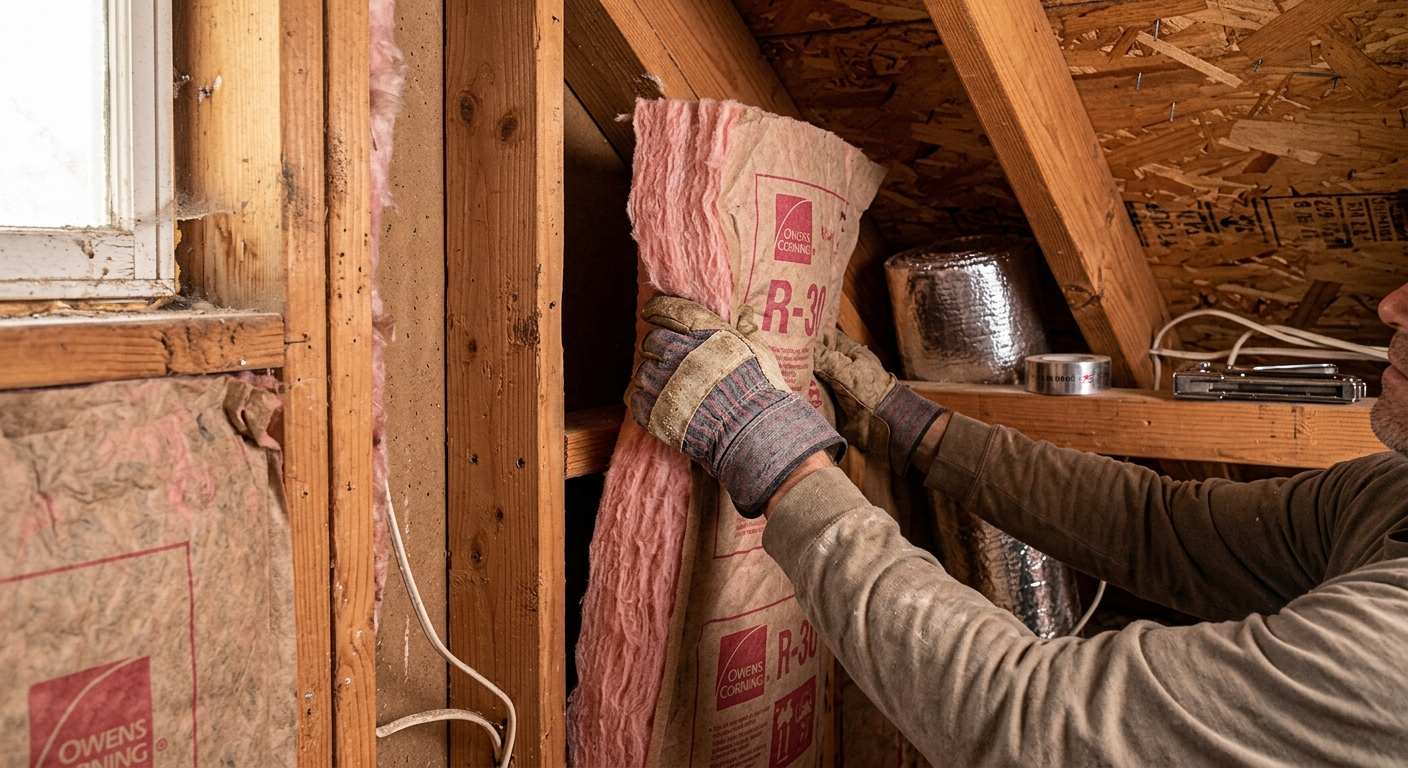
- Measure your attic’s square footage and check your existing insulation depth. Use the DOE’s online ZIP Code Insulation Program to find your recommended R-value (R-38 to R-60 for most of the continental US).
- Before adding any insulation, air seal the attic floor thoroughly. Use canned foam to seal around all top plates, recessed light fixtures (use an IC-rated cover box first), plumbing vents, and wiring penetrations. This step alone can reduce energy loss by 15 to 20%.
- Install rafter baffles (cardboard or foam chutes) at every eave to maintain a clear airflow channel from soffits to ridge. Blocking this channel causes moisture damage and voids most roofing warranties.
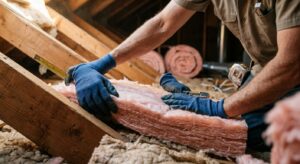
- Pick up bagged blown-in cellulose or blown-in fiberglass and rent or borrow the blower machine. Cellulose is typically less expensive per bag and has a slightly higher R-value per inch than fiberglass batts.
- Set up the blower machine outside or at the attic opening, run the hose up into the attic, and blow insulation in even layers working from the far corners toward the hatch. Use depth markers (simple ruler stakes) to verify consistent depth.
- Re-insulate the attic hatch as the final step, and document your finished depth and estimated R-value for utility rebate applications and future home sales.
- Closed-cell spray polyurethane foam (SPF) application: two-component spray foam requires a heated proportioner, proper pressure calibration, full respiratory protection, and a mandatory 24-hour off-gassing window. Improperly mixed foam never cures, emitting isocyanates indefinitely. Always hire a licensed SPF contractor.
- Injection foam into existing closed walls: drilling through exterior cladding or interior drywall at precise intervals, injecting foam, and patching correctly requires specialized training. Missed cavities or over-pressurized injection can bow drywall or leave voids. Get three bids from certified installers.
- Crawlspace encapsulation with spray foam on rim joists and a vapor barrier on the ground: a properly encapsulated crawlspace can reduce floor-level heating loads by 15 to 18%, but incorrect vapor barrier lapping or missing a ground cover extension creates a worse moisture problem than doing nothing.
- Cathedral ceiling insulation: vented cathedral ceilings with inadequate depth for both insulation and a ventilation channel require careful calculation of allowable R-values. An unvented cathedral assembly using closed-cell foam requires a building permit and professional design in most jurisdictions.
- Insulating around recessed lights in fire-rated ceiling assemblies: if your home has IC-rated or ICAT-rated cans, a certified energy auditor should assess them first before any insulation is added above. Non-IC fixtures can ignite insulation and must be replaced or boxed before proceeding.
Why It Works: The Benefits
The EPA estimates that properly air sealing and insulating can save homeowners an average of 15% on total energy costs, translating to $200 to $600 per year for a typical home depending on climate and existing conditions.
DIY attic insulation materials run $200 to $600 for most homes, with no labor cost. At average energy savings, many homeowners recover that investment in 1 to 3 years compared to 4 to 7 years for professionally installed equivalents.
Proper insulation eliminates the cold floors, drafty corners, and rooms that never reach the right temperature. Homes with continuous attic insulation at R-38 or higher show temperature swings 30 to 50% smaller between rooms.
Correctly installed insulation keeps surfaces above the dew point, preventing condensation inside wall cavities. This directly reduces the risk of mold, wood rot, and the expensive remediation that follows.
ENERGY STAR certified insulation upgrades are a recognized selling point, and homes with documented energy improvements sell faster and often at a premium of 2 to 5% in energy-conscious markets.
💰 Savings Impact by Action
Sealing attic floor penetrations before adding insulation reduces conditioned air loss by 15 to 20% compared to insulation added without air sealing.
Bringing attic insulation from R-11 to R-38 reduces heating and cooling loads by 10 to 15% in most US climate zones according to DOE data.
Encapsulating a vented crawlspace with vapor barrier and rim joist insulation can reduce floor-level heat loss by up to 18%.
Foam gaskets behind exterior wall outlets and switch plates eliminate a surprisingly common infiltration pathway, reducing drafts by up to 5% at near-zero cost.
Professionally installed dense-pack cellulose in empty wall cavities reduces wall heat loss by up to 12%, with a typical payback of 4 to 7 years.
🏠 Key Concepts Explained
The Science Behind It
Heat moves in three ways: conduction (direct transfer through a solid), convection (movement through air or liquid), and radiation (infrared waves traveling through space). Insulation primarily fights conduction, slowing the rate at which heat travels through your walls, ceiling, and floors. The R-value system measures exactly this resistance. A higher R-value means heat moves more slowly, which means your heating and cooling system runs less to maintain your set temperature.
But here is what trips up most DIYers: air leakage is not conduction. A gap or crack in your building envelope allows conditioned air to flow directly out of your home, carrying all of its energy with it. No amount of insulation on either side of that gap stops the loss. This is why building scientists consistently show that air sealing first and then insulating produces dramatically better results than insulation alone. Studies from the Lawrence Berkeley National Laboratory found that air infiltration accounts for 25 to 40% of space conditioning energy use in typical US homes.
Vapor dynamics add another layer of complexity that catches DIYers off guard. In cold climates, interior moisture-laden air wants to migrate toward the cold exterior, and if it hits a surface below the dew point inside your wall or ceiling assembly, it condenses. Insulation compresses this moisture into a small space with limited drying potential, creating ideal conditions for mold. This is why vapor retarder placement, assembly design, and local climate zone all must be considered together, and why insulating inside existing wall cavities or on the underside of roof decks without professional design is genuinely risky.
Frequently Asked Questions
▼ I added attic insulation but my energy bills did not change. What went wrong?
The most common cause is skipping the air sealing step before adding insulation. If air is freely flowing through gaps around top plates, recessed lights, and plumbing penetrations, adding more fluffy insulation on top has minimal effect. Go back to the attic floor with a can of foam and seal every visible penetration. The second possibility is that your HVAC ducts run through an unconditioned attic and are leaking conditioned air, which insulation alone cannot fix.
▼ How do I know if I already have enough insulation in my attic?
Go into your attic and look straight down. If you can see the tops of the floor joists (typically 2×6 or 2×8 lumber), you have less than R-19 and are significantly under-insulated for any US climate zone. If insulation is flush with or slightly above the joists, you have roughly R-19 to R-25. Most of the continental US should be at R-38 to R-60. Use a ruler to measure the actual depth and check the DOE’s recommended levels for your ZIP code at energystar.gov.
▼ Can I use spray foam cans from the hardware store to insulate a whole wall cavity?
No, and attempting it will create a bigger problem. Consumer-grade expanding foam dramatically over-expands in a closed cavity, bowing drywall and leaving voids. It is designed for sealing gaps up to 3 inches wide, not filling open framing cavities. For existing closed wall cavities, the only practical DIY option is dense-pack blown cellulose through small holes, which requires a specialized nozzle. Even that is best left to professionals to avoid under-packing and settling.
▼ My home was built in 1965. Is it safe to add insulation myself?
It can be, with one important first step. Homes built before 1980 may contain asbestos in pipe insulation, loose vermiculite attic insulation, or acoustic ceiling tiles, and disturbing it without testing creates a serious health hazard. Have a certified inspector collect samples for a lab test before touching anything. Fiberglass batt or blown cellulose is safe to add on top of existing fiberglass or rockwool insulation, but if you see gray or silver loose granules in the attic, stop and test first.
▼ Will adding attic insulation make my roof ice dam problem worse?
Done correctly, it will make ice dams better, not worse. Ice dams form when heat escaping from the living space melts snow on the roof, which then refreezes at the cold eaves. Proper attic insulation combined with maintained ventilation keeps the attic cold and uniform, which is exactly what prevents ice dam formation. The critical mistake to avoid is blocking soffit vents when installing insulation, which disrupts ventilation and can worsen ice dams.
Quick Tips
- Check your local utility’s rebate portal before buying materials. Many utilities offer $0.10 to $0.20 per square foot rebates on attic insulation, covering 20 to 40% of your material cost.
- Rent an infrared thermometer or borrow a thermal camera from a tool-lending library to identify your coldest walls and floors before deciding where to focus your insulation budget.
- Cellulose insulation is made from 75 to 85% recycled content, has a lower embodied energy than fiberglass, and is treated with borate for fire and pest resistance. It is often the best value for DIY attic top-ups.
- If your home has a vented crawlspace, insulating between the floor joists does very little without also adding a ground vapor barrier. The two improvements work together and the barrier alone costs $100 to $200 in materials.
- Document your insulation project with photos and receipts. It qualifies for the federal Energy Efficient Home Improvement Credit (25C) at 30% of costs up to $1,200 per year as of 2024.
Variations for Your Situation
- Apartment or Renter: Renters cannot modify attic insulation or wall assemblies, but can still capture meaningful savings. Focus on outlet gaskets ($5 to $15 for the whole unit), draft snakes or door sweeps for exterior doors (most landlords approve these), and window insulator film kits ($15 to $30) on single-pane windows. Report visible gaps around plumbing or baseboards to your landlord in writing, as addressing them benefits both parties. Combined, these steps can reduce heating and cooling loss by 5 to 10% at minimal cost.
- Tight Budget Under $100: Start with the highest-impact free step: locate your three biggest air leaks using a stick of incense on a windy day and watch for smoke movement near outlets, baseboards, and the attic hatch. Seal those with a $6 can of foam and a $4 tube of caulk. Next priority is an attic hatch cover if you have pull-down stairs. These three steps address the most disproportionate heat loss points in most homes and can deliver 5 to 8% savings for under $50 in materials.
- Older Home Pre-1980: These homes were built with minimal insulation standards and higher natural air infiltration rates, so the savings potential is larger but the risks are higher. Test for asbestos before disturbing any existing materials. Expect to find knob-and-tube wiring in the attic, which must be inspected by a licensed electrician before any insulation is added above it. Prioritize air sealing the attic floor first since older framing has more gaps at top plates. Budget $300 to $500 for professional air sealing and testing if you are unsure what you are working with, then DIY the insulation top-up afterward once the assembly is confirmed safe.