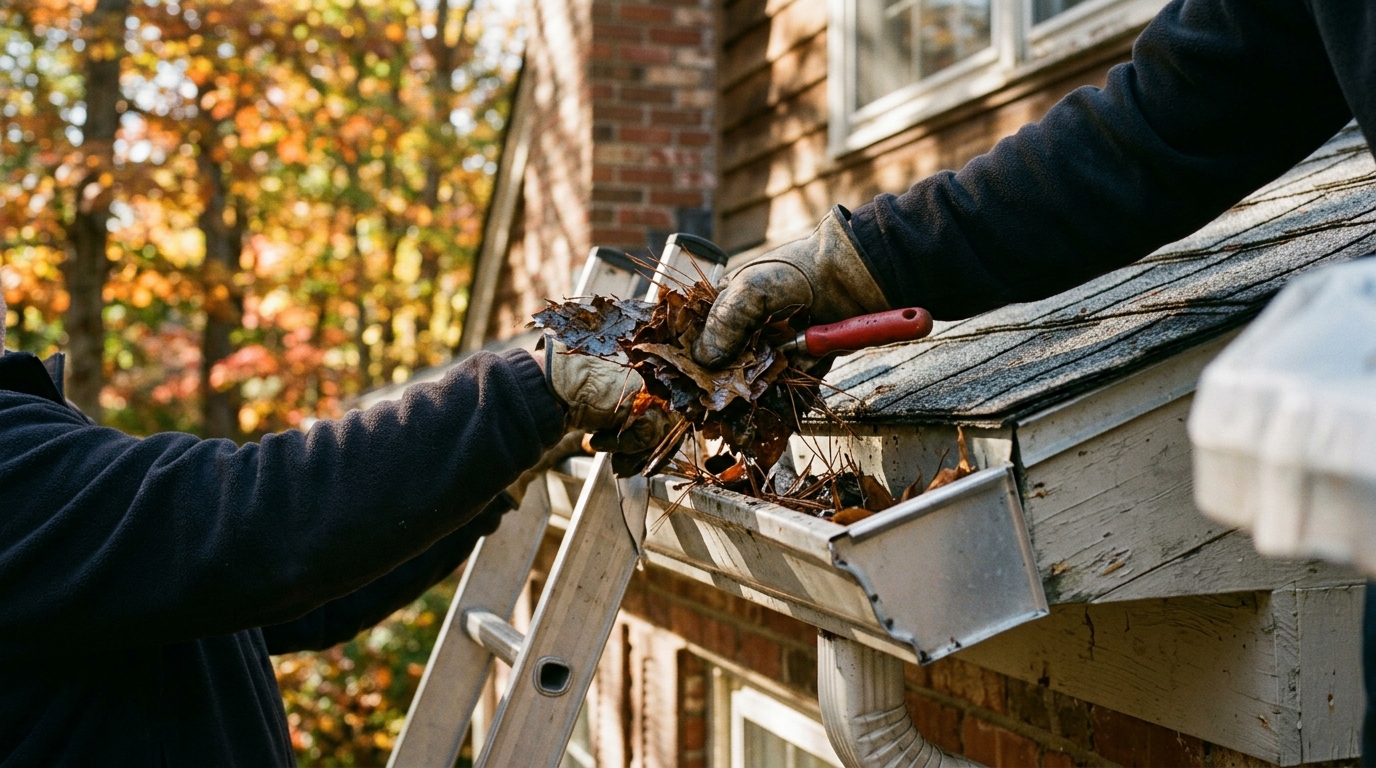
Every autumn, millions of homeowners watch leaves pile up in their gutters and tell themselves they’ll deal with it later. But by the time winter arrives, those clogged gutters become ice dam factories, forcing meltwater to back up under shingles, into walls, and across ceilings. The average ice dam claim runs between $4,000 and $6,000, and many homeowners are shocked to learn their insurer considers it a preventable maintenance failure.
The physics behind the problem is straightforward: when gutters are blocked, water can’t drain. It pools, freezes, and creates a ridge of ice at the roof’s edge. As heat escapes through the roof, snow above melts and that water has nowhere to go except sideways, under your shingles and into your home. A clean gutter, by contrast, channels water off the roof and away from your foundation before it ever gets a chance to freeze in the wrong place.
This post walks you through a complete fall gutter cleaning routine, from a quick DIY approach you can do in an afternoon to a more thorough professional-grade inspection that catches hidden problems early. You’ll also find the key building science concepts, real cost and savings numbers, and answers to the questions homeowners most commonly ask about gutter maintenance before winter hits.
What You’ll Need
Click on an item below to shop for the recommended items for this recipe on Amazon.
As an Amazon Associate, we earn from qualifying purchases.
How to Do It
- Wait until most leaves have fallen in your area, typically after two-thirds of the trees in your neighborhood have dropped their leaves, so you only need to clean once.
- Set up a stable extension ladder on firm, level ground. Use a ladder stabilizer (standoff) to keep the ladder off the gutter itself and prevent denting.
- Wearing rubber gloves, scoop debris from the gutter into a bucket or drop cloth on the ground below. Work from the end opposite the downspout toward the downspout, pushing debris toward the drain.
- Flush each gutter section with a garden hose starting at the closed end. Watch the water flow toward the downspout. A properly pitched gutter should drain completely with no pooling.
- Check the downspout by running the hose directly into the top opening at full pressure. Water should exit freely at the bottom. If it backs up, use a plumber’s snake or downspout auger to clear the blockage.
- Inspect visible gutter hangers and end caps while you have the ladder up. Rehang any sections sagging more than 1 inch and reseal any end caps showing gaps using gutter sealant.
- Complete all steps from the DIY Hand Cleaning approach first, then continue with the following inspection and repair steps.
- After flushing, mark any low spots where water pools by leaving the hose running and watching. Any section holding more than a half-inch of water needs re-pitching. The correct slope is one-quarter inch of drop per 10 feet of gutter run toward the downspout.
- Re-pitch sagging sections by adjusting or replacing gutter spikes or hidden hangers. Replace old spike-and-ferrule hangers with screw-in hidden hangers ($0.50 to $1.50 each) every 24 inches for a much more secure attachment.
- Apply gutter sealant (a tube costs $6 to $12) to any visible seams, end caps, or joints showing separation or rust. Clean the area with a wire brush and wipe dry before applying sealant for a lasting bond.
- Check downspout extensions at ground level. Each downspout should discharge water at least 4 to 6 feet from the foundation. Add flexible plastic extensions ($5 to $10 each) to any downspout that terminates too close to the house.
- Consider installing gutter guards rated for heavy leaf loads if you cleaned more than two full buckets of debris. Micro-mesh guards ($1.50 to $3.50 per linear foot DIY) allow water in while blocking most debris, reducing future cleaning frequency by 50 to 75%.
- Get at least two quotes from local gutter cleaning services in September or early October before demand spikes. Ask specifically whether the quote includes flushing downspouts and a basic inspection.
- Request that the crew inspect and report on gutter pitch, hanger condition, seam integrity, and downspout discharge locations. A good service will note any issues without necessarily charging to fix them on the spot.
- Ask for photos or a walk-through after the job so you understand the current condition of your system. Reputable companies offer before-and-after photos as standard practice.
- If the crew identifies fascia rot, significant sagging, or cracked seams, get a written itemized estimate for repairs before approving additional work. Compare that estimate with a second opinion from a gutter contractor.
- Schedule a return visit or set a calendar reminder for spring cleaning after snowmelt to clear any debris deposited during winter, completing a full two-visit annual maintenance cycle.
Why It Works: The Benefits
Ice dam water damage repairs average $4,000 to $6,000 per incident, and major cases involving drywall, insulation, and mold remediation can exceed $12,000. A $0 to $200 annual cleaning routine eliminates this risk.
Properly functioning gutters direct roof runoff at least 4 to 6 feet from the foundation. Overflowing gutters dump that same water directly at the base of the house, contributing to basement moisture intrusion and long-term foundation damage.
Gutters holding standing water and debris corrode 2 to 3 times faster than clean gutters. Annual cleaning can extend gutter system lifespan from roughly 15 years to 25 or more years, delaying a $1,500 to $4,000 replacement cost.
Many roofing material warranties and homeowner insurance policies require documented routine maintenance. Neglected gutters that cause ice dam damage can result in denied claims, leaving you fully responsible for repair costs.
Overflowing gutters saturate wooden fascia boards and soffits, leading to rot that compromises the structural attachment point for the gutter system itself. Replacing rotted fascia adds $500 to $2,000 to what was a simple cleaning job.
💰 Savings Impact by Action
Clean, properly pitched gutters eliminate the meltwater backup that causes ice dams, preventing claims that average $4,000 to $6,000 per incident.
Annual cleaning removes corrosive debris and standing water, extending aluminum gutter lifespan by up to 40% and delaying a $1,500 to $4,000 replacement.
Functioning gutters with proper downspout extensions reduce roof runoff reaching the foundation by up to 80%, lowering basement moisture intrusion risk.
Preventing overflow-related saturation reduces fascia rot risk by roughly 30%, avoiding $500 to $2,000 in wood replacement costs per occurrence.
🏠 Key Concepts Explained
The Science Behind It
Ice dams form because of a temperature differential across the roof surface. Heat escaping from the conditioned living space warms the roof deck above the exterior walls, melting snow from the underside. That meltwater flows down the slope until it reaches the cold overhang, where there is no heat below it. At the overhang, the water refreezes and accumulates into a ridge of ice, which is the dam. The water pooling behind the dam has nowhere to go except sideways and backward, under the shingles and into the roof assembly.
Gutters play a critical role in this system because a functioning gutter channels meltwater off the roof edge and away before it can pool and refreeze in dangerous quantities. A clogged gutter, by contrast, is already full of debris and possibly standing water or ice from previous cycles. Meltwater hits the gutter and immediately backs up onto the roof edge rather than draining away. This dramatically accelerates ice dam formation and increases the volume of water that can infiltrate the roof assembly during each melt cycle.
The freeze-thaw dynamic also explains why timing matters so much. Water weighs about 62 pounds per cubic foot and expands nearly 9% when it freezes. A 20-foot section of gutter holding standing water can exert hundreds of pounds of force on hangers and seams as it freezes. Repeated expansion and contraction loosens fasteners, opens seams, and gradually pulls the entire gutter system away from the fascia. Clean, properly pitched gutters drain between rain or melt events and never hold standing water long enough for this destructive cycle to begin.
Frequently Asked Questions
▼ My gutters are clean but I still got ice dams last winter. What am I missing?
Clean gutters reduce ice dam risk significantly but do not eliminate it if the root cause is heat escaping through your roof. The permanent fix for chronic ice dams is improving attic insulation (target R-38 to R-60 depending on climate zone) and sealing attic bypasses so conditioned air cannot warm the roof deck. Adding soffit and ridge ventilation helps flush warm air out of the attic before it melts snow. A clean gutter helps drain meltwater that does form, but stopping the heat source is the complete solution.
▼ How do I know if my gutters are pitched correctly?
Run your garden hose at the end of a gutter section opposite the downspout and watch the flow. Water should move steadily toward the downspout with no pooling anywhere along the run. The correct pitch is roughly one-quarter inch of drop for every 10 feet of gutter. If you see standing water after flushing, that section needs to be re-pitched by adjusting the hanger screws up or down until the slope is correct.
▼ Can I clean gutters in winter if I missed the fall window?
You can clean gutters in winter during a mild stretch above freezing, but frozen debris is much harder to remove and ladder conditions are more dangerous. If temperatures drop below freezing regularly, focus instead on installing roof heat cables along the gutter line and roof edge as a stopgap measure, which cost $50 to $150 for a typical section. Plan to do a thorough cleaning in early spring as your first priority before the next rainy season.
▼ My downspout is clogged and the hose does not clear it. What should I do?
Disconnect the downspout from the gutter outlet at the top by removing the screws or pop rivets holding the elbow in place. Feed a plumber’s snake or a downspout cleaning attachment on a drill from the top down, or from the bottom up if the clog appears near the bottom outlet. For stubborn clogs you can also use a wet-dry vacuum to suck debris from the bottom opening. If the downspout is corroded or crushed internally, replacing a downspout section costs $10 to $30 in materials and is a straightforward swap.
▼ Do gutter guards mean I never have to clean gutters again?
No gutter guard eliminates maintenance entirely. Micro-mesh guards are the most effective category and can reduce cleaning frequency to once every two to three years for most homes, but they still accumulate roof grit, seeds, and fine debris over time. Foam and brush-style guards actually trap debris inside and can make cleaning harder than no guard at all. If you install guards, plan on at least an annual visual inspection and occasional light rinsing from the ground with a hose.
Quick Tips
- Set a phone calendar reminder for October 20th each year as your gutter cleaning trigger date, then adjust based on local leaf-fall progress.
- After flushing downspouts, check where they discharge during a heavy rainstorm. If water is pooling against the foundation, add extensions immediately.
- Use a bright flashlight or phone camera to inspect gutter interiors from the ladder before scooping. Look for rust spots, separated seams, or cracks that sealant can fix while you are already up there.
- If you install gutter guards, do not skip annual inspections entirely. Debris can still accumulate on top of guards and cause overflow on one side of the guard, giving a false sense of security.
Variations for Your Situation
- Apartment or Condo Owner: If you own a condo or live in an HOA community, gutter maintenance is typically the responsibility of the association or building management. Document the gutter condition with photos each fall and submit a written maintenance request to your HOA or property manager by early October. If ice dams cause interior damage to your unit, your maintenance request records are critical for insurance purposes. Renters should notify landlords in writing and follow up before the first freeze.
- Tight Budget (Under $50): The tools for basic gutter cleaning cost almost nothing if you already own a ladder and garden hose. Spend $8 to $12 on a pair of rubber gloves and a cheap gutter scoop if needed, and use an old bucket from the garage. Skip gutter guards for now and focus entirely on cleaning and flushing. If you cannot safely use a ladder, some local handypersons charge $75 to $100 for a single-story cleaning, which is still far cheaper than an ice dam repair claim.
- Older Home (Pre-1980): Homes built before 1980 often have steel gutters rather than aluminum, which are heavier and more prone to rust perforation. When cleaning, look carefully for rust-through holes, which appear as orange staining inside the gutter channel. Small holes can be patched with gutter repair tape or sealant ($8 to $15), but widespread rust means the system is near end of life. Also check that downspouts connect to a functional drainage system rather than an old buried clay pipe, which may be collapsed or root-invaded and require a plumber to assess.