Your basement walls are one of the biggest sources of heat loss in the average home, yet most homeowners either ignore them entirely or insulate them incorrectly. An uninsulated poured concrete or block basement wall has an R-value of roughly R-1 to R-2, meaning heat flows through it almost as freely as through a single pane of glass. In cold climates, that translates directly into higher heating bills, cold floors, and a furnace that never quite keeps up.
When it comes to insulating basement walls, two materials dominate the conversation: rigid foam board and spray foam. Both are far superior to fiberglass batts in a below-grade environment, but they work differently, cost differently, and suit different situations. Rigid foam is affordable, DIY-friendly, and available at any home center. Spray foam seals gaps and insulates in one step but typically requires a professional and a larger upfront investment. The right choice depends on your wall condition, budget, moisture situation, and whether you plan to finish the space.
In this post, you will learn exactly how each material performs, what it costs, how long it takes to pay back, and which approach makes sense for your specific basement. We cover a DIY rigid foam installation you can complete in a weekend, as well as a professional spray foam upgrade for homeowners who want maximum performance with minimal hassle.
What You’ll Need
Click on an item below to shop for the recommended items for this recipe on Amazon.
As an Amazon Associate, we earn from qualifying purchases.
How to Do It
- Inspect the basement walls thoroughly for active water seepage, efflorescence (white mineral deposits), or cracks wider than a hairline. Address any water intrusion before insulating. Foam will not fix a wet basement and will trap moisture behind it.
- Choose your foam board: 2-inch XPS (extruded polystyrene, typically pink or blue) provides R-10 and has a low vapor permeance of 1 perm, making it a good moisture retarder. Foil-faced polyiso at 2 inches gives R-13 but should not be used below grade on exterior-facing walls because it loses R-value in sustained cold. EPS (beadboard) is the most affordable at R-4 per inch and is vapor-open, which some building scientists prefer below grade.
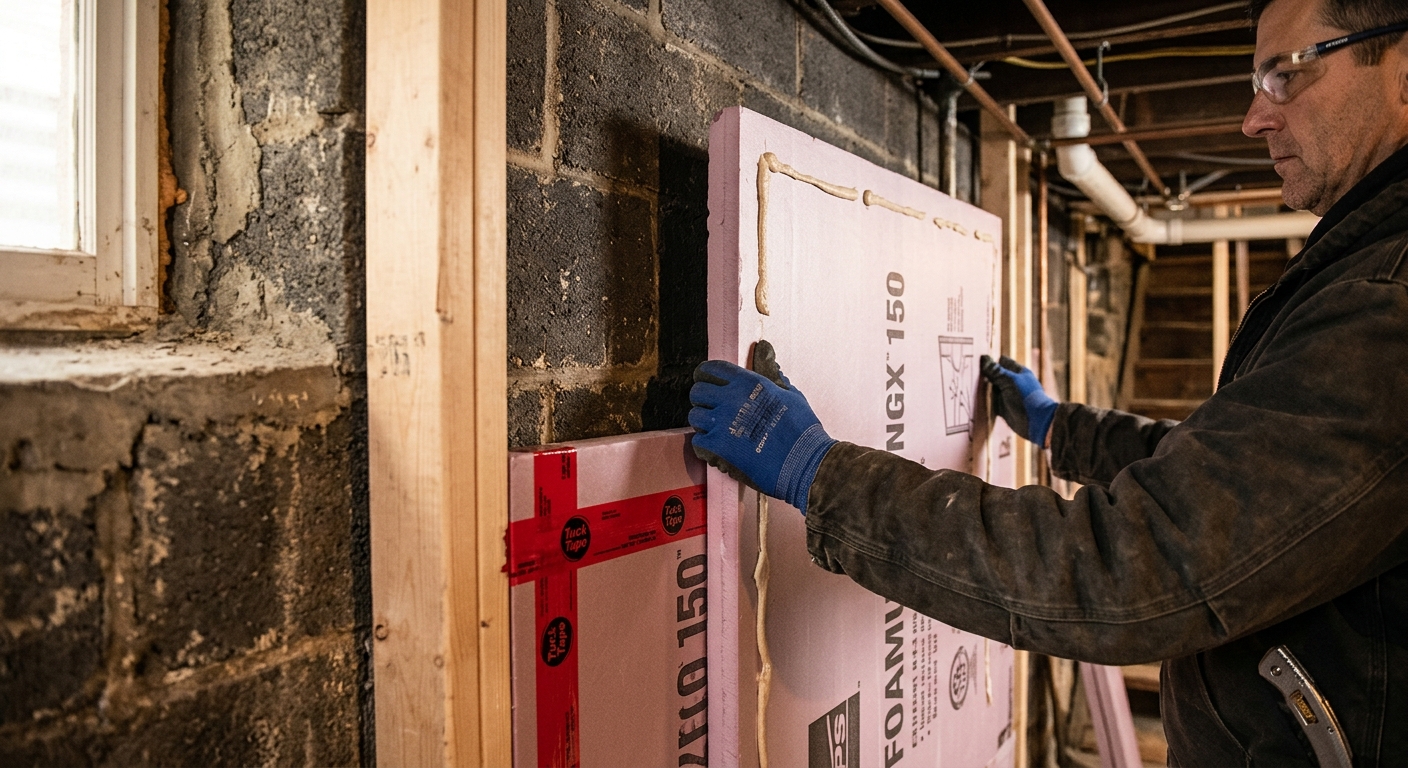
- Cut boards to fit floor to ceiling using a utility knife and straightedge. Score the face deeply and snap cleanly. For block walls with uneven surfaces, use construction adhesive rated for foam and fill any gaps behind boards with canned spray foam to prevent air bypassing.
- Adhere boards to the wall using foam-compatible construction adhesive applied in a zigzag pattern or dabs at 12-inch intervals. Press firmly and hold for 30 to 60 seconds. For additional security on taller walls, use concrete screws with large plastic washers at the top and middle of each board.
- Tape all seams between boards using foil tape or Tuck Tape specifically rated for foam insulation. Seal the perimeter at the floor and ceiling with canned spray foam or acoustical sealant. Every gap is a thermal bypass and a potential condensation point.
- Install half-inch drywall directly over the foam boards as a required thermal barrier before using the space. Attach drywall using 3-inch screws driven through the foam into pressure-treated furring strips glued to the concrete, or use masonry screws into the concrete through the foam and drywall. Tape, mud, and finish drywall to complete the wall.
- Get at least three bids from licensed spray foam contractors. Ask specifically for closed-cell foam (not open-cell) for below-grade walls. Open-cell foam is vapor-permeable and not appropriate for basement wall applications where ground moisture is present.
- Prepare the basement by removing all stored items, covering the floor with plastic sheeting, and taping plastic over any HVAC equipment, water heaters, and electrical panels. Spray foam overspray is nearly impossible to remove from surfaces once cured.
- The contractor will apply 2 to 3 inches of closed-cell spray foam directly to the concrete or block wall in passes, allowing each pass to cure before adding more. At 2 inches, you achieve approximately R-12 to R-14. At 3 inches, R-18 to R-21. Discuss your target R-value with the contractor upfront based on your climate zone.
- Closed-cell spray foam expands 30 to 60 times its liquid volume and self-adheres to concrete, filling every crack, gap, and irregular surface automatically. This provides both insulation and an air and vapor barrier in a single application with no taping required.
- Allow 24 hours before re-entering the space and 24 to 48 hours before installing drywall. The foam will have a slight off-gassing odor during curing. Ventilate the space by opening basement windows or running a fan exhausting to the outside during the curing period.
- Install half-inch drywall over the cured foam as a required thermal and fire barrier. Because the foam bonds directly to the wall, furring strips are typically glued or anchored to the foam surface to provide a nailing base for drywall. Confirm the installation detail with your contractor before work begins.
Why It Works: The Benefits
Insulating an unfinished basement to R-15 can reduce whole-home heating and cooling costs by 15 to 30% annually, with savings toward the higher end in climates with long heating seasons. The DOE estimates basement insulation upgrades save an average of $200 to $500 per year depending on home size and fuel type.
A properly insulated basement wall raises the air temperature in the basement by 10 to 20 degrees Fahrenheit in winter, which in turn warms the floor surface of the living area above by 3 to 8 degrees. That shift eliminates the cold-feet feeling that plagues many homes built on uninsulated basements.
Closed-cell spray foam and foil-faced rigid foam both act as vapor retarders, reducing the inward migration of ground moisture through concrete by up to 90%. This dramatically lowers the risk of mold growth on wood framing, subfloors, and stored items.
An insulated, comfortable basement can be finished as living space, a home office, or a gym, effectively adding square footage to your home at a fraction of new construction cost. Finished basement additions return 60 to 75 cents on every dollar spent at resale according to Remodeling Magazine’s Cost vs. Value data.
When the basement is properly conditioned and insulated, your furnace or heat pump cycles less frequently. Shorter run cycles extend equipment lifespan and can delay a $3,000 to $7,000 system replacement by several years.
💰 Savings Impact by Action
Insulating unfinished basement walls from R-2 to R-15 reduces whole-home heating energy use by 15 to 25% in cold climates.
Sealing and insulating rim joists alone eliminates up to 15% of total basement air and heat loss at minimal cost.
Taping foam seams and sealing perimeter gaps with canned foam prevents cold air bypass that can cut effective R-value by up to 20%.
Closed-cell spray foam at 3 inches achieves R-18 to R-21 and a vapor permeance below 1 perm, reducing heat and moisture loss by up to 30% versus an uninsulated wall.
Combining continuous rigid foam plus stud-cavity mineral wool to R-22 or higher can reduce basement heating loads by 30 to 35% compared to an uninsulated baseline.
🏠 Key Concepts Explained
The Science Behind It
Concrete and masonry are terrible insulators but excellent conductors of both heat and moisture. A standard 8-inch poured concrete wall has an R-value of about R-0.64, barely more than nothing. The ground surrounding your basement stays at a relatively constant 50 to 55 degrees Fahrenheit year-round in most of North America. In winter, that means the wall is perpetually trying to equalize your 68-degree indoor air with the cold ground outside, pulling heat out of your home around the clock. In summer, that same ground temperature can actually help cool the space, which is why insulating only the upper portion of the wall (the above-grade section) and leaving the below-grade section uninsulated is sometimes worth considering in mixed climates.
The physics of moisture are equally important. Concrete has a high vapor permeance, meaning water vapor moves through it relatively freely from the high-moisture soil side to the lower-moisture interior side. When warm indoor air contacts a cold concrete wall and falls below its dew point temperature, moisture condenses on or within the wall assembly. This is why fiberglass batts installed directly against concrete walls are a disaster: they absorb that moisture, stay wet, and become a perfect mold habitat. Rigid foam and closed-cell spray foam work because they keep the concrete wall itself warmer (closer to indoor air temperature), shifting the dew point to a location where condensation either cannot occur or can dry harmlessly to the interior.
Closed-cell spray foam achieves its outstanding performance through a combination of mechanisms. Its cell structure is filled with a low-conductivity blowing agent gas rather than air, giving it an R-value of 6 to 7 per inch compared to R-4 to R-5 for rigid foams. Its density of 2 pounds per cubic foot makes it dimensionally stable, structurally rigid when bonded to concrete, and essentially impermeable to vapor at 0.8 to 1.0 perm. Rigid foam boards are slightly more vapor-permeable depending on type, which is not necessarily a problem but means seam taping and edge sealing become critical to preventing air and moisture movement at the joints between boards.
Frequently Asked Questions
▼ How do I know if I should fix my basement moisture problem before insulating?
Tape a 12-inch square of plastic sheeting to the bare concrete wall, seal all edges with tape, and leave it for 24 to 48 hours. If you find moisture on the back side of the plastic (against the wall), you have water migrating through the concrete from the outside. If moisture is on the room-facing side, it is interior humidity condensing. Ground-water migration requires drainage or waterproofing before insulating. High indoor humidity can be managed with a dehumidifier and improved ventilation.
▼ Can I install rigid foam over existing painted or sealed concrete walls?
Yes, as long as the paint or sealer is in good condition and not peeling. Construction adhesive will bond to most painted concrete surfaces adequately. If the paint is flaking or the sealer is failing, remove it with a wire brush before applying foam. Peeling paint between the foam and wall creates voids where air can bypass the insulation and moisture can accumulate.
▼ My basement has a stone or rubble foundation. Can I still insulate it?
Rigid foam boards are nearly impossible to install on stone foundations because the surface is too irregular to achieve solid contact. Professional closed-cell spray foam is the correct solution here because it conforms to any surface and self-seals all gaps. Spray foam applied 2 to 3 inches thick will encapsulate the irregular stonework, seal air leaks between stones, and deliver R-12 to R-20 in a single application. Budget $3.50 to $5.00 per square foot for this work.
▼ Will insulating my basement walls make my basement smell musty?
Done correctly, basement insulation reduces mustiness by eliminating the condensation that feeds mold growth on cold concrete surfaces. However, if you insulate over an existing moisture problem or leave gaps in the foam where condensation can occur, you can make odor problems worse. If your basement already smells musty, have it inspected and remediated for mold before insulating. Enclosing a mold problem behind foam and drywall does not eliminate it.
▼ How long will it take to see savings on my energy bill after insulating?
Most homeowners notice a meaningful reduction in their first full heating season after insulating, typically within 3 to 6 months of completion. Depending on your baseline energy use and local fuel costs, savings of $150 to $400 per year are common for a 1,000 to 1,500 square foot basement insulated to R-15. At those rates, a DIY rigid foam project typically pays back in 3 to 5 years, and a professional spray foam job in 5 to 8 years.
Quick Tips
- In Climate Zones 5 and above (most of the northern United States and all of Canada), the IRC recommends a minimum of R-15 for basement walls. Use 3 inches of XPS or 2.5 inches of closed-cell spray foam to meet this target.
- If you are insulating with rigid foam and plan to finish the wall, consider a hybrid approach: apply 1.5 inches of rigid foam directly to the concrete for air and moisture control, then frame a 2×4 stud wall 0.5 inches in front of it and fill the stud cavities with mineral wool batts for an additional R-15, achieving a total of R-22 or higher.
- Always use pressure-treated lumber for any bottom plates or furring strips that contact concrete directly. Untreated wood absorbs ground moisture from the slab and rots within a few years, even in a basement that appears dry.
- For rim joists (the framing at the very top of the basement wall where the floor system sits), use cut-and-cobble rigid foam or spray foam in 2-pound closed-cell canned kits. Rim joists are responsible for up to 15% of total basement heat loss and are often overlooked.
Variations for Your Situation
- Tight Budget (under $500): Focus on the rim joists first using cut-and-cobble XPS foam cut to fit between joists and sealed with canned spray foam. Rim joist air sealing alone can cut basement heat loss by 10 to 15% and costs $75 to $150 in materials for an average home. Then insulate the above-grade portion of the wall (the section above outdoor ground level) with rigid foam, which delivers the highest return since it is exposed to outdoor temperature swings rather than stable ground temperature.
- Older Home (pre-1980 with possible moisture issues): Start with a full moisture assessment before purchasing any materials. Run a dehumidifier for a week and monitor the walls. If you find recurring dampness, invest in an interior drain tile system or exterior waterproofing before insulating. For stone or brick foundations common in homes built before 1940, budget for professional closed-cell spray foam at $3.00 to $5.00 per square foot rather than attempting rigid boards on irregular surfaces. Consider having an energy auditor assess the full basement envelope first.
- Planning to Finish the Basement as Living Space: Use the hybrid approach for best performance and code compliance. Apply 1 to 2 inches of rigid foam (R-5 to R-10) directly to the concrete wall for continuous thermal and moisture control, then frame a 2×4 stud wall in front of it, fill with R-13 mineral wool batts, and finish with drywall. Total wall R-value reaches R-18 to R-23, which meets or exceeds code in most climate zones and leaves a cavity for electrical wiring without penetrating the foam layer.