Mobile and manufactured homes are among the least energy-efficient housing types in the country. Older units built before HUD’s 1994 energy standards often have wall cavities with only R-7 to R-11 insulation, uninsulated or poorly insulated floors exposed to outside air, and single-pane windows that bleed heat in winter and let it pour in during summer. The result is heating and cooling bills that can run 50 to 100% higher per square foot than a comparable site-built home.
The good news is that mobile homes have a unique structure that actually makes certain insulation upgrades easier and more cost-effective than in traditional homes. The underbelly, skirting, and roof cavity are all accessible with basic tools and inexpensive materials. Even renters or owners on a tight budget can make meaningful improvements without a contractor or a permit.
This guide walks you through the most impactful insulation strategies for mobile and manufactured homes, from free and low-cost air sealing fixes you can do this weekend to a full underbelly insulation project that typically pays for itself in one to two heating seasons. Every approach is ranked by cost, difficulty, and realistic savings so you can start where it makes the most sense for your situation.
What You’ll Need
Click on an item below to shop for the recommended items for this recipe on Amazon.
As an Amazon Associate, we earn from qualifying purchases.
How to Do It
- Walk the perimeter of your home and inspect the skirting for gaps, missing panels, cracked sections, or openings where utility lines enter. Note every gap larger than a quarter inch.
- Purchase a few cans of low-expansion spray foam (Great Stuff or equivalent) and a tube of exterior-grade paintable caulk. Total cost is typically $15 to $30.
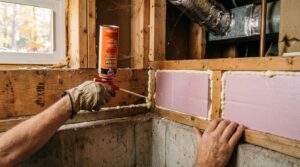
- Seal all utility penetrations through the floor and skirting with spray foam, including water supply lines, drain pipes, electrical conduits, and HVAC ducts that pass through the floor.
- Replace any missing or cracked skirting panels. Replacement vinyl skirting panels typically cost $5 to $15 each at a mobile home supply store or online.
- Inside the home, run a bead of caulk along the base of all exterior walls where the wall meets the floor, and around window frames where they meet the wall trim.
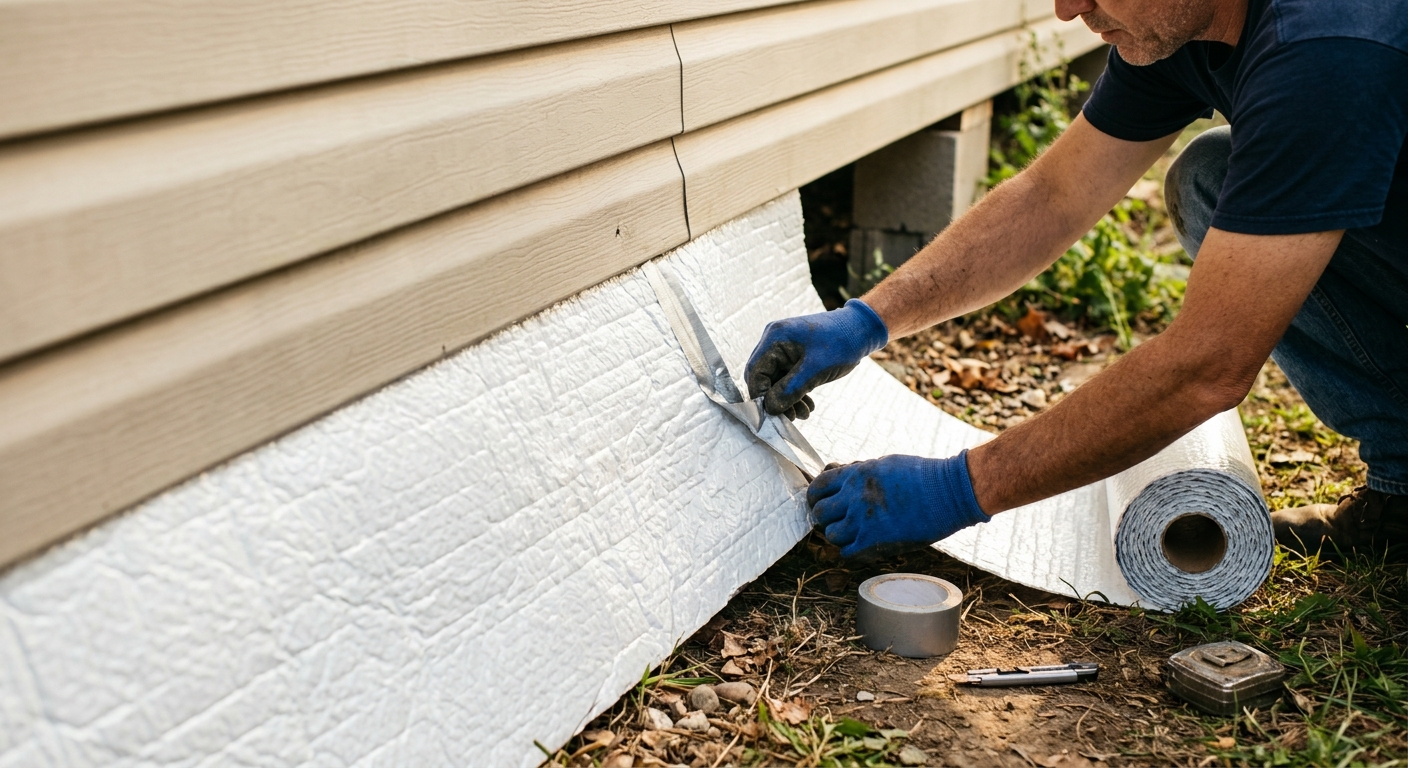
- Check your underbelly vapor barrier (the black or white material visible under the home) for tears or holes. Patch small tears with HVAC foil tape, which costs about $8 per roll and adheres well to the belly board.
- Assess your existing underbelly. If the original belly board is intact and the existing insulation is dry, you can add insulation from the outside without tearing anything out. If it is wet, sagging, or missing, remove it in sections using a utility knife and check the floor joists for moisture damage before proceeding.
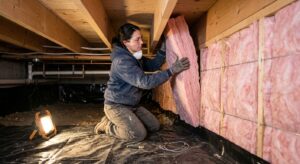
- Purchase unfaced fiberglass batt insulation sized to fit your floor joist depth. Most mobile homes use 2×6 joists, so R-19 batts (6.25 inches) are the correct thickness. A 1,000 sq ft floor needs approximately 12 to 15 bags of batts at $25 to $40 each.
- Staple or wire-hang the batts between floor joists with the kraft facing up toward the living space (warm side) if you are in a heating-dominated climate. In a cooling-dominated climate, orient the facing downward. This placement controls vapor diffusion correctly.
- Cover the installed batts with a new 6-mil poly vapor barrier or a replacement belly board material (woven polyethylene belly wrap sold specifically for manufactured homes). Staple it to the bottom of the joists every 12 inches and seal all seams with HVAC foil tape.
- Upgrade your skirting to insulated foam-backed vinyl skirting panels if your existing skirting is uninsulated. These panels provide R-3 to R-5 and cost about $2 to $4 per linear foot more than standard vinyl.
- Leave at least two vented skirting panels on opposite sides of the home to allow for minimal air circulation under the home in humid climates, which prevents moisture buildup. In cold-dry climates, a fully sealed skirting is acceptable and preferred.
- Check your roof cavity depth by removing a ceiling light fixture or vent cover and measuring with a ruler. Most older mobile homes have 6 to 8 inches of clearance, limiting you to blown-in insulation to add R-value without structural changes.
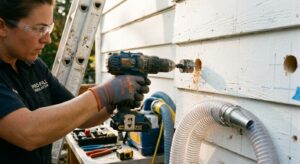
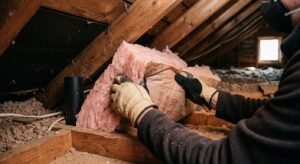
- Hire a blown-in insulation contractor or rent a blower machine from a home improvement store. Add blown cellulose or fiberglass to bring the attic to R-30 to R-38. Blown insulation reaches into existing cavities without demolition and costs $0.50 to $1.50 per square foot installed.
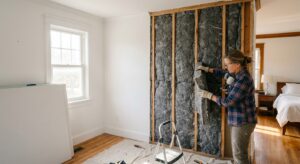
- If your walls are accessible during a renovation, replace existing cavity insulation with R-13 to R-15 high-density batts and add a continuous layer of 1-inch rigid foam board (R-5 to R-6) on the exterior before re-siding. This addresses metal thermal bridging.
- Seal all top-plate penetrations between the ceiling and wall cavity with spray foam before adding blown insulation to prevent short-circuiting the air barrier.
- Install radiant barrier foil under the roof decking or on top of the ceiling insulation if you are in a hot climate (climate zones 1 through 3). Radiant barriers reduce cooling loads by 5 to 10% in high-sun regions by blocking radiant heat transfer.
- After completing roof and wall work, have a contractor perform a blower door test to measure air changes per hour. A well-sealed and insulated manufactured home should achieve 5 to 7 ACH50 or better.
Why It Works: The Benefits
Owners who add underbelly insulation and seal skirting gaps typically report 20 to 35% reductions in monthly utility costs, with some cold-climate homeowners saving $600 to $900 per year on heating alone.
Insulating the underbelly to R-19 or better raises floor surface temperatures by 8 to 15 degrees F on cold days, eliminating the cold-feet problem that is the most common comfort complaint in unimproved mobile homes.
When the building envelope holds conditioned air better, the heating or cooling system cycles less often. Shorter runtimes extend equipment life and can delay a furnace or heat pump replacement by several years.
An insulated and skirted underbelly keeps the crawl space temperature significantly warmer in freezing conditions, dramatically reducing the risk of burst pipes, which can cost $1,000 to $5,000 or more to repair.
Sealing gaps in the underbelly and around penetrations prevents dust, pollen, rodent entry, and ground moisture from being drawn into living spaces through the floor by the stack effect.
💰 Savings Impact by Action
Adding R-19 to an uninsulated or degraded floor assembly reduces floor heat loss by up to 25% of total home energy use in cold climates.
Sealing skirting gaps, pipe penetrations, and wall-floor joints reduces uncontrolled air infiltration by 15 to 20% of total heating and cooling load.
Installing insulated skirting panels reduces wind-driven heat loss from the underbelly by 8 to 12% by eliminating the convective air movement beneath the floor.
Bringing ceiling insulation from R-11 to R-30 with blown cellulose reduces cooling and heating loads through the roof by 12 to 18% depending on climate zone.
Adding weatherstripping and door sweeps to all exterior doors and caulking window frames reduces infiltration at openings by 5 to 10% of total air leakage.
🏠 Key Concepts Explained
The Science Behind It
Heat moves through three mechanisms: conduction, convection, and radiation. In a mobile home, all three work against you simultaneously. The thin metal or wood framing conducts heat directly between the outside and inside. The large air gap under an uninsulated floor creates convective loops where cold outdoor air strips heat from the floor surface continuously. And a dark-colored metal roof absorbs solar radiation and re-radiates it as heat into the ceiling assembly. Insulation works by trapping millions of tiny air pockets that resist conductive heat flow, which is measured as R-value. Adding R-19 to a floor that previously had R-0 does not just add a little improvement, it creates an exponential reduction in heat loss because thermal resistance compounds as layers are added.
The stack effect is especially powerful in mobile homes. Warm air is less dense than cold air, so it rises and escapes through any gaps at ceiling level, creating a negative pressure zone near the floor that actively pulls cold outside air in through underbelly openings and floor penetrations. This is why sealing gaps at the floor is so effective: you are not just plugging a hole, you are breaking the pressure-driven circuit that drives continuous air exchange. A single half-inch gap around a pipe penetration through the floor can allow the same air leakage as a baseball-sized hole in the wall, according to DOE research on manufactured housing infiltration rates.
Vapor barriers in floors work on a simple principle: moisture in air moves from high concentration to low concentration, passing through materials until it reaches a cold surface where it condenses. In winter in most climates, the cold side is outside, so moisture migrates downward through the floor. Placing the vapor-resistant layer on the warm upper side of the insulation slows that migration before the moisture reaches the cold zone and condenses inside the assembly. If the barrier is placed on the wrong side or omitted entirely, moisture accumulates inside the floor cavity over months and seasons, leading to mold, wood rot, and insulation degradation that can cost thousands to remediate.
Frequently Asked Questions
▼ My floor is still cold after I insulated the underbelly. What did I miss?
Check whether the new insulation is sagging or has gaps between batts, which create cold bridges across the whole floor. Also inspect the belly wrap for any unsealed seams where cold air can still circulate under the insulation. If the skirting is open or missing panels, cold air is flowing freely under the home and overwhelming even good insulation, so that must be addressed too.
▼ There is moisture and mold in my underbelly. Should I still add insulation?
No, not yet. Adding insulation over a wet assembly traps the moisture and accelerates rot and mold growth. First identify the source: ground moisture rising up (fix with a ground cover vapor barrier of 6-mil poly), a plumbing leak (repair the leak), or condensation from poor vapor barrier placement (correct the vapor barrier orientation). Allow the cavity to fully dry, treat any mold with a borate-based wood preservative, and then insulate. In severe cases consult a contractor.
▼ Can I insulate a mobile home I am renting without the landlord’s permission?
You can do the completely non-invasive steps without any structural changes: door sweeps, window film, draft snakes, and caulking around interior trim are all reversible and typically acceptable under most leases. For underbelly or skirting work, get written permission first since these involve the structure of the home. Some landlords will split the cost or do the work themselves if you present the bill savings in writing.
▼ How do I insulate a mobile home that is on a permanent foundation instead of piers?
If the crawl space is fully enclosed with a foundation wall, treat it like a traditional crawl space: insulate the interior foundation walls with rigid foam board to R-10 or better, install a 6-mil ground vapor barrier across the entire floor, and condition or ventilate the space according to your climate zone. This is often more effective than insulating the floor above and eliminates the cold floor problem entirely.
▼ What R-value should I aim for in my mobile home floor, roof, and walls?
The 2021 HUD Manufactured Home Construction and Safety Standards require R-11 to R-22 in floors, R-11 to R-21 in walls, and R-22 to R-38 in ceilings depending on thermal zone. For maximum savings, target R-19 to R-30 in the floor and R-30 to R-38 in the ceiling regardless of what was originally installed. Walls are harder to upgrade but adding exterior rigid foam to R-5 is achievable during re-siding.
Quick Tips
- Prioritize the underbelly over the walls: you get roughly 3 to 4 times the savings per dollar spent compared to wall insulation in a typical mobile home.
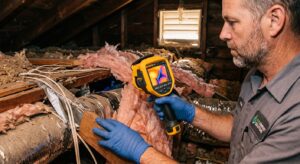
- Use a thermal leak detector or an inexpensive infrared thermometer to scan your floors and walls from inside on a cold day. Cold spots map exactly where insulation is thin or missing.
- Add door sweep seals to all exterior doors. Mobile home doors frequently have large gaps at the bottom that account for more air leakage than an average homeowner would expect.
- If you add significant insulation and air sealing, install a carbon monoxide detector if you do not already have one. Tighter homes require attention to combustion appliance venting.
Variations for Your Situation
- Tight Budget (under $50): Focus on air sealing only using one to two cans of spray foam ($10 each) and a roll of HVAC foil tape ($8) to seal underbelly tears, pipe penetrations, and skirting gaps. Add foam weatherstripping to exterior doors ($5 to $10 per door). These steps alone can reduce infiltration by 15 to 20% and cost under $50 total with zero special tools required.
- Older Home (pre-1994): Homes built before HUD’s 1994 energy code update are likely to have R-7 walls, R-11 floors, and no vapor barrier in the underbelly. Start with a full inspection for moisture damage before adding any insulation. Budget for removing and replacing degraded underbelly material rather than adding over it. Look into the DOE Weatherization Assistance Program specifically, as pre-1994 manufactured homes are a priority category for federal funding.
- Double-Wide or Triple-Wide: The marriage wall (the seam where two units connect) is a frequent source of air infiltration and moisture entry. Add inspection of this seam to your air sealing checklist and use low-expansion spray foam and tape to seal the gap from both the interior and the underside. Roof seams on double-wides also deserve attention: apply a self-adhesive roof tape or re-roof coating to the center ridge seam to prevent water intrusion that can destroy ceiling insulation.