A $50,000 home energy retrofit is one of the largest investments a homeowner can make, and it raises an obvious question: what does that money actually do to your monthly utility bill? The answer depends heavily on your starting point, your climate, and which upgrades you prioritize, but real-world data from the Department of Energy and ENERGY STAR retrofit programs consistently show that a comprehensive upgrade can cut total energy costs by 30 to 50 percent. For a home spending $300 per month on energy, that is $90 to $150 back in your pocket every month, every year.
The problem is that most homeowners hear a big dollar figure and assume the payback period is impossibly long. But that framing ignores three things: utility rebates and federal tax credits that can cover 25 to 40 percent of project costs, the rising trajectory of energy prices, and the non-financial returns like comfort, indoor air quality, and home resale value. A properly planned retrofit does not just save energy, it restructures how your home interacts with weather, making it fundamentally easier and cheaper to heat and cool.
This post breaks down exactly where that $50,000 goes, what each major upgrade contributes to monthly savings, how long payback actually takes under realistic assumptions, and how to approach this whether you are doing it in phases or all at once. We will give you the numbers without the sales pitch.
What You’ll Need
Click on an item below to shop for the recommended items for this recipe on Amazon.
As an Amazon Associate, we earn from qualifying purchases.
How to Do It
- Commission a professional home energy audit (cost: $200 to $500, often free through utilities). The blower door test and infrared scan will rank your biggest losses and ensure you invest where returns are highest.
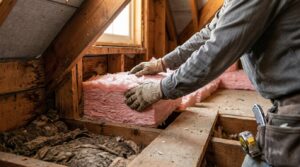
- Phase 1: Air sealing and attic insulation. A contractor can seal bypasses and add blown-in insulation to reach R-49 to R-60 for $2,500 to $5,000. This alone typically saves 15 to 20 percent on annual energy costs.
- Phase 2: Crawlspace or basement insulation and band joist sealing. Budget $1,500 to $4,000. Encapsulating a crawlspace also prevents moisture issues that damage floors and framing.
- Phase 3: Replace the heating and cooling system with a cold-climate heat pump only after the envelope is tightened. Right-sizing the new equipment to the improved load saves 20 to 30 percent compared to replacing in-kind on a leaky home.
- Apply for the 25C federal tax credit each year upgrades are completed. Insulation, heat pumps, and windows each qualify separately, letting you stack up to $3,200 per year in credits across multiple tax years.
- Track your utility bills monthly using a simple spreadsheet. Compare to the same month from the prior year, adjusting for degree-days if you want precision. Most homeowners see measurable savings within the first full billing cycle after each phase.
- Hire a building performance contractor or certified Passive House consultant to model your home’s energy use before any work begins. A proper energy model tells you the exact projected savings for each measure and helps justify the investment.
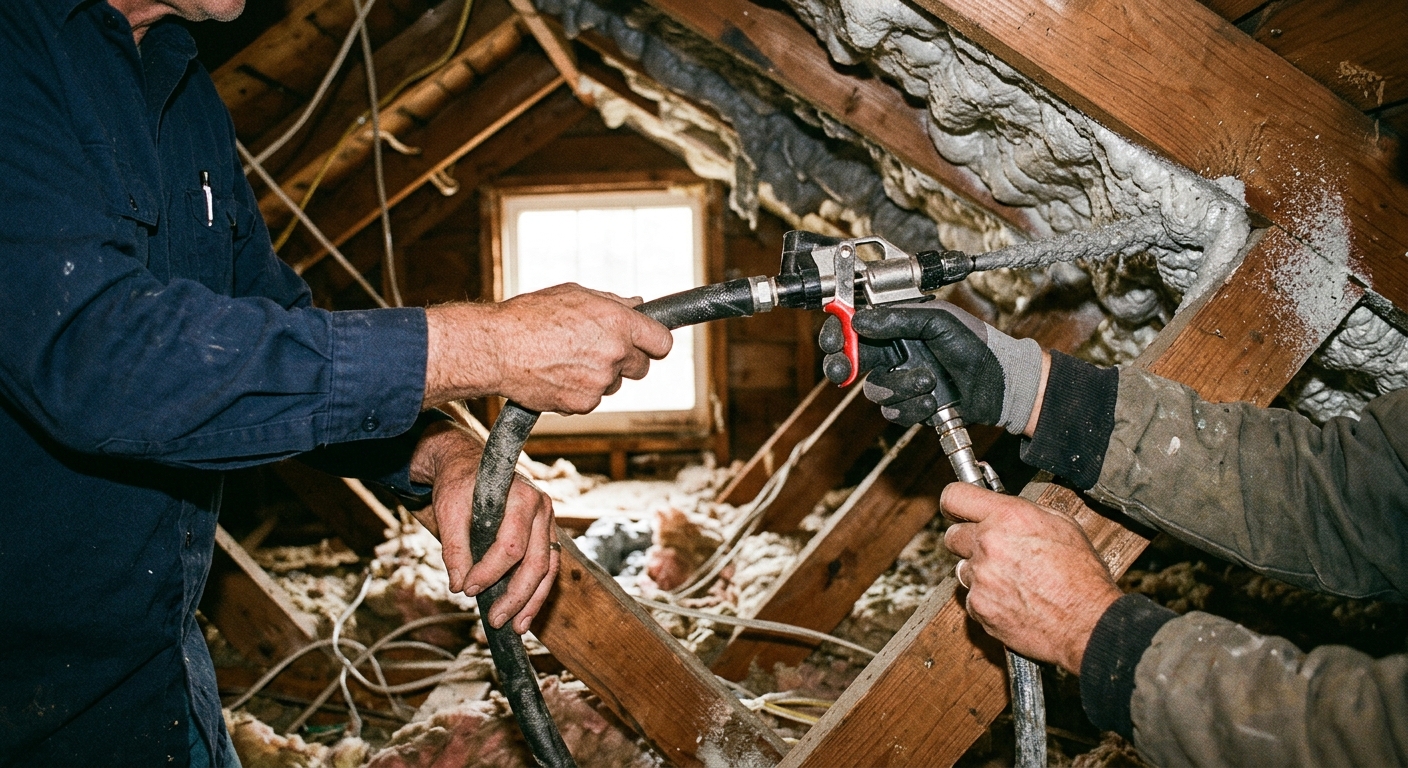
- Complete the full thermal envelope package: dense-pack wall insulation, attic air sealing and R-60 insulation, crawlspace or basement encapsulation, and continuous exterior rigid foam if budget allows. Budget $15,000 to $22,000 for this package on a typical 1,800 to 2,400 sq ft home.
- Replace all single-pane or low-performing double-pane windows with triple-pane or ENERGY STAR Most Efficient units. Budget $8,000 to $18,000 depending on window count. Focus on north-facing and west-facing windows first if budget is limited.
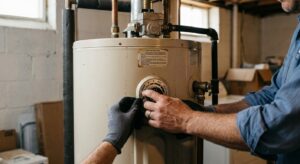
- Install a cold-climate heat pump system (HSPF2 greater than 9) sized to the post-retrofit load, not the original load. Add a heat pump water heater simultaneously. Combined equipment budget: $12,000 to $18,000 before incentives.
- Install an ERV or HRV with outdoor air intakes sized for the post-sealing ACH target. Budget $2,500 to $4,500 installed. This is non-negotiable for a tight home and preserves indoor air quality.
- After project completion, conduct a final blower door test to verify the achieved ACH, document all equipment for tax credit filing, and request a utility bill comparison report from your contractor at the 6-month and 12-month marks.
Why It Works: The Benefits
A comprehensive retrofit on a home spending $250 to $350 per month on energy typically delivers $80 to $175 in monthly savings, translating to $960 to $2,100 annually. High-energy-cost regions see the upper end of that range.
The Inflation Reduction Act provides tax credits covering 30 percent of costs for insulation, heat pumps, windows, and more, up to $3,200 per year. Many utilities layer on additional rebates, reducing a $50,000 project to $30,000 to $38,000 in real out-of-pocket cost.
Studies from the Lawrence Berkeley National Laboratory show energy-efficient homes sell for 2.7 to 6 percent more than comparable inefficient homes. On a $400,000 home, that is $10,800 to $24,000 in added resale value, partially or fully recapturing retrofit costs.
Eliminating drafts, cold walls, and uneven temperatures is often cited by retrofitted homeowners as the most immediately noticeable benefit. Rooms that were previously 5 to 8 degrees colder than the thermostat reading become consistently comfortable.
A tighter, better-insulated home allows a properly sized HVAC system to cycle less frequently, reducing wear and extending equipment life by an estimated 3 to 7 years. Fewer cycles also means lower maintenance costs over time.
💰 Savings Impact by Action
Professional air sealing reducing ACH from 8 to below 3 cuts heating and cooling infiltration losses by up to 20 percent annually.
Upgrading attic insulation to R-49 or R-60 reduces conducted heat gain and loss through the ceiling by 15 to 25 percent of total load.
Replacing a gas furnace with a cold-climate heat pump (HSPF2 greater than 9) reduces heating energy consumption by 40 to 60 percent depending on electricity vs. gas costs.
Replacing single-pane windows with ENERGY STAR triple-pane units reduces window-related heat loss and gain by up to 40 percent, contributing roughly 10 percent to whole-house savings.
A heat pump water heater replacing a standard electric resistance unit uses 60 to 70 percent less electricity, saving the average household $300 to $550 per year and contributing roughly 12 percent to total energy cost reduction.
🏠 Key Concepts Explained
The Science Behind It
Every dollar spent on a home energy retrofit is really buying a reduction in heat transfer. Heat moves in three ways: conduction through solid materials like walls and windows, convection through air movement and infiltration, and radiation from warm surfaces to cool ones. A deep retrofit attacks all three simultaneously. Insulation slows conduction, air sealing stops convection losses, and low-emissivity window coatings block radiant heat gain in summer and loss in winter.
The reason a comprehensive retrofit saves more than the sum of its parts is a concept called load interaction. When you seal and insulate a home, the peak heating and cooling load drops significantly. A smaller peak load means a smaller, correctly sized HVAC system can maintain comfort while running fewer hours. Fewer operating hours mean lower energy consumption, lower wear, and longer equipment life. This compounding effect is why a whole-house retrofit targeting 40 percent savings often outperforms four separate 10 percent improvements done independently.
On the economics side, the real return on a retrofit is calculated against the counterfactual: what would you have spent over 20 years without acting? With energy prices rising at an average of 3 to 5 percent annually over the past decade, every dollar saved today is worth more in future years. A $150 monthly savings in year one becomes a $243 monthly savings in year 20 at 3 percent annual energy price inflation, which dramatically improves the internal rate of return on a seemingly expensive upfront investment.
Frequently Asked Questions
▼ We spent $50,000 on a retrofit and our bills barely dropped. What went wrong?
This usually means either the work was not properly air-sealed before insulation was added, or the HVAC system was not replaced or recalibrated to match the new lower load. Request a post-retrofit blower door test to verify actual air tightness. If the ACH number is above 5, significant infiltration is still occurring and the contractor may owe remediation. Also pull a year-over-year utility comparison adjusted for heating and cooling degree-days, since an unusually mild year can mask real savings.
▼ How do I know if the $50,000 estimate I got is reasonable or inflated?
A full deep energy retrofit on a 1,800 to 2,400 sq ft home typically runs $25,000 to $55,000 for envelope plus HVAC work, so the range is legitimate. Get at minimum three bids from certified building performance contractors and ask each one to show you projected savings by measure. If a contractor cannot provide measure-by-measure savings estimates backed by an energy model or HERS rating, treat their quote with skepticism. Also compare what is included: a quote including heat pump water heater, ERV, and full envelope work is a different product than one covering only insulation.
▼ Can I spread this work over several years to manage the cost?
Absolutely, and in many cases phasing is the smarter strategy. The federal 25C tax credit resets annually, so spreading work across two or three tax years can increase total credits captured. The key rule is to complete air sealing and attic insulation in the first phase, since these have the highest return and also reduce the size and cost of HVAC equipment you will need to buy in a later phase. Do not replace windows before sealing the attic; you will overpay for low-priority upgrades while your biggest losses continue.
▼ Will a deep retrofit make my home too tight and cause moisture or air quality problems?
Only if the contractor skips mechanical ventilation, which is a serious and unfortunately common omission. A properly executed retrofit includes an ERV or HRV sized to ASHRAE 62.2 standards, which continuously supplies fresh filtered air at a controlled rate. This actually improves indoor air quality compared to the random and uncontrolled infiltration of a leaky home. Ask your contractor specifically how they plan to meet ventilation requirements before any sealing work begins.
▼ Does a deep energy retrofit actually help with home resale, or is that just marketing?
The resale benefit is real but varies by market. Lawrence Berkeley National Lab research found ENERGY STAR certified and solar-equipped homes sold for 2.7 to 6 percent more in California, and similar premiums have been documented in the Northeast. In markets where buyers do not yet request energy audits or HERS ratings, the premium may be smaller or harder to capture. The safest strategy is to get a HERS rating certificate after the retrofit is complete, which gives buyers a credible third-party document to justify the premium rather than relying on your word.
Quick Tips
- Request itemized savings projections for each upgrade from your contractor before signing. Any reputable building performance contractor can provide measure-by-measure savings estimates, not just a total project number.
- Check the DSIRE database (dsireusa.org) for state-specific rebates before starting. Some states offer $2,000 to $10,000 in additional incentives on top of federal credits, significantly shortening payback.
- Prioritize the attic first. Heat rises, and an unsealed, under-insulated attic is typically responsible for 25 to 35 percent of a home’s total heating and cooling loss. It is also the easiest and least disruptive area to upgrade.
- Get three bids from BPI-certified or RESNET HERS-rated contractors, not general contractors. Credentials matter because a building science specialist will address air sealing and combustion safety in ways a general insulation crew will not.
Variations for Your Situation
- Tight Budget (Phase 1 Only, Under $8,000): Focus entirely on air sealing and attic insulation, which deliver the highest return per dollar of any retrofit measure. A professional blower door guided air seal plus blown-in attic insulation to R-49 typically costs $3,000 to $6,500 and can save 15 to 22 percent annually. Apply for the 25C tax credit to recover 30 percent of that cost. Skip windows and HVAC replacement until you have savings built up.
- Older Home (Pre-1980): Homes built before 1980 often have uninsulated walls, single-pane windows, knob-and-tube wiring, and original boilers or furnaces. Before any insulation work, hire an electrician to inspect and clear wiring, and have a BPI auditor test for asbestos-containing materials in pipe insulation or floor tiles. Budget an additional $3,000 to $8,000 for remediation before efficiency work begins. The good news is that pre-1980 homes have the most room for improvement and often see 40 to 55 percent energy reductions post-retrofit.
- Apartment or Condo Owner: In-unit improvements are still possible and valuable. Focus on window insulation film ($30 to $80 per window), door sweep installation, smart thermostat upgrades, and a heat pump water heater if you have an individual unit water heater. Collectively these can save 10 to 18 percent on in-unit energy costs. For larger envelope or HVAC work, bring a professional energy audit report to your HOA or building management; documented savings projections are the most effective tool for getting building-wide improvements approved.