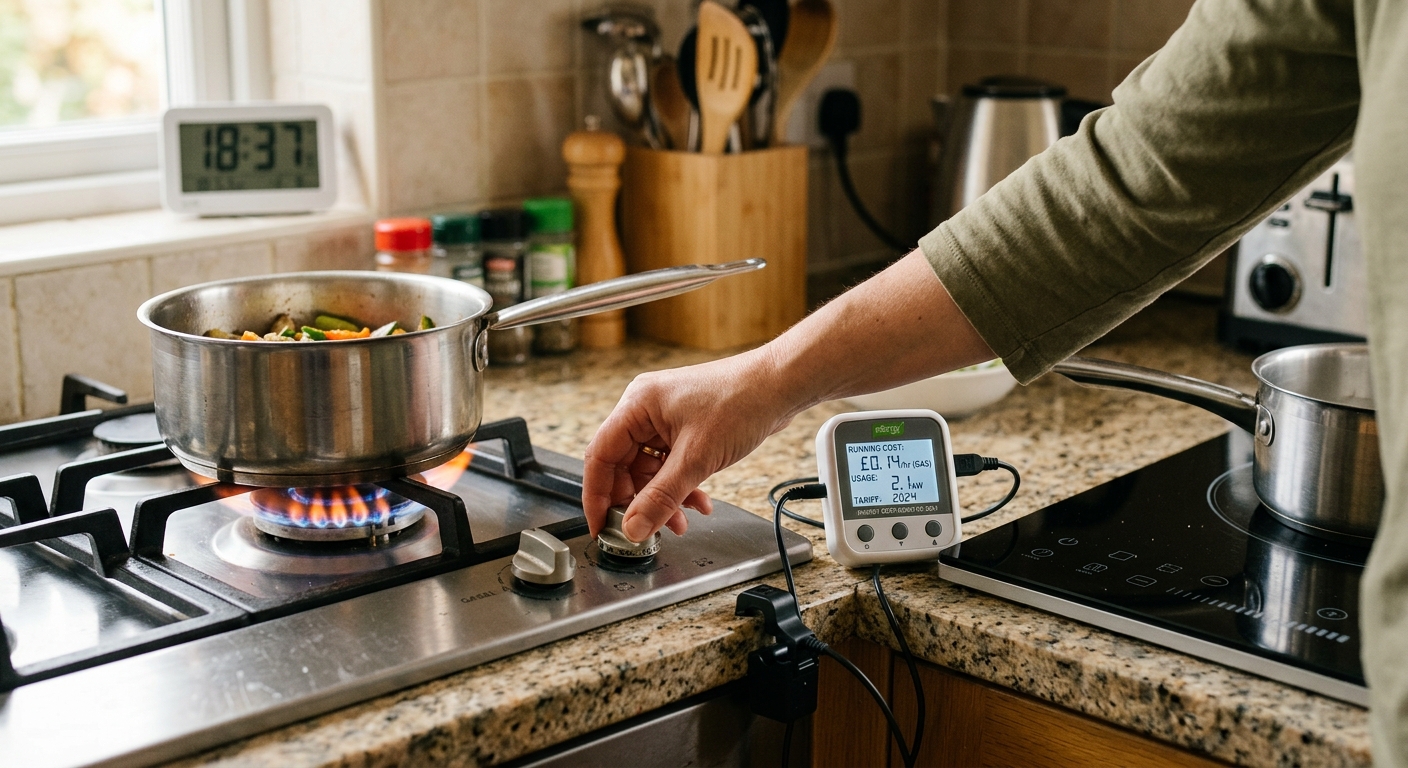
Walk into any kitchen showroom and you will hear the same debate: gas versus electric. Chefs love the instant flame control of gas, while others swear by the consistent heat of electric. But when it comes to your monthly utility bill, the answer is more nuanced than either camp admits. The true cost of cooking depends on your local gas and electricity rates, the efficiency of the appliance itself, and how you actually cook every day.
Here is a number that surprises most homeowners: a standard gas range converts only about 32 to 40% of its energy into usable heat for your food, while a traditional electric coil or smooth-top range reaches 74 to 77% efficiency. Induction cooktops push that number to 84 to 90%. That gap matters, even when natural gas costs less per BTU than electricity in most U.S. markets. Depending on your utility rates, the cheaper fuel can end up costing you more at the burner.
This post runs the actual math on all three cooking technologies, shows you how to calculate your own cost per meal, and gives you practical steps to lower your cooking energy bill starting today, whether you own a 1960s gas range or a brand-new electric range. We also cover what to consider if you are thinking about switching technologies entirely.
What You’ll Need
Click on an item below to shop for the recommended items for this recipe on Amazon.
As an Amazon Associate, we earn from qualifying purchases.
How to Do It
- Find your gas rate in dollars per therm and electricity rate in cents per kWh on your utility bill or provider website. Write both down before doing any math.
- Calculate your gas cost per usable BTU: divide your gas rate by 100,000 BTUs per therm, then divide again by 0.38 (average gas stove efficiency). Compare to electricity cost per usable BTU: divide your electricity rate in cents by 100 to get dollars per kWh, then divide by 0.85 for induction or 0.75 for electric resistance.
- Use lids on pots whenever simmering or boiling. A covered pot boils water up to 30% faster, reducing burner-on time by 5 to 10 minutes per use.
- Match burner size to pan size. Using a large burner under a small pan wastes 30 to 40% of heat on gas and causes uneven heating on electric. Always use the smallest burner that fits your cookware.
- Use residual heat: turn off an electric coil or smooth-top burner 3 to 5 minutes before cooking is done. The element stays hot enough to finish the job at zero additional energy cost.
- For gas users, check burner flames monthly. A healthy flame is steady and blue with a small yellow tip. Uneven, orange, or very yellow flames indicate a dirty or misadjusted burner that is wasting gas and should be cleaned or serviced.
- Purchase a single-burner induction cooktop rated 1,800 watts or higher from brands like Duxtop, NuWave, or Breville. Look for models with 10 or more power settings and a digital timer. Budget $40 to $80 for a solid unit.
- Confirm your cookware is induction-compatible by holding a magnet to the bottom of each pot. If the magnet sticks firmly, it works with induction. Cast iron, stainless steel with a magnetic base, and most carbon steel pans are compatible. Copper and aluminum without a steel base are not.
- Place the induction unit on a stable, heat-resistant countertop surface near a standard 15-amp outlet. No special wiring is needed for units under 1,800 watts.
- Use the induction cooktop for your highest-energy tasks: boiling pasta or potatoes, simmering sauces for 20 or more minutes, and frying. These are the use cases where induction’s 84 to 90% efficiency versus gas’s 32 to 40% delivers the biggest savings.
- Track your cooking habits for 30 days, noting which meals you cooked on induction versus your main range. Most households find they can shift 50 to 70% of cooktop cooking to the induction unit over time.
- Calculate your monthly savings: if you previously spent $8 per month cooking those meals on gas, induction at average U.S. rates for the same usable heat output costs about $5 to $6, saving $2 to $3 per month and paying back the device in 18 to 40 months.
- Get three months of utility bills and calculate your average monthly cooking energy cost using the method in the Quick Fix approach. This becomes your baseline to measure savings against.
- Check whether your kitchen has a 240V outlet behind or near the range location. Gas kitchens typically only have 120V outlets. If no 240V is present, get one to two quotes from licensed electricians. Expect $200 to $500 to add a dedicated 240V, 40-amp or 50-amp circuit.
- Research induction ranges in your budget. Entry-level induction ranges start around $700 to $900. Mid-range models from Samsung, LG, GE, and Bosch run $1,000 to $1,800 and include better oven performance and more burner zones. Premium models go to $2,500 or more.
- Check federal and state incentives before buying. The Inflation Reduction Act provides a tax credit of up to $840 for an induction range through many utility rebate programs. Some states stack additional rebates. Visit dsireusa.org or your utility website for current offers in your area.
- Schedule delivery and installation through the retailer, or hire a local appliance installer. Ensure the old range is disconnected properly. If converting from gas, have a licensed plumber or gas fitter cap the gas line at the wall, not just at the appliance.
- After 60 days of use, compare your utility bills to your pre-installation baseline. Most households cooking daily see $50 to $150 per year in direct energy savings, with payback periods of 4 to 7 years on the appliance cost before rebates, or 2 to 4 years after rebates.
Why It Works: The Benefits
Switching from a gas range to an induction cooktop at average U.S. utility rates saves roughly $0.03 to $0.08 per meal, which adds up to $22 to $58 per year for a household cooking once daily.
Induction cooktops transfer up to 90% of energy directly to the pan, generating far less ambient heat. This can reduce summer cooling load from cooking by 15 to 30%, saving an additional $20 to $50 per season in AC costs.
Gas combustion releases nitrogen dioxide, carbon monoxide, and fine particulates indoors. Studies including a 2022 Stanford University report found that gas stoves can raise indoor NO2 levels above EPA outdoor standards. Switching to electric or using strong ventilation eliminates this health cost entirely.
Natural gas prices are historically more volatile than electricity rates, with winter price spikes of 40 to 100% in some years. Electric cooking costs are more stable year-round, making budgeting easier for households with fixed incomes.
Induction boils water roughly 25 to 50% faster than gas or electric resistance, reducing total burner-on time and energy consumed per meal even at the same power rating.
💰 Savings Impact by Action
Replacing a gas range with an induction model reduces cooking energy cost by 25 to 40% at average U.S. utility rates due to induction’s 84 to 90% thermal efficiency versus gas’s 32 to 40%.
Using lids, right-sizing burners, and leveraging residual heat can reduce cooking energy consumption by 15 to 20% on any appliance type with no equipment changes.
Using a portable induction cooktop for 60% of stovetop cooking in a gas household reduces gas cooking costs by roughly 20 to 25% with a one-time investment of $40 to $120.
Switching from gas to induction reduces waste heat entering the kitchen by up to 50%, lowering summer cooling load from cooking by 15 to 25% and saving $20 to $50 per cooling season.
Pre-boiling water in an electric kettle before stovetop cooking reduces burner energy used for boiling tasks by 10 to 15% because electric kettles operate at 80 to 85% efficiency.
🏠 Key Concepts Explained
The Science Behind It
The core reason induction cooking is so efficient comes down to electromagnetic induction. An induction cooktop passes an alternating current through a copper coil beneath the glass surface, creating a rapidly changing magnetic field. When a ferromagnetic pan sits on the surface, this field induces electrical eddy currents directly inside the pan’s metal, generating heat right where you need it. The cooktop surface itself stays relatively cool because it is not the source of heat. That means virtually no energy is lost heating the surrounding air, the burner grate, or the cooktop glass.
Gas combustion works very differently. Burning natural gas releases energy in all directions simultaneously. The flame heats the bottom of the pan, but it also heats the air around the pan, the grate, the surrounding countertop area, and ultimately the room. Building scientists calculate that only 32 to 40% of a gas burner’s released energy actually transfers into the cookware and food. The rest rises as convective heat loss into your kitchen. In summer, that waste heat adds directly to your cooling load, so your air conditioner has to work harder to compensate. This secondary energy penalty is almost never included in simple fuel-cost comparisons but can add $30 to $80 per cooling season to your total home energy bill.
Electric resistance coil and smooth-top ranges fall in between. They do not lose energy to combustion byproducts, but they do lose heat through radiant losses from the element surface into the air around the pan. Their 74 to 77% efficiency rating reflects this. For most U.S. homeowners at average utility rates, electric resistance and gas cooking cost roughly the same per meal within a few cents. Induction is the outlier that genuinely changes the math, combining high efficiency with increasingly competitive electricity rates. As more utilities roll out renewable generation, the carbon footprint advantage of induction over gas also grows over time.
Frequently Asked Questions
▼ Is gas cooking really cheaper than electric if gas costs less per BTU?
Not necessarily. At average U.S. rates of $1.30 per therm for gas and $0.16 per kWh for electricity, gas is cheaper in raw energy content. But a gas stove uses only 32 to 40% of that energy, versus 84 to 90% for induction. Once you account for efficiency, the usable energy cost is much closer, and in high-electricity-rate states like California or New York, induction can actually be cheaper per meal. Run the math using your specific utility rates to find your real answer.
▼ My home only has gas hookups. Is switching to induction worth the electrical upgrade cost?
Adding a 240V circuit costs $200 to $500 depending on your panel location and local labor rates. If you are also replacing an aging range, factor the electrical upgrade into the total cost and calculate your payback including any available rebates. In many cases, federal IRA rebates of up to $840 cover most or all of the appliance cost difference, making the electrical upgrade the only significant out-of-pocket expense. Get one to two electrician quotes to know your exact number.
▼ Will switching to induction actually show up on my electric bill?
Yes, but the increase in electricity use will be partially offset by lower gas bills if you are abandoning gas cooking. A household cooking daily on induction uses roughly 25 to 40 kWh of electricity per month for cooking, which at $0.16 per kWh is about $4 to $6.40 monthly. Compare this to your current gas cooking cost by reviewing your bill history. Many households find the net change is small, and some see a net reduction once the gas base charge is eliminated if cooking was their primary gas use.
▼ Can I use my existing cookware with an induction cooktop?
Test each piece with a magnet before buying an induction unit. If a magnet sticks firmly to the bottom, it will work. Cast iron, carbon steel, and most stainless steel pots are compatible. Copper, aluminum, and glass cookware will not work unless they have a bonded magnetic base. Replacing incompatible cookware adds $50 to $300 to your total project cost and should be factored into the payback calculation.
▼ Does cooking method make a big difference in energy use regardless of appliance type?
Yes, significantly. Using lids, matching pan size to burner size, pre-boiling water in a kettle, and using the microwave for small meals can cut cooking energy by 15 to 25% on any appliance. These habits are free and work immediately. They also compound the savings from a more efficient cooktop. Start with behavior changes and layer in equipment upgrades for maximum impact.
Quick Tips
- Use a kettle to pre-boil water before adding it to a pot on the stove. Electric kettles are 80 to 85% efficient and boil faster than any burner, cutting boiling time and energy in half.
- For gas users, clean burner caps and ports monthly with a soft brush and warm soapy water. Clogged ports create uneven, inefficient flames that waste gas and increase carbon monoxide risk.
- Use the microwave or toaster oven for meals under two servings. These appliances use 50 to 80% less energy than heating a full-size electric oven or running two burners.
- If you have a smooth-top electric range, use flat-bottomed cookware. Warped or rounded pan bottoms reduce contact with the element, cutting heat transfer efficiency by 20 to 30% and increasing cooking time.
Variations for Your Situation
- Apartment or Rental: If you cannot replace the range, focus on a portable single-burner induction cooktop ($40 to $80) for your highest-energy cooking tasks. No installation or landlord permission is needed for a countertop unit plugged into a standard outlet. Use it for boiling, simmering, and frying, and reserve the existing range for oven use or when you need multiple burners. This alone can shift 50 to 70% of your stovetop energy to a more efficient appliance.
- Tight Budget (under $50): Zero in on the free habit changes from the Quick Fix approach. Using lids, right-sizing your burner, and turning off electric elements early costs nothing and can save 10 to 20% on cooking energy. Also consider a $25 to $40 single-burner induction unit from Amazon for boiling water only. Even this single use case, boiling pasta or potatoes several times per week, can save $1 to $2 per month and pay back the device in under two years.
- Older Home with Aging Range (15 or more years old): An older range is likely running below its rated efficiency due to worn igniters, degraded seals, and element wear. If your gas range is 15 or more years old, a service inspection ($80 to $150) may reveal whether cleaning and adjustments can restore efficiency, or whether replacement is the smarter financial move. An old electric coil range that costs $400 to $600 to replace with a modern smooth-top model will typically pay back in 5 to 8 years in energy savings alone, faster if a rebate applies.