Hard water is one of the most expensive silent problems in American homes. Scale buildup inside your water heater can cut its efficiency by up to 48% over time, according to the Water Quality Research Foundation. That same scale coats your pipes, clogs your showerheads, destroys washing machine heating elements, and leaves a chalky film on every dish you own. Yet most homeowners either buy the wrong softener size or skip one entirely, never connecting the dots between hard water and rising utility bills.
Sizing a water softener is not complicated once you understand two numbers: your water hardness level in grains per gallon (GPG) and your household’s daily water consumption. Get those two numbers right, and the rest of the math takes about two minutes. Get them wrong, and you end up with a system that either regenerates every other day, wasting 25 to 50 gallons of water per cycle, or one that runs out of capacity and lets hard water pass through untreated for days at a time.
This guide walks you through testing your water hardness, calculating the correct grain capacity for your home, choosing between time-clock and demand-initiated regeneration systems, and understanding exactly what payback period to expect. Whether you are sizing your first softener or replacing an old one that never quite worked right, these steps will save you money on the purchase and on every utility bill that follows.
What You’ll Need
Click on an item below to shop for the recommended items for this recipe on Amazon.
As an Amazon Associate, we earn from qualifying purchases.
How to Do It
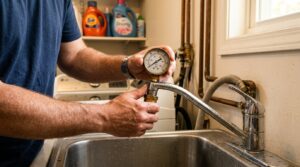
- Purchase a water hardness test kit or strips rated for 0 to 25 GPG. Test your cold water at the kitchen tap following the kit instructions. Note the result in GPG. If your municipal utility provides a water quality report, you can also pull the hardness number from there and skip the test.
- Check your water bill or meter to find your household’s average daily water use in gallons. If you do not have that figure, use this reliable estimate: 75 gallons per person per day for a typical American household. Multiply the number of people in your home by 75.
- Add iron adjustment to your hardness number if applicable. Test for dissolved iron using an inexpensive iron test strip. For every 1 mg/L of iron present, add 4 GPG to your hardness figure. Example: 12 GPG hardness plus 1 mg/L iron equals an effective hardness of 16 GPG.
- Run the sizing formula: Daily Softening Requirement = Adjusted GPG multiplied by Daily Gallons Used. Example: 16 GPG times 300 gallons per day equals 4,800 grains per day. Multiply that by 7 to get the minimum 7-day capacity: 4,800 times 7 equals 33,600 grains. Round up to the next standard size, in this case a 32,000 or 40,000 grain unit.
- Cross-check by confirming the unit you are considering lists its salt efficiency rating. A well-designed 32,000 grain softener should regenerate using no more than 6 to 8 lbs of salt. If the manufacturer lists 10 or more lbs, look for a more efficient model with a demand-initiated controller.
- Record your GPG, daily usage, effective hardness, and calculated grain capacity, and keep these numbers. You will need them to program the softener’s regeneration settings after installation.
- Choose a demand-initiated regeneration (DIR) softener in the grain capacity you calculated in the sizing step. Look for NSF/ANSI 44 certification, which verifies the unit meets efficiency and capacity claims. Brands meeting this standard include Fleck, Pentair, and Morton.
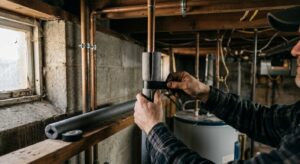
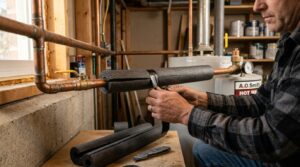
- Locate the installation point on your cold water main, after the pressure regulator but before the water heater and any outdoor hose bibs. You want softened water going to interior hot and cold lines only. Outdoor irrigation does not benefit from softening and wastes your salt budget.
- Shut off the main water supply and drain the lines by opening the lowest faucet in the house. Cut into the main line using a pipe cutter and install a bypass valve assembly, which comes with most modern softeners. This lets you isolate the softener for maintenance without cutting water to the house.
- Connect the inlet and outlet ports to the bypass valve using the fittings included with the unit. Most systems use 1-inch connections. Use Teflon tape on all threaded joints and keep connections straight to avoid stress on the control head. Connect the drain line from the softener to a utility sink drain, floor drain, or standpipe with a proper air gap to prevent backflow.
- Fill the brine tank with one bag of water softener salt, ensuring the salt level stays below the water line inside the tank. Do not overfill. Set the hardness number and daily water usage on the control head using the values you calculated. Run a manual regeneration cycle and check all connections for leaks under pressure.
- After 48 hours of normal use, retest your water at a tap past the softener using your hardness test kit. A properly functioning system should read 0 to 1 GPG. If hardness is still elevated, recheck your capacity settings and confirm the bypass valve is fully in service position.
- Contact a water treatment company certified by the Water Quality Association (WQA). Ask specifically for a whole-house water analysis, not just a sales demonstration. A proper test covers hardness, iron, manganese, pH, TDS, and any region-specific contaminants.
- Review the results with the technician and ask them to justify their recommended grain capacity against your actual daily usage, not a generic estimate. Request a demand-initiated unit rather than a time-clock model unless they provide a compelling reason otherwise.
- Ask for an itemized quote that separates equipment cost from labor. Compare the equipment portion against retail pricing online to confirm you are not paying a large markup. A fair equipment markup is 20 to 40% above retail, not double.
- Confirm the installation includes a bypass valve, a proper air gap on the drain line, and programming of the control head to your specific hardness and household size. These are not optional extras. A correctly commissioned system should be left delivering 0 GPG at all indoor taps.
- Request a written service agreement that covers what happens if the unit fails to soften adequately within the first 30 days. A reputable installer will stand behind their sizing recommendation and installation work.
Why It Works: The Benefits
Properly softened water prevents scale, keeping your water heater operating at peak efficiency. The Water Quality Research Foundation found that softened water can reduce water heating energy use by 20 to 48% depending on the heater type and incoming hardness level.
Dishwashers, washing machines, and water heaters operating on hard water above 10 GPG can fail 30 to 50% sooner than those running on softened water. A correctly sized softener can add 5 to 10 years to major appliance life.
Hard water binds with soap to form insoluble scum rather than lather, forcing you to use more product. Homes switching to softened water typically cut soap, shampoo, and detergent usage by 50 to 75%, saving $200 to $400 per year for an average family of four.
Scale restricts pipe diameter over years of buildup, increasing water pressure requirements and causing premature valve and fixture failure. Preventing scale accumulation reduces plumbing repair calls by a meaningful margin in hard water regions above 15 GPG.
A properly sized demand-initiated softener uses 6 to 8 pounds of salt per regeneration and wastes 25 to 50 gallons of water, compared to an oversized unit regenerating unnecessarily every 2 to 3 days and wasting 200 or more extra gallons per week.
💰 Savings Impact by Action
Preventing scale on heating elements and tank surfaces reduces water heating energy consumption by 20 to 48% depending on incoming hardness, with the midpoint around 29% for homes above 10 GPG.
Softened water lathers fully without binding with minerals, reducing soap, shampoo, and detergent purchases by 50 to 75% for most households.
Switching from a time-clock softener to a demand-initiated regeneration model reduces salt consumption by 30 to 50% by eliminating unnecessary regeneration cycles.
Water heaters and dishwashers in very hard water areas fail up to 30 to 50% sooner without softening, making a correctly sized softener a meaningful appliance-life extender.
Reduced scale accumulation in pipes and valves lowers the frequency of fixture replacements and plumbing service calls by an estimated 10 to 20% over a 10-year period in areas above 15 GPG.
🏠 Key Concepts Explained
The Science Behind It
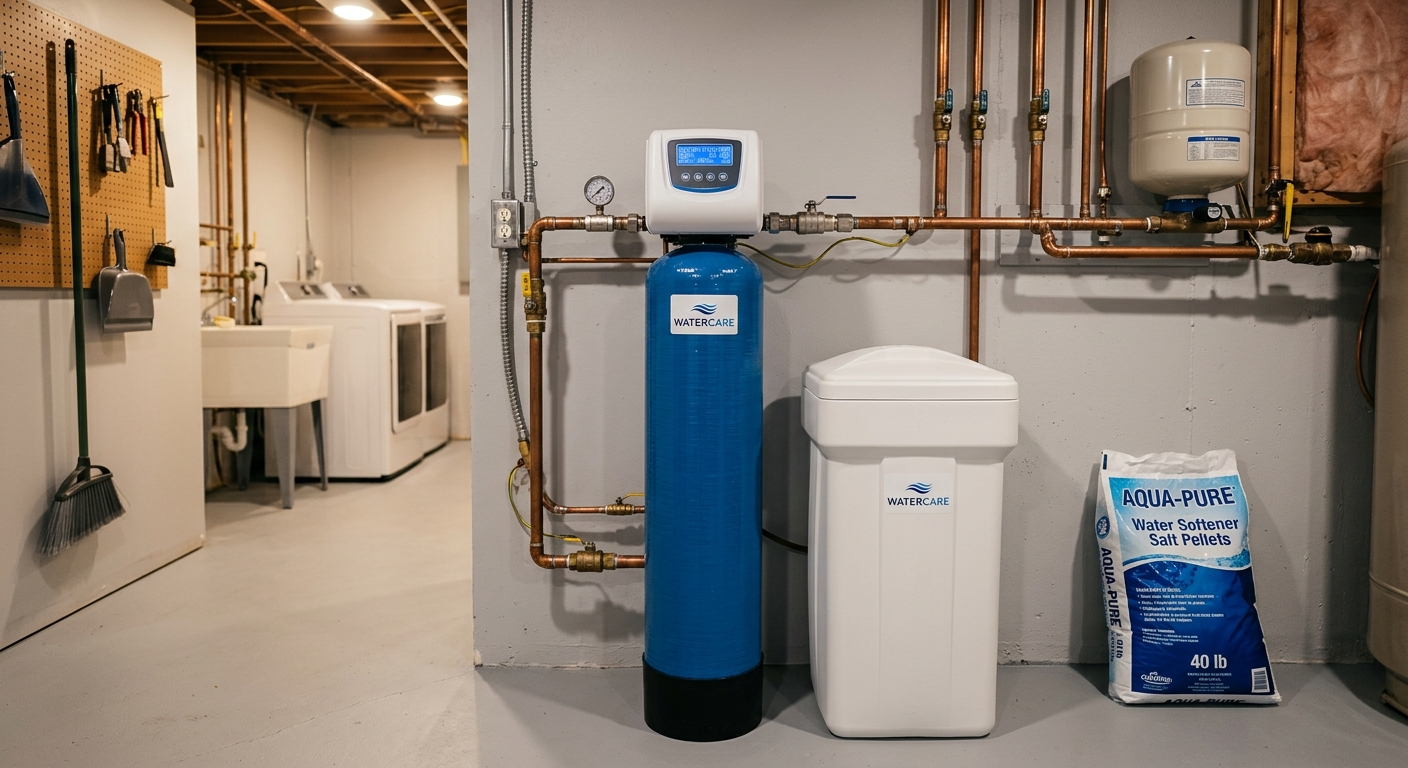
Water softening works through a process called cation exchange. Inside the mineral tank, millions of tiny polystyrene resin beads carry a negative charge and are pre-loaded with sodium ions. When hard water flows through, the calcium and magnesium ions, both positively charged and with a stronger attraction to the resin than sodium, swap places with the sodium ions and bond to the beads. The water that exits the tank has traded its hardness minerals for a small amount of sodium and is chemically soft.
During regeneration, a concentrated brine solution floods the resin tank. The overwhelming concentration of sodium ions in the brine displaces the accumulated calcium and magnesium, flushing them down the drain along with the spent brine. The resin is then rinsed and returned to its sodium-loaded state, ready to soften again. This is why salt consumption directly correlates with your water hardness and daily volume. The harder your water and the more water you use, the more regenerations you need and the more salt you consume.
The scale-prevention benefit is rooted in basic heat transfer physics. Calcium carbonate scale has a thermal conductivity of roughly 0.5 to 2.9 W/mK, compared to steel at approximately 50 W/mK. That means even a thin layer of scale is dramatically more resistant to heat transfer than the metal it coats. A water heater element coated in scale must run hotter and longer to push the same amount of heat energy into the water, which is exactly why the Water Quality Research Foundation documented efficiency losses of up to 48% in very hard water areas. Properly softened water keeps heating surfaces clean and conducting heat efficiently for the full lifespan of the appliance.
Frequently Asked Questions
▼ My softener is working but I still see scale. What is going wrong?
First, test the water at a tap that is clearly downstream of the softener with a hardness test strip. If you read more than 1 GPG, the unit is not softening fully, which usually means your grain capacity setting is too low for your actual water use or hardness. Also check that the bypass valve is fully in the service position and not partially bypassed. If hardness tests at 0 GPG at the tap but you still see white residue, that scale is likely leftover from before you installed the softener and needs a descaling cleaner to clear.
▼ How often should my softener regenerate and how much salt should it use?
A properly sized demand-initiated softener should regenerate every 7 to 10 days under normal household use. Each cycle should consume roughly 6 to 8 pounds of salt for a standard 32,000 to 48,000 grain unit. If yours is regenerating every 2 to 3 days, it is undersized for your water hardness or daily usage. If it is regenerating daily, check whether the hardness setting on the control head is correct, since a misconfigured setting is often the cause.
▼ Can I install a water softener if I am on a septic system?
Yes, but with some caveats. The backwash brine from regeneration adds sodium and water to your septic system. Most septic engineers agree that a demand-initiated softener regenerating every 7 to 10 days poses no significant risk to a properly functioning septic system. However, a time-clock softener regenerating daily or near-daily can add enough sodium to disrupt the bacterial balance in the tank. Stick with a DIR unit sized correctly for your home and your septic system should be fine.
▼ My water is very hard, above 20 GPG. Do I need a special softener?
At 20 GPG or above, you need to calculate carefully and size up. Using the formula, a family of four at 300 gallons per day against 20 GPG requires 6,000 grains per day, or 42,000 grains for a 7-day regeneration cycle. A 48,000 grain unit is the right fit here. Avoid the temptation to buy a high-capacity 80,000 grain unit just to regenerate less often. Oversized units can allow channeling in the resin bed and uneven softening. Two properly sized units in parallel is a better solution for very high demand.
▼ Is it worth softening water in an apartment or rented home?
A point-of-use countertop or under-sink water conditioner is a reasonable option for renters and typically costs $100 to $300 with no permanent installation required. These units protect your faucets and appliances immediately downstream but do not help your water heater or washing machine the way a whole-house system would. If you rent long-term and your landlord allows it, a portable whole-house softener that connects to the main shutoff with compression fittings is another option, ranging from $300 to $600, and moves with you when you leave.
Quick Tips
- Always use evaporated pellet salt rather than rock salt in your brine tank. Rock salt contains more impurities that can foul the resin and clog the brine injector over time.
- Check your brine tank every 4 to 6 weeks and keep salt at least one-third full but no more than two-thirds full to prevent salt bridging, which is a crust that forms and blocks the water from reaching the salt below.
- If you are on a sodium-restricted diet, consider a potassium chloride softener instead. It works identically to sodium chloride but adds potassium rather than sodium to the treated water. Potassium chloride typically costs about twice as much as sodium chloride.
- Test your softened water hardness with a simple test strip quarterly. Hardness creeping above 1 GPG at a post-softener tap is an early warning that your resin may need cleaning with a resin cleaner product or that your capacity settings need adjustment.
Variations for Your Situation
- Apartment/Rental: Renters cannot typically install a whole-house softener but can use a portable countertop water conditioner ($100 to $250) connected to the kitchen faucet. This protects the dishwasher and reduces scale on pots and fixtures. For laundry, adding a half cup of washing soda to each load acts as a water softening booster and reduces detergent needs by about 30% in hard water areas.
- Tight Budget (under $200): Start with a water hardness test ($10 to $15) to confirm you actually have a problem worth solving. If hardness is between 7 and 14 GPG, a basic time-clock single-tank softener from a big-box store in the $150 to $200 range will work, though it is less efficient than a DIR unit. Set it to regenerate every 8 to 10 days and track your salt use monthly. Upgrade to a DIR controller when budget allows since the salt savings typically pay for the controller upgrade within 18 months.
- Older Home (pre-1980): Homes of this era often have galvanized steel pipes that have decades of scale buildup inside the walls. Installing a softener will slow future accumulation but will not clear existing scale and can actually loosen some of that old buildup, temporarily increasing sediment in your water. Install a whole-house sediment filter (5 to 10 micron) upstream of the softener to protect the resin bed. Also have your incoming water pressure tested since scale-narrowed pipes often produce pressure below the 40 PSI minimum a softener needs to operate correctly.