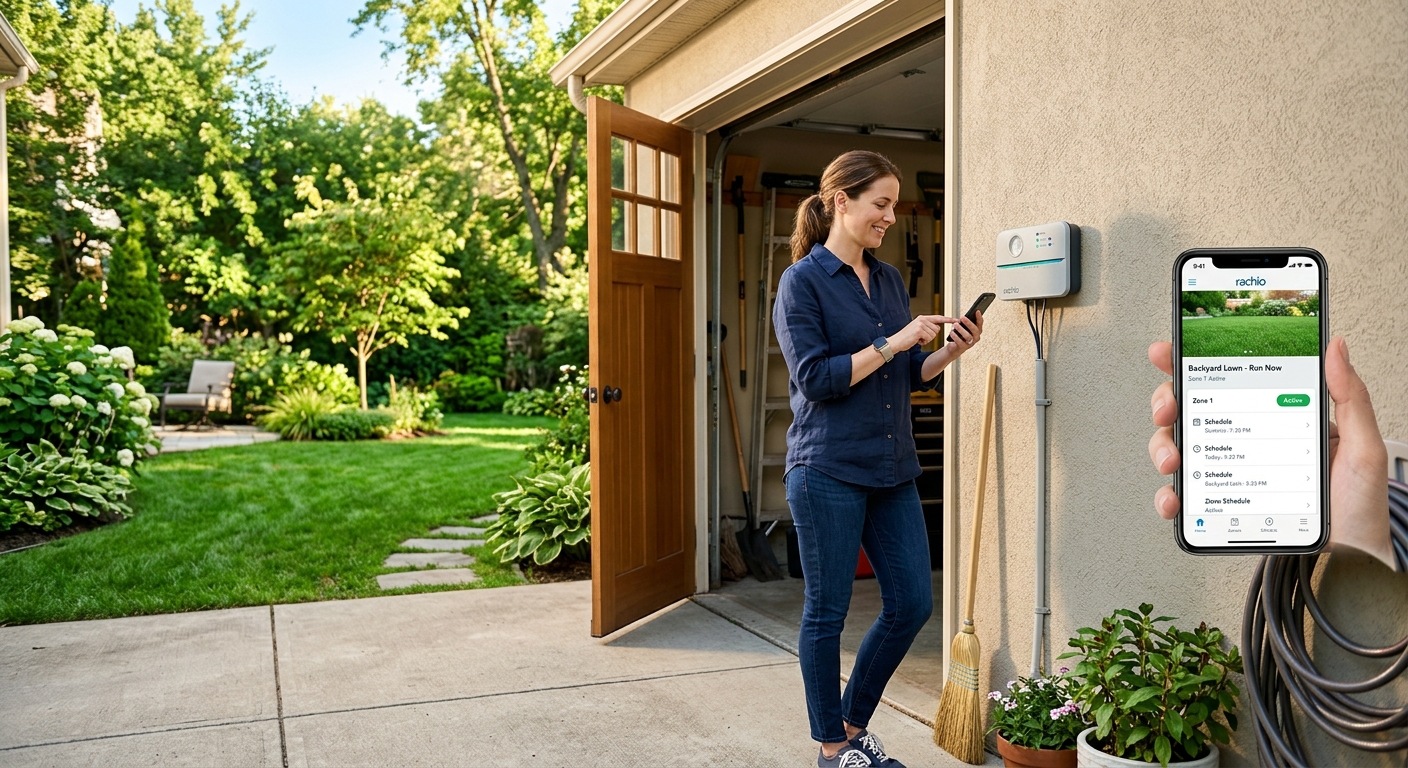
If your sprinkler system runs on a basic timer, it almost certainly watered your lawn the morning after a rainstorm this year. That is not just wasteful, it is expensive. The average American household spends about $1,000 per year on water, and roughly 30 percent of that goes outdoors. In warmer, drier climates that share can climb above 60 percent. A dumb timer has no idea whether the soil is already saturated, whether temperatures dropped overnight, or whether a cold front just rolled through, so it waters anyway, every single time its schedule says to.
Smart irrigation controllers solve this by pulling real-time weather data, local evapotranspiration rates, and sometimes direct soil moisture readings to decide whether your lawn actually needs water on any given day. The result is a system that waters your landscape precisely when it needs it and skips cycles when it does not. EPA WaterSense-certified smart controllers have been shown to save an average of 8,700 gallons per year compared to standard timer-based systems, which translates to $140 to $200 in water savings for a typical suburban home.
This post walks you through two practical approaches: a quick setup swap you can do yourself in under an hour using a plug-and-play smart controller, and a more thorough DIY upgrade that includes zone-by-zone optimization, rain sensor installation, and scheduling fine-tuning. Both approaches can realistically pay back the hardware cost within one irrigation season, and the ongoing savings compound every year after that.
What You’ll Need
Click on an item below to shop for the recommended items for this recipe on Amazon.
As an Amazon Associate, we earn from qualifying purchases.
How to Do It
- Take a photo of the existing controller wiring before disconnecting anything. Label each zone wire with masking tape and a marker matching the terminal it came from (Zone 1, Zone 2, Common, Master Valve, etc.).
- Shut off power to the controller at the wall outlet or breaker. Remove the old unit from the wall and carefully transfer each labeled wire to the corresponding terminal on the new smart controller, following the manufacturer’s wiring diagram.
- Mount the new controller in the same location or a dry indoor spot with Wi-Fi signal. Connect it to your home Wi-Fi network using the manufacturer’s app on your smartphone.
- Enter your home address or zip code in the app so the controller can pull local weather station data. Select your soil type (clay, loam, or sandy), sun exposure for each zone, and the type of sprinkler heads installed (rotor, fixed spray, or drip).
- Set a baseline watering schedule using the app’s smart schedule wizard. The controller will then automatically adjust run times and skip days based on real-time weather and ET data from that point forward.
- Run each zone manually for 2 minutes via the app to confirm all wiring transferred correctly and every head is operating before relying on the automated schedule.
- Complete the Plug-and-Play Smart Controller Swap steps above first to establish the baseline smart system.
- Perform a catch cup test on each zone: place 6 to 8 straight-sided containers (tuna cans work well) evenly across a zone, run the zone for exactly 15 minutes, then measure the depth of water in each can. Average the readings and multiply by 4 to get inches per hour. Enter this actual precipitation rate into the app for that zone rather than relying on the head-type default.
- Note the variance between your catch cup measurements. If some cans show twice the water of others, you have coverage gaps or misaligned heads. Adjust head arc and radius before finalizing schedules so you are not compensating for poor coverage by over-watering.
- Install a wired rain/freeze sensor in an open area away from roof overhangs, following the manufacturer’s instructions to connect it to the sensor terminals on the smart controller. This provides a hardware-level shutoff that works even if Wi-Fi is down.
- Walk each zone while it runs and note any heads with broken seals, clogged nozzles, or spray aimed at pavement. Replace clogged nozzles (about $1 to $3 each) and adjust heads spraying hardscape, as this is pure waste the smart controller cannot compensate for.
- After two full weeks of automated operation, review the watering history in the app. If any zone consistently waters more than 1 inch per week during mild weather, reduce that zone’s allowed weekly water budget by 10 to 15 percent and monitor turf response over the following two weeks.
Why It Works: The Benefits
EPA WaterSense data shows smart controllers save an average of 8,700 gallons per year. At average U.S. water rates of $0.015 per gallon, that is roughly $130 to $200 in direct savings per year, enough to recover the cost of a mid-range controller in a single season.
Over-watering is the leading cause of lawn disease, fungal growth, and shallow root development. By watering only when soil moisture is depleted, smart controllers encourage deeper root growth and reduce the conditions that foster fungal problems, meaning fewer lawn treatments and less reseeding over time.
Every major smart controller includes a smartphone app that lets you adjust schedules, skip a zone, or shut off the entire system from anywhere. This is especially valuable when you are traveling and a rain event hits, preventing an entire watering cycle from running unnecessarily.
More than 200 U.S. water utilities offer rebates of $25 to $100 for WaterSense-certified smart controllers, cutting payback time even further. Some California and Southwest utilities rebate up to $80 per controller, bringing a $150 unit down to $70 out of pocket.
Over-watering flushes lawn fertilizer and pesticides off your property and into storm drains before plants can absorb them, meaning you buy more product and do more environmental harm. Precise watering keeps inputs in the root zone, reducing annual fertilizer needs by an estimated 15 to 20 percent.
💰 Savings Impact by Action
Automatically skipping cycles before and after rain events eliminates an estimated 30 percent of total irrigation volume applied by timer-based systems in climates with regular summer rainfall.
Calibrating run times to actual daily evapotranspiration demand rather than a fixed schedule reduces over-application by up to 20 percent compared to manually set timers.
Splitting run times into short bursts with soak intervals reduces surface runoff on clay soils by up to 15 percent, ensuring applied water reaches the root zone instead of running off.
Automatic seasonal adjustment of run times as temperatures drop in fall prevents the 10 percent average over-watering that occurs when homeowners leave peak-summer schedules unchanged into cooler months.
🏠 Key Concepts Explained
The Science Behind It
The core physics behind smart irrigation savings comes down to one principle: water your plants based on what they actually lost, not based on a clock. Every day, the sun heats the soil surface, wind moves dry air across wet leaves, and plants pump water from roots to leaves as part of photosynthesis. All of that moisture exits the system as either evaporation from the soil or transpiration from plant tissue. Scientists call the combined rate evapotranspiration, or ET, and it can be calculated with reasonable accuracy from temperature, humidity, solar radiation, and wind speed data that weather stations collect continuously. A smart controller downloads that daily ET value for your specific location and computes exactly how many inches of water your landscape deficit amounts to, then runs only enough irrigation to replace what was lost.
Soil acts as a water reservoir, and that reservoir has both a capacity and an absorption rate that vary by soil type. Sandy soils absorb water quickly but hold very little, requiring more frequent, shorter watering cycles. Clay soils hold a large volume but absorb water slowly, sometimes as little as 0.2 inches per hour. When a sprinkler applies water faster than the soil can absorb it, the excess either puddles or runs off the surface entirely, never reaching plant roots. Smart controllers address this through cycle-and-soak programming: they split a single long run time into two or three shorter bursts separated by 30 to 60 minute soak periods, giving clay soils time to absorb each application before the next one begins. This single adjustment can reduce runoff waste by 20 to 30 percent on clay-heavy soils without changing how much total water is scheduled.
Rain events add a significant wild card that standard timers completely ignore. Even a modest 0.5-inch rain event fully replaces several days of ET deficit for most lawns in temperate climates. Because a traditional timer has no awareness of that rain, it applies its full scheduled irrigation on top of whatever fell naturally, pushing soils well past field capacity. That excess water drains past the root zone into the subsoil where it is completely unavailable to plants, meaning it was applied at cost but delivered zero benefit. Weather-based smart controllers factor in both forecasted rainfall and confirmed precipitation from nearby weather stations, automatically skipping or shortening cycles in response. Studies by the Irrigation Association found that weather-based controllers reduce irrigation volume by an average of 47 percent compared to unmanaged timer-based systems in climates with variable summer rainfall.
Frequently Asked Questions
▼ My smart controller is skipping watering too often and my lawn is starting to look stressed. What do I adjust?
The most common cause is that the controller’s allowed depletion threshold is set too conservatively, or the soil type is entered as sandy when it is actually loam or clay. Open the app and increase the allowed soil moisture depletion from the default (often 50 percent) up to 60 to 65 percent, which tells the controller to wait a bit longer before watering but also allows deeper watering when it does run. Also confirm your ET data source is pulling from a nearby weather station rather than a regional average, since distant stations in cooler or shadier locations will underestimate your actual water demand.
▼ My controller says it watered but the soil still feels dry. Is the controller broken?
The controller itself is almost certainly fine. The most likely culprits are a stuck closed zone valve solenoid, a broken wire in the zone circuit, or a main shutoff valve that was accidentally left partially closed after winterization. Test by running that zone manually from the controller while you watch the heads. If no heads pop up, check the solenoid on that zone valve at the valve box in the yard. A solenoid that hums but the zone does not open usually indicates a failed solenoid, which is a $10 to $20 part and a straightforward DIY replacement.
▼ Can I install a smart controller if I only have a two-wire or direct-burial decoder system?
Standard smart controllers like Rachio, RainBird ST8, or Hunter Hydrawise require traditional multi-wire zone wiring and are not compatible with two-wire decoder systems used in some commercial and higher-end residential installations. If you have a decoder system, you will need a smart controller specifically designed for two-wire compatibility, such as the Hunter ACC2 or Baseline BaseStation 3200, which are significantly more expensive and typically require professional installation.
▼ I rent my home. Can I still use a smart controller without making permanent changes?
Yes, with your landlord’s permission on the controller swap. Smart controller installation is reversible, since you are only replacing the wall-mounted control box and not modifying any in-ground components. Save the original controller and all its wiring documentation so you can reinstall it before moving out. Most landlords are agreeable since the upgrade reduces the property’s water bill. If the irrigation system is on a shared utility account, confirm with your landlord who actually pays the water bill before investing.
Quick Tips
- Set each zone’s root depth in the app accurately. Turf grass is typically 4 to 6 inches, ground cover 6 to 8 inches, and shrubs 12 to 18 inches. This directly controls how much water the controller applies per cycle and prevents over-watering.
- Water between 4 a.m. and 8 a.m. to minimize evaporation loss from solar heat and wind. Midday watering in full sun can lose 20 to 30 percent of applied water to evaporation before it ever reaches the root zone.
- Separate turf zones from drip irrigation zones in your controller settings. Drip systems deliver water directly to root zones at very low precipitation rates and need completely different run times and soil settings than overhead spray zones.
- Review your system’s watering history in the app at the end of each month. Most apps show total gallons used per zone. Zones consistently using more than neighboring zones often have a stuck-open solenoid, a leak, or a misaligned head worth investigating.
Variations for Your Situation
- Apartment or Condo with No In-Ground System: Renters or condo owners with container gardens or drip-irrigated patio plants can use a smart hose-end timer like the Orbit B-hyve or Rachio 3 hose-end adapter ($40 to $80) that attaches directly to an outdoor spigot. These units connect to Wi-Fi and use the same weather-based ET logic as full controllers, cutting hose watering time by 20 to 30 percent with no tools or landlord approval needed.
- Tight Budget Under $100: Start with a WaterSense-certified timer that includes a manual rain delay button and a basic rain sensor bypass input, such as the Orbit 57894 at around $30. Add a $15 wireless rain sensor. This does not deliver full ET-based scheduling but eliminates the single biggest waste source (watering after rain) for about $45 total, saving an estimated 15 to 25 percent on irrigation water. Apply for a utility rebate to offset the cost further.
- Older Home with Aging Irrigation Infrastructure: If your system is more than 15 years old, inspect all zone valves and heads before installing a smart controller. Smart scheduling cannot compensate for heads that are stuck open, spray patterns aimed at driveways, or valve solenoids that leak. Budget $50 to $150 for head replacements and solenoid repairs before the controller upgrade, since fixing the hardware first ensures the smart scheduling delivers its full potential savings rather than managing a leaky baseline.