If your bedroom feels like a sauna while the living room stays perfectly comfortable, or your home office is freezing while everyone else is fine, you are not alone. Uneven room temperatures affect millions of homes and are almost never caused by a broken HVAC system. Instead, they are almost always the result of small, fixable imbalances in airflow, insulation, or how the system is being operated. The good news is that the fix rarely requires a new furnace, additional ductwork, or any new equipment at all.
The root cause is almost always one of a handful of building science issues: closed or blocked supply vents, duct leakage sending conditioned air into unconditioned spaces, poor insulation in certain areas, or airflow restrictions that starve some rooms while overfeeding others. Understanding which issue applies to your home is the key, and the diagnostic steps are straightforward enough for any homeowner to do on a Saturday morning.
This post walks you through practical, low-cost approaches to rebalancing your home’s comfort, from quick five-minute vent adjustments to a more thorough DIY airflow tuning session. You will also find the building science behind why rooms become unbalanced in the first place, real numbers on how much comfort and efficiency you can recover, and answers to the most common questions homeowners ask when dealing with this problem.
What You’ll Need
Click on an item below to shop for the recommended items for this recipe on Amazon.
As an Amazon Associate, we earn from qualifying purchases.
How to Do It
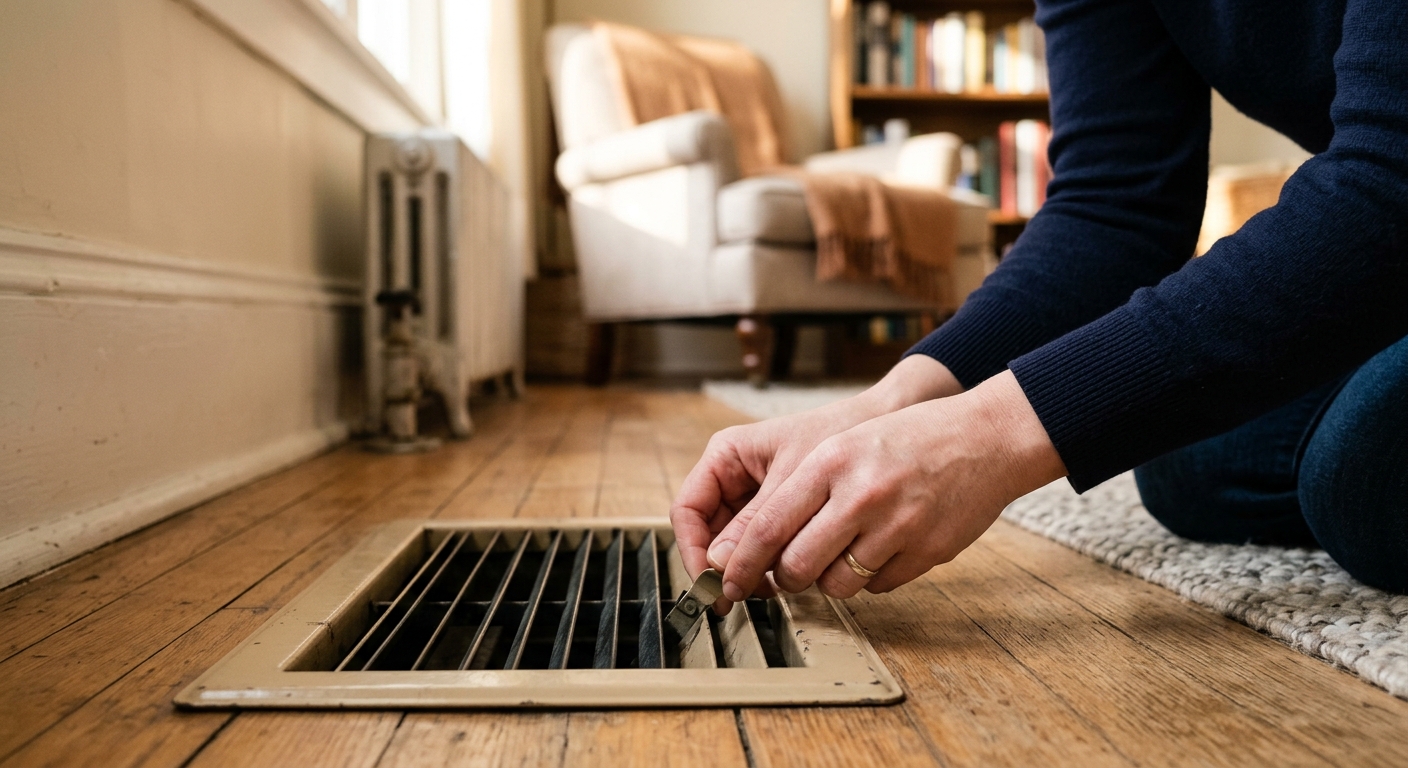
- Walk every room and make sure all supply vents are fully open. Partially closing vents in comfortable rooms does not redirect air to uncomfortable ones because it increases system static pressure and reduces total airflow. Open all vents fully as your starting point.
- Check that no furniture, rugs, curtains, or appliances are sitting on top of or directly in front of supply vents. A blocked vent can lose 50 to 70% of its effective airflow. Shift any obstructions at least 12 inches away.
- Identify which rooms run too hot and which run too cold. Use a simple indoor thermometer or a free smartphone IR thermometer app as a rough guide. Write down the readings room by room.
- For rooms that are too warm, close interior blinds or curtains on south and west-facing windows between noon and 5 PM. This alone can reduce solar heat gain enough to drop room temperature by 3 to 5 degrees on sunny afternoons.
- Leave interior doors open as much as possible, especially bedroom doors. Closed doors trap air and prevent the return air system from drawing properly, causing pressure imbalances that cut airflow by 30 to 60% in those rooms.
- Check and replace your air filter if it is dirty. A clogged filter increases system static pressure across the board, reducing airflow to every room and amplifying existing imbalances. Filters should typically be replaced every 60 to 90 days.
- Do a full duct inspection in your attic, basement, or crawlspace. Look for disconnected joints, obvious gaps, or sections where flex duct has kinked or sagged. Even one disconnected duct connection can send 20 to 40% of your system’s air into an unconditioned space instead of the intended room.
- Use HVAC metal tape (not standard duct tape, which fails within a year) to seal any gaps, loose joints, or disconnected sections you find. Pay special attention to connections at the air handler and at each branch takeoff. This single step can recover 15 to 25% of lost conditioned air.
- Measure airflow from each supply vent using a simple piece of tissue paper or a cheap anemometer (available for $20 to $30). Vents in rooms that are too cold should feel noticeably stronger than vents in rooms that are already comfortable. This tells you whether you have a duct restriction or a heat gain issue.
- Adjust the damper on any branch ducts that have inline damper handles, typically visible as a small lever or wing nut on round metal duct in accessible spaces. Partially close dampers on well-served areas and fully open them toward underserved rooms. Make small adjustments of 10 to 15% at a time and recheck temperatures after one full system cycle.
- Seal air bypasses in attic spaces above problem rooms using fire-rated caulk or foam. Focus on top plates at interior walls, gaps around recessed lights, and plumbing or wiring penetrations. These bypasses allow heat to transfer directly between unconditioned and conditioned spaces and are one of the most overlooked causes of room temperature imbalance.
- Install inexpensive door undercut sweeps or leave a 1-inch gap under bedroom doors to allow return air to flow back to central return vents even when doors are closed. This eliminates the pressure imbalance that cuts off airflow without requiring any structural changes.
- Apply solar control window film to south and west-facing windows in chronically hot rooms. Quality DIY window films cost $25 to $60 for a standard window and block 40 to 70% of solar heat gain, reducing room temperature by 4 to 8 degrees on peak summer afternoons.
- Add foam gaskets behind outlet and switch plate covers on exterior walls in cold rooms. These small gaps are a surprisingly significant source of cold air infiltration and take about two minutes each to fix with $5 foam gasket kits from any hardware store.
- Inspect the attic hatch above any hot upper-floor rooms. If it is uninsulated, add a rigid foam cover to the attic side rated at least R-15. Attic hatches are often the single worst thermal bypass in a home, sometimes equivalent to a 3-square-foot hole in the ceiling.
- Add a layer of attic insulation above any room that runs significantly hotter in summer or colder in winter than the rest of the house. DOE recommends R-38 to R-60 for most climate zones. Blown-in insulation can be rented as a machine from most big-box hardware stores for around $50 per day with free rental when you purchase the insulation bags.
Why It Works: The Benefits
Proper airflow balancing can reduce temperature differences between rooms from 8 to 12 degrees down to 2 to 4 degrees, eliminating the hot and cold spots that force occupants to overcool or overheat the whole house.
Homes with balanced airflow run HVAC cycles 10 to 20% shorter because the thermostat reaches setpoint more efficiently, translating to $100 to $300 per year in savings for a typical 2,000 square foot home.
A system fighting against blocked vents and high static pressure runs longer and works harder. Rebalancing can extend equipment life by reducing unnecessary runtime by 15% or more.
Stagnant rooms with poor airflow accumulate dust, humidity, and pollutants. Improving circulation pulls room air through the filter more frequently, which reduces airborne particles in problem rooms.
Unlike zoning systems that cost $2,000 to $5,000 installed, the balancing techniques in this post cost between $0 and $150 and can be completed without any professional help in most cases.
💰 Savings Impact by Action
Sealing leaky duct connections recovers 20 to 30% of conditioned air that would otherwise be lost to unconditioned spaces, directly improving airflow to underserved rooms.
Properly adjusting duct dampers and removing obstructions reduces HVAC runtime by 10 to 15% because the system reaches setpoint faster with balanced airflow.
Solar control window film on south and west windows reduces peak cooling load in those rooms by 40 to 70%, cutting overall cooling energy use by up to 15% in sun-heavy climates.
Upgrading attic insulation to R-38 or above reduces heat transfer into living spaces by 15 to 25%, directly lowering the temperature of rooms directly below the roofline.
Restoring return airflow under closed bedroom doors can recover 30 to 60% of the airflow lost due to pressure imbalance, reducing the need to overcool or overheat to compensate.
🏠 Key Concepts Explained
The Science Behind It
Your forced-air HVAC system works by maintaining a continuous loop: the blower pushes conditioned air out through supply ducts to each room, and that same air must return to the air handler through return ducts to be reconditioned and circulated again. The system is designed around a target static pressure, which is essentially the resistance the blower has to push against. When any part of the circuit is disrupted, whether by a closed vent, a kinked duct, or a blocked return, the pressure balance shifts and airflow to individual rooms changes significantly.
The reason rooms become uneven over time often comes down to how duct systems are designed. Most residential duct systems are designed using a simplified model that assumes all rooms are equal, all doors are open, and ducts are perfectly sealed. In reality, ducts lose 20 to 30% of conditioned air to leakage (per the EPA), rooms have wildly different heat loads based on window area and sun exposure, and door positions change constantly. Rooms at the far end of long duct runs or at the top of a two-story home tend to be underserved because pressure drops as air travels farther from the blower. This is why upper floors are often hotter in summer and why the last bedroom down the hall never feels quite right.
Solar heat gain compounds these existing imbalances dramatically. A standard double-pane window with no shading has a solar heat gain coefficient of roughly 0.4, meaning it allows 40% of the solar energy that hits it to enter the room as heat. On a sunny July afternoon with 300 BTUs per square foot of solar radiation, a single south-facing window of 15 square feet can add nearly 1,800 BTUs per hour to a room. That is significant compared to the typical supply airflow for a single room, which may only deliver the equivalent of 2,000 to 4,000 BTUs of cooling per hour. The room simply generates heat faster than the HVAC can remove it, which is why window treatments and film are so effective as a complement to airflow fixes.
Frequently Asked Questions
▼ I opened all my vents and the hot room is still 8 degrees warmer. What else can I try?
An 8-degree difference after vents are fully open usually means the room has a higher heat load than the system can address through airflow alone. Check for uninsulated attic space directly above the room, large west-facing windows, and whether the supply duct serving that room has any kinks, disconnections, or leakage. Adding window film and sealing attic bypasses above that room will likely close the remaining gap.
▼ Can I just close some vents in rooms that are too cold to push more air elsewhere?
No, and this is the most common mistake homeowners make. Closing supply vents does not redirect air to other rooms because residential duct systems are not pressurized loops. Closing vents raises system static pressure, which reduces total airflow and can damage your equipment over time. Focus on fixing the cause of the cold room rather than reducing air to warmer ones.
▼ My second floor is always 5 to 10 degrees hotter than the first floor. Is this fixable without adding equipment?
Yes, in most cases. Two-story homes are particularly affected by the stack effect, solar gain through upper-floor windows, and undersized duct runs to upper zones. Start by confirming attic insulation is at R-38 or above, seal attic bypasses above the second floor, and apply window film to upper-floor south and west windows. If the system has accessible duct dampers in the basement or first-floor ceiling, partially close dampers serving first-floor rooms during summer to bias more airflow upward.
▼ How long before I notice the temperature difference improve after making these changes?
Quick fixes like opening vents and moving furniture show results within one system cycle, usually 15 to 30 minutes. Duct sealing and damper adjustments typically stabilize over 24 to 48 hours as the system finds its new equilibrium. Window film and insulation improvements are most noticeable on the next hot or cold day after installation.
▼ My home is a one-story slab with no attic access. Can I still fix this?
Yes. Focus on the envelope and airflow adjustments you can make from inside: open all vents, ensure return air flow under doors, apply window film to high-gain windows, and check whether supply registers are clean and unobstructed. If the slab home has a crawlspace rather than a full basement, inspect ducts there for leakage and seal with HVAC metal tape. For homes on a slab with ducts in the slab itself, duct sealing from inside the vents using aeroseal technology (a professional service costing $1,500 to $3,000) is the most effective long-term option.
Quick Tips
- Run your ceiling fan on the lowest speed counterclockwise in summer to pull cool air up from the floor, and clockwise at low speed in winter to push warm air that pools near the ceiling back down into the living space.
- Check attic insulation depth above your hottest rooms first. In homes built before 1990, it is common to find R-11 or less in spots, well below the R-38 to R-60 recommended by DOE for most U.S. climate zones.
- A $15 digital indoor thermometer left in each problem room for 24 hours gives you far better data than a quick hand check. Log temperatures at morning, midday, and evening to identify whether the problem is constant or only occurs during peak sun hours.
- If you have a smart thermostat, use its remote sensor feature if available. Sensors placed in the hottest or coldest rooms can tell the system to keep running until those spaces reach setpoint rather than stopping when the thermostat location is satisfied.
Variations for Your Situation
- Apartment/Rental: Renters cannot access ductwork or modify the HVAC system, but can still make meaningful improvements. Focus on portable approaches: use a $25 to $40 box fan in doorways to manually circulate air between rooms, apply removable window film (available in no-adhesive static-cling versions for $20 to $40 per window), add door draft stoppers to prevent cold air from creeping under entry doors, and use a $30 smart plug with a small portable fan to automate air circulation in problem rooms. Notify your landlord in writing of any extreme temperature differences, as many lease agreements require habitable temperatures in all rooms.
- Tight Budget (Under $50): Zero-cost steps alone can recover a significant portion of the imbalance. Open all vents, remove obstructions, leave interior doors open, and close window coverings during peak sun hours. For under $15, add foam gaskets behind outlet covers on exterior walls and purchase a replacement air filter. For under $30 total, add a door undercut sweep or gap under bedroom doors to restore return air flow. These free and near-free steps alone address the most common causes of room imbalance in the majority of homes.
- Older Home (Pre-1980): Homes built before 1980 typically have duct systems that were never properly balanced, little to no attic insulation by modern standards, and high envelope leakage rates of 10 to 20 air changes per hour compared to the 3 to 5 typical in newer homes. Prioritize attic air sealing and insulation above all else since this delivers the highest return. Use a smoke pencil or incense stick near electrical outlets, attic hatches, and top-of-wall areas on windy days to find the largest infiltration points. Consider scheduling a professional energy audit, which costs $150 to $400 but identifies the specific issues in your home and often pays for itself within one heating season through improved efficiency.