Your air conditioner was designed to do two jobs at once: lower the temperature and remove moisture from the air. The problem is that moisture removal is the harder of the two tasks, and in humid climates, your AC often spends more energy wringing water out of the air than actually cooling it. When indoor humidity climbs above 60%, you start feeling hot and clammy even if the thermostat reads a comfortable 74°F, so you crank the AC lower, your bill climbs higher, and you are still not comfortable.
A standalone dehumidifier takes that moisture burden off your air conditioner entirely. But here is what most homeowners miss: where you place that dehumidifier determines whether it barely helps or dramatically changes how your whole cooling system performs. A unit tucked in a corner of the basement facing a wall can move far less air than the same unit placed thoughtfully in a central, high-humidity zone. Placement affects airflow coverage, moisture source proximity, and how efficiently the dehumidifier exhausts warm air without fighting your AC.
In this post, we cover the building science behind humidity and cooling efficiency, show you exactly where to position a dehumidifier for maximum AC relief, and walk through quick and DIY-level approaches to get your setup right today. Real numbers are included so you can judge whether the investment makes sense for your home.
What You’ll Need
Click on an item below to shop for the recommended items for this recipe on Amazon.
As an Amazon Associate, we earn from qualifying purchases.
How to Do It
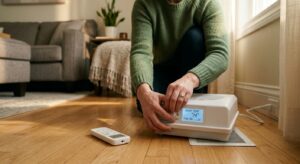
- Check your current indoor humidity with a hygrometer or your thermostat display. If it reads above 55%, your placement and settings need adjustment. Hygrometers cost $10 to $15 at hardware stores.
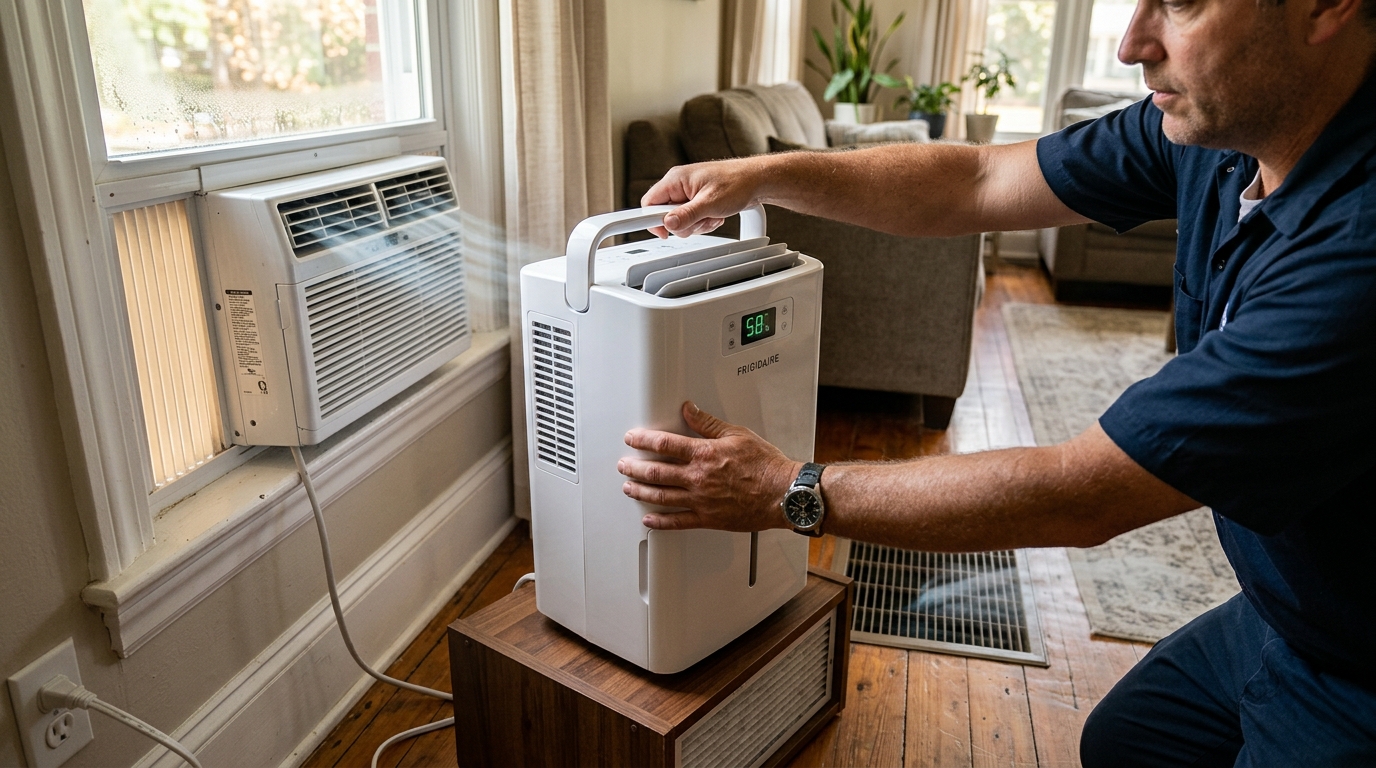
- Move your dehumidifier away from walls and furniture so all intake vents have at least 12 inches of clear space on all sides. Most units pull air from the sides or back, and wall proximity chokes intake airflow by 20 to 30%.
- Position the unit in the room or floor where humidity originates. For most homes this is the basement, laundry area, or first floor near the kitchen. Avoid placing it in a closed bedroom or bathroom where exhaust heat will fight your AC directly.
- Set the humidistat to 45 to 50% relative humidity, not lower. Running below 45% wastes electricity with diminishing comfort returns and can over-dry wood floors and furniture.
- Point the dry-air exhaust toward a doorway or open area rather than at a wall. This helps circulated dry air reach adjacent rooms instead of recirculating immediately into the intake.
- Empty the reservoir or confirm the drain hose is clear and sloped downward. A full tank causes most units to shut off automatically, meaning the unit may have been off for hours without you realizing it.
- Purchase a dehumidifier rated for at least 50 pints per day if your home is under 2,000 square feet, or 70 pints per day for larger homes. Look for ENERGY STAR certification, which guarantees at least 15% better efficiency than minimum federal standards.
- Choose a central basement location with access to a floor drain, utility sink drain, or a condensate pump. Central placement in an open basement allows airflow to pull moisture from the entire lower level rather than just one corner.
- Attach the included drain hose or purchase a standard 5/8-inch garden hose adapter to the dehumidifier drain port. Route the hose with a consistent downward slope of at least 1 inch per foot to the drain point. Avoid loops or low spots where water collects and blocks flow.
- If no gravity drain is reachable, install a small condensate pump ($25 to $45) near the dehumidifier. Connect the pump’s inlet to the dehumidifier drain port and route the pump’s discharge line up and out to a sink or exterior.
- Plug the dehumidifier into a dedicated outlet if possible, or at minimum a circuit that is not shared with your AC air handler or major appliances. Voltage sags on shared circuits can reduce dehumidifier efficiency and shorten motor life.
- Set the unit running and verify the drain flow is working before leaving it unattended. After 48 hours, recheck your hygrometer reading and confirm humidity has dropped to 45 to 50%. Adjust the humidistat setting slightly if needed.
- Get quotes from two licensed HVAC contractors for a ducted whole-home dehumidifier such as an Aprilaire 1850 or Santa Fe Advance2. Ask each contractor to explain where they plan to tie into your existing ductwork and confirm the unit is sized to your home’s square footage.
- Request that the contractor measure your home’s Manual J latent load before sizing the unit. Guessing size leads to short-cycling and poor performance. Proper sizing is based on square footage, climate zone, infiltration rate, and occupant count.
- Have the unit installed with its own drain line running to a floor drain or condensate pump. This ensures it operates independently of your AC and can run even when your AC is off, such as during mild weather when humidity is high but cooling is not needed.
- Ask the contractor to set the integrated humidistat to 50% RH and confirm it is wired to call for dehumidification independently of the AC thermostat.
- After installation, monitor your utility bills for the next two billing cycles and compare to the same months in the prior year. Homeowners in Zone 2 climates typically see 15 to 25% reductions in cooling costs after whole-home dehumidifier installation.
Why It Works: The Benefits
Reducing indoor humidity from 65% down to 50% can cut AC runtime by 10 to 20%, translating to roughly $30 to $90 per cooling season for an average home spending $450 per year on cooling.
Every degree you raise your thermostat saves approximately 3% on cooling costs. Proper dehumidification lets most homeowners comfortably raise their setpoint by 2 to 4 degrees, saving 6 to 12% before any other changes.
When your AC no longer has to handle peak latent loads alone, compressor cycles become shorter and less frequent. Reducing compressor short-cycling and overwork can add 2 to 4 years to the life of an average central AC system.
Dust mites thrive above 50% relative humidity and mold growth accelerates above 60%. Maintaining indoor humidity at 45 to 50% removes the conditions that fuel both, improving air quality and reducing allergy symptoms.
Humid air stratifies and makes rooms feel uneven. Dehumidifying at the right location, particularly a lower level, smooths out the temperature and comfort difference between floors by 2 to 4 degrees of perceived temperature.
💰 Savings Impact by Action
Optimizing dehumidifier position for full airflow coverage increases moisture removal capacity by up to 20 to 30%, reducing the latent load your AC must handle.
Lowering indoor humidity to 50% allows raising the thermostat 2 to 4 degrees, saving approximately 3% per degree for a total of 6 to 12% on cooling costs.
Homes in humid climates with dedicated dehumidification see AC runtime drop 10 to 20% as the unit no longer bears the full latent cooling load.
A ducted whole-home dehumidifier in Climate Zones 1 through 3 reduces total cooling energy use by 15 to 25% compared to AC-only humidity control.
🏠 Key Concepts Explained
The Science Behind It
Air conditioning works by passing warm indoor air over a cold evaporator coil. Two things happen simultaneously: sensible cooling (lowering air temperature) and latent cooling (condensing water vapor out of the air). The latent process requires significantly more energy per unit of heat removed because it involves a phase change, turning water vapor into liquid. In a humid climate like the Southeast or Mid-Atlantic, latent loads can represent 30 to 50% of a home’s total cooling demand, meaning nearly half your cooling bill can trace back to moisture, not heat.
When you add a standalone dehumidifier, you are essentially pre-processing the air before your AC ever sees it. The dehumidifier uses its own refrigerant cycle to condense moisture and exhaust drier air. Your AC then only needs to handle the sensible cooling load. Because sensible cooling is more efficient per unit of energy than combined sensible-plus-latent cooling, your AC’s effective capacity and efficiency (measured as EER or SEER) increases when humidity is already controlled. This is why homes with whole-home dehumidifiers often see their central AC cycle on and off in shorter, more efficient bursts rather than running long continuous cycles.
Placement matters because of how dehumidifiers interact with the air volume they serve. A unit tucked in a corner with restricted intake sees reduced airflow across the evaporator coil, which raises the coil temperature and reduces condensation efficiency. Additionally, moisture migrates from high-concentration zones (basement slab, crawl space, exterior walls) to lower-concentration zones through diffusion and airflow. Intercepting moisture near its source before it disperses into your main living area means your AC handles a fundamentally drier air mass from the start, compounding the efficiency gain.
Frequently Asked Questions
▼ My dehumidifier is running constantly but the humidity won’t drop below 65%. What’s wrong?
First check that all windows and doors are closed and that your dehumidifier is sized correctly for the space. A 30-pint unit cannot effectively dehumidify a 2,000-square-foot basement. If the unit is correctly sized and humidity stays stubbornly high, you likely have active moisture intrusion, such as water seeping through a foundation wall or a missing crawl space vapor barrier, and no amount of dehumidification capacity will overcome a continuous water source.
▼ Where is the single best place to put a dehumidifier in my home?
For most homes, a central open area of the basement or lowest occupied floor is the highest-impact location. This intercepts moisture rising through the stack effect before it reaches living areas and places the unit near the most common moisture sources. If you have no basement, place the unit in a central first-floor hallway or the room with the highest measured humidity, at least 12 inches from all walls.
▼ Will a dehumidifier make my home too cold or work against my AC?
A properly placed dehumidifier complements your AC rather than fighting it. The only scenario where it adds to your cooling load is if the unit is running in a conditioned living space during peak heat and its waste heat noticeably warms that room. To avoid this, place it in a basement or utility area, or run it primarily at night when outdoor temperatures drop and the heat penalty is minimal.
▼ How long before I see the savings on my electric bill?
Most homeowners in humid climates notice a meaningful bill reduction within one to two billing cycles during peak cooling season. The savings show up as shorter AC runtime, which you can confirm by tracking how often your AC cycles on per hour before and after dehumidifier placement changes. A hygrometer reading consistently between 45 and 50% indoors is your confirmation that the system is working.
▼ Can a renter use a portable dehumidifier effectively without any modifications?
Yes. A portable dehumidifier requires no installation and no landlord permission. Place it in a central open area of your apartment, set the humidistat to 50%, and use the built-in reservoir (emptied daily) or request permission to run a short drain hose to a bathroom sink. Units in the 30 to 50 pint range cost $150 to $250 and are the most practical humidity solution available to renters.
Quick Tips
- Set your AC fan to AUTO, not ON. Running the fan continuously when the compressor is off re-evaporates moisture collected on the evaporator coil back into your home, undoing the dehumidification your AC just performed.
- Keep interior doors open between the dehumidifier’s location and the rest of the home. Closed doors block dry air from reaching living spaces and can cause the dehumidifier to cycle off from local low humidity while the rest of the house stays damp.
- In spring and fall when outdoor temperatures are mild but humidity is high, run your dehumidifier without running the AC. Your AC is not efficient at removing moisture when it is only 65°F outside, but a dedicated dehumidifier handles those conditions well and costs far less to operate.
- Check and clean your dehumidifier’s air filter every two weeks during peak season. A clogged filter reduces airflow across the coil by 15 to 25%, directly cutting moisture removal capacity and making the unit run longer to hit its set point.
Variations for Your Situation
- Apartment/Rental: Renters cannot modify central HVAC but can use a portable dehumidifier with no permission required. Choose a 30 to 50 pint ENERGY STAR unit ($150 to $250) and place it in your main living area or bedroom hallway. Empty the tank daily or request permission to run a 6-foot drain hose to a bathroom sink. This approach can reduce perceived temperature by 2 to 3 degrees and let you raise your thermostat setpoint, cutting window AC or mini-split runtime meaningfully.
- Tight Budget (under $50): If you already own a dehumidifier, the zero-cost placement optimization in the Quick Fix approach costs nothing and can recover 15 to 30% of lost dehumidifier efficiency just by moving the unit and clearing its airflow. If you do not own one yet, a refurbished or open-box 30-pint unit can often be found for $60 to $80 at hardware store clearance or online marketplaces. Pair it with a $10 hygrometer to confirm it is actually working.
- Older Home (pre-1980): Homes built before 1980 typically have higher envelope leakage, meaning outdoor humid air infiltrates more freely and a single portable dehumidifier may be undersized for the moisture load. Prioritize air sealing (weatherstripping doors, caulking window frames) alongside dehumidification. In these homes, a whole-home ducted dehumidifier is often more cost-effective long-term than running multiple portable units, and the payback period is typically 2 to 3 cooling seasons given how much more these homes spend on cooling overall.