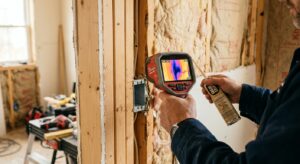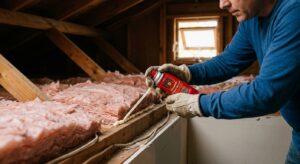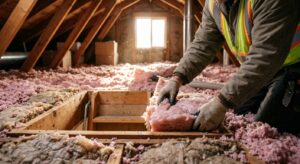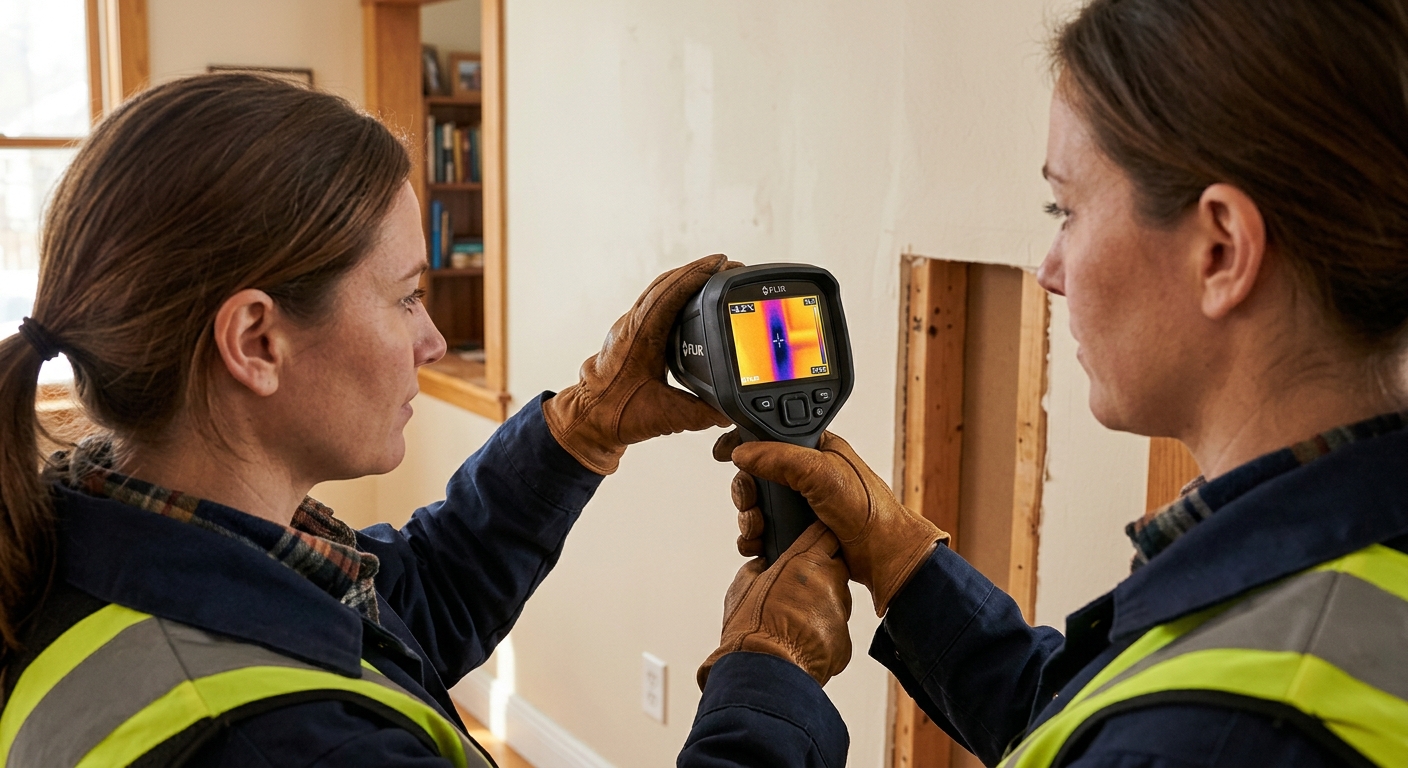
You insulated your attic, sealed the obvious gaps, and still get a shocking energy bill every winter. Sound familiar? The culprit is often thermal bridging, a phenomenon where highly conductive materials like steel studs, wood framing, concrete beams, or metal fasteners create a direct path for heat to bypass your insulation entirely. It is invisible to the naked eye but shows up clearly on an infrared camera as glowing stripes of heat loss running right through your walls.
Thermal bridging is not a minor rounding error. In a home with standard 2×6 wood-framed walls, the framing itself makes up roughly 25 percent of the wall area, and wood conducts heat about 400 times better than air. In steel-framed construction, the problem is far worse. The Steel Stud Manufacturers Association acknowledges that steel framing can reduce a wall assembly’s effective R-value by 50 percent or more compared to its labeled cavity insulation value. That gap between the R-value on the bag and the real-world performance of your wall is costing you money every single day.
This post breaks down exactly what thermal bridging is, where it hides in a typical home, and what you can do about it ranging from zero-cost adjustments you can make today to professional retrofits that pay for themselves within a few years. Whether you are planning a renovation or just trying to understand why one wall always feels cold, you will leave with a clear action plan.
What You’ll Need
Click on an item below to shop for the recommended items for this recipe on Amazon.
As an Amazon Associate, we earn from qualifying purchases.
How to Do It
- On a cold day with at least a 15-degree difference between indoor and outdoor temperatures, run your hand slowly across exterior walls. Cold vertical stripes spaced 16 or 24 inches apart indicate stud bridging. Cold horizontal lines near floors or ceilings indicate rim joists or structural ties.
- Check your utility bills for the three highest-use winter months and note which rooms feel coldest at the same thermostat setting. Rooms with more exterior wall area and steel or concrete elements are the most likely candidates for significant bridging losses.
- Look at exterior walls in unfinished spaces like basements and garages. Exposed metal connectors, anchor bolts, and shelf angles are high-priority point and linear bridges you can often address without disturbing finished walls.
- Use a free infrared thermometer (many hardware stores sell them for under $20) to measure surface temperatures on exterior walls versus interior partition walls. A difference of more than 5 degrees Fahrenheit on a cold day points to significant heat loss through bridging.
- Make a simple priority list ranking rooms and wall sections by temperature difference and exterior exposure. This becomes your action plan for the DIY or professional approaches below.
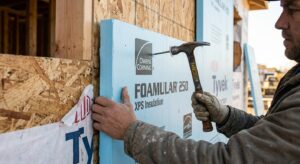
- Select a rigid foam insulation product rated for your climate. Polyisocyanurate (polyiso) offers R-6 to R-6.5 per inch and is the most efficient option. Expanded polystyrene (EPS) provides R-3.8 per inch and is more budget-friendly. For a steel-stud wall, a minimum of 1.5 inches of polyiso is recommended to significantly reduce bridging losses.
- Measure the wall area and purchase enough rigid foam panels to cover it completely without gaps. Continuous coverage is the entire point: any gap reinstates the thermal bridge you are trying to eliminate.
- Cut panels to fit using a utility knife and straightedge. Score the foil or plastic facing firmly, then snap the panel over a hard edge. For EPS, a fine-tooth handsaw works well.
- Attach panels directly to the face of existing framing using cap-head roofing nails or screws with large fender washers. For interior basement applications, you can also use foam-compatible construction adhesive as a primary fastener on flat concrete or masonry walls.
- Tape all seams between panels with foil-faced tape rated for thermal applications. This prevents air movement between panels that would undermine insulation performance and also serves as an air barrier.
- If required by your local code, cover the foam with a thermal barrier such as half-inch drywall before occupying the space. Check with your local building department, as most jurisdictions require foam to be protected from direct exposure in occupied areas.
- Hire a building performance contractor certified by BPI or RESNET to conduct a blower door test and infrared scan. This documents your baseline effective R-value and identifies all thermal bridges before work begins, giving you a benchmark to verify results after completion.
- Work with the contractor to select an exterior insulation system. Common options include mineral wool boards (non-combustible, vapor-open, R-4 per inch) and rigid polyiso with rainscreen furring strips. The contractor will specify thickness based on your climate zone to keep the dew point outside the framing assembly.
- The contractor removes existing cladding (siding, stucco, or clapboard) and inspects sheathing for any moisture damage caused by years of condensation on thermal bridges. Damaged sheathing is replaced at this stage.
- Continuous insulation is installed over the entire exterior wall plane, lapped at corners and transitions to maintain a true thermal break. Window and door rough openings are extended with bucks to accommodate the added wall thickness.
- New cladding is installed over the insulation system, typically over a drainage plane and ventilated rainscreen assembly. This step also improves moisture management and extends the life of the cladding.
- Request a post-project infrared scan and blower door retest to confirm the thermal bridges have been addressed and document the improvement for your records, your insurance company, and any future home sale.
Why It Works: The Benefits
Adding a continuous layer of 1.5-inch rigid foam insulation over a steel-stud wall can restore 40 to 50 percent of lost R-value, translating to measurable reductions in monthly energy use, often 15 to 25 percent for the conditioned areas served by those walls.
Eliminating cold stud lines raises interior surface temperatures by 3 to 8 degrees Fahrenheit, which directly reduces radiant heat loss from your body and makes a room feel comfortable at a lower thermostat setting.
Keeping wall surfaces above the dew point by adding continuous insulation can prevent moisture accumulation that leads to mold growth and wood rot, potentially saving thousands in remediation costs.
Once you account for and address thermal bridging, your home’s actual energy performance aligns more closely with your thermostat settings and predicted bills, making it easier to budget and plan further improvements.
Homes with documented envelope improvements and higher effective R-values appraise and sell better in energy-conscious markets. ENERGY STAR and DOE Zero Energy Ready Home certifications both require addressing thermal bridging explicitly.
💰 Savings Impact by Action
Insulating and air-sealing rim joists with rigid foam can reduce whole-home heat loss by 5 to 10 percent due to eliminating a continuous linear bridge at the building perimeter.
Adding 1.5 to 2 inches of rigid foam over steel-stud or wood-framed walls can restore 40 to 50 percent of lost effective R-value, reducing wall-related heat loss by up to 25 percent.
Replacing aluminum window frames with thermally broken vinyl or fiberglass frames eliminates a high-conductivity point bridge and reduces window assembly heat loss by up to 8 percent of whole-home energy use.
A full exterior continuous insulation retrofit covering all above-grade walls typically reduces heating and cooling energy consumption by 15 to 20 percent compared to pre-project baseline.
🏠 Key Concepts Explained
The Science Behind It
Every material resists heat flow to a different degree, measured as its thermal resistance or R-value per inch. Fiberglass batt insulation sits around R-3.5 per inch. Wood framing is about R-1.25 per inch. Steel studs are less than R-0.01 per inch because steel has a thermal conductivity nearly 1,600 times greater than the still air trapped in insulation fibers. When a steel stud runs from the cold exterior sheathing to the warm interior drywall, heat bypasses the insulation entirely by flowing through the stud. The result is that a nominally R-19 steel-stud wall assembly can have an effective whole-wall R-value as low as R-8 or R-9.
The physics of why continuous insulation works so well comes down to the concept of thermal resistance in series. When you add a layer of rigid foam over the entire face of a framed wall, heat cannot reach the studs without first passing through the foam. Every stud now sits in the warm zone on the interior side of the insulation layer, dramatically reducing its temperature differential and therefore its rate of heat transfer. A 1.5-inch layer of polyiso at R-9.6 does not simply add R-9.6 to the wall. It also multiplies the effectiveness of the existing cavity insulation by eliminating the bypass path, which is why whole-wall performance improvements from continuous insulation often exceed what the added R-value alone would predict.
Thermal bridging also interacts with moisture in a way that compounds the energy penalty over time. Cold surfaces attract condensation, and repeated wetting of wood framing reduces its R-value further and promotes mold and decay. The DOE estimates that moisture-degraded insulation can lose 20 to 40 percent of its rated R-value. Addressing thermal bridges therefore protects both the energy performance and the structural integrity of your building envelope simultaneously, making it one of the highest-leverage improvements available in an existing home.
Frequently Asked Questions
▼ How do I know if thermal bridging is actually my problem and not just air leakage?
Air leakage produces drafts you can feel and often smell, and it is worse on windy days. Thermal bridging produces cold surfaces that are consistent regardless of wind, with no detectable air movement at the wall surface. The best diagnostic is an infrared thermometer or a rental thermal imaging camera: bridging shows as repeating cold stripes matching framing spacing, while air leakage shows as irregular cold patches near penetrations and seams. Many homes have both, so fixing air leakage first with caulk and spray foam is the right first step, then reassessing for bridging with a thermometer afterward.
▼ My house has vinyl siding. Can I add exterior insulation without replacing it?
Not practically, because exterior continuous insulation must go behind the cladding to work correctly. However, the good news is that vinyl siding is one of the cheapest cladding materials to remove and reinstall, and many contractors can re-use the original vinyl after adding insulation, significantly reducing project cost. This is the ideal time to bundle insulation with a siding refresh. Get quotes from contractors who specialize in exterior insulation retrofits rather than general siding contractors, as the detailing around windows and doors requires building science knowledge.
▼ I added insulation but my walls still feel cold. What am I missing?
The most common oversight after adding cavity insulation is leaving the rim joist and band joist uninsulated, which creates a continuous cold ring at floor level that radiates chill into rooms. Check also whether your window frames are aluminum, as aluminum is an extreme thermal bridge that no amount of wall insulation can fix; replacing with vinyl or fiberglass frames is the only real solution for that. Finally, confirm that your new insulation is truly continuous with no gaps at corners, electrical boxes, or pipe penetrations, since even small gaps can account for a disproportionate share of remaining heat loss.
▼ Does thermal bridging matter as much in a hot climate as in a cold one?
Yes, though the mechanism runs in reverse. In summer, thermal bridges allow heat to flow inward from a hot wall assembly into your cooled living space, increasing your air conditioning load. Steel stud homes in hot-humid climates like Florida and Texas can see cooling penalties comparable to heating penalties in cold climates. The same continuous insulation strategies apply, and the payback period in high-cooling-load climates can actually be shorter because air conditioning costs more per BTU than heating in most regions.
▼ Will fixing thermal bridging actually show up on my energy bill?
Yes, but the timeline and magnitude depend on how severe the bridging was and how much of the envelope you treated. Rim joist insulation typically shows a noticeable bill reduction within the first full heating season. Whole-wall continuous insulation retrofits generally reduce bills by 10 to 25 percent, and most homeowners see a clear drop by month two or three after completion. For the clearest comparison, track your energy use per heating degree day (available from your utility or weather services) rather than raw dollar amounts, because weather variation can otherwise obscure real savings.
Quick Tips
- Always check rim joists first. They are the most accessible and cost-effective thermal bridge to fix in nearly every home built on a wood frame foundation.
- When shopping for rigid foam, compare cost per R-value per square foot, not just price per sheet. Polyiso costs more per sheet but delivers more R-value per inch, often making it cheaper per R overall.
- In cold climates (Climate Zones 5 through 8), the minimum recommended continuous insulation thickness for a 2×6 wood-framed wall is 2 inches of polyiso or 3 inches of EPS to keep the dew point safely outside the framing and avoid moisture problems.
- If you are renovating a basement, insulate the walls with continuous rigid foam rather than batt insulation between studs. Basement stud walls are notorious thermal bridges because the framing sits against a cold masonry wall with nowhere for heat to go except out.
Variations for Your Situation
- Apartment/Rental: Renters cannot modify wall assemblies, but thermal bridges at windows are fair game. Install interior window insulation film kits ($15 to $30 per window) to add a dead-air layer and raise surface temperatures. Heavy thermal curtains with a cold-air dam at the bottom can cut window-related heat loss by 25 percent. Draft snakes at door bases and removable rope caulk in window frames are renter-safe and fully reversible. Focus your effort on the rooms with the most exterior wall exposure.
- Tight Budget (under $50): Rim joist insulation is your best dollar-for-dollar move. Buy one sheet of 2-inch polyiso foam board for about $25, cut it into blocks sized to fit between joists, and friction-fit it into every rim joist bay you can reach from inside the basement. Add canned spray foam around the perimeter of each block to seal edges. This single project often costs $30 to $80 total and can reduce whole-home heat loss by 5 to 10 percent with no professional help needed.
- Older Home (pre-1980): Homes built before 1980 often have no sheathing behind the siding, just boards or skip sheathing, which makes exterior insulation retrofits more complex and requires additional air barrier work. Start with a professional energy audit before spending on materials, because older homes frequently have bigger wins available from air sealing than from insulation alone. When you do address bridging, prioritize the basement and crawl space rim joists first, since those are accessible without disturbing potentially hazardous wall materials. Always test for asbestos and lead paint before cutting into any wall assemblies.