Your electric bill arrives every month, you wince at the total, and you pay it. Sound familiar? Most homeowners treat their utility statement like a black box, trusting that the number is correct and moving on. But electric bills are packed with separate charges, tiered rate structures, fuel adjustments, and fees that most customers never scrutinize, and those unchecked line items can quietly drain your wallet month after month.
The good news is that reading your bill like a pro is a skill anyone can learn in a single sitting. Once you understand the difference between your energy charge and your demand charge, know what a fuel adjustment clause actually is, and can calculate your cost per kilowatt-hour, you have real leverage: to catch billing errors, time your high-consumption tasks strategically, and compare your usage against realistic benchmarks. The average U.S. household spends about $1,500 per year on electricity, and studies from the American Council for an Energy-Efficient Economy suggest that awareness alone, paired with simple behavioral changes, can trim bills by 5 to 15 percent.
This post walks you through every section of a typical residential electric bill, explains the charges that most customers ignore, shows you how to spot errors and rate mismatches, and gives you a step-by-step process for turning that monthly statement into an actionable energy improvement plan. No engineering degree required.
What You’ll Need
Click on an item below to shop for the recommended items for this recipe on Amazon.
As an Amazon Associate, we earn from qualifying purchases.
How to Do It
- Pull out your current bill and locate the summary box. Find three numbers: total amount due, total kWh used this month, and billing period in days. Divide kWh by days to get your daily average consumption.
- Find your effective cost per kWh by dividing the total bill amount by total kWh used. Compare this to your stated rate. If the two numbers differ significantly, hidden charges are inflating your true cost.
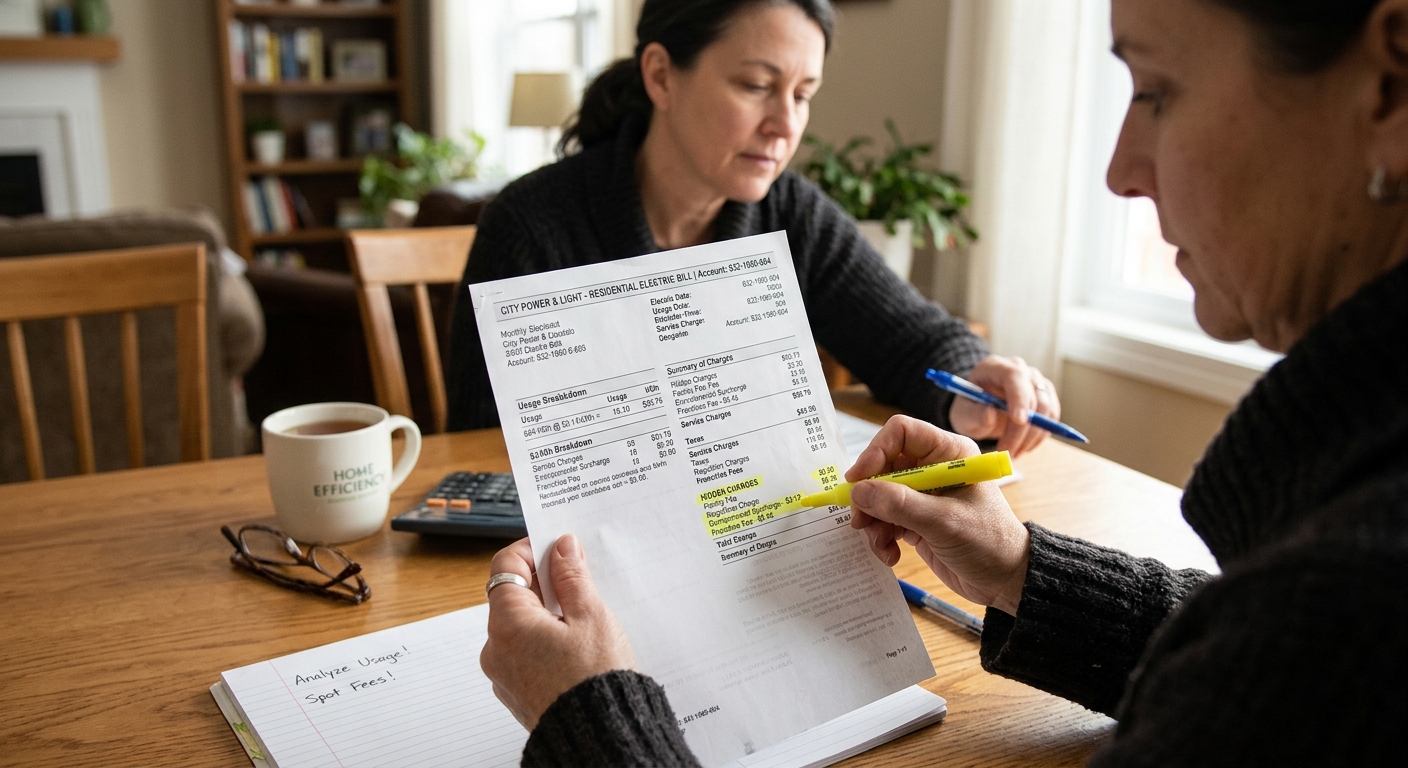
- Scan every line item below the energy charge. Look specifically for: fuel adjustment clause, distribution charge, transmission charge, customer charge, and any surcharges or riders. Write down any charge you cannot define.
- Check whether your meter read is labeled ‘actual’ or ‘estimated.’ An estimated read means your usage was not physically or digitally confirmed. If estimated, note the reading on your meter and call your utility to submit an actual read.
- Compare this month’s kWh to the same month last year using the usage history chart most bills include. A jump of more than 15% with no change in household size or behavior warrants investigation.
- If you find a charge you cannot explain or a suspicious spike, call your utility’s customer service line with the specific line-item name and dollar amount ready. Ask them to define the charge and confirm your current rate plan.
- Download or request 12 months of billing history from your utility’s online portal or by calling customer service. Most utilities provide this as a PDF or CSV export at no charge.
- Set up a simple spreadsheet with columns for: billing month, days in period, kWh used, total bill amount, effective cost per kWh (bill divided by kWh), and any unusual charges. Enter all 12 months of data.
- Calculate your 12-month average daily kWh. Then flag any month where daily usage is more than 20% above or below your average. Research what was different: extreme weather, guests, a new appliance, a renovation.
- Call your utility and ask a customer service agent to confirm: your current rate plan name, whether time-of-use pricing is available in your area, and whether any bill credits or low-income assistance programs apply to your account.
- If time-of-use pricing is available, ask the agent to run a bill comparison showing what your last 3 months would have cost on each available rate plan. Choose the plan that fits your household’s natural schedule.
- Set a recurring monthly calendar reminder to log your new bill data into your spreadsheet within 5 days of receiving each statement. After 3 months, you will have enough personal baseline data to catch anomalies before they compound.
- Purchase a whole-home energy monitor such as a Sense, Emporia Vue 2, or Emonitor. These devices install in your electrical panel and track real-time consumption by circuit or by learned appliance signature.
- Turn off the main breaker and install the current transformer clamps around your two main service lines inside the panel following the manufacturer’s instructions. If you are uncomfortable working near an electrical panel, hire an electrician for this step.
- Connect the monitor to your home Wi-Fi and download the companion app. Enter your utility rate (including tiered thresholds and time-of-use windows) so the app calculates real dollar cost, not just kWh.
- After 30 days, compare your monitor’s reported total kWh to your actual utility bill. A discrepancy of more than 5% may indicate a meter accuracy issue worth reporting to your utility.
- Use the app’s appliance-level breakdown to identify your top five energy consumers. Cross-reference with your bill’s cost-per-kWh to calculate what each appliance actually costs per month in dollars.
Why It Works: The Benefits
Meter misreads, estimated billing, and rate code errors are more common than most customers realize. Identifying an error and requesting a correction can result in a credit of $50 to $200 or more on a single bill.
Switching from a standard flat rate to a time-of-use plan, or vice versa, can reduce your effective cost per kWh by 10 to 20% depending on your household schedule. You cannot make this switch if you do not first understand which plan you are currently on.
Once you know your peak hours and tier thresholds, shifting dishwasher, laundry, and EV charging to off-peak windows (typically after 9 PM) can cut time-of-use charges by 20 to 30% on those specific loads.
Tracking your kWh usage monthly lets you spot appliance failures, phantom loads, or HVAC inefficiencies before they become expensive. A water heater element failing, for example, can add 100 to 200 kWh per month before the unit completely breaks down.
Customers who call their utility with specific data (account numbers, billing dates, exact line-item charges) resolve disputes and access hardship programs or rate adjustments far faster than those calling with only a vague complaint about a high bill.
💰 Savings Impact by Action
Switching from a flat rate to the optimal time-of-use plan for your schedule reduces effective cost per kWh by 10 to 20% without changing any consumption habits.
Moving high-draw appliances like laundry, dishwashers, and EV charging to off-peak hours reduces time-of-use charges on those loads by up to 30%, translating to roughly 15 to 20% of total bill savings for active households.
Catching and correcting a single meter misread or rate code error can reduce a single month’s bill by 10 to 40%, with some cases resulting in multi-month credits.
Households that actively monitor monthly kWh consumption reduce usage by an average of 5 to 12% through behavioral awareness alone, according to utility demand-side management program data.
Identifying a failing appliance (such as a degraded water heater element or refrigerator running constantly) through bill spike analysis and replacing it can eliminate 100 to 200 excess kWh per month, saving roughly 10 to 15% on annual bills.
🏠 Key Concepts Explained
The Science Behind It
Electric bills are not a single charge. They are a stack of distinct cost components that reflect the physical and economic reality of how electricity is generated, transported, and delivered to your home. The energy charge covers the actual electrons you consume, measured in kilowatt-hours. One kWh is 1,000 watts consumed for one hour, so a 100-watt bulb running for 10 hours equals 1 kWh. At the U.S. average rate of around 16 cents per kWh in 2024, that bulb costs about 1.6 cents per hour to operate, a number that scales dramatically when applied to a 5,000-watt central air conditioner running 8 hours per day.
Beyond energy charges, the transmission and distribution components on your bill reflect the physics of moving power across the grid. High-voltage transmission lines carry electricity from power plants over long distances with relatively low losses. But when voltage is stepped down for neighborhood distribution, resistance in the lines increases and losses grow. These infrastructure costs are real and are passed to customers through fixed and variable line charges. The fuel adjustment clause exists because the cost of natural gas, coal, or other generation fuels fluctuates with commodity markets, and utilities are permitted by regulators to pass those swings directly to customers rather than absorb them quarterly.
Tiered and time-of-use rate structures are grounded in the economics of grid supply and demand. During peak demand windows, typically late afternoon and early evening on hot weekdays, utilities must bring their most expensive and least efficient ‘peaker plants’ online to meet demand. Charging customers more during those windows is both a cost-recovery mechanism and a deliberate price signal designed to shift load away from the most carbon-intensive and expensive generation sources. Understanding this mechanism means that when you run your dishwasher at 10 PM instead of 6 PM, you are not just saving money on your bill, you are also reducing demand for the dirtiest power on the grid.
Frequently Asked Questions
▼ My bill jumped 40% this month but I did not change anything. What happened?
First, check whether the prior month was based on an estimated read. If so, the current month’s spike may simply be a catch-up charge for underbilled usage. Next, check whether a new appliance, a guest stay, or an extreme weather event drove extra consumption. If none of those apply, request a meter test from your utility, which is typically free and can identify faulty metering equipment.
▼ How do I find out which rate plan I am on?
Your rate plan name is usually printed on your bill near the account information section, often labeled ‘rate schedule’ or ‘service classification.’ If it is not visible, log into your utility’s online account portal or call customer service and ask them to read your current tariff code and name. Then search that tariff name on your utility’s website to see the full rate sheet with all tiers and time windows.
▼ Can I actually get money back if I find a billing error?
Yes. If a utility confirms a metering error or billing mistake, they are required by state public utility commission rules to issue a corrected bill and apply a credit. In cases of prolonged overbilling, some states mandate interest on the overcollected amount. Document everything in writing and ask the representative for a case or confirmation number.
▼ What is the customer charge on my bill and can I get rid of it?
The customer charge (sometimes called a service charge or meter charge) is a fixed monthly fee that covers the utility’s cost of maintaining your account, meter, and service connection regardless of how much electricity you use. It typically ranges from $8 to $25 per month and cannot be eliminated short of canceling service. However, it is important context: it means your savings from conservation are capped at the variable portion of your bill, not the total.
▼ My neighbor has the same house size and pays $40 less per month. Why?
Differences in bill amounts between similar homes most often come down to thermostat habits, appliance age, water heater type, and air sealing quality rather than rate differences. Ask your neighbor if they are on a different rate plan, then compare kWh usage (not just dollar amounts) since rates vary by account type. If their kWh is genuinely lower, a home energy audit can identify where your house is consuming more.
Quick Tips
- Set up autopay but still review your bill every month before the payment processes. Most utilities give a 2 to 3 week window between bill delivery and due date, which is enough time to dispute an error.
- If your bill shows kWh usage but no breakdown of rate tiers, call and ask for a copy of your current rate tariff by name. Tariff sheets are public documents and will show you exactly where your tier thresholds sit.
- Take a photo of your meter reading on the same calendar day each month and log it. If your utility ever estimates your bill, you have documented proof of actual consumption ready to submit.
- Check whether your utility offers a budget billing or levelized payment plan. These plans average your annual usage into 12 equal payments, eliminating summer bill spikes, though you should still audit the underlying kWh charges.
Variations for Your Situation
- Apartment or Renter: If your landlord pays electricity or your building uses a master-metered allocation system, request a written breakdown of how your share is calculated. In many states, landlords using sub-metering or RUBS (Ratio Utility Billing System) are required to disclose the methodology. Even without access to a utility account, you can track monthly charges per square foot and compare against local utility average rates using your state public utility commission’s published residential benchmarks.
- Tight Budget (under $50): Focus entirely on the free steps: download 12 months of history, calculate your effective cost per kWh, call your utility for a rate comparison, and submit an actual meter read if any month was estimated. These zero-cost actions alone can reveal overcharges or rate plan mismatches worth $100 to $300 annually with no equipment purchase required.
- Older Home (pre-1980): Older homes often have higher baseline consumption due to resistance electric heat, older refrigerators, and poor insulation, which means tiered rates hit them harder and earlier in the billing period. Prioritize identifying whether you are crossing into a higher rate tier each month, as even modest efficiency improvements like refrigerator replacement or attic air sealing can keep you in the lower tier year-round and produce outsized bill savings compared to the same improvements in a newer home.