Spring is the sweet spot of the energy calendar. Outdoor temperatures hover between 55 and 70 degrees Fahrenheit across most of the country, which means your home sits comfortably close to your target indoor temperature with almost no help from your furnace or air conditioner. Yet the average American household still spends nearly $100 per month on energy in April and May, largely because their systems are running on autopilot left over from winter.
The opportunity here is real. Heating and cooling account for roughly 43% of a typical home’s energy bill according to the U.S. Energy Information Administration. When outdoor conditions are mild enough that you rarely need either system, eliminating unnecessary runtime can cut your total energy cost by 30 to 50% compared to January or August. That is not a rounding error. It is the difference between a $180 winter bill and a $90 spring bill.
This post walks you through exactly how to capture that savings window, from zero-cost thermostat adjustments you can make today to a half-day DIY audit that sets your home up for a cooler, cheaper summer. The steps are ordered by effort so you can start with the easiest wins and go deeper if you want to maximize results.
What You’ll Need
Click on an item below to shop for the recommended items for this recipe on Amazon.
As an Amazon Associate, we earn from qualifying purchases.
How to Do It
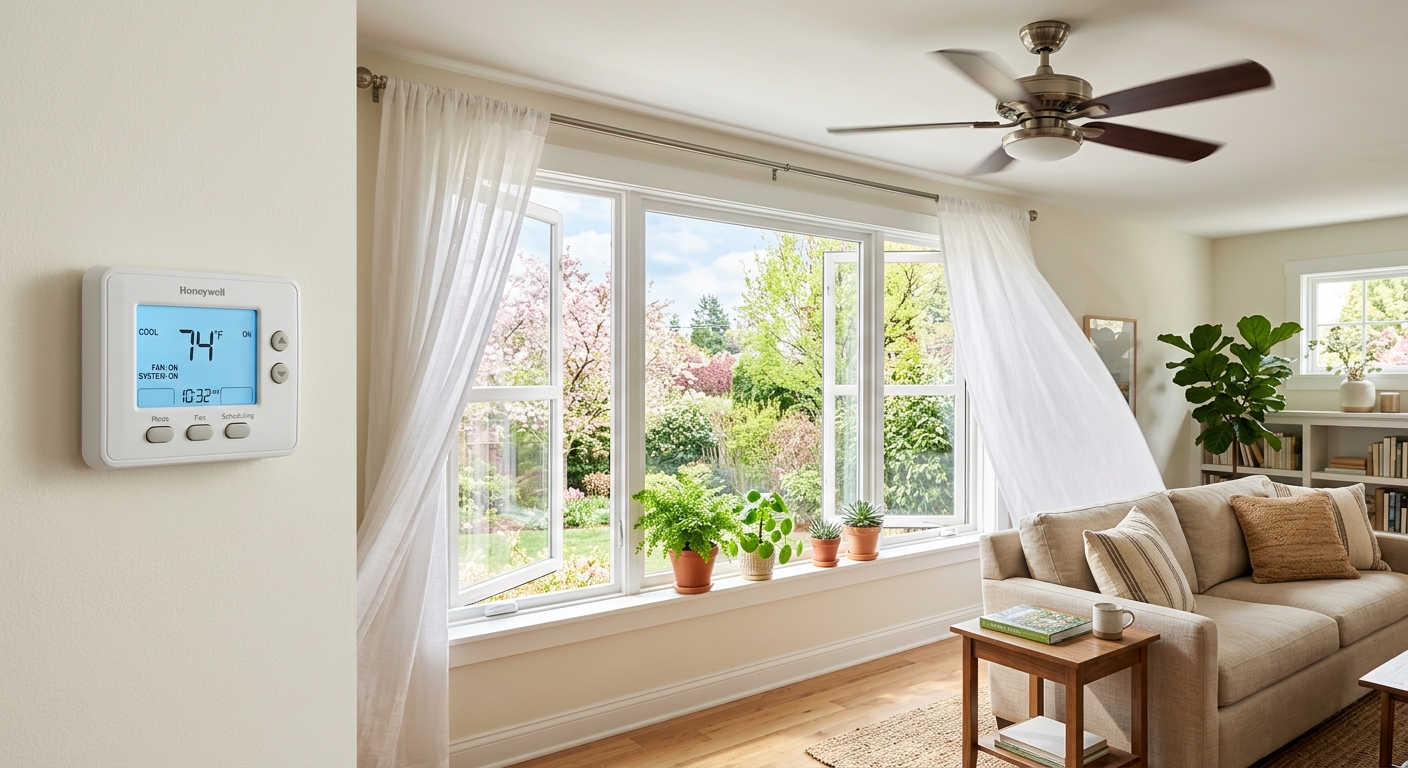
- Switch your thermostat from Heat to Cool or to the Auto position, and raise the cooling setpoint to 74 to 76 degrees Fahrenheit. If overnight lows are above 55 degrees, set the heating setpoint to 60 degrees so the furnace only kicks on during an unexpected cold snap.
- Turn on the Auto or Circulation fan mode on your thermostat instead of leaving it on continuous On. Continuous fan running costs $15 to $25 per month in electricity alone, with no heating or cooling benefit in mild weather.
- Open windows on opposite sides of your home by 4 to 6 inches each morning once outdoor temperature drops below your indoor temperature, typically before 8 a.m. Close them by late morning before outdoor temps rise above indoor levels.
- Switch ceiling fans to counterclockwise (summer mode) at low speed. This creates a wind-chill effect that makes 76 degrees feel like 72 degrees, letting you raise your thermostat setpoint without sacrificing comfort.
- Pull window shades or blinds on south and west-facing windows between noon and 4 p.m. to block peak solar heat gain. This alone can reduce afternoon indoor temperature rise by 3 to 5 degrees.
- Replace your HVAC air filter with a clean MERV 8 to 11 filter. A clogged filter forces the blower to work harder, reducing efficiency by 5 to 15% and increasing runtime. Check the old filter against a light source. If you cannot see light through it, it is overdue.
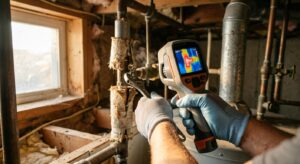
- Walk your home’s perimeter and press your hand slowly along the bottom of exterior doors, around window frames, and near electrical outlets on exterior walls. Feel for air movement. Mark any leaks with painter’s tape. On a windy day, a lit incense stick or candle held near suspected gaps will visibly flutter if air is moving.
- Apply foam backer rod and paintable latex caulk to gaps around window frames where they meet the wall. For doors, replace worn weatherstripping on the top and sides using a peel-and-stick foam or V-strip product. A door sweep on the bottom of drafty exterior doors costs about $12 and eliminates a surprisingly large leak path.
- Check your attic access hatch. This is one of the most overlooked air leaks in the house. If the hatch is uninsulated or has no weatherstripping, cut a piece of rigid foam board to fit the top and attach with construction adhesive. Add foam tape around the perimeter of the frame. This one fix can save 3 to 5% on annual heating and cooling costs.
- Inspect your dryer vent, bathroom exhaust fan covers, and kitchen range hood damper from inside and outside. Dampers stuck open are a continuous source of conditioned air loss. Clean any lint or debris and ensure flaps close freely when the appliance is off.
- Schedule or perform a DIY AC pre-season check: remove the condenser cover if you winterized it, clear any debris from around the outdoor unit to 18 inches on all sides, and visually inspect the refrigerant lines for damaged insulation. A clean, unobstructed condenser runs 10 to 15% more efficiently than a blocked one.
- Turn off power to your HVAC system at the breaker before removing the old thermostat. Take a photo of the existing wiring before disconnecting anything so you have a reference during reinstallation.
- Install the new thermostat base according to the included instructions. Most standard systems use a C-wire for power. If yours does not have one, choose a battery-powered model or a smart thermostat with a plug-in adapter kit.
- Program a spring and fall schedule that allows the home to drift to 78 to 80 degrees during the 8 to 10 hours you are away and overnight when outdoor temps are mild. DOE data shows proper setback scheduling saves an average of 10% annually on heating and cooling combined.
- Enable any Eco or Away mode on a smart thermostat so it adjusts automatically when no motion is detected. This eliminates the most common source of wasted runtime, which is conditioning an empty house.
- After one full billing cycle, compare your energy use on the utility portal or the app. Most smart thermostats display runtime hours per day. Use this data to fine-tune your schedule and confirm the system is not running unnecessarily during mild overnight hours.
Why It Works: The Benefits
Homeowners who actively manage their systems in spring routinely see bills 30 to 50% below their January peak, with some reaching annual lows under $70 per month in mild climates.
Every hour your furnace or AC does not run extends the life of the equipment. Reducing system runtime by 60 to 70% during the two to three mild spring months meaningfully reduces annual wear cycles and can delay costly repairs.
Opening windows during mild spring days flushes out VOCs, dust, and stale air that built up all winter, reducing reliance on recirculated HVAC air and improving freshness at zero energy cost.
Air sealing and insulation work done in spring reduces cooling load by up to 20% all summer long, meaning the one or two hours you invest in April can pay off on every single June, July, and August bill.
Passive ventilation strategies like cross-ventilation and night flushing can maintain indoor temperatures within 2 to 3 degrees of setpoint on most spring days without running any mechanical system at all.
💰 Savings Impact by Action
Programming setbacks when away or asleep saves an average of 10% annually on combined heating and cooling costs according to DOE data.
Sealing gaps, cracks, and penetrations in the building envelope reduces conditioned air loss by up to 20%, lowering both heating and cooling runtime.
Replacing a clogged filter restores full system airflow and can recover 5 to 15% of lost HVAC efficiency immediately.
Strategic window management on mild spring days can eliminate AC runtime almost entirely, reducing cooling energy use by 30 to 35% compared to running the system continuously.
Clearing debris and cleaning coils on the outdoor AC unit restores heat rejection capacity, improving efficiency by 10 to 15% on the first cooling days of the year.
🏠 Key Concepts Explained
The Science Behind It
Your home is essentially a thermal box constantly exchanging energy with the outdoors. In winter, heat flows out through every surface because your interior is warmer than the outside. In summer, heat flows in for the opposite reason. Your HVAC system exists to counteract that constant flow. In spring, the outdoor temperature is naturally close to your comfort zone, so the temperature differential driving that heat transfer is small, sometimes only 5 to 10 degrees instead of 40 to 60 degrees in peak seasons. Since heat flow rate is directly proportional to that temperature difference (a principle called Fourier’s Law of Heat Conduction), your home loses or gains heat several times slower in spring than in winter or summer, which is why your system barely needs to run.
Natural ventilation works because air has density. Cooler air is denser and sinks while warmer air is less dense and rises, creating the stack effect. By opening low windows to admit cool outdoor air and high windows or ridge vents to exhaust warm interior air, you create a passive chimney effect that continuously cycles fresh, cool air through your living space. On a spring evening with a 15-degree differential between indoors and outdoors, this passive strategy can lower indoor temperature at a rate of 1 to 2 degrees per hour with zero energy cost.
The efficiency gains from spring maintenance also follow clear physics. A dirty air filter increases static pressure in the duct system, forcing the blower motor to work harder to move the same volume of air. Studies from Lawrence Berkeley National Laboratory found that heavily fouled filters can reduce system airflow by up to 15%, meaning the system runs longer per cycle to reach setpoint. Similarly, an outdoor condenser unit blocked by leaves or shrubs cannot reject heat efficiently, raising the refrigerant condensing temperature and reducing the system’s coefficient of performance (COP) by 10 to 15%. Clearing these obstructions in spring before the first hot day is one of the highest-return, lowest-effort maintenance tasks a homeowner can perform.
Frequently Asked Questions
▼ My spring energy bill is not dropping even though the weather is mild. What am I missing?
The most common culprits are a thermostat still set to winter heating mode, a fan left on continuous instead of Auto, or an older programmable thermostat that reverted to its factory schedule. Check that your cooling setpoint is above your current indoor temperature so the AC is not running unnecessarily. Also pull up your utility’s usage graph online. If you see spikes in the evening, appliances like electric water heaters, dryers, and ovens are contributing more than your HVAC and need their own attention.
▼ Can renters do any of this without landlord permission?
Yes, most of these steps require no permanent modifications. Adjusting thermostat settings, switching ceiling fan direction, using window insulation film (removable), adding a door draft stopper, and opening windows strategically are all renter-safe. For air sealing, use removable rope caulk or foam tape that peels off cleanly rather than permanent caulk. Notify your landlord if you find significant gaps or a broken door sweep, as these are maintenance issues the landlord is typically responsible for fixing.
▼ How quickly will I actually see savings on my bill?
Thermostat and ventilation changes show up on your very next billing cycle, typically within 30 days. Air sealing and filter changes take one to two billing cycles before the savings are clearly visible because usage varies with weather. To see the clearest comparison, look at your utility’s year-over-year usage chart, which normalizes for weather differences and shows your actual efficiency improvement.
▼ What if I live in a humid Southern climate where spring is already warm and muggy?
In climates like the Gulf Coast or Southeast, spring humidity often makes natural ventilation impractical by mid-April because outdoor dew points climb above 60 degrees Fahrenheit, making the air feel sticky even at mild temperatures. In these climates, focus on the thermostat scheduling and air sealing steps, but keep the AC running in dehumidification mode rather than opening windows on humid days. Set your thermostat to 76 to 78 degrees and use ceiling fans to maintain comfort. Your savings window is narrower but still real in March and early April.
▼ My AC starts up fine but the house takes forever to cool down on the first warm day of spring. Is something wrong?
This is usually normal on the first warm day because the building’s thermal mass absorbed heat all afternoon before the system turned on. If it takes more than 45 minutes to 1 hour to drop 5 degrees with the AC running continuously, check that the condenser is clean and unobstructed, the filter is fresh, and all supply vents are open. If none of those fix it, the system may be low on refrigerant from a slow winter leak, which requires a licensed HVAC technician to diagnose and repair.
Quick Tips
- Set a phone reminder for April 1 each year titled Spring HVAC Mode. It takes 10 minutes to flip settings and pays back all season.
- Check your utility’s time-of-use rates. In spring when you do run AC, shifting use before 4 p.m. and after 9 p.m. can cut the per-kilowatt-hour cost by 20 to 40% in many markets.
- Use a $15 indoor-outdoor thermometer to see exact temperature comparisons before deciding to open windows or run the AC. Guessing leads to wasted runtime.
- If you have a programmable thermostat but never programmed it, you are likely wasting 10 to 15% of your HVAC budget. The default factory schedule assumes 24-hour occupancy at full setpoint.
Variations for Your Situation
- Apartment or Rental: Renters without access to the main HVAC system can still capture most of the savings. Use a smart plug-in outlet thermometer to track indoor temperature and run a portable fan instead of window AC on mild days. Apply removable rope caulk around drafty window frames (it peels off cleanly at move-out). A door draft stopper costs $10 and eliminates a major air leak. If you have baseboard electric heat, use a smart plug-in thermostat controller on your space heaters to avoid overnight heating in mild weather, saving $20 to $40 per month.
- Tight Budget (under $30): Start with zero-cost steps: adjust the thermostat, open windows strategically, switch ceiling fans to summer mode, and close blinds on afternoon sun. Then spend $8 to $12 on a replacement air filter and $12 on a door sweep for your leakiest exterior door. These three steps together can deliver 15 to 25% savings with under $25 invested and less than one hour of effort.
- Older Home (pre-1980): Homes built before energy codes typically have 30 to 50% more air leakage than newer construction and far less insulation, meaning the savings opportunity is larger but requires more effort. Prioritize attic air sealing and adding insulation to reach R-38 if you are currently below R-19. The EPA estimates this upgrade saves 15% on total heating and cooling costs with a payback of 3 to 5 years. In the meantime, interior window insulation kits ($6 to $10 per window) can meaningfully reduce heat gain through single-pane glass.