Your central air conditioner has a quiet efficiency killer hiding outside your home. The condenser unit, that large metal box humming away in your yard or on a pad beside your house, contains a set of coils that release heat pulled from inside your home. Over time, those coils get coated with dirt, grass clippings, cottonwood seeds, and debris. When that happens, your AC cannot shed heat effectively, and the system has to run longer and work harder to reach the same temperature.
The U.S. Department of Energy estimates that dirty coils can reduce your air conditioner’s efficiency by 10 to 30%, depending on how badly they are fouled. That translates directly into higher monthly bills and more wear on the compressor, which is the single most expensive component to replace. Keeping the coils clean is one of the highest-return maintenance tasks a homeowner can perform, and most people never do it.
In this post, you will learn exactly how to inspect and clean your condenser coils safely, what products to use, how often to do it, and when the job is better left to a professional. Whether you want a quick rinse or a thorough deep clean, the steps below will help you get your system running at peak efficiency before the hottest days of the year hit.
What You’ll Need
Click on an item below to shop for the recommended items for this recipe on Amazon.
As an Amazon Associate, we earn from qualifying purchases.
How to Do It
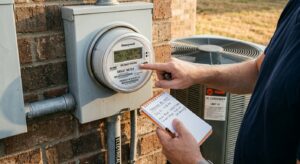
- Turn the thermostat to OFF and then cut power to the condenser at the outdoor disconnect box, usually a small box mounted on the wall within a few feet of the unit. Pull the fuse block or flip the breaker. Never work on the unit with power on.
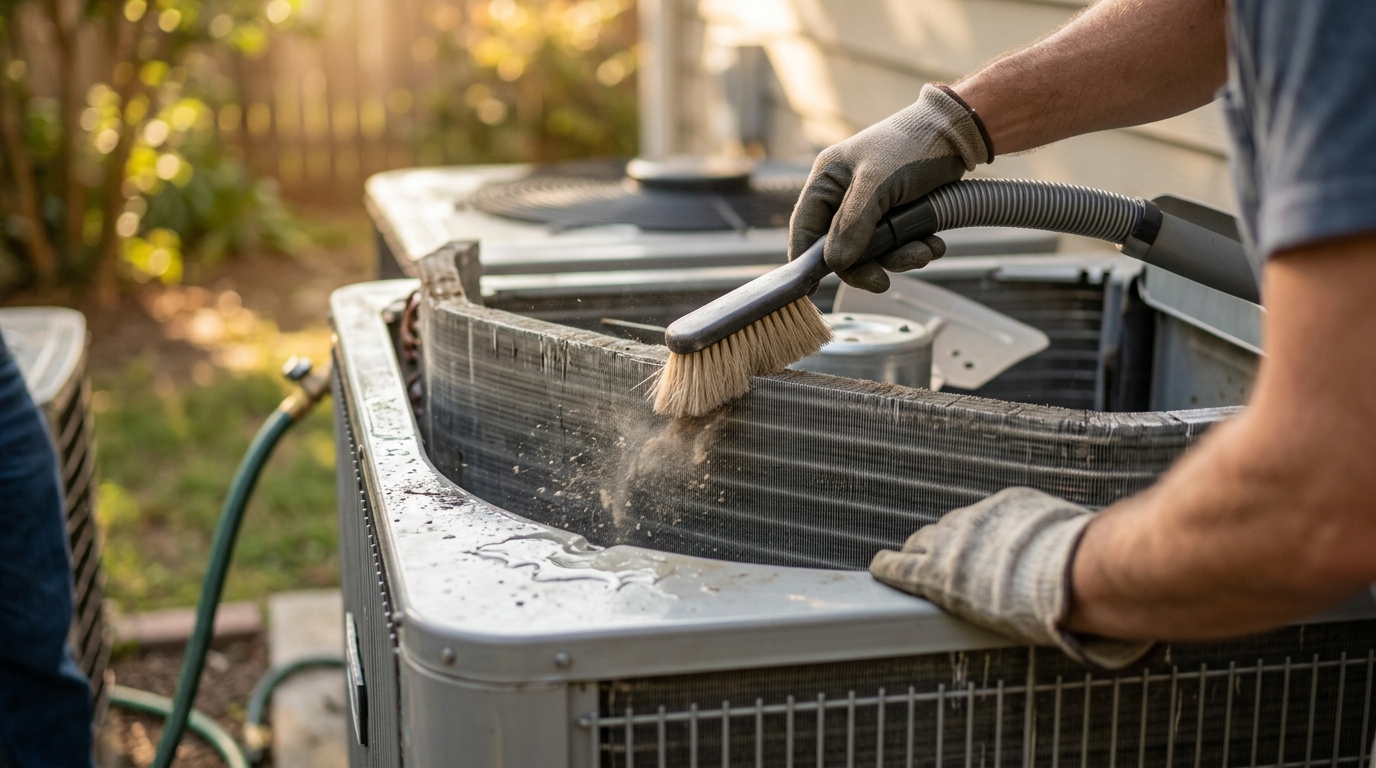
- Use your hands or a soft brush to remove large debris such as leaves, grass clippings, and cottonwood seeds from the top grille and the sides of the unit.
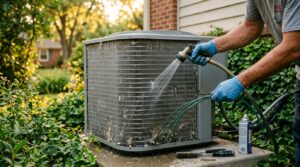
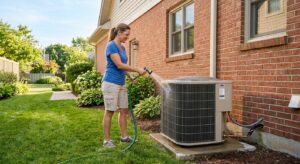
- Set your garden hose to a gentle to medium spray (not a pressure washer). Starting from the inside of the unit if the top panel is accessible, spray outward through the fins to flush debris out the exterior. If you cannot remove the top, spray from the outside aiming slightly upward into the fins.
- Work around all four sides of the unit, rinsing until the water running off is clear and free of dirt.
- Allow the unit to air dry for 5 to 10 minutes, then restore power at the disconnect and set the thermostat back to cool. Listen for normal startup sounds.
- Turn the thermostat to OFF and cut power at the outdoor disconnect box. Confirm power is off before proceeding.
- Remove the top grille panel by unscrewing the fasteners around the perimeter (usually 4 to 8 screws). Carefully lift the grille and fan assembly and set it aside without straining the wiring. Alternatively, lean it against the unit if the wires are short.
- Use a fin comb or soft-bristle brush to gently straighten any bent aluminum fins and brush loose surface debris downward and out of the coil. Work carefully, as fins bend easily.
- Apply a no-rinse or self-rinsing foaming coil cleaner (available at hardware stores for $12 to $25) evenly across all four sides of the coil, following the label directions. Most products foam up, lift dirt, and drain away on their own within 10 to 15 minutes.
- For heavily soiled coils, use a rinse-required coil cleaner and flush thoroughly with a gentle hose spray from the inside out after the dwell time specified on the label, typically 5 to 10 minutes.
- Reinstall the top grille and fan assembly, restore power at the disconnect, and let the system run for a full cycle. Check that the air blowing from the top of the unit feels noticeably warm, which confirms the unit is rejecting heat properly.
- Schedule a spring tune-up with a licensed HVAC technician before peak cooling season, ideally in April or May when appointment availability is better and rates may be lower.
- The technician will clean the coils with commercial-grade coil cleaner, check refrigerant charge with gauges, and measure supply and return air temperature differential (target is 16 to 22 degrees F across the evaporator).
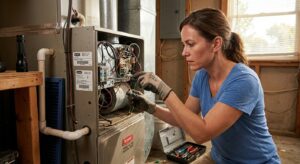
- They will inspect and tighten electrical connections, check capacitor health, measure motor amperage, and lubricate moving parts where applicable.
- Ask for a written report of readings so you have a baseline for future visits and can spot degradation trends over time.
- If the tech finds low refrigerant, request a leak check before simply adding refrigerant, since adding refrigerant to a leaking system only delays a larger repair.
Why It Works: The Benefits
Restoring clean coils can reduce cooling energy consumption by 10 to 30%, which translates to $30 to $100 or more in savings over a single cooling season for a typical 3-ton residential system running in a hot climate.
Running a system with dirty coils raises compressor head pressure and operating temperatures, accelerating wear. Annual cleaning can add several years to the life of a compressor that costs $1,500 to $2,800 to replace.
A clean condenser can reject heat efficiently, allowing the system to reach your set temperature faster and maintain it more consistently, reducing the hot afternoon lag many homeowners experience.
Overheated compressors are a leading cause of summer service calls. Cleaning coils before peak season lowers operating temperatures and reduces the chance of a breakdown on the hottest day of the year when HVAC techs are busiest.
Cleaning the unit gives you a chance to inspect for bent fins, refrigerant line insulation damage, and electrical issues before they become expensive problems, catching faults early when repairs are simpler and cheaper.
💰 Savings Impact by Action
Removing debris from severely fouled condenser coils can restore up to 30% of lost cooling efficiency by bringing condensing temperature back to design spec.
Maintaining 18 to 24 inches of clear space around the condenser unit ensures design airflow volume, preventing a 5 to 10% efficiency penalty from restricted outdoor airflow.
Replacing a clogged indoor air filter restores indoor airflow and can reduce overall system energy use by up to 15% while protecting the evaporator coil from dirt buildup.
Homes with consistent annual HVAC maintenance average 10 to 25% lower cooling costs compared to systems that go several years without service, according to ENERGY STAR program data.
🏠 Key Concepts Explained
The Science Behind It
Your air conditioner works by compressing a refrigerant, which raises its temperature, then routing that hot refrigerant through the condenser coil outside. The coil fins and a large fan transfer that heat into the outdoor air, cooling the refrigerant back into a liquid so it can absorb more heat from inside your home. This heat rejection step is where dirty coils create real problems. When a layer of dirt, pollen, or debris coats the fins, it creates a thermal barrier between the refrigerant and the outdoor air. The refrigerant stays hotter than it should, and the compressor must work harder and longer to push it through the cycle.
The efficiency penalty is rooted in what refrigeration engineers call condensing temperature. Every air conditioner is designed to operate with the refrigerant condensing at a specific temperature, typically around 100 to 120 degrees F depending on the outdoor ambient temperature. When coils are fouled, condensing temperature climbs well above that range. Refrigeration performance data shows that a 10-degree F rise in condensing temperature increases compressor energy consumption by roughly 3 to 5%. Add in reduced airflow from packed fins and you can easily reach the 10 to 30% efficiency loss range the DOE cites for dirty coils.
Foaming coil cleaners work by using surfactants and mild alkaline or acidic chemistry to break the bond between organic debris and the aluminum fins. The foam suspends dirt particles so that gravity or a light rinse can carry them away without requiring mechanical scrubbing that would bend fins. This is why commercial coil cleaners outperform plain water on caked-on buildup. Restored fin geometry and clean surfaces allow maximum air-to-refrigerant contact, bringing condensing temperature back to design spec and restoring the full rated efficiency of the system.
Frequently Asked Questions
▼ I cleaned the coils but my AC is still running constantly and not keeping up. What now?
Dirty coils are only one of several causes of poor cooling performance. After cleaning, check that your indoor air filter is not clogged, that all supply and return vents are open and unobstructed, and that no refrigerant lines are iced over. If the system still struggles, the most likely causes are low refrigerant charge, a failing capacitor, or undersized equipment for the heat load. Call a licensed HVAC technician to check refrigerant levels and run electrical diagnostics.
▼ How do I know if my condenser coils are actually dirty enough to clean?
Shine a flashlight through the fins from inside the unit looking outward. If you can see light clearly through the fins, they are reasonably clean. If the view is blocked by a gray or brown matting of debris, cleaning is overdue. Cottonwood and pet hair are especially visible and easy to spot packed into the lower fins.
▼ Can I use a pressure washer instead of a garden hose to save time?
No. Pressure washers bend the thin aluminum fins, and bent fins permanently reduce airflow through the coil. They can also damage the coil tubing itself and force water into wiring and motor bearings. A standard garden hose with a spray nozzle set to a firm but gentle stream is the correct tool.
▼ My condenser unit is older than 15 years. Is it worth cleaning or should I just replace it?
Cleaning is almost always worth doing even on older equipment because it costs nothing to a few dollars and can still improve efficiency measurably. However, if your system is 15 to 20 years old and your technician finds low refrigerant, a failing compressor, or the refrigerant type is the older R-22 (now discontinued), start getting replacement quotes alongside the repair estimate. Use the ENERGY STAR savings calculator at energystar.gov to compare the cost of a new high-efficiency unit against ongoing repair and operating costs.
▼ What if I notice the copper refrigerant lines are coated in ice after I turn the system back on?
Ice on the refrigerant lines (either the large insulated suction line or the smaller liquid line) usually indicates either severely restricted airflow or low refrigerant charge. Turn the system off and let it thaw completely (1 to 2 hours), then check and replace the indoor air filter and make sure all vents are open. If it ices up again after those fixes, you likely have a refrigerant leak and need a licensed technician to locate and repair it before adding refrigerant.
Quick Tips
- Clean condenser coils every spring before turning on the AC for the first time, and again mid-summer if you live near cottonwood trees or in a dusty area.
- Keep a 2-foot vegetation-free zone around the condenser unit year-round. Overgrown shrubs restrict airflow just as much as dirty coils.
- Never run the AC when outdoor temperatures are below about 60 degrees F, as this can cause the refrigerant to behave abnormally and damage the compressor.
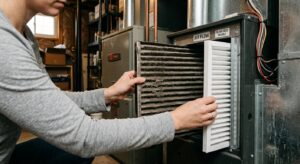
- Replace your indoor air filter at the same time you clean the condenser coils. A clogged filter restricts indoor airflow, reducing how much heat the system can move and undermining all the work you did outside.
Variations for Your Situation
- Apartment or Condo: Renters with central HVAC typically cannot access or clean the shared condenser unit. Focus on what you can control: replace your indoor air filter every 1 to 3 months with a MERV 8 to 11 filter ($8 to $20), make sure no furniture is blocking return air vents, and notify your landlord or HOA in writing if the system seems to be underperforming. If you have a window or through-wall AC unit, you can clean its exterior coils using the garden hose method, typically cutting your unit’s energy use by 5 to 15%.
- Tight Budget (under $20): Skip the commercial coil cleaner and use the free garden hose rinse method described in the Quick Fix approach. This alone removes the bulk of debris and restores meaningful efficiency at no cost. Pair it with a fresh air filter ($8 to $12) and clear vegetation from around the unit. Together these zero-to-minimal-cost steps typically recover 10 to 20% of lost efficiency without spending money on cleaners.
- Older Home with Window AC Units: Window air conditioners have both an evaporator coil on the indoor side and a condenser coil on the outdoor side. Remove the unit from the window or work carefully in place, vacuum the indoor coil with a soft brush attachment, then rinse the outdoor coil gently with a hose. Coil cleaner spray ($12 to $20) helps with heavy buildup. Cleaning a neglected window unit can reduce its electricity draw by 10 to 20%, which adds up quickly since window units often run on older, less efficient compressors.