If you crank the heat to 70°F and your living room feels warm while your bedroom hovers at 62°F, you are not alone. Uneven heating is one of the most common comfort complaints among homeowners, and it affects everything from sleep quality to monthly utility bills. The frustrating part is that most people assume the problem lives inside their furnace or heat pump, when the real culprits are almost always somewhere else entirely: leaky ducts, blocked vents, poor insulation, or air pressure imbalances that push conditioned air in the wrong direction.
The good news is that fixing uneven heating rarely requires a full system replacement. A $15,000 HVAC overhaul is often overkill when strategic improvements costing a few hundred dollars can solve 80% of the problem. Understanding why certain rooms stay cold, and addressing each cause systematically, is how professional energy auditors approach it, and you can do the same thing at home with basic tools and a methodical eye.
This post walks you through the real science behind uneven heating, a quick-fix checklist you can run through in an afternoon, and a more thorough DIY upgrade path for persistent cold spots. You will also find troubleshooting answers for common scenarios, real savings numbers, and guidance on when a professional is genuinely worth calling.
What You’ll Need
Click on an item below to shop for the recommended items for this recipe on Amazon.
As an Amazon Associate, we earn from qualifying purchases.
How to Do It
- Walk every room with the heat running and hold your hand 6 inches from each supply vent to feel airflow strength. Note which rooms have weak flow compared to others and write them down.
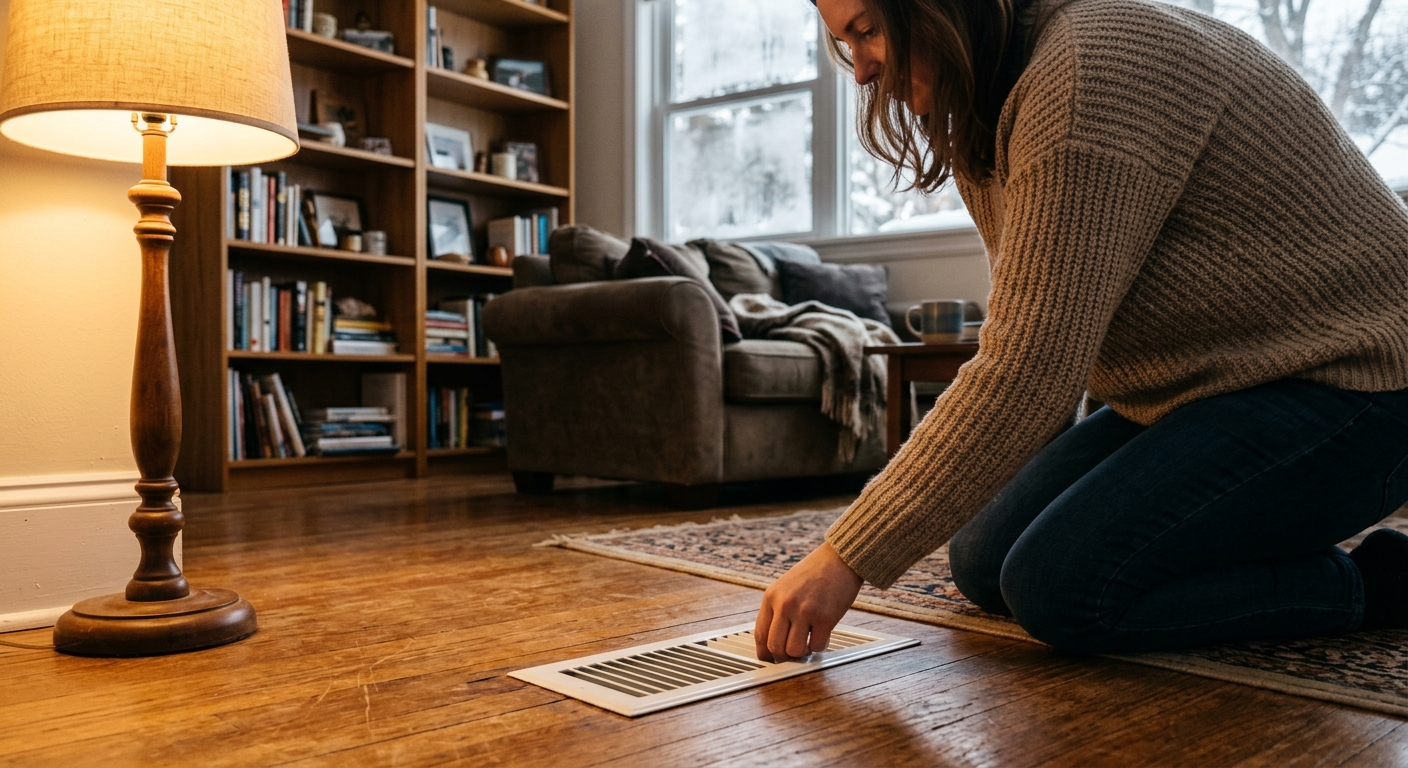
- Check that all supply and return vents are fully open and unobstructed. Move furniture, rugs, drapes, or storage boxes blocking any vent by at least 18 inches on all sides.
- Adjust the damper tabs or damper levers inside accessible supply duct boots. Partially close dampers on rooms that are too warm to redirect pressure toward colder rooms. Recheck room temperatures after 30 to 60 minutes.
- Close interior doors briefly to test pressure: hold a thin strip of tissue near the door gap and note if air blows strongly through the crack when the system runs. Strong outward flow signals a return air imbalance in that room. Adding a 1-inch door undercut (or simply leaving doors open) equalizes pressure.
- Verify your thermostat is not located near a heat source, sunny window, or drafty exterior wall. If it is, relocate it to an interior wall in a central living area or switch to a smart thermostat with remote room sensors.
- Access your attic and crawlspace and visually inspect all duct connections, seams, and joints. Look for gaps, disconnected flex duct sections, or silver tape that has dried out and pulled away. Pay special attention to the first 3 feet of duct off the air handler and at any elbow or junction.
- Apply mastic duct sealant (a paintable gray paste) to all accessible duct seams and connections using a brush or your gloved hands. Mastic is far more durable than any tape. For gaps wider than 1/4 inch, embed fiberglass mesh tape into the wet mastic before it dries.
- Check attic insulation depth above the coldest rooms. The DOE recommends R-49 to R-60 in most northern climates. If you see joists fully exposed or insulation compressed below 10 inches of depth, add blown-in or batt insulation to bring it to the recommended level.
- Inspect the floor above any garage or crawlspace in cold rooms. Insulation should fill the entire joist bay between the subfloor and the bottom of the joist with no gaps or sagging. Add insulation supports (wire rods or nylon straps) to hold batts in place if needed.
- Seal attic bypasses: holes around plumbing pipes, electrical wires, and ceiling light fixtures in the attic floor. These are major stack-effect entry points. Use fire-rated caulk for small gaps and rigid foam board plus caulk for larger openings.
- After sealing and insulating, run the system for a full heating cycle and recheck temperatures in previously cold rooms using a simple indoor thermometer. Most homeowners see a 4 to 8°F improvement within the first full heating day.
- Hire a certified HVAC technician or home energy auditor to perform a duct blaster test, which pressurizes the duct system to precisely measure total leakage percentage. Homes with leakage above 15% of system airflow almost always have uneven heating problems.
- Ask for a room-by-room Manual J load calculation to verify that each room’s duct sizing matches its actual heat loss. Rooms with undersized duct runs will never heat evenly regardless of how well sealed the rest of the system is.
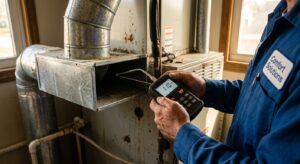
- Request duct rebalancing: the technician adjusts all dampers systematically using an airflow hood or anemometer to deliver the correct cubic feet per minute to each room based on its calculated load, rather than guessing by feel.
- Discuss adding zone dampers if the home has distinct areas with very different heating needs (e.g., a finished basement and a two-story great room). A two-zone damper system typically costs $1,500 to $3,500 installed and can cut heating bills by 15 to 20% beyond standard sealing improvements.
- Review any recommendations for a ductless mini-split in a chronic problem room. A single-zone mini-split installed in a room over a garage or with poorly accessible ductwork costs $1,500 to $3,500 installed and provides precise, independent temperature control with payback in 3 to 5 years in cold climates.
Why It Works: The Benefits
Addressing duct balance and air sealing typically narrows room-to-room temperature variation from 8 to 12°F down to 2 to 4°F, which is the threshold most occupants perceive as comfortable and even.
Sealing duct leaks alone can reduce heating energy use by 20 to 30% according to the U.S. Department of Energy, since you stop paying to heat your attic, crawlspace, and wall cavities instead of your living areas.
When conditioned air actually reaches all rooms efficiently, the system reaches setpoint faster and cycles less frequently, extending equipment life and reducing maintenance costs over time.
Pressure imbalances that cause uneven heating also pull unconditioned air from attics, crawlspaces, and garages into the living space, bringing dust, mold spores, and carbon monoxide risk. Fixing the root cause improves what you breathe.
Addressing insulation gaps in floors above crawlspaces or garages raises floor surface temperatures by 6 to 10°F, which has an outsized effect on perceived comfort since radiant temperature affects how warm people feel regardless of air temperature.
💰 Savings Impact by Action
Sealing leaky duct connections with mastic stops 20 to 30% of heated air from escaping into unconditioned spaces before it reaches living areas.
Sealing attic bypasses reduces stack-effect infiltration, cutting heating energy use by up to 15% while eliminating cold drafts at floor level.
Redirecting airflow to underserved rooms through damper adjustment reduces runtime by ensuring all zones reach setpoint in the same cycle.
Bringing attic insulation to DOE-recommended R-49 levels reduces heating load by 15 to 20% in homes currently below R-19.
Room sensor-equipped smart thermostats that average multiple room temperatures save approximately 10 to 12% annually by preventing the system from satisfying one warm location while cold rooms remain below setpoint.
🏠 Key Concepts Explained
The Science Behind It
Forced-air heating systems are designed around balanced airflow: the volume of air pushed out through supply registers must equal the volume pulled back through return registers, and the pressure in every room should roughly equalize when the system runs. When this balance breaks down, the laws of fluid dynamics take over. Air follows the path of least resistance, so rooms with restricted ducts, blocked vents, or missing return paths simply receive less conditioned air than rooms where airflow is unimpeded. The heating system may technically be producing the right amount of heat, but the distribution system is failing to deliver it where it is needed.
Heat loss compounds the problem. Every exterior wall, window, and floor assembly loses heat at a rate determined by its R-value and the temperature difference between inside and outside. A bedroom with an exterior wall on two sides, a floor above an unheated garage, and a single undersized duct run is fighting a battle on multiple fronts simultaneously. The duct delivers less heat than the room needs, and the room loses heat faster than a better-insulated one. This is why identical rooms on opposite sides of a house can differ by 10°F or more on a cold day.
The stack effect adds another layer of complexity in winter. As warm air rises toward the top of the house and leaks out through attic bypasses and upper-level gaps, it creates a low-pressure zone on the lower floors that actively pulls cold outside air inward through every crack in the foundation, rim joist, and lower-floor framing. This infiltration is invisible but measurable: a typical pre-1990 home has the equivalent of a 1 to 2 square foot hole in its shell when all the small gaps are added up. Sealing attic bypasses and rim joists simultaneously reduces heat loss and cuts the driving force behind cold floors, making lower-level rooms dramatically more comfortable without changing the heating system at all.
Frequently Asked Questions
▼ Why is one room always cold no matter what I try?
A chronically cold room almost always has one of three root causes: an undersized or disconnected duct, a missing or undersized return air path, or a severe insulation deficiency in the floor, ceiling, or walls. Check the duct feeding that room by removing the register and looking inside with a flashlight. If the duct is connected but the room is still cold, hire an HVAC technician to measure actual airflow with an instrument. You may need a new duct branch or a supplemental heating source like a mini-split or electric baseboard.
▼ My upstairs is always too hot and my downstairs is always too cold. What is going on?
This is a classic two-story stack effect and thermal stratification problem. Warm air rises and accumulates upstairs while the heating system, which usually has its thermostat on the main floor, satisfies and shuts off before enough heat reaches downstairs. Start by partially closing supply dampers on all upstairs rooms by about 25 to 30% to redirect airflow downward, and add or reposition a return air duct on the lower level if one is missing. A zoning system with separate upper and lower thermostats is the most complete fix and typically pays back in 3 to 4 years through energy savings.
▼ I sealed my ducts but certain rooms are still cold. Did I waste my money?
Not at all. Duct sealing improves overall system efficiency but does not fix fundamental duct sizing or distribution imbalances on its own. The next step is to check whether the duct serving the cold room is the right size for its heat load: a single 4-inch round duct cannot adequately heat a 200-square-foot bedroom in a cold climate. An HVAC technician can run a quick Manual J room calculation and confirm whether you need an additional duct branch or a larger register opening.
▼ Can I fix uneven heating in a rental apartment without touching the HVAC?
Yes, with some limitations. Start by placing door draft stoppers, window insulating film (around $10 to $20 per window), and thermal curtains on cold exterior windows in problem rooms. A small electric oil-filled radiator ($40 to $80) set on a timer is the most efficient supplemental heat source and requires no landlord permission. Notify your landlord in writing about any duct or vent that appears blocked or disconnected, as they are responsible for maintaining the system’s basic function.
▼ How do I know if my furnace is undersized versus my ducts being the real problem?
Check how long the furnace runs on the coldest days of the year. If it runs more than 80 to 90% of the time (nearly continuously) but still cannot reach setpoint throughout the house, the furnace may be undersized or losing too much output to duct leakage. If it cycles on and off normally and the thermostat location reads setpoint but other rooms are cold, the issue is almost certainly distribution, not furnace capacity. An HVAC technician can measure supply air temperature and static pressure to separate these two causes definitively.
Quick Tips
- Set your thermostat fan to ON rather than AUTO during very cold stretches to continuously circulate air and reduce stratification between floors, at a cost of roughly $5 to $15 per month in fan electricity.
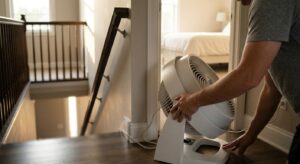
- Use a box fan on the floor aimed upward in a two-story home to push warm air that has pooled near the ceiling back down to the living level, reducing floor-to-ceiling temperature differences by 3 to 6°F.
- Insulate hot water pipes and any supply ducts that run through unheated crawlspaces or garages to reduce heat loss before conditioned air or water even reaches the living space.
- Replace standard white plastic vent registers with adjustable metal ones in problem rooms, as metal registers allow finer airflow adjustment and do not warp or partially close over time the way plastic ones do.
Variations for Your Situation
- Apartment or Rental: Renters cannot modify ductwork or insulation, so focus on reducing heat loss at windows and doors instead. Install interior window insulation film on the coldest windows for $10 to $20 each, add door draft stoppers, and use a programmable plug-in outlet timer with an oil-filled electric radiator ($40 to $80) in chronically cold rooms. Report blocked or visibly disconnected vents to your landlord in writing, as HVAC maintenance is typically their legal obligation.
- Tight Budget Under $100: Focus exclusively on the zero and low-cost steps that deliver the highest return. Clear all blocked vents and adjust duct dampers at no cost. Seal the three to five most visible attic bypasses (pipe penetrations and top plates) with a $6 can of fire-rated caulk. Add door sweeps to cold rooms for $8 to $12 each. These steps alone commonly deliver 5 to 10°F improvements in the coldest rooms without buying any major materials.
- Older Home Pre-1980: Homes built before modern energy codes typically have fiberglass batt insulation that has settled or been disturbed, no vapor barriers in crawlspaces, and original single-pane or early double-pane windows with high air leakage. Start with a professional energy audit ($150 to $400, often subsidized by utilities) to identify the biggest heat loss areas using a blower door test. Prioritize attic air sealing and insulation first, then crawlspace encapsulation, as these two measures typically provide the fastest payback in older construction.