A sunroom should be one of the best rooms in your home. Instead, for millions of homeowners, it sits empty nine months a year because it becomes an icebox in January and an oven in July. The culprit is almost always the same: thin walls, a poorly insulated roof or ceiling, and large expanses of glass that bleed heat in winter and absorb it in summer. These rooms were often designed as three-season spaces, and the original builders cut corners on the thermal envelope.
The good news is that a targeted insulation upgrade can turn a sunroom from a liability into a genuine living space. Depending on your starting point, you can reduce the heating and cooling load of the room by 40 to 60%, making it comfortable to use on a cold winter morning or a hot August afternoon. The investment typically pays back in 2 to 5 years through lower energy bills and the avoided cost of space heaters or window AC units running full blast.
This guide walks you through exactly how sunroom heat loss works, which insulation upgrades deliver the most bang for your buck, and how to approach the project whether you want a simple weekend DIY fix or a more thorough professional retrofit. We cover walls, ceilings, floors, and the often-overlooked transition between the sunroom and your main house.
What You’ll Need
Click on an item below to shop for the recommended items for this recipe on Amazon.
As an Amazon Associate, we earn from qualifying purchases.
How to Do It
- Walk the perimeter of the sunroom on a cold or windy day with a lit incense stick or damp hand and locate drafts at the base of the walls, around glazing frames, where the sunroom roof meets the house wall, and at the door threshold. Mark each gap with painter’s tape.
- Seal all identified gaps with paintable latex caulk for gaps under 1/4 inch and low-expansion spray foam for gaps 1/4 to 1 inch wide. Pay special attention to the flashing line where the sunroom roof ties into the main house wall, as this joint is almost always leaking.
- Apply self-adhesive foam weather stripping to all operable doors and windows in the sunroom. Replace the door sweep on any exterior sunroom doors if you can see daylight under them.
- Install interior window insulation film on single-pane glass panels. Brands like 3M or Frost King make shrink-film kits that add a trapped air layer, raising effective R-value from roughly R-1 to R-2.5. Apply with a hair dryer for a clear, wrinkle-free finish.
- Add a thermal cellular shade or heavy insulating curtain on the wall separating the sunroom from the main house. Closing this barrier at night prevents the sunroom from acting as a cold air reservoir that chills your main living space.
- Place a rug with a thick pad over any exposed concrete or tile slab floor. A 1-inch pad with an area rug adds roughly R-2 to the floor surface and eliminates the cold-feet problem that makes sunrooms feel uncomfortable in winter.
- Measure and assess your sunroom structure. Identify which surfaces are solid framed walls versus glass panels, and check whether the ceiling is a flat drywall surface, exposed rafters, or polycarbonate or glass roofing. Solid surfaces are where insulation will have the most impact.
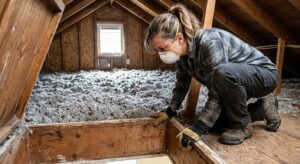
- For a flat or drywall ceiling, remove the existing surface and install R-19 to R-30 unfaced batts between the joists, then re-drywall. If the ceiling cavity is shallow (under 3.5 inches), use high-density R-15 batts. Alternatively, attach 2-inch rigid polyisocyanurate foam board (R-13) directly to the underside of the existing ceiling with construction adhesive, then cover with new drywall.
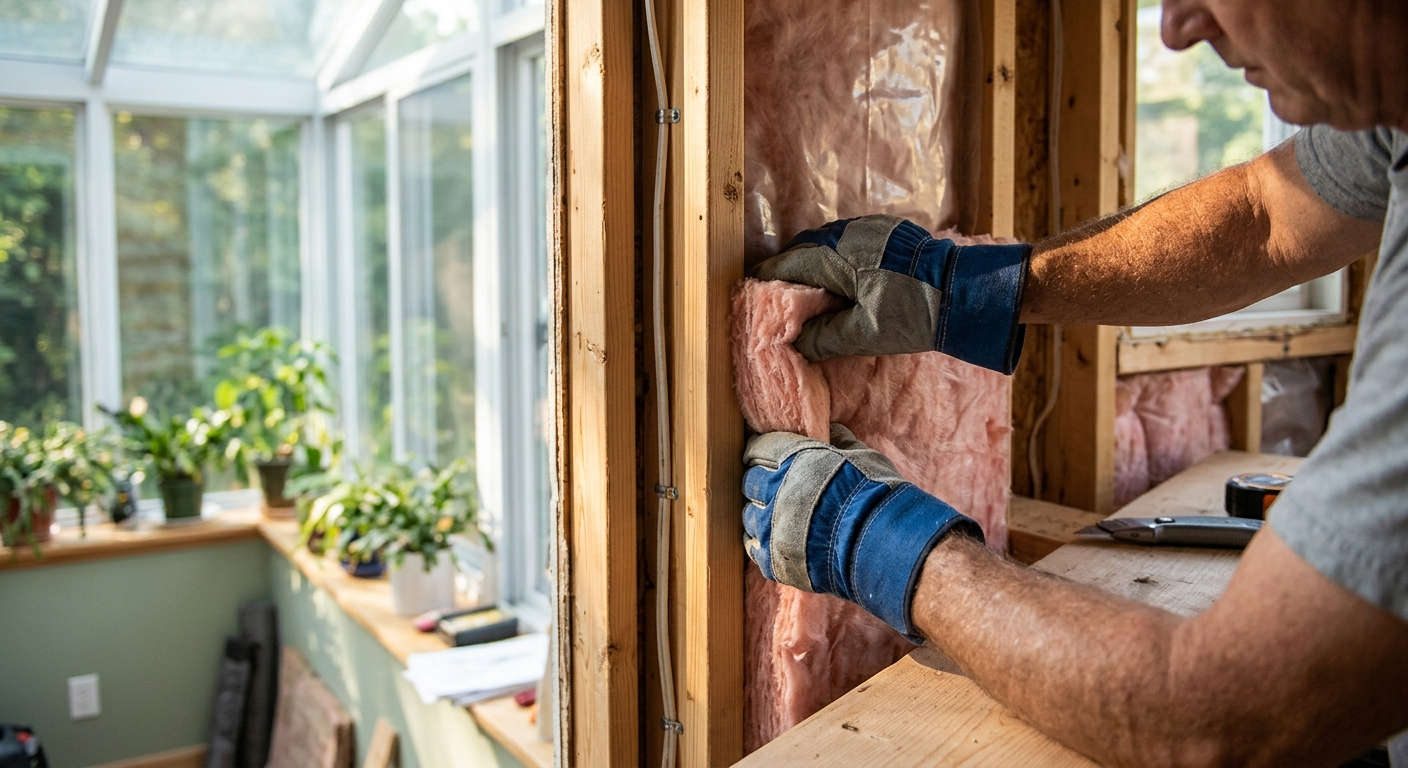
- For knee walls or solid lower wall sections below the glazing, remove the interior drywall or paneling, install R-13 to R-15 batts in the stud cavities, staple a kraft-faced vapor retarder on the warm-in-winter side, and re-drywall. Use 5/8-inch moisture-resistant drywall for sunrooms in humid climates.
- Insulate the sill plate and rim joist area at the base of all walls using cut-and-cobble rigid foam. Cut 2-inch polyisocyanurate to fit snugly in the rim joist bay, seal all edges with canned spray foam, and then cover with a 1-inch foam layer for a combined R-20 at the rim.
- If the sunroom has a vented crawl space or unconditioned space below, insulate the floor with R-19 to R-30 batts installed between floor joists, held in place with wire hangers. Alternatively, lay 2-inch rigid XPS foam over a concrete slab, cover with a layer of plywood, and re-install flooring for an above-slab floor R-value of R-10.
- After all insulation is installed, air seal every penetration, electrical box, and joint with canned spray foam or acoustical caulk before closing up walls. This combined air-sealing and insulation approach typically delivers 30 to 50% better performance than insulation alone.
- Hire a sunroom specialist or window contractor to assess your existing glazing system and quote the cost of replacing glass panels with low-E double-pane units. A solar heat gain coefficient (SHGC) of 0.25 to 0.35 and a U-factor of 0.30 or below is the target for year-round performance in most climates.
- Have the contractor replace all single-pane glass or polycarbonate roofing panels with insulated glazing units. For a glass roof, insulated glass units with a tilt of more than 20 degrees require a contractor experienced with structural glazing, as standard replacement window glass is not rated for overhead installation.
- After glazing replacement, have a spray foam contractor apply closed-cell spray foam to all solid wall cavities and the roof deck from the inside. Closed-cell foam at R-6.5 per inch provides both air sealing and insulation in one step, and its rigidity adds structural value to lightweight sunroom framing.
- Replace any existing electric baseboard heaters or portable space heaters with a dedicated mini-split heat pump sized for the room. A 9,000 BTU single-zone mini-split handles sunrooms up to about 400 square feet and operates at 250 to 300% efficiency, dramatically cutting operating costs compared to resistance heating.
- Have your contractor install a mechanical ventilation path, such as a small dedicated ERV (energy recovery ventilator) or an operable high-low vent pair, to manage humidity and air quality in the now tightly sealed room. Skipping this step in a high-performance sunroom leads to condensation and mold problems within one to two heating seasons.
Why It Works: The Benefits
Properly insulating a sunroom can cut its heating and cooling energy use by 40 to 60%. If you are currently running a dedicated space heater or window AC unit, eliminating or downsizing that equipment saves $200 to $600 per year depending on climate and unit size.
The biggest payoff is practical comfort. An insulated sunroom with proper glazing can maintain 65 to 70 degrees Fahrenheit on days as cold as 20 degrees with minimal supplemental heat, turning a three-season space into a four-season room you actually use.
If your sunroom connects directly to your home’s ductwork, poor insulation forces your whole-house system to work harder. Sealing and insulating the sunroom can reduce the connected HVAC system’s runtime by 10 to 20% in peak seasons.
A fully conditioned four-season room adds meaningful square footage to your usable living space. Real estate professionals consistently note that converted sunrooms return 50 to 70% of their renovation cost at resale, with the best returns in climates with cold winters.
Air sealing alone, even before adding bulk insulation, eliminates the cold drafts that make sunrooms feel uninhabitable in winter. Sealing perimeter gaps and glazing joints stops the stack-effect infiltration that can cause a 15 to 20 degree temperature difference between floor and ceiling height.
💰 Savings Impact by Action
Sealing perimeter gaps, glazing joints, and the house-sunroom junction can reduce total heat loss by up to 25% with no material insulation added.
Replacing single-pane glass with low-E double-pane units cuts conductive heat loss through the glass by 40%, which is the single largest improvement available.
Insulating an uninsulated sunroom roof or ceiling to R-25 reduces ceiling heat loss by up to 30% of the room’s total thermal load.
Interior insulating window film raises single-pane glass from R-1 to roughly R-2.5, reducing glazing heat loss by up to 15% at a fraction of replacement cost.
Replacing a resistance space heater with a high-efficiency mini-split reduces heating energy consumption by 50 to 60% for the same amount of delivered heat.
🏠 Key Concepts Explained
The Science Behind It
A sunroom loses heat through four distinct pathways: conduction through solid surfaces, conduction through glazing, air infiltration through gaps, and radiation from warm interior surfaces toward cold glass. On a cold winter night, a single-pane glass panel at 25 degrees Fahrenheit acts almost like an open hole in the wall from a heat-loss standpoint, with an R-value of roughly 1. Compare that to an R-19 insulated wall, and you can see why the glass dominates the energy equation. Upgrading to double-pane low-E glass raises the effective R-value to about R-3.5 to R-4, cutting conductive heat loss through the glazing by 65 to 70%.
The ceiling and roof are typically the second largest loss pathway, and they are often the most neglected. Because heat rises, the temperature difference between the warm air near the ceiling and a cold glass or thin polycarbonate roof panel is at its maximum at the very spot where conduction is occurring most aggressively. Installing R-20 to R-30 insulation above or below the roof deck can reduce ceiling heat loss by 80 to 90% compared to an uninsulated surface, making it the highest-leverage solid-surface upgrade available. In rooms with sloped glass roofs, interior insulated panels or Roman shades on tracks designed for sloped glazing can provide meaningful improvement without replacing the glass.
Air infiltration deserves special attention because it interacts with the stack effect in tall sunrooms. When warm air rises and escapes through gaps at the top of the room, cold outside air is pulled in through gaps at the bottom to replace it. This creates a continuous convective loop that removes heat from the room even when the sun is not shining and wind speeds are low. Research from the Lawrence Berkeley National Laboratory consistently shows that air sealing in leaky enclosures delivers returns equal to or exceeding those of adding insulation, because it stops the mechanism that carries heat away rather than just slowing its transfer through solid materials.
Frequently Asked Questions
▼ I insulated my sunroom walls but it still feels cold. What am I missing?
In most cases, the glazing is still the dominant heat loss pathway and insulating the walls alone cannot overcome it. Check whether the glass is single-pane by holding a lighter near the surface and counting the reflections: two reflections mean double-pane, one means single. If it is single-pane, adding insulating window film or cellular shades will have more impact than any additional wall insulation you add. Also check the ceiling, as an uninsulated roof can account for 30 to 50% of total room heat loss on its own.
▼ My sunroom ceiling is all glass or polycarbonate. What can I insulate?
You cannot easily add bulk insulation to a glass roof, but you can significantly reduce heat loss with interior insulating Roman shades or insulated panel systems designed for sloped glazing. These products, available from companies like Skylight Shades or Hunter Douglas, can reduce heat loss through a glazed ceiling by 35 to 50% when closed. For a more permanent solution, a contractor can install a dropped insulated ceiling below the glass, sacrificing some light but creating an R-20 or better thermal barrier.
▼ Will insulating my sunroom cause moisture or condensation problems?
It can, if you tighten the room without managing humidity. As you reduce air infiltration, moisture from occupants and the adjacent house has fewer pathways to escape. Monitor relative humidity with a hygrometer and aim to keep it below 50% in winter. If humidity climbs, add a small dehumidifier or install a trickle vent or ERV to introduce controlled fresh air. Condensation on glass surfaces in winter is normal when indoor humidity is high; it signals that you need more ventilation or dehumidification, not less insulation.
▼ Can I connect my sunroom to my existing HVAC system instead of adding a separate heater?
You can, but it often creates more problems than it solves unless your existing system was sized to handle the added load. Most HVAC systems are sized for the original home footprint, and adding an uninsulated or poorly insulated sunroom to the duct system forces the system to run longer cycles to compensate. If you want to use central HVAC, first complete all insulation and air sealing upgrades, then have an HVAC contractor perform a Manual J load calculation to confirm your existing system has spare capacity. A dedicated mini-split is almost always the more efficient and more controllable solution.
▼ How do I insulate a sunroom floor that is a concrete slab?
The most practical approach is to lay 1 to 2 inches of rigid XPS or polyisocyanurate foam directly on the slab, stagger and tape the seams, then cover with a layer of 3/4-inch plywood fastened with concrete screws and finished with your choice of flooring. This adds R-5 to R-10 below your feet, eliminates the cold-slab feeling, and does not require any structural modification. The tradeoff is that you raise the floor height by 1.75 to 2.75 inches, so you may need to adjust the door threshold and transitions to adjacent rooms.
Quick Tips
- Insulate the ceiling before the walls. Heat rises, and a poorly insulated roof loses more energy per square foot than any other surface in the room.
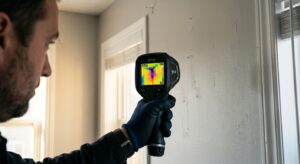
- Use a thermal camera or hire an energy auditor for $100 to $300 to pinpoint where your sunroom is losing the most heat before spending money on materials. The results are often surprising.
- Cellular honeycomb shades on sunroom windows reduce nighttime heat loss through glazing by 40 to 60% and cost far less than replacement glass. Choose top-down bottom-up models so you can block heat loss at the top while keeping a view.
- If you add a mini-split to heat and cool the sunroom, choose a model rated for operation down to -5 or -13 degrees Fahrenheit (hyper-heat models from Mitsubishi, Fujitsu, or Daikin). Standard mini-splits lose efficiency rapidly below 20 degrees, which is exactly when you need the heat most.
- Paint the interior walls of your sunroom a medium or dark color if you want to maximize thermal mass benefit. Darker surfaces absorb more radiant solar energy during the day, which gets stored and slowly released at night.
Variations for Your Situation
- Apartment or Rental Sunroom: You likely cannot modify walls or replace glazing, but you can make a significant difference with reversible upgrades. Install interior window insulation film on all glass surfaces (it peels off cleanly), add cellular shades on tension rods, lay an area rug with a thick pad over the floor, and use draft stoppers at the door threshold. Collectively these steps cost $100 to $250 and can reduce heat loss enough to make the room usable in mild winter weather. Clear it with your landlord first and save all packaging so you can restore everything when you move out.
- Tight Budget (under $300): Focus your dollars in order of impact. Spend $30 to $50 on caulk and spray foam to seal every visible gap at the perimeter, glazing frames, and roofline junction. Spend $80 to $120 on interior window film kits for the largest glass panels. Spend the remainder on a single cellular shade for the doorway between the sunroom and your main house to stop the room from draining heat from your home at night. This sequence addresses air infiltration and the worst glazing losses first and will deliver 20 to 35% improvement in comfort before you spend anything on bulk insulation.
- Older Sunroom Pre-1990: Older sunrooms often have aluminum single-track framing, single-pane glass, and minimal or no insulation in solid walls. The aluminum frames are a severe thermal bridge, and repairing them is typically not cost-effective without replacing the entire glazing system. Prioritize air sealing first since older systems have decades of sealant shrinkage and gap accumulation. Then add interior insulating shades and an interior dropped ceiling with R-19 batts if the roof is glass. Budget $1,500 to $3,500 for meaningful improvement, and get a professional assessment on whether a full replacement sunroom kit (available from manufacturers like C-Thru or TEMO) would cost less over a 10-year horizon than repairing the existing structure.