Every winter, millions of homeowners notice the same thing: their house starts to smell a little off. Maybe it’s a lingering cooking smell, a faint mustiness, or just a heaviness in the air that wasn’t there in October. This isn’t your imagination. When you close the windows and crank up the heat, your home becomes a sealed box. Moisture from showers, cooking, breathing, and even houseplants has nowhere to escape. CO2 levels creep up. VOCs from furniture, cleaning products, and building materials accumulate. The result is that unmistakable stale-air feeling that sends people reaching for air fresheners, which only mask the problem.
The real fix is ventilation: controlled, intentional airflow that brings in fresh outdoor air without wasting the heat you’re paying for. Modern building science has given us precise tools for this, from simple bathroom fan upgrades to energy recovery ventilators (ERVs) that capture up to 80% of the heat from exhaust air before it leaves your home. You don’t have to choose between comfort and fresh air, and you don’t have to crack the windows and freeze.
This post walks you through exactly why winter stale-air happens, which ventilation strategies actually work, and how to match the right approach to your budget and home type. Whether you’re in an apartment with no mechanical system access or a house where you’re ready to invest in a whole-home solution, there’s a practical fix here for you.
What You’ll Need
Click on an item below to shop for the recommended items for this recipe on Amazon.
As an Amazon Associate, we earn from qualifying purchases.
How to Do It
- Run your bathroom exhaust fan for 20 minutes after every shower, not just during. This is the single most effective free step for reducing winter humidity and musty odors.
- Run your kitchen range hood on low continuously while cooking and for 15 minutes afterward. If your hood vents outside (not recirculating), this removes cooking moisture, grease particles, and combustion byproducts directly.
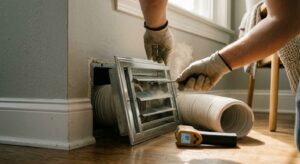
- Check that your bathroom and kitchen exhaust fans actually vent outdoors. Hold a tissue near the grille while the fan runs. Weak suction or tissue falling away suggests the duct is blocked, disconnected, or the fan is undersized.
- Crack one window 1 to 2 inches in the most-used room for 10 minutes twice a day during mild winter days above 30 degrees Fahrenheit. Cold, dry outdoor air dilutes indoor pollutants more effectively than warm air.
- Set your HVAC system fan to ‘On’ instead of ‘Auto’ for 15 to 20 minutes twice daily to circulate and filter air even when the furnace isn’t heating. This costs roughly $3 to $8 per month in electricity but meaningfully improves air mixing.
- Calculate the fan size you need: multiply bathroom square footage by 1.1 to get minimum CFM. For example, a 60 square foot bathroom needs at least a 66 CFM fan. Most builder-grade fans are undersized at 50 CFM.
- Choose a fan with a built-in humidity sensor (brands like Broan, Panasonic, and Delta make models in the $60 to $120 range). These automatically run when humidity spikes above a set threshold, removing the need to remember.
- Turn off the bathroom circuit breaker and verify power is off with a non-contact voltage tester before touching any wiring.
- Remove the old fan grille and housing. Disconnect the duct connection and electrical wiring, noting which wires connect where. Take a photo before disconnecting.
- Install the new fan housing into the ceiling opening, securing it to the joist or using the adjustable brackets most models include. Reconnect wiring following the included instructions, match wire colors, and cap connections with wire nuts.
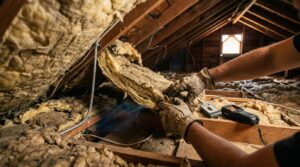
- Reattach the duct to the new fan outlet, ensuring it runs as straight and short as possible to the exterior vent cap. Insulate the duct in unconditioned attic space to prevent condensation. Restore power and test with a tissue or anemometer.
- Have an HVAC technician perform a blower door test to measure your home’s current air tightness. Homes tighter than 5 ACH50 benefit most from mechanical ventilation like an ERV.
- Select an ERV sized to your home. The general rule is 1 CFM per 100 square feet of floor area plus 7.5 CFM per bedroom. A 2,000 square foot, 3-bedroom home needs roughly 42 to 50 CFM of continuous ventilation.
- Have the ERV unit mounted near your furnace or air handler in the mechanical room. The contractor will connect two ducts to the outside (one intake, one exhaust) and integrate the unit with your existing ductwork or run dedicated supply and exhaust ducts to key rooms.
- Set the ERV to run continuously at a low speed (typically 20 to 30 CFM) with a boost mode triggered by the bathroom fan switch or a CO2 sensor for higher ventilation when the home is occupied.
- After installation, verify balanced airflow by asking the technician to measure supply and exhaust CFM at the unit. An imbalanced ERV can depressurize the home and pull in more air through leaks than intended.
- Change the ERV filters every 6 to 12 months (typically $15 to $40 per filter set) and clean the heat exchanger core annually with warm water per manufacturer instructions to maintain efficiency.
Why It Works: The Benefits
Proper ventilation dilutes and removes cooking smells, pet odors, and VOC buildup continuously. Homeowners who install ERVs or upgrade bathroom fans report noticing the difference within the first week, especially in open-plan homes where kitchen odors spread to every room.
Controlled exhaust ventilation can reduce indoor relative humidity by 10 to 20 percentage points in winter, keeping levels in the safe 30 to 50% range. This directly cuts the risk of mold growth in attics, crawl spaces, and wall cavities, where remediation costs often run $2,000 to $10,000.
The EPA estimates indoor air can be 2 to 5 times more polluted than outdoor air in winter. Ventilation reduces CO2 concentrations, which above 1,000 ppm cause measurable drops in cognitive performance and energy levels. Proper ACH keeps CO2 closer to the 600 to 800 ppm outdoor baseline.
A basic exhaust fan wastes all the heat in expelled air. An ERV recovers up to 80% of that heat, so you get continuous fresh air for an energy penalty of only 1 to 3% of your annual heating bill, typically $30 to $80 per year in a well-insulated home.
Excess indoor humidity in winter migrates into wall cavities and attic sheathing, causing wood rot, nail popping, and paint peeling. Ventilation that keeps indoor humidity below 50% can extend the life of your roof sheathing, framing, and exterior paint by years.
💰 Savings Impact by Action
Energy recovery ventilators capture 70 to 80% of heat from exhausted air, delivering fresh air with only a 1 to 3% annual heating cost increase instead of the 8 to 12% increase from unrecovered exhaust ventilation.
Keeping indoor humidity below 50% through ventilation reduces mold growth risk by roughly 30%, potentially avoiding remediation costs that average $3,500 per incident.
Adding a timer to an existing bathroom fan increases effective ventilation runtime by 20 to 40% with no hardware change, reducing pollutant accumulation for about $12 in materials.
Upgrading to a MERV-11 furnace filter and running the air handler fan periodically removes 15 to 25% more airborne particles per pass compared to a standard MERV-8 filter.
🏠 Key Concepts Explained
The Science Behind It
The stale smell of a winter home is largely a ventilation problem rooted in dilution. The indoor air quality standard ASHRAE 62.2 recommends a continuous whole-home ventilation rate of 7.5 CFM per person plus 3 CFM per 100 square feet of floor area. Most sealed winter homes fall well short of this without mechanical ventilation. When fresh air stops coming in, pollutant concentrations follow a simple accumulation curve: the rate of increase equals the emission rate minus the removal rate. With removal near zero, everything builds up.
Heat recovery ventilators and energy recovery ventilators solve this using a counter-flow heat exchanger, a core where two air streams (incoming cold fresh air and outgoing warm stale air) pass in opposite directions across thin membranes without mixing. Heat transfers across the membrane from the warm stream to the cold stream. In an ERV, the membrane is also slightly vapor-permeable, so some moisture transfers back to the incoming air, which prevents the incoming air from being uncomfortably dry in very cold climates. The result is fresh air delivered at close to indoor temperature, with 70 to 80% of the heating energy retained.
Simple bathroom exhaust fans work on a different principle: they create a slight negative pressure inside the home, which causes outdoor air to infiltrate through any available crack or gap. This works for spot ventilation but is less controlled than a balanced ERV system. In very tight homes, aggressive exhaust fans can actually backdraft combustion appliances if the makeup air path is restricted. This is why building codes increasingly require balanced mechanical ventilation in new construction and why pairing exhaust fans with a fresh-air intake pathway is best practice in retrofits.
Frequently Asked Questions
▼ My bathroom fan is running but my house still smells stale. What am I missing?
The most common culprits are a disconnected or kinked duct in the attic (the fan sounds like it’s working but exhausts into the attic instead of outside), or a fan that’s simply too small for the space. Pull down the grille and look inside with a flashlight. If the damper isn’t moving or the duct looks crushed, that’s your problem. For sizing, confirm your fan’s CFM rating on the label and compare it to your bathroom square footage times 1.1.
▼ Will running my ventilation fans all winter spike my heating bill?
A 70 CFM bathroom fan running 2 hours per day exhausts about 8,400 cubic feet of conditioned air per month, which costs roughly $5 to $12 in lost heat depending on your climate and fuel prices. That’s a reasonable trade-off for fresh air. If you’re concerned about energy loss, upgrading to an ERV eliminates most of that penalty by recovering 70 to 80% of the heat before it leaves the house.
▼ Can renters fix stale air without touching HVAC or fans?
Yes. Focus on behavioral ventilation: run existing bathroom and kitchen fans longer, briefly crack windows during mild days, and use a HEPA air purifier with an activated carbon filter ($80 to $200) to capture particles and VOCs. A desktop CO2 monitor helps you know when to ventilate. You can also ask your landlord to clean or replace exhaust fan filters, which is a normal maintenance item and costs them almost nothing.
▼ My house is newer and very well sealed. Is stale air actually a bigger problem for me?
Yes, and this is exactly backward from what most people assume. Older leaky homes ventilate by accident through cracks and gaps. New tight homes (built after roughly 2010) often rely entirely on mechanical ventilation, and if that system isn’t installed or isn’t working correctly, air quality can be significantly worse than in an older house. Check whether your home has an HRV or ERV in the mechanical room. If it doesn’t, or if the filters haven’t been changed in years, that’s your first priority.
▼ How do I know if my home’s air quality is actually bad or if I’m just imagining it?
Get a CO2 monitor and check readings in the morning before opening windows, especially in bedrooms. Healthy indoor CO2 is under 1,000 ppm. Above 1,200 ppm you may notice fatigue or headaches. Also check indoor relative humidity with a $10 hygrometer. Winter readings above 55% indicate excess moisture that ventilation needs to address. These two measurements tell you more about your air quality than any smell test.
Quick Tips
- Set bathroom fans on a 24-hour timer to run 10 to 15 minutes every hour automatically, which meets ASHRAE 62.2 intermittent ventilation requirements without any effort.
- Keep interior doors open during the day to allow air to circulate freely through the home. Closed doors in sealed winter houses create isolated pockets of stale air that smell worse than the rest of the house.
- Replace recirculating kitchen range hood filters (charcoal filters) every 3 to 6 months in winter. Saturated charcoal stops absorbing odors and can actually re-release captured smells back into the kitchen.
- Place houseplants strategically but don’t rely on them as air purifiers. Plants add humidity (which you may not need in winter) and some species off-gas small amounts of CO2 at night. If air quality is your goal, a ventilation fan beats a plant every time.
Variations for Your Situation
- Apartment/Rental: Renters typically cannot modify exhaust fans or install ERVs. Focus on maximizing existing ventilation by running bathroom fans longer, using the kitchen hood every time you cook, and investing in a portable HEPA plus activated carbon air purifier ($100 to $250) for the bedroom and main living area. A desktop CO2 monitor ($50 to $80) helps you know when to briefly open a window. Request in writing that your landlord service or replace bathroom fans that seem weak, as this is a standard maintenance obligation in most leases.
- Tight Budget (under $50): Start with a $10 hygrometer and a $12 digital timer for your bathroom fan. Set the timer to run the fan for 12 minutes every hour overnight and during the day. This meets ASHRAE intermittent ventilation guidelines at almost zero cost and will noticeably reduce musty odors within one to two weeks. Then add the habit of running range hood and bathroom fans for 15 minutes after cooking and showering. These two steps alone address 80% of the winter stale-air problem for most homes.
- Older Home (pre-1980): Older homes typically have more air infiltration through gaps and cracks, which actually provides some accidental ventilation. The stale air problem in older homes is more often localized: poor kitchen or bathroom ventilation ducts that terminate in the attic or crawl space rather than outside. Start by tracing your exhaust fan ducts to confirm they exit the building envelope. Also check for unsealed fireplace dampers, which can draw cold air in and push warm stale air to upper floors through the stack effect. Sealing and insulating the attic hatch is often the highest-impact first step for older homes.