Every spring, millions of homeowners seal their windows tight and crank up the AC, hoping to escape pollen season indoors. But without the right filters, sealed gaps, and smart ventilation habits, your home can actually concentrate allergens rather than block them. Pollen, dust mites, pet dander, and mold spores circulate through ductwork, sneak through poorly sealed doors and windows, and settle into carpets and upholstery where standard cleaning rarely reaches.
The good news is that stopping allergens does not require an expensive air purification system or a full home renovation. A combination of the right HVAC filter, targeted air sealing, and a few behavioral changes can dramatically reduce your indoor allergen load. The EPA estimates that indoor air can be two to five times more polluted than outdoor air, and during high pollen season that gap widens further if your home is not properly filtered and sealed.
This guide walks you through the building science behind why allergens get in and stay in, then gives you two clear action paths: a quick fix you can do in 30 minutes today, and a more thorough DIY upgrade that addresses the root causes. We also cover what to do if you rent, if you are on a tight budget, or if your home was built before 1980.
What You’ll Need
Click on an item below to shop for the recommended items for this recipe on Amazon.
As an Amazon Associate, we earn from qualifying purchases.
How to Do It
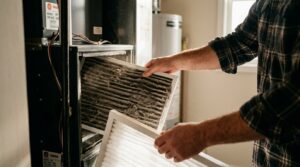
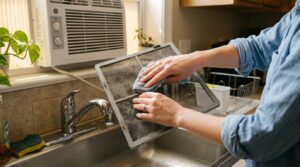
- Check your current air filter: pull it out and hold it up to light. If you cannot see light through it, it is overdue. If it is a thin fiberglass panel (MERV 4 or lower), plan to replace it with a pleated MERV 11 or MERV 13 filter sized to match your existing slot dimensions.
- Install a MERV 11 to 13 pleated filter in your HVAC return air handler. Make sure the arrow on the filter frame points toward the blower, not away from it. Gaps around the filter frame let unfiltered air bypass the media entirely, so check for a snug fit.
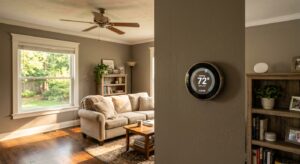
- Set your thermostat fan to ON rather than AUTO for 2 to 4 hours each morning during high pollen days (check your local pollen count at airnow.gov or a weather app). This runs air through the filter continuously even when the system is not heating or cooling, scrubbing the air in your home.
- Place a damp doormat at every exterior entry and ask household members to remove shoes at the door. Shoes tracked in during high-pollen periods deposit pollen directly onto floor surfaces where it gets kicked back into the air.
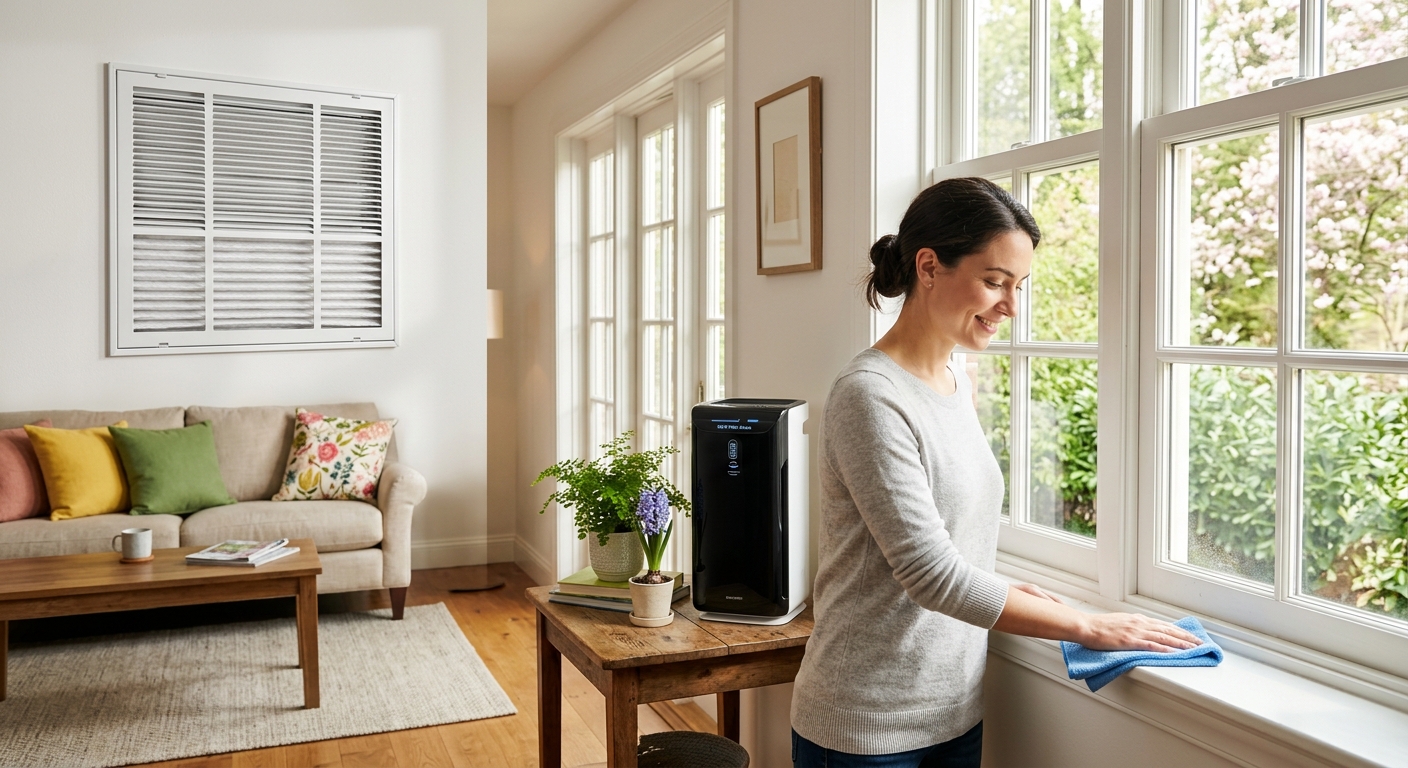
- Wipe down window sills, door frames, and entry surfaces with a damp microfiber cloth rather than a dry duster. Dry dusting launches settled pollen back into the air; damp wiping captures and removes it.
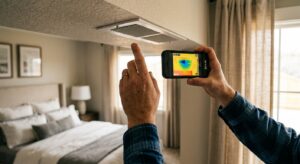
- Audit your home for infiltration points by running your hand around window frames, door frames, electrical outlets on exterior walls, attic hatches, and plumbing penetrations on a windy day. Mark any spots where you feel air movement with a piece of painter’s tape.
- Apply foam weatherstripping to door frames where you felt drafts. Self-adhesive EPDM or foam tape costs $5 to $10 per door and compresses to form an airtight seal. For the door bottom, install a door sweep with a rubber gasket, which also blocks pollen that blows in under the gap.
- Use paintable latex caulk to seal gaps around window frames, where baseboards meet exterior walls, and around plumbing and electrical penetrations on exterior walls. A single $5 tube of caulk covers approximately 30 linear feet. Let it cure for 24 hours before painting.
- Install a MERV 13 pleated filter in your HVAC system and set a phone reminder to replace it every 60 days during pollen season rather than the standard 90 days, since high outdoor pollen loads clog filters faster.
- Add a portable HEPA air purifier (rated for the square footage of your bedroom or main living area) to capture ultrafine particles the HVAC filter may miss. Look for units with a Clean Air Delivery Rate matching your room size. Run it on medium setting continuously during pollen season.
- Check your bathroom and kitchen exhaust fan dampers: these flap-style backdraft dampers often fail open over time, creating a direct pathway for outdoor air to enter. Remove the vent cover, clean the damper with a damp cloth, and confirm it closes fully when the fan is off. Replace a stuck-open damper for $8 to $15.
- Schedule a professional blower door test with a certified energy auditor or HVAC contractor. This pressurizes your home to measure actual air leakage rate and identifies the largest infiltration zones, so remediation is targeted rather than guesswork. Cost is typically $150 to $300 and is often subsidized by utility rebate programs.
- Have an HVAC technician inspect and seal your ductwork using mastic sealant or Aeroseal duct sealing technology. Leaky return ducts in attics or crawl spaces pull in unfiltered air loaded with insulation fibers, mold spores, and rodent debris. Duct sealing can improve HVAC efficiency by 20 to 30% and eliminate a major allergen entry point.
- Ask about upgrading your air handler to an HVAC system with a built-in MERV 16 or HEPA bypass filter cabinet. These systems are installed in-line with the ductwork and can achieve hospital-grade filtration without the airflow restrictions that high-MERV filters cause in older, lower-static systems.
- Consider installing an Energy Recovery Ventilator if you have sealed your home tightly. A properly sealed home needs controlled fresh air exchange to avoid moisture and CO2 buildup. An ERV brings in fresh outdoor air but filters it and pre-conditions it, so you get ventilation without raw pollen infiltration.
Why It Works: The Benefits
Upgrading from a MERV 4 fiberglass filter to a MERV 11 or 13 pleated filter reduces airborne pollen and coarse dust by up to 85%, according to ASHRAE testing data, often producing noticeable symptom relief within 24 to 48 hours of installation.
Homeowners who improve indoor air quality through filtration and air sealing often report spending 20 to 40% less on over-the-counter antihistamines and decongestants during peak pollen season, with combined annual savings of $50 to $200 per allergy sufferer.
Allergen exposure at night causes nasal congestion and disrupted breathing. Reducing bedroom allergen levels through proper filtration and sealed windows has been shown in clinical studies to improve sleep efficiency by 15 to 25% in allergy sufferers.
A properly sealed home requires less conditioned air to maintain temperature because it loses less to infiltration, trimming heating and cooling costs by 10 to 20% annually while also keeping allergens out.
Higher-quality filters prevent fine particles from coating evaporator coils and blower wheels. Clean coils operate 15% more efficiently and are far less likely to grow mold colonies that then get distributed through ductwork during cooling season.
💰 Savings Impact by Action
Upgrading from MERV 4 to MERV 13 reduces captured airborne pollen and fine allergens by up to 70% per air cycle through the system.
Sealing door, window, and penetration gaps reduces outdoor allergen infiltration by up to 20% and cuts heating and cooling loss simultaneously.
Maintaining indoor humidity below 50% reduces active mold spore counts by up to 50% and eliminates conditions for dust mite reproduction.
Running the HVAC fan continuously during peak pollen hours reduces steady-state airborne particle counts by 35 to 45% compared to Auto mode.
A true HEPA portable purifier captures 99.97% of particles 0.3 microns and larger in the room where it operates, covering what central HVAC filtration misses.
🏠 Key Concepts Explained
The Science Behind It
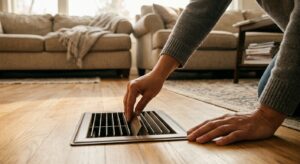
Your home is not a sealed box. Even when every window and door is shut, air moves through hundreds of small gaps in the building envelope driven by temperature differences, wind pressure, and the mechanical action of your HVAC system. During spring mornings when pollen is at its peak, the temperature difference between warm indoor air and cooler outdoor air creates a pressure stack that draws outside air through foundation cracks and lower-level gaps, carrying pollen particles with it. A typical unimproved home has enough leakage to completely replace its interior air with outside air roughly once per hour.
Once inside, pollen particles behave differently based on their size. Larger grass and tree pollen grains (20 to 100 microns) settle quickly onto horizontal surfaces, which is why tabletops and floors need frequent damp wiping during pollen season. Fine weed pollen and mold spores (1 to 10 microns) remain suspended in air for extended periods and are the primary target of HVAC filtration. A MERV 11 filter captures approximately 65 to 80% of particles in the 1 to 3 micron range in a single pass, while MERV 13 captures 85 to 90%. The key word is single pass: the more air cycles your HVAC processes per hour, the lower the steady-state particle count in your home, which is why continuous fan operation during high-pollen periods compounds the benefit of a better filter.
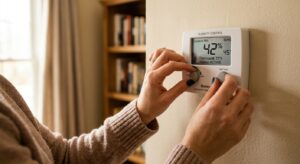
Humidity plays an equally important role. At relative humidity above 60%, mold spores begin to colonize surfaces and reproduce, adding a biological allergen load on top of the pollen problem. Dust mites, another major allergen trigger, thrive at humidity between 70 and 80% and effectively die off when humidity drops below 50%. This is why a hygrometer (under $15) is one of the most useful tools an allergy sufferer can own: maintaining indoor humidity between 40 and 50% simultaneously suppresses mold growth, kills dust mite colonies, and keeps nasal passages from drying out from over-conditioning.
Frequently Asked Questions
▼ I replaced my filter with a MERV 13 and now the airflow from my vents feels weak. What is wrong?
Your HVAC system likely does not have sufficient fan capacity for the increased static pressure of a MERV 13 filter. Drop down to MERV 11, which still captures 65 to 75% of fine allergens but creates significantly less restriction. Alternatively, an HVAC technician can assess whether your blower motor can be adjusted to higher speed or whether a filter cabinet with a larger surface area can be installed to reduce the pressure drop while keeping the MERV 13 media.
▼ My allergy symptoms are worst in the morning. Why does that happen even though my windows were closed all night?
Pollen settles onto bedding, pillows, and carpet overnight and gets disturbed back into the air when you move around in the morning. It can also enter through HVAC infiltration or small gaps while outdoor pollen peaks between 5 AM and 10 AM. Wash bedding in hot water (130 degrees F) weekly during pollen season, run your HVAC fan on continuous mode overnight, and consider a HEPA purifier in the bedroom running on low throughout the night.
▼ Can a renter improve indoor air quality without making permanent changes to the apartment?
Yes. Most landlords permit tenants to swap HVAC filters since it is standard maintenance, so upgrade to a MERV 11 pleated filter and replace it every 60 days. Add a portable HEPA air purifier in your bedroom and main living area, which requires no installation and can move with you. Use removable foam weatherstripping tape on drafty windows and door bottoms as a temporary, damage-free seal, and remove it when you leave.
▼ How long before I notice a real improvement in symptoms after making these changes?
Most people notice measurable improvement in 24 to 72 hours after installing a higher-MERV filter and running the fan continuously, since the system needs several air cycles to bring down the ambient particle count. Full symptom improvement from air sealing takes a few days longer as infiltration rates decrease. If symptoms persist beyond one week after completing the DIY upgrade, schedule an HVAC inspection to check for duct leaks or coil mold growth.
▼ What if my home still smells musty even after I improved the filter?
A musty smell during spring usually points to mold growth on the HVAC evaporator coil or in ductwork, not just filter bypass. Have a technician inspect and clean the evaporator coil, which is a common site for mold colonization in humid climates. You should also check that your condensate drain line is clear and draining properly, since a blocked drain causes standing water near the coil. Running a dehumidifier to bring indoor humidity below 50% will prevent recurrence.
Quick Tips
- Change HVAC filters every 45 to 60 days during peak pollen season rather than every 90 days. A clogged filter both restricts airflow and stops capturing particles effectively.
- Vacuum carpets and upholstered furniture with a vacuum that has a HEPA-rated bag or filter. Standard vacuums without HEPA exhaust blow fine particles back into the air as they clean.
- Shower and change clothes when returning home from time outdoors on high-pollen days. Pollen clings to hair and fabric and is then transferred to pillows, couches, and carpet fibers.
- Keep bedroom windows closed at night even when outdoor temperatures are comfortable. Nighttime cooling breezes can deposit significant pollen on bedding, where you spend 7 to 8 hours with your face close to the surface.
- Use a portable air purifier with a true HEPA filter in bedrooms rather than relying solely on central HVAC filtration, since central systems only filter air when the fan is running and cannot address particle settling in stagnant bedroom air.
Variations for Your Situation
- Apartment/Rental: Start with a portable HEPA air purifier rated for your bedroom square footage (look for a CADR of at least 200 for a standard bedroom). Replace the apartment HVAC filter with a MERV 11 pleated version, which most leases permit as routine maintenance. Use peel-and-stick foam weatherstripping tape on leaky window frames and place damp-entry mats at the front door. Total cost is $60 to $180 with no permanent modifications.
- Tight Budget (under $50): Focus on the filter swap first since it delivers the highest allergen reduction per dollar. A 3-pack of MERV 11 pleated filters costs $18 to $28 and immediately improves filtration. Spend the remainder on a $10 tube of caulk for the two or three worst window gaps you can feel drafts through. Set the HVAC fan to continuous during peak pollen hours at zero additional cost. These three steps alone can reduce indoor pollen by 40 to 55%.
- Older Home (pre-1980): Homes built before modern building codes typically have infiltration rates of 1.5 to 3.0 ACH, meaning the envelope leaks heavily enough that filtration alone cannot keep up. Prioritize air sealing at the attic floor (the largest leakage zone in older homes) and around window frames before upgrading filters. Also check that existing attic insulation has not settled below R-19, since thin insulation leaves gaps around ceiling fixtures that act as direct pollen pathways. A utility rebate-funded energy audit will give you a prioritized list of sealing targets for your specific home.