If your heating and cooling bills feel stubbornly high no matter what you do, there is a good chance your home’s insulation is the culprit. The U.S. Department of Energy estimates that about 90% of existing American homes are under-insulated, meaning conditioned air is constantly escaping through ceilings, walls, and floors while outdoor temperatures push right back in. That invisible leakage translates directly into dollars on your monthly utility bill.
The good news is that insulation upgrades are among the highest-return home improvements available. Unlike a new HVAC system or a kitchen remodel, adding insulation to your attic can pay for itself in as little as one to three years through energy savings alone, and it keeps paying dividends for decades. The 2022 Inflation Reduction Act also offers a federal tax credit of up to 30% of material costs (capped at $1,200 per year), which shortens payback periods even further.
This post walks you through the highest-impact insulation upgrades for a typical home, starting with the single best move most homeowners can make (attic insulation), then covering walls, floors, and air sealing. You will get real cost and savings numbers, step-by-step approaches from DIY to professional, and a clear framework for deciding where your insulation dollar goes furthest.
What You’ll Need
Click on an item below to shop for the recommended items for this recipe on Amazon.
As an Amazon Associate, we earn from qualifying purchases.
How to Do It
- Measure your attic floor area and check existing insulation depth. Use a ruler to determine current R-value (roughly R-3 per inch for fiberglass batts, R-2.5 per inch for older loose fill). Most DOE climate zones call for R-38 to R-49 total, so calculate how many inches you need to add.
- Before adding insulation, air seal all penetrations. Use canned spray foam to seal around recessed light housings (use IC-rated covers first), plumbing and wiring penetrations, and the tops of interior walls. This step is non-negotiable: skipping it reduces the effectiveness of new insulation by up to 30%.
- Install baffles (cardboard or foam ventilation chutes) at every rafter bay along the eaves to protect soffit vents and maintain airflow from soffit to ridge. Blocked soffit vents cause moisture buildup and can rot roof sheathing.
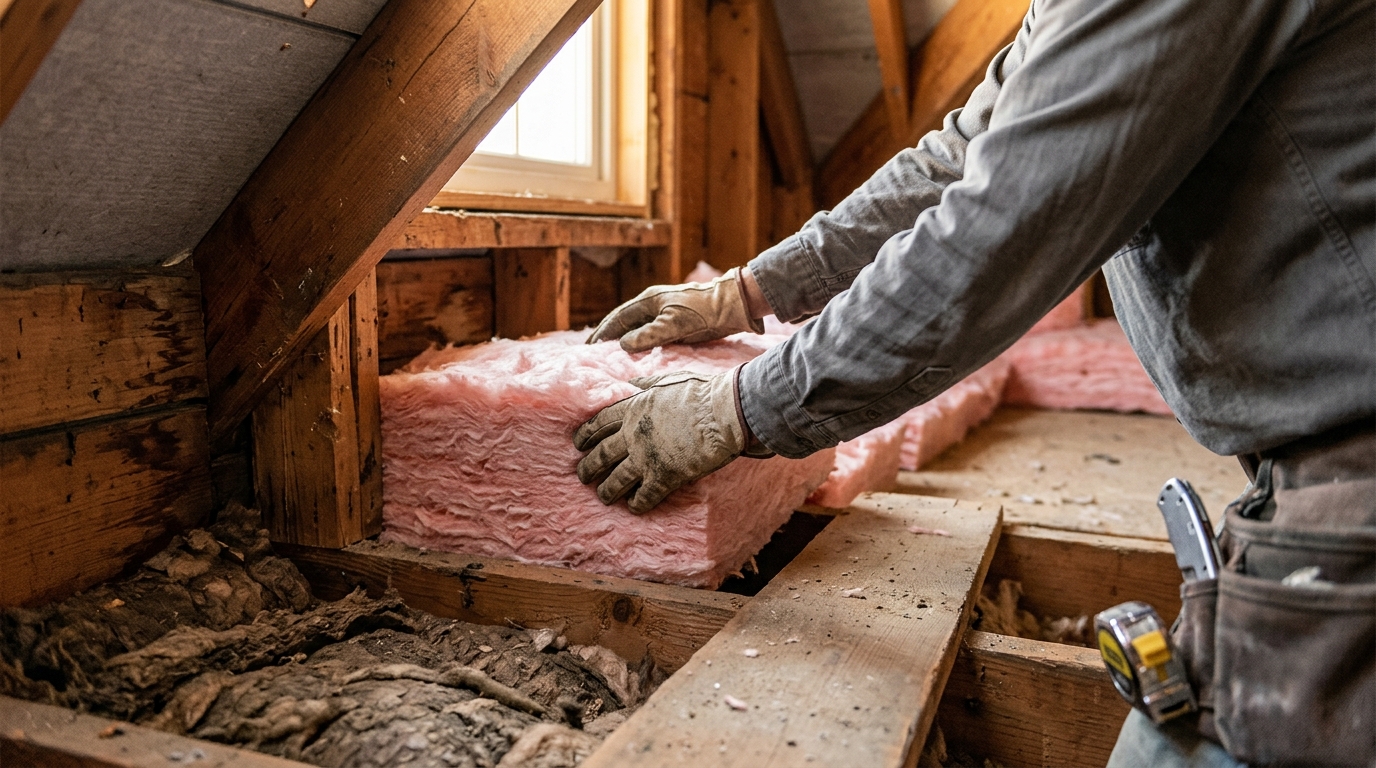
- Set up the blower machine at the attic hatch or an exterior door. Have a helper feed bags into the hopper while you direct the hose. Work from the far corners of the attic back toward the hatch to avoid stepping on newly installed insulation.
- Blow insulation to the depth required to hit your target R-value, using the depth markers included with the bags (usually printed rulers you staple to rafters). For R-38 with blown fiberglass, you need approximately 12 to 13 inches of settled depth.
- Insulate the attic hatch with an insulated cover or glue rigid foam board to the back of the hatch door to bring it up to at least R-15. Attic hatches are one of the most overlooked thermal weak points in a home.
- Schedule a home energy audit before getting insulation quotes. An auditor using a blower door test will identify exactly where your biggest air leakage and insulation gaps are, ensuring you invest in the highest-impact areas rather than guessing.
- Have the contractor apply two-component closed-cell spray foam to seal all major air leakage points: rim joists in the basement or crawlspace, attic bypasses, and around HVAC penetrations. Closed-cell foam delivers R-6 to R-7 per inch and acts as both an air barrier and vapor retarder.
- For attic floors, have the contractor install blown-in cellulose or fiberglass over the spray-foamed areas to reach the target R-value for your climate zone. Cellulose is made from recycled paper, has an R-value of about 3.7 per inch, and is treated for fire and pest resistance.
- Ask the contractor to insulate and air seal the attic hatch or pull-down stairs as part of the project scope. Many contractors skip this unless specifically requested.
- After project completion, request documentation of installed R-values and materials used. This documentation is required to claim the federal 25C energy efficiency tax credit and may be needed for utility rebate programs.
- Schedule a post-installation blower door test if budget allows. A well-executed professional insulation and air sealing project should reduce air changes per hour (ACH) by 20 to 40%, which you can verify with this test.
Why It Works: The Benefits
Upgrading attic insulation from R-11 to R-38 in a typical 1,500-square-foot home can reduce heating and cooling costs by 15 to 25% annually, saving $200 to $600 per year depending on climate and fuel type.
A DIY attic insulation project using blown-in fiberglass costs $500 to $1,500 in materials for an average home. Combined with the 30% federal tax credit, the net cost drops to $350 to $1,050, placing payback in the one to three year range in most U.S. climate zones.
Proper insulation eliminates the cold spots in winter and hot rooms in summer that occur when heat moves freely through ceilings and exterior walls. Homeowners commonly report a 5 to 8 degree Fahrenheit improvement in room temperature consistency after an attic upgrade.
When the thermal envelope holds temperature better, your heating and cooling system runs for shorter cycles. Reduced runtime directly extends equipment life and can delay costly system replacements by several years.
Energy-efficient homes sell for a premium. Studies by the Lawrence Berkeley National Laboratory found that homes with documented energy efficiency improvements sell for 2 to 3% more than comparable homes, often recovering insulation costs at resale.
💰 Savings Impact by Action
Upgrading attic insulation from R-11 to R-38 or higher reduces heating and cooling loads by 15 to 25% in most U.S. climate zones.
Sealing attic bypasses and penetrations before insulating can reduce total home energy use by up to 20% according to EPA estimates.
Insulating and air sealing basement rim joists with rigid foam reduces perimeter heat loss by up to 10% in cold climates.
Adding an insulated cover to an unsealed attic hatch eliminates a thermal short-circuit that can account for 5% of attic heat loss despite its small size.
Insulating a vented crawlspace floor or encapsulating and conditioning an unvented crawlspace reduces floor heat loss and can lower heating bills by 10 to 15%.
🏠 Key Concepts Explained
The Science Behind It
Heat always flows from areas of higher temperature to areas of lower temperature, and it does so through three mechanisms: conduction (direct contact), convection (air movement), and radiation (infrared energy). Insulation primarily combats conduction by trapping millions of tiny air pockets within fibers or foam cells. Those pockets slow heat transfer because still air is a poor conductor. The R-value rating directly measures how much resistance a given thickness of material provides to conductive heat flow.
What most homeowners do not realize is that convective heat transfer, driven by air movement through gaps and cracks, can account for as much as 40% of total home energy loss. This is why air sealing is as important as the insulation itself. When warm air finds a gap around a recessed light or a plumbing penetration, it bypasses the insulation entirely, carrying heat with it. The result is that a home can be insulated to code on paper but still perform like an insulated cardboard box with holes cut in it.
Radiant heat transfer is particularly important in attics. On a sunny summer day, a dark roof can reach 150 to 160 degrees Fahrenheit, and that heat radiates down into the attic space. A thick layer of insulation on the attic floor slows the rate at which that radiant energy gets absorbed into your living space below, which is why attic insulation provides its biggest payback in both hot and cold climates. The thermal mass of the insulation material also plays a role: denser materials like cellulose absorb heat slowly over the day and release it at night, dampening temperature swings even when outdoor temperatures are extreme.
Frequently Asked Questions
▼ My attic already has some insulation. Do I need to remove it before adding more?
In most cases, no. You can blow new insulation directly on top of existing batts or loose fill as long as the existing material is dry, free of mold, and not vermiculite. If the existing insulation is wet or moldy, find and fix the moisture source first, then remove the damaged material before re-insulating. Adding on top of existing insulation is faster, cheaper, and just as effective when the existing material is in good condition.
▼ I added attic insulation but my energy bills barely changed. What went wrong?
The most common reason is air leakage that was not addressed before the insulation was installed. Gaps around recessed lights, plumbing penetrations, and wall top plates allow conditioned air to bypass even thick insulation. The second common cause is duct leakage: if your HVAC ducts run through the attic and are leaky, you may be losing 20 to 30% of conditioned air before it reaches your living space. Have a contractor perform a duct blaster test to check duct tightness.
▼ Can I insulate my attic in summer? Will the heat make it dangerous?
Attic temperatures can reach 130 to 150 degrees Fahrenheit on summer afternoons, which is genuinely dangerous. Plan DIY attic work for early morning on a mild, cloudy day, and limit sessions to 20 to 30 minutes with breaks in a cool area. Bring plenty of water and wear a respirator, long sleeves, gloves, and safety glasses. Professional crews work with powered ventilation equipment that makes conditions more manageable, so if your timeline is summer, the professional approach is safer.
▼ Will adding insulation cause moisture problems in my attic?
Adding insulation to an attic floor (not the rafters) does not typically create moisture problems as long as soffit and ridge vents remain clear and functional. The ventilation system keeps attic air moving, which prevents moisture buildup. Problems arise when insulation blocks soffit vents, which is why installing baffles at the eaves is a required step, not optional. If your attic already has poor ventilation or signs of moisture staining, address the ventilation first.
▼ Does insulation help in summer as much as in winter?
Yes, insulation works in both directions. In summer it slows the transfer of heat from your hot attic (which can exceed 140 degrees Fahrenheit) into your living space below, reducing the cooling load on your air conditioner. DOE data shows that proper attic insulation can reduce cooling energy use by 10 to 20% in hot climates like the Southeast and Southwest, where the payback can be even faster than in heating-dominated northern climates.
Quick Tips
- Check your current attic insulation depth with a ruler before buying materials. If you have less than 7 inches of any type, you are almost certainly losing significant money every month.
- Utility companies in most states offer rebates of $100 to $500 for insulation upgrades. Search the DSIRE database (dsireusa.org) or call your utility to find programs before you buy anything.
- Insulating rim joists (the band of framing around the perimeter of your basement or crawlspace) with cut-and-cobble rigid foam is a fast DIY project costing $150 to $300 that can reduce heating costs by 5 to 10% in cold climates.
- Use a thermal imaging camera or app to find hidden insulation gaps before and after your project. Many hardware stores rent thermal cameras, and some utility companies lend them for free to customers.
Variations for Your Situation
- Apartment/Rental: Renters cannot modify attic or wall insulation, but can add thermal curtains (reducing window heat gain and loss by 25%), apply interior window insulation film, and use draft stoppers at doors. These measures cost $50 to $200 total and can trim 5 to 10% from utility bills without any structural changes. Ask your landlord about rebate-eligible insulation upgrades since landlords benefit from reduced complaints about comfort.
- Tight Budget (under $50): Focus first on the two highest-impact free or near-free steps: seal gaps around your attic hatch with weatherstripping ($8 to $12) and use canned spray foam to seal the most obvious penetrations visible from inside the attic. If you can only do one thing, buy an insulated attic hatch cover kit ($30 to $50) and install it over your existing hatch. This single fix on an unsealed hatch is equivalent to closing a window-sized hole in your ceiling.
- Older Home (pre-1980): Homes built before 1980 often have little to no attic insulation, knob-and-tube wiring in the attic space, and possible vermiculite insulation. Have the attic inspected by a licensed contractor before doing any DIY work. Knob-and-tube wiring must be evaluated by an electrician before insulation is added. If vermiculite is present, hire an asbestos-certified abatement contractor before any disturbance. Once these safety items are cleared, older homes typically see the largest savings from insulation upgrades precisely because the baseline is so low, with paybacks often under 18 months.