If your heating bills spike every January or you notice frost on interior walls when the wind chill drops, your insulation is likely failing you. In extreme cold climates, the difference between adequate and excellent insulation can mean hundreds of dollars per heating season and a home that feels genuinely comfortable rather than just tolerably warm. Not all insulation is created equal, and choosing the wrong type for your climate zone can leave real money and comfort on the table.
Extreme cold introduces challenges that mild-climate insulation strategies simply cannot address. Moisture-laden air migrates through wall assemblies, thermal bridging through studs and joists bypasses even thick batts, and the sheer temperature differential between inside and outside demands materials with the highest possible R-value per inch. Understanding how each insulation type performs under these conditions is the first step toward making a smart investment.
This post compares the most effective insulation options for cold climates, including spray foam, rigid foam board, mineral wool, and dense-pack cellulose, with real R-values, installed costs, and payback periods. Whether you are tackling a DIY attic upgrade this weekend or planning a full wall assembly overhaul with a contractor, you will find a practical path forward here.
What You’ll Need
Click on an item below to shop for the recommended items for this recipe on Amazon.
As an Amazon Associate, we earn from qualifying purchases.
How to Do It
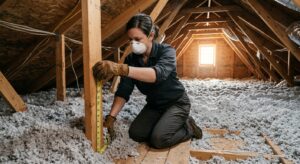
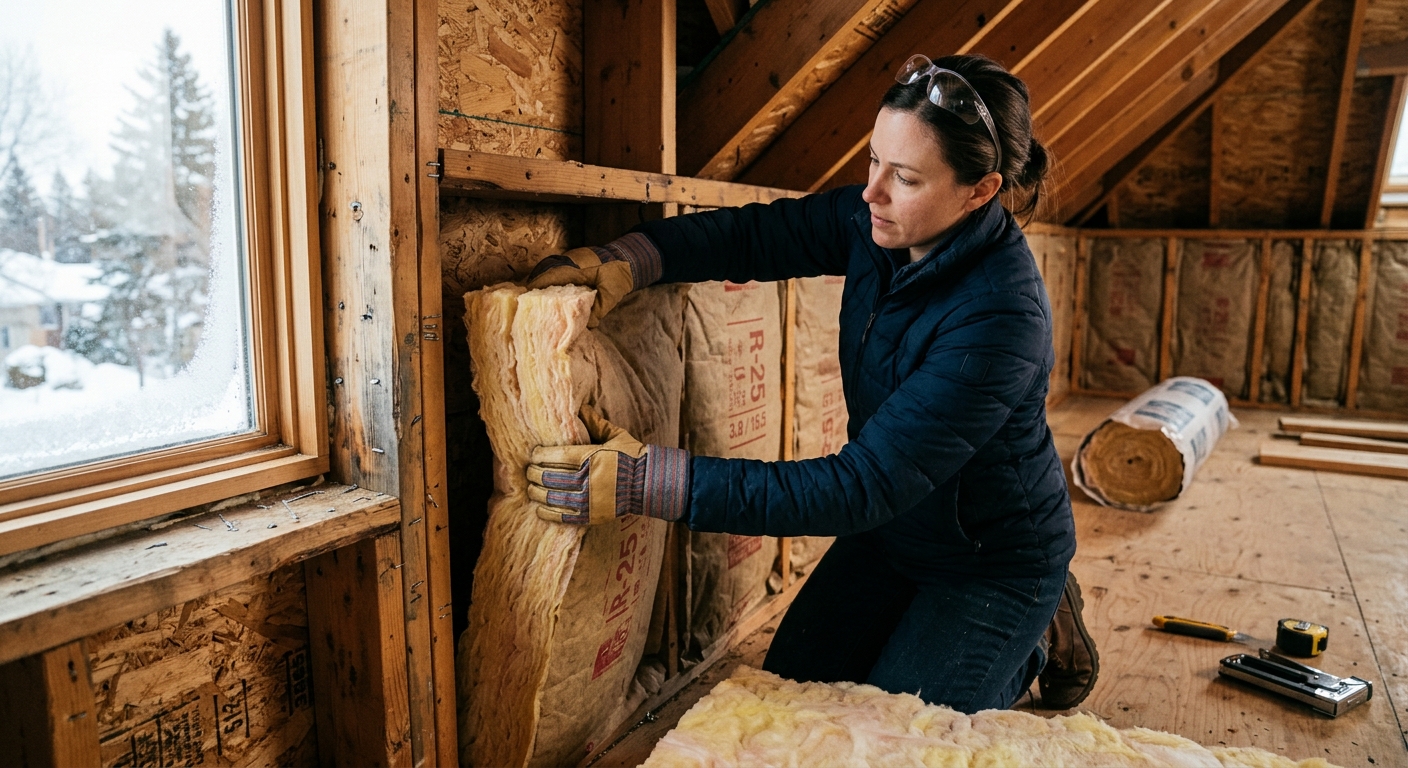
- Measure your existing attic insulation depth. In Climate Zones 6 and 7, the DOE recommends R-49 to R-60. If you have less than 12 to 15 inches of blown insulation, a top-up is your fastest payback upgrade.
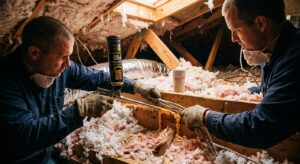
- Before adding insulation, seal all attic bypasses: top plates, recessed light cans, attic hatches, plumbing and electrical penetrations. Use canned spray foam for gaps under 3 inches and rigid foam board plus acoustical caulk for larger openings like soffits.
- Install an insulated attic hatch cover rated to at least R-38. A bare attic hatch is like leaving a window open all winter and is a common overlooked heat loss point.
- Rent a blow-in insulation machine from a home improvement store for free when you purchase at least 10 bags of cellulose or blown fiberglass. Cellulose is preferred in extreme cold for its higher settled R-value of 3.2 to 3.8 per inch and superior air resistance.
- Blow insulation to the depth required for your target R-value, working from the eaves toward the center hatch. Keep soffit baffles clear to maintain attic ventilation and prevent ice dam formation.
- After completion, verify depth with a ruler in 5 to 6 locations across the attic floor. Depth markers stapled every 4 feet make future inspection easy.
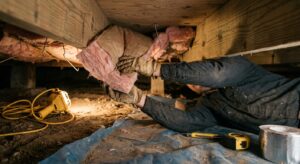
- Access your basement or crawlspace rim joist area, which runs around the entire perimeter of the home just above the foundation wall. Look for daylight, cobwebs indicating air movement, frost, or bare wood.
- Cut 2-inch rigid closed-cell foam board to fit snugly between each joist bay. Closed-cell foam here serves triple duty as insulation at R-12, an air barrier, and a vapor retarder, all critical for extreme cold performance.
- Press each foam panel firmly into the joist bay so it contacts the rim joist squarely. The fit should be snug enough to hold without fasteners initially.
- Seal all four edges of each foam panel with canned two-component spray foam or acoustical sealant. This step is critical: the air seal is as important as the thermal resistance at this location.
- For additional R-value in Climate Zone 7 or colder, cut a second layer of 2-inch foam and glue it to the first layer with foam adhesive, staggering seams, to achieve R-24 before finishing.
- In a basement, cover foam with a fire-rated material such as 0.5-inch drywall per most building codes. Crawlspace installations may be exempt but check your local jurisdiction.
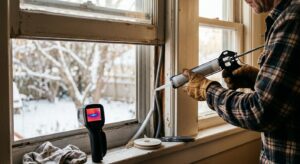
- Schedule an energy audit first, ideally with a blower door test, to identify and prioritize which areas of the home account for the most heat loss. This prevents spending money on lower-impact areas when higher-priority zones remain untreated.
- Discuss with your contractor whether open-cell (R-3.7 per inch, vapor permeable) or closed-cell (R-6.5 per inch, vapor retarder) foam is appropriate for each location. In Climate Zones 6 and 7, closed-cell is almost always preferred for wall cavities and below-grade assemblies.
- For existing walls, request injection foam or drill-and-fill dense-pack instead of open-wall spray foam unless you are already planning to expose the framing for other renovations. Injection foam is less disruptive and costs 30 to 50% less than a full gut renovation approach.
- Request a test area on the first day to verify the foam is expanding and curing correctly. Improperly mixed two-component foam can remain tacky, shrink, or emit odors for weeks, and catching this early protects your investment.
- After foam cures (typically 24 hours), verify R-value depth with a probe in multiple locations and confirm all penetrations, electrical boxes, and window rough openings are fully detailed before framing or drywall proceeds.
- File for any applicable utility rebates or the federal 25C energy efficiency tax credit, which covers 30% of insulation material costs up to $1,200 per year for qualifying improvements as of 2024.
Why It Works: The Benefits
Upgrading from R-19 fiberglass batts to a properly detailed R-30 or higher wall assembly can reduce heating energy consumption by 20 to 40% annually. For a home spending $2,400 per year on heat, that is $480 to $960 back in your pocket each winter.
High-performance insulation combined with air sealing eliminates the radiant cold surfaces and convective drafts that make rooms feel uncomfortable even when the thermostat reads 70 degrees. Occupants consistently report improved comfort at lower thermostat settings, which compounds the energy savings.
Correctly specified insulation keeps wall sheathing and framing above the dew point, preventing the interstitial condensation that leads to mold, rot, and structural damage. Closed-cell spray foam in particular also acts as a Class II vapor retarder, eliminating the need for a separate poly vapor barrier in most assemblies.
Dense insulation materials, especially mineral wool with its sound absorption coefficient of 0.95 or higher, reduce exterior noise transmission by 25 to 45%, making the home noticeably quieter during wind storms common in cold-climate regions.
DOE studies indicate that high-efficiency insulation upgrades return 60 to 80 cents on the dollar at resale, while also making the home faster to sell in cold-climate markets where buyers actively ask about heating costs.
💰 Savings Impact by Action
Bringing attic insulation from R-19 to R-60 with proper air sealing reduces heating energy loss through the ceiling by up to 25% annually.
Insulating and air-sealing rim joists with 2-inch closed-cell foam eliminates a heat loss pathway responsible for up to 15% of whole-house heating load.
Adding 2 to 3 inches of continuous rigid foam to exterior walls eliminates thermal bridging and can improve whole-wall effective R-value by 20% or more.
Professional blower-door-guided air sealing alone reduces heating and cooling energy use by 10 to 20% by eliminating bypasses that insulation cannot address.
Replacing fiberglass batts with closed-cell spray foam in a 2×6 wall cavity increases effective R-value from R-15 to R-21 and eliminates convective losses, reducing wall heat transfer by up to 30%.
🏠 Key Concepts Explained
The Science Behind It
Heat flows from warm areas to cold areas through three mechanisms: conduction (direct contact), convection (air movement carrying heat), and radiation (infrared energy traveling through space). In extreme cold, the temperature differential between your conditioned interior (68 to 72 degrees Fahrenheit) and the outdoor air (sometimes minus 20 to minus 40 degrees Fahrenheit) creates an enormous driving force for heat to escape through every available path. Insulation works primarily by trapping still air in tiny pockets, which is a poor conductor of heat, but only when those air pockets are not allowed to move convectively through the insulation matrix.
This is why materials like closed-cell spray foam and dense-pack cellulose outperform open fiberglass batts in extreme cold. At very high temperature differentials, research from Oak Ridge National Laboratory shows that air movement within low-density insulation creates convective loops that reduce effective R-value by 15 to 40% compared to lab-rated values. Dense and rigid materials physically prevent these air movements, so their real-world performance stays close to their rated values. Closed-cell spray foam goes further by entirely eliminating the air-filled void space, replacing it with a rigid closed-cell matrix that blocks conduction, convection, and vapor diffusion simultaneously.
Vapor diffusion physics explains why the ratio of interior to exterior insulation matters so much in cold climates. The dew point of typical indoor air at 70 degrees Fahrenheit and 35% relative humidity is approximately 40 degrees Fahrenheit. In a wall assembly, the temperature drops gradually from inside to outside. If that 40-degree dew point falls somewhere within the wall framing or at the sheathing surface, moisture from interior air will condense there. By placing enough continuous exterior rigid foam to keep the sheathing temperature above 40 degrees even on the coldest nights, you push the dew point safely to the exterior and keep the entire structural wall assembly dry year after year.
Frequently Asked Questions
▼ My heating bills are still high after adding attic insulation. What am I missing?
High heating bills after an attic upgrade almost always point to air leakage that was not addressed before blowing in insulation. Schedule a blower door test with a local energy auditor (typically $200 to $400) to locate the specific bypass points, which are often top plates, attic hatches, and recessed lights. Also check whether your basement rim joists and crawlspace are insulated, as these two areas combined can account for 15 to 25% of total heat loss and are frequently overlooked.
▼ Is spray foam really worth the high cost compared to cheaper options?
Closed-cell spray foam is worth the premium in specific applications: rim joists, basement walls, unvented roof assemblies, and anywhere you need a combined air barrier and vapor retarder in a single product. In open attic floors or between standard wall studs where cost per square foot matters more, dense-pack cellulose or mineral wool batts plus a dedicated air barrier often deliver 85 to 90% of the performance at 40 to 60% of the cost. Match the material to the location rather than applying one solution everywhere.
▼ How do I know what R-value I actually need for my climate?
The DOE’s Climate Zone map divides the US into zones 1 through 8, with zones 6 and 7 covering most of the northern tier and Alaska. Zone 6 requires R-49 to R-60 in attics, R-20 to R-25 in walls, and R-25 to R-30 in floors over unconditioned spaces. Zone 7 pushes those numbers to R-60 in attics and R-30 in walls. You can find your exact zone and recommended R-values using your ZIP code at the DOE’s energystar.gov insulation guide.
▼ Can I add rigid foam to the outside of my existing walls without major renovation?
Yes, and this is actually one of the most cost-effective wall upgrades because it adds insulation while eliminating thermal bridging through studs, all without disturbing interior finishes. The process involves removing siding, adding 1 to 4 inches of continuous rigid foam board over the sheathing, then re-siding with furring strips to create a rainscreen gap. Plan for window and door extensions to account for the thicker wall assembly. Costs typically run $5 to $12 per square foot installed and the payback period is 5 to 10 years in extreme cold climates.
▼ My older home has no vapor barrier in the walls. Is this a big problem?
It depends entirely on your climate zone and your wall assembly. Homes built before the 1970s often have no vapor retarder and were designed to dry in both directions, which worked reasonably well with low indoor humidity and drafty construction. If you are tightening the envelope and adding humidification, the risk of moisture accumulation increases. The safest approach in extreme cold is to either add closed-cell spray foam inside (which acts as its own vapor retarder) or add exterior rigid foam to shift the dew point safely toward the outside. Have a building science professional review your specific assembly before making changes.
Quick Tips
- Always air-seal before you insulate. Adding insulation over existing air leaks traps the moisture carried by those air currents and accelerates rot. Air sealing first costs almost nothing extra and multiplies the effectiveness of every insulation dollar.
- In extreme cold climates, prioritize the building envelope in this order by return on investment: attic first, basement and rim joists second, walls third. Attics offer the largest area and lowest installation cost per square foot.
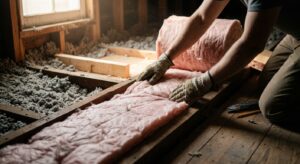
- Mineral wool (rock wool) batts are an excellent wall insulation choice because they are fire-resistant to over 1,000 degrees Fahrenheit, hydrophobic (they shed water rather than absorbing it), and maintain their R-value of 4.2 per inch even when slightly compressed, unlike fiberglass.
- When comparing insulation quotes, always ask for the installed R-value at the thermal boundary, not just the material nominal R-value. A contractor quoting R-21 batts in a standard 2×6 wall is delivering a whole-wall R-value of roughly R-15 after thermal bridging, which is a critical distinction for your energy budget.
Variations for Your Situation
- Apartment/Rental: Renters cannot modify wall assemblies or attic insulation, but can significantly reduce heat loss with interior window insulation film kits ($20 to $40 per window), draft snakes at door thresholds, insulating outlet and switch plate gaskets on exterior walls, and a heavy insulating curtain (R-2 to R-4) on north-facing windows. These measures combined can reduce drafts and radiant heat loss enough to cut heating energy use by 8 to 15% at a total cost under $150. Always get landlord permission before any physical modifications.
- Tight Budget (under $50): Start with canned spray foam and a tube of acoustical caulk to seal the three highest-impact air leakage points in most cold-climate homes: the attic hatch (seal the frame, add a foam gasket), basement rim joists (apply foam bead around the perimeter where wood meets concrete), and top and bottom plates of exterior walls accessible from the basement. These three steps together cost under $40 in materials and can reduce air infiltration by 10 to 20% with no specialized tools or skills required.
- Older Home (pre-1980): Homes built before modern energy codes typically have 2×4 walls with R-11 fiberglass batts, uninsulated rim joists, minimal attic insulation, and significant air leakage throughout the building shell. The best sequence is: first get a blower door-guided air sealing session (often subsidized by utilities), then bring attic insulation to R-49 minimum, then address rim joists with rigid foam, and finally consider dense-pack injection into wall cavities if your heating bills remain high after the first three steps. Budget $1,500 to $4,000 spread over two to three years for a comprehensive whole-house approach, with the attic yielding the fastest payback.