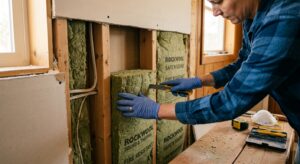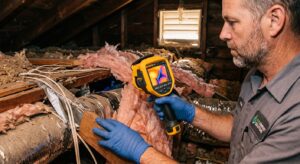
If your basement feels cold and drafty no matter how high you crank the heat, your rim joists are almost certainly part of the problem. Rim joists, also called band joists, are the framing members that sit on top of your foundation wall and close off the ends of your floor joists. They are directly exposed to outdoor temperatures, typically uninsulated, and riddled with gaps where air flows freely in and out of your home. The Department of Energy estimates that air leakage accounts for 25 to 40% of a home’s heating and cooling energy loss, and rim joists are a leading contributor.
The good news is that rim joists are one of the most cost-effective places to insulate in your entire home. Unlike attic insulation projects that require renting equipment or hiring a crew, rim joist sealing is a true DIY weekend project. A few hours, a utility knife, some rigid foam board, and a can of spray foam is all it takes to dramatically cut your heating bills and make your floors noticeably warmer.
In this post, we will walk you through exactly what rim joists are, why they leak so badly, and two practical approaches ranging from a quick foam-and-seal fix to a more thorough insulated assembly. We will also cover real savings numbers, common mistakes to avoid, and answers to the questions homeowners most often ask.
What You’ll Need
Click on an item below to shop for the recommended items for this recipe on Amazon.
As an Amazon Associate, we earn from qualifying purchases.
How to Do It
- Measure the height and width of each rim joist bay, which is the rectangular opening between each pair of floor joists along the foundation wall. Most bays are 14.5 inches wide and between 7 and 12 inches tall.
- Cut pieces of 2-inch-thick rigid foam board (polyisocyanurate or XPS) to fit snugly inside each bay. A utility knife and straightedge are all you need. Aim for a fit that is tight but can still be pushed in by hand.
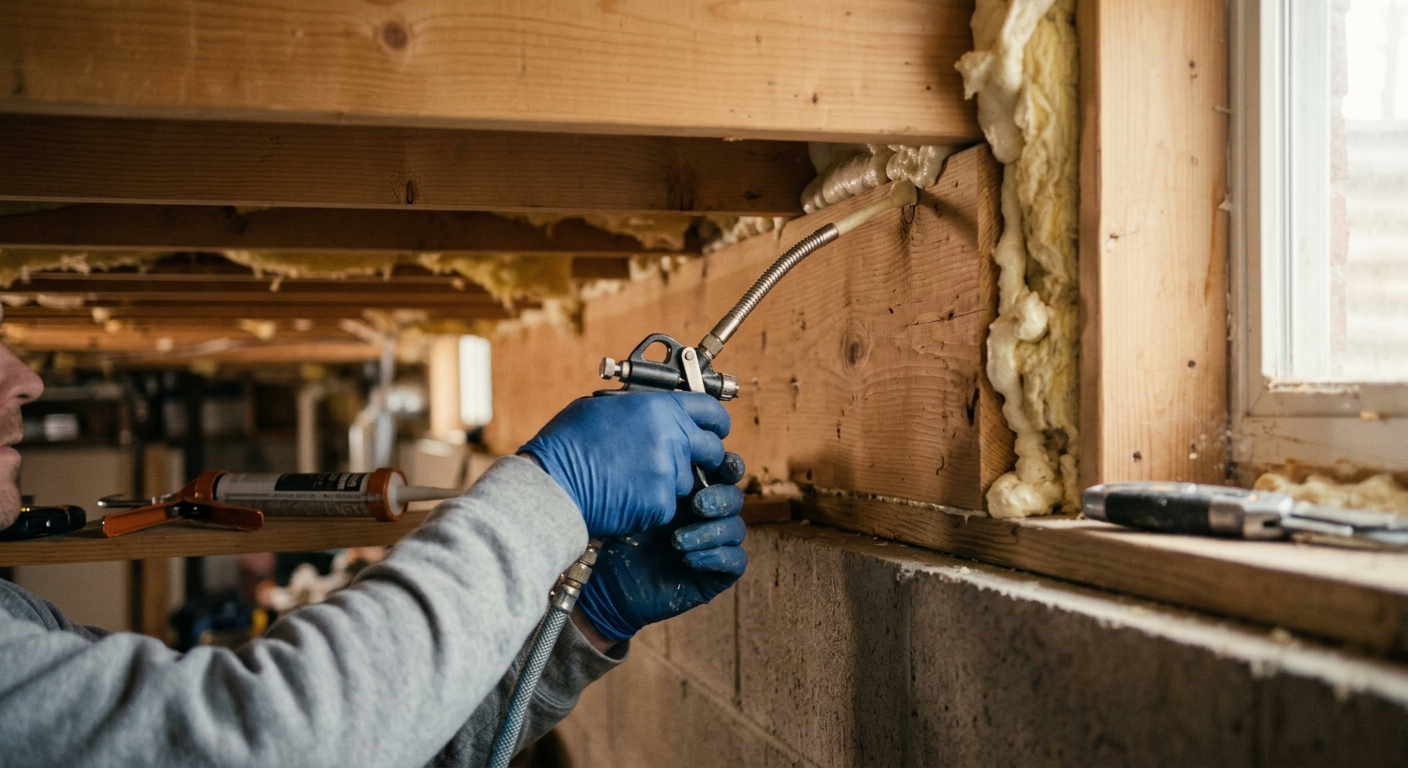
- Before inserting the foam, spray a bead of low-expansion spray foam sealant around any visible gaps, cracks, or pipe penetrations on the rim joist face to handle the irregularities that the flat foam board cannot conform to.
- Press the cut foam plug firmly into each bay so it sits flush against the rim joist. The foam should be snug enough that it stays in place without fasteners.
- Run a continuous bead of low-expansion spray foam around all four edges of each foam plug, sealing it to the surrounding wood framing. This edge seal is critical and is what actually stops air movement.
- Allow the foam to cure for 30 to 60 minutes, then trim any excess cured foam flush with the framing using a utility knife. Inspect for any gaps and apply additional sealant as needed.
- Clean the rim joist area thoroughly. Remove any existing fiberglass batts, which are ineffective here and may be hiding moisture damage. Inspect wood for rot or mold and address any issues before proceeding.
- Seal large gaps, pipe penetrations, and sill plate cracks with backer rod and caulk or with small amounts of canned spray foam. This ensures your two-component foam is not wasted filling voids it cannot reach effectively.
- Shake and warm the two-component spray foam kit components per manufacturer instructions. Cold canisters (below 65 degrees Fahrenheit) produce uneven foam and poor adhesion.
- Apply the first coat of closed-cell spray foam at approximately 1 inch thickness across the entire rim joist surface and into each bay. Work steadily from one end of the basement to the other in a consistent sweeping motion.
- Allow the first coat to cure fully, typically 15 to 30 minutes, then apply a second coat to bring total thickness to 2 to 3 inches. This achieves R-12 to R-21 and creates a complete vapor retarder rated at 1 perm or less.
- Inspect the finished surface for voids or thin spots and touch up as needed. Note that exposed closed-cell foam in a finished space must be covered with a 15-minute thermal barrier such as drywall per most building codes.
- Schedule a home energy audit or get quotes from two to three insulation contractors. Ask specifically for closed-cell spray foam at 2 to 3 inches on rim joists and request the final R-value and air permeance rating in writing.
- Clear the basement perimeter of stored items and ensure the contractor has access to all rim joist bays, including behind finished walls if applicable.
- Ask the contractor to address sill plate air sealing at the same time, since the sill plate joint between foundation and framing is equally leaky and adds little cost when the crew is already set up.
- After the job, verify coverage visually. Closed-cell foam should be a uniform 2 to 3 inches thick with no visible wood gaps. Request documentation for any rebates, as many utility companies offer $0.10 to $0.25 per square foot for rim joist insulation.
Why It Works: The Benefits
Properly sealed and insulated rim joists can reduce a home’s heating energy use by 10 to 20%, with savings of $150 to $400 per year depending on climate, home size, and fuel type.
Sealing the rim joist eliminates the cold air pocket that forms along the perimeter of the floor above, noticeably warming floors in first-floor rooms adjacent to the foundation, sometimes by 5 to 10 degrees Fahrenheit.
Keeping the rim joist wood above the dew point year-round eliminates condensation, which is the primary cause of mold and wood rot in basement rim joist assemblies.
Material costs for a typical 1,500-square-foot home run $100 to $250. With annual savings of $150 to $400, most homeowners recover the full investment within one to two heating seasons.
Air sealing the rim joist also reduces noise infiltration, insect entry, and outdoor odor intrusion, making finished or semi-finished basements significantly more comfortable.
💰 Savings Impact by Action
Air sealing and insulating rim joists reduces basement heat loss by up to 20%, making it one of the highest-return insulation projects in a home.
Caulking the sill plate joint simultaneously with rim joist work captures an additional 5 to 8% reduction in infiltration losses at negligible extra cost.
Replacing existing fiberglass rim joist batts with rigid foam reduces both conductive and air-infiltration losses by an additional 10 to 15% compared to fiberglass alone.
Combining rim joist sealing with foundation wall insulation and sill plate sealing can reduce total heating load by 20 to 25% in homes with uninsulated basements.
🏠 Key Concepts Explained
The Science Behind It
Heat moves through a rim joist by two mechanisms simultaneously: conduction and air infiltration. Conduction is the direct transfer of heat energy through solid materials, and wood, at around R-1 per inch, is a poor insulator. A 1.5-inch-thick rim joist board has an effective R-value of about R-1.5, roughly 10 times less than what building codes now require. Every square foot of uninsulated rim joist is essentially a direct thermal connection between your heated basement and the outdoors.
Air infiltration is often the bigger problem. The rim joist assembly includes numerous gaps: where the sill plate meets the foundation, where the rim joist meets the sill plate, where subflooring meets the rim joist, and at every floor joist end. These gaps are driven by the stack effect, a pressure difference caused by warm air rising inside the house. In a two-story home during winter, the pressure difference between the low basement and the upper floors can reach 5 to 10 Pascals, enough to drive significant air exchange through small openings. This is why you feel a cold draft along the perimeter of the first floor even when no windows or doors are open.
Closed-cell foam and rigid polyisocyanurate board both address conduction and infiltration simultaneously because they are impermeable to air movement. Fiberglass batts, by contrast, are an insulator only. They do not stop air flow and can actually trap moisture against the cold rim joist face, worsening condensation risk. This is why building scientists consistently recommend foam-based solutions specifically for rim joist assemblies, even in climates where fiberglass batts are otherwise common and effective.
Frequently Asked Questions
▼ How do I insulate rim joists in a finished basement where the walls are already drywalled?
This is the most common challenge in older homes. If the drywall is in good condition and the rim joist area was never properly insulated, you have two realistic options: remove the drywall along the perimeter to access the bays, or leave it and accept the ongoing heat loss. Removing and replacing a one-foot strip of drywall around the perimeter is a manageable DIY project and pays for itself quickly. Do not inject foam blindly behind existing drywall, as you cannot verify coverage or address moisture issues you cannot see.
▼ Why does my basement still feel cold after I sealed the rim joists?
Rim joists are a major but not the only source of basement heat loss. Check whether the foundation walls themselves are insulated, as uninsulated poured concrete or block walls are significant heat sinks below grade. Also inspect the sill plate joint at the base of the rim joist for visible gaps. If the basement has a concrete floor, floor insulation may be worth exploring as well. A home energy audit can identify which remaining improvements will deliver the most value.
▼ Can I use regular canned spray foam from the hardware store instead of rigid foam board?
Yes, but it takes significantly more cans and more time than the cut-and-plug method and gets expensive fast. A single 12-ounce can covers roughly 1 to 2 square feet at useful thickness, so a typical home basement perimeter could require 20 to 40 cans costing $200 to $400 in material alone. For full bays, rigid foam board plus edge-seal canned foam is more economical. Canned foam alone works well for irregularly shaped gaps, penetrations, and as the edge sealant around foam plugs.
▼ Will sealing the rim joists cause moisture problems in my basement?
Done correctly, it does the opposite. Uninsulated rim joists create condensation because warm moist basement air contacts cold wood. Adding foam keeps the wood above the dew point year-round, eliminating the moisture source. The concern only arises if you seal over pre-existing moisture intrusion from outside, such as a leaking foundation. Resolve any active water entry before insulating, and make sure gutters and grading direct water away from the foundation.
▼ Does rim joist insulation qualify for the federal tax credit?
Yes. As of 2025, the Energy Efficient Home Improvement Credit (25C) covers insulation materials at 30% of cost, up to $1,200 per year. Rim joist insulation materials qualify. Keep your receipts, and confirm with your tax preparer that the installation meets the IRC criteria for your climate zone. Many state and utility rebate programs stack on top of this credit.
Quick Tips
- Work on a cool dry day. High humidity or wet wood surfaces reduce adhesion of spray foam sealant and can cause foam to peel away from framing over time.
- Use polyisocyanurate (polyiso) rigid foam board rather than EPS if your rim joist gets warm in summer. Polyiso delivers R-6.5 per inch versus R-4 for EPS and performs better at higher temperatures.
- Take photos of every bay before and after. These are valuable for insurance documentation, future renovation reference, and utility rebate applications.
- Check your local utility company’s website before buying materials. Many offer rebates of $50 to $200 specifically for rim joist insulation, which can cut your material costs significantly.
Variations for Your Situation
- Crawl Space: The same cut-and-plug method applies in a crawl space, but working conditions are tighter. Use a battery-powered headlamp, knee pads, and a respirator rated for organic vapors. Prioritize the foam board approach over spray foam kits in confined spaces due to fume concentration. Consider a full crawl space encapsulation if the crawl space is vented, as this often delivers greater total energy savings than rim joists alone.
- Tight Budget (under $50): Focus on caulking and low-expansion spray foam on visible gaps at the sill plate and around any pipe or wire penetrations through the rim joist. A single can of low-expansion foam ($8 to $12) and a tube of acoustical sealant caulk ($10) applied to every visible crack and gap can cut infiltration by 40 to 60% of the potential improvement at essentially no cost. Save the foam board for a follow-up project when budget allows.
- Older Home (pre-1960): Homes from this era often have a double sill plate, balloon framing, or a rubble stone foundation, each of which changes the approach. Balloon-framed homes have open stud bays that run continuously from basement to attic, meaning the rim joist gap also connects to wall cavities. Seal the top and bottom of each stud bay with rigid foam plugs and spray foam before addressing the rim joist face itself. Stone foundations may not have a true rim joist at all; focus instead on sealing the mudsill and any visible gaps at the framing-to-foundation interface with hydraulic cement and foam.