Most utilities have moved toward time-of-use (TOU) rates, where electricity costs far more between roughly 4 p.m. and 9 p.m. than it does overnight. In many regions, off-peak power runs 8 to 14 cents per kilowatt-hour while peak power runs 30 to 55 cents. That gap is the whole opportunity. You are paying a premium for the exact hours your family cooks dinner, runs the AC, and charges devices.
A home battery lets you play the same game the utility does. It fills up when power is cheap, usually between midnight and 6 a.m., then feeds your home when power is expensive. You use the same amount of energy, but a larger share of it is bought at the low rate. Many people assume this only works with rooftop solar. It does not. Solar adds more savings, but a grid-charged battery can pay off on its own if your rate spread is wide enough.
This post walks through how the strategy works, what the math looks like, and two ways to set it up: a plug-in portable battery for targeted loads and a whole-home battery system installed by a licensed electrician. We will also cover how to check whether your rate plan makes this worthwhile before you spend a dollar.
What You’ll Need
Click on an item below to shop for the recommended items for this recipe on Amazon.
As an Amazon Associate, we earn from qualifying purchases.
How to Do It
- Pull 12 months of utility data and your TOU rate sheet. Confirm your peak and off-peak rates and the exact hours of each window. You want at least a 15 cent per kWh spread.
- Choose a portable power station with LFP chemistry, at least 2 kWh capacity, and pass-through charging. Models in the 2 to 3 kWh range cost roughly $800 to $2,500.
- Plug the unit into a standard 120V outlet and set it to charge only during off-peak hours using a smart plug with scheduling (around $15), since most portable units do not have built-in TOU timers.
- Connect your highest-value evening loads: a home office setup, TV and streaming gear, refrigerator, lamps, and a window AC unit or space heater if your unit supports the wattage.
- Check the unit’s display or app after a week to see how many kWh you shifted, then multiply by your rate spread to calculate actual dollar savings.
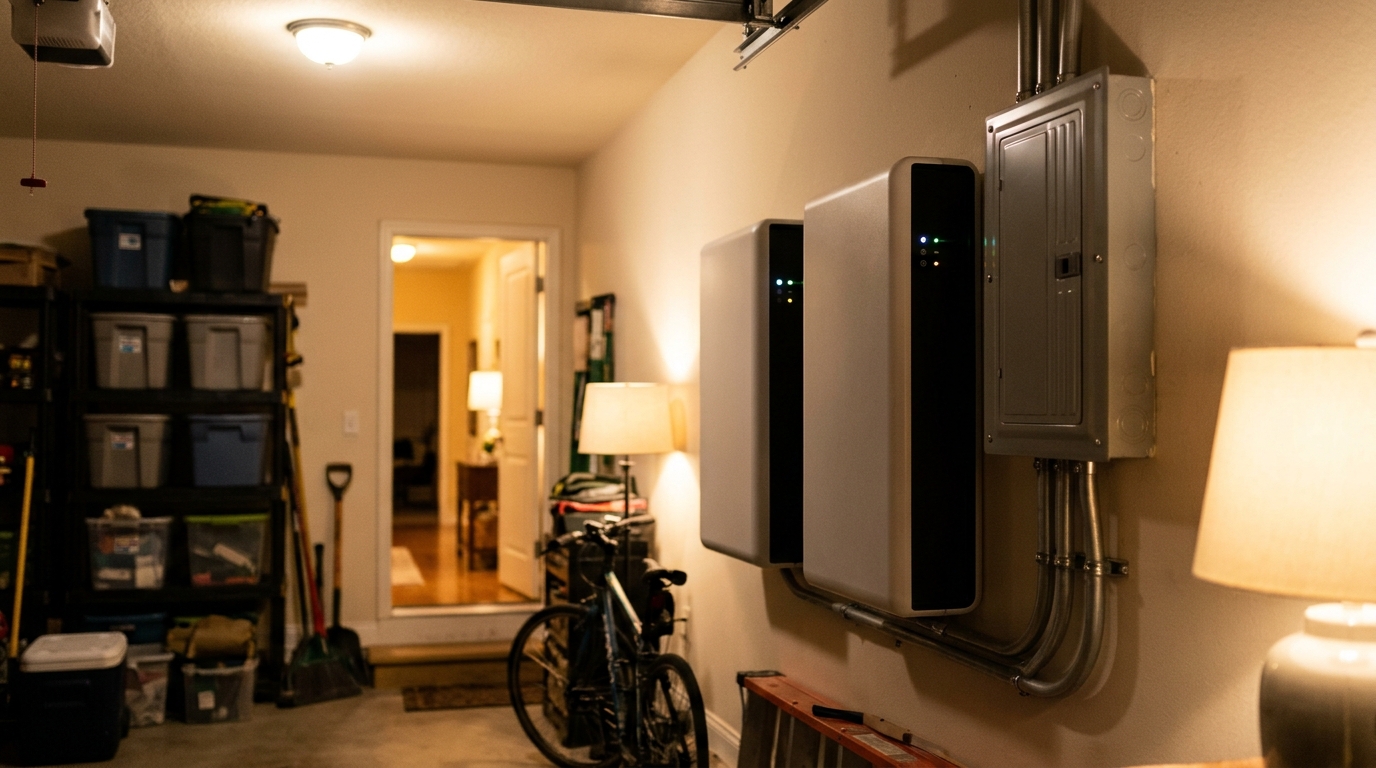
- Get three quotes from licensed installers. Ask each for the battery model, usable kWh, inverter kW, warranty terms, and the projected annual savings based on your actual rate plan.
- Size the system to your evening peak. Look at your smart meter data for the 4 to 9 p.m. window. Most homes land between 8 and 15 kWh, so one 10 to 13.5 kWh battery covers the majority of use.
- Confirm incentives before signing. The federal residential clean energy credit has covered 30% of battery costs in recent years, and many states and utilities add rebates. Rules change, so verify current eligibility with your installer and a tax professional.
- Have the installer program a TOU charge and discharge schedule: charge from the grid between roughly midnight and 6 a.m., discharge from 4 to 9 p.m., and reserve 20% of capacity for backup.
- After commissioning, review the monitoring app weekly for the first month. Adjust the reserve level and schedule if you find the battery empties before the peak window ends.
Why It Works: The Benefits
Shifting 8 to 10 kWh per day from a 35 cent peak rate to a 12 cent off-peak rate saves about $1.85 to $2.30 per day before efficiency losses, or roughly $600 to $800 per year.
Most whole-home batteries double as backup power. A 10 kWh battery can run a refrigerator, lights, internet, and phone chargers for 12 to 24 hours, which has real value in storm-prone areas.
Shifting load out of the 4 to 9 p.m. peak helps utilities avoid firing up expensive, high-emission peaker plants. In some areas, utilities pay you extra through demand response programs, often $50 to $200 per kW-year.
A battery installed today can later pair with rooftop solar. This raises self-consumption of solar from about 30 to 40% to 70 to 90%, which matters most where net metering pays poorly.
TOU peak rates have risen faster than off-peak rates in many markets. Every increase in the spread improves your battery’s return, so the investment gets better with time rather than worse.
💰 Savings Impact by Action
Charging at 12 cents and discharging at 35 cents cuts the cost of shifted energy by about 60%, lowering total bills by 25 to 35% on TOU plans.
Running dishwashers, laundry, and EV charging overnight trims another 8 to 12% from peak-period usage at no cost.
Where utilities bill for your highest 15-minute draw, a battery can flatten spikes and reduce demand charges by 10 to 20%.
Adding a battery to existing solar raises self-consumption from about 35% to 80%, avoiding up to 40% more of your purchased grid power.
The federal tax credit has covered 30% of installed battery cost in recent years, directly shortening payback by one to two years.
🏠 Key Concepts Explained
The Science Behind It
Electricity prices are high in the evening because of a mismatch between supply and demand. Solar generation fades around sunset just as people arrive home and turn on lights, ovens, and air conditioners. Grid operators cover that gap with fast-ramping natural gas plants that cost more to run, and TOU rates pass that cost through to customers. Overnight, demand drops while baseload plants and wind keep running, so wholesale power is cheap.
A battery exploits this by moving energy through time. In physics terms, you are converting electrical energy to chemical energy at night and back to electrical energy during the evening. The conversion is not perfect. Lithium batteries lose roughly 5 to 12% of the energy as heat in the cells and inverter, which is why the rate spread must exceed the losses. If you buy at 12 cents and get back 92% of it, your effective cost of stored power is about 13 cents, still far below a 35 cent peak rate.
The economics also depend on depth of discharge and cycle count. LFP chemistry tolerates deep, daily cycling far better than older lead-acid or nickel-based designs, which is why it dominates the home market. Each full cycle ages the battery slightly, so you can think of every stored kWh as carrying a small wear cost of about 2 to 4 cents. Even with that included, a 20 cent spread leaves a healthy margin.
Frequently Asked Questions
▼ Is a home battery worth it without solar panels?
It can be, but only if your peak-to-off-peak spread is about 15 to 20 cents per kWh or more. Run the numbers using your actual TOU rates and evening usage. If the spread is narrow, you are usually better off adding solar first or waiting for rates to widen.
▼ Why is my battery empty before the peak window ends?
Your evening load is likely larger than the battery’s usable capacity, or the reserve setting is holding back energy. Check your meter data for the true 4 to 9 p.m. use, then consider shifting big loads like the dryer or oven outside the peak window, or adding a second battery module.
▼ Can renters use a battery to save on peak rates?
Yes, with a portable power station on a smart plug schedule. You cannot wire into the panel without landlord approval, but a plug-in unit can cover a refrigerator, electronics, and a window AC. Expect to offset roughly 2 to 4 kWh per day.
▼ How long before I see savings on my bill?
You will see the change on your very next billing cycle, since the savings come from shifting daily usage. Track your on-peak kWh before and after in your utility portal to confirm. Full payback of the purchase price takes years, but the monthly bill reduction starts immediately.
▼ What happens to my battery if my utility changes its rates?
A narrower spread reduces savings, while a wider one increases them. Batteries still provide backup power and can switch to solar self-consumption or demand response income as alternatives. Review your plan annually and ask your installer about software updates that adjust the schedule.
Quick Tips
- Run your dishwasher, laundry, and EV charging overnight regardless of battery use. Shifting flexible loads is free and stacks with battery savings.
- Set your battery reserve to 20 to 30% if outages are a concern in your area, and lower it to 10% in mild seasons to capture more savings.
- Pre-cool or pre-heat your home during off-peak hours, then let the battery carry the HVAC through the evening peak.
- Check your TOU window dates each year. Many utilities adjust the peak hours between summer and winter, and your battery schedule should follow.
Variations for Your Situation
- Apartment/Rental: Skip the panel work and buy a 1 to 3 kWh portable LFP power station for $800 to $2,500. Pair it with a $15 smart plug to charge overnight, and plug in your refrigerator, router, and a window AC. You will shift roughly 2 to 4 kWh daily and save $150 to $300 per year.
- Tight Budget (under $50): You cannot buy storage, but you can shift loads. Move the dishwasher, washer, dryer, and EV or e-bike charging to off-peak hours using built-in delay timers, which are free. Pre-cool the house in the afternoon before peak starts. These steps alone often cut a TOU bill by 8 to 15%.
- Older Home (pre-1980): Older homes often have 100-amp panels and limited wall space, so confirm panel capacity before quoting a battery. Plan for a possible subpanel or load-management device ($500 to $2,000 extra), and prioritize air sealing and attic insulation first, since lowering evening HVAC demand shrinks the battery you need.