Your utility company may be sitting on one of the best deals in home efficiency, and most homeowners have no idea it exists. Free home energy audits, sometimes called home energy assessments, are offered by the majority of electric and gas utilities across the United States as part of state-mandated efficiency programs. A trained auditor visits your home, identifies where you are losing energy, and hands you a prioritized list of improvements. Some programs even include free weatherization materials or rebates on upgrades.
The average American household spends about $2,200 per year on energy bills, according to the U.S. Energy Information Administration. A professional audit followed by recommended improvements can reduce that by 15 to 30 percent, saving $330 to $660 annually. For homeowners who qualify for income-based programs like the Weatherization Assistance Program, the upgrades themselves may be fully funded at no cost. That is a significant return on a phone call or a few minutes on your utility’s website.
This post covers how to find and schedule a free audit through your utility, what to expect during the visit, how to prepare so you get the most out of it, and how to prioritize the resulting recommendations for the fastest payback. Whether you are a renter looking for leverage with your landlord or a homeowner ready to tackle insulation and air sealing, the audit is the right starting point.
What You’ll Need
Click on an item below to shop for the recommended items for this recipe on Amazon.
As an Amazon Associate, we earn from qualifying purchases.
How to Do It
- Visit your electric and gas utility’s website and search for ‘home energy audit,’ ‘home energy assessment,’ or ‘energy efficiency programs’ in the customer service or programs section.
- If you cannot find it online, call the customer service number on your monthly bill and ask specifically: ‘Do you offer a free home energy audit or assessment for residential customers?’ Utilities are required to inform you of available programs.
- Check your state energy office website (search your state name plus ‘energy office programs’) and the ENERGY STAR Rebate Finder at energystar.gov to confirm all programs available in your ZIP code.
- Schedule the audit appointment. Some utilities send their own staff; others use contracted energy auditors. Either way, the audit should be no cost or heavily subsidized, often under $50 for a comprehensive visit.
- Prepare for the appointment by gathering 12 months of energy bills (your utility can email these), noting any rooms that are consistently uncomfortable, and writing down known issues like drafty windows or a high heating bill.
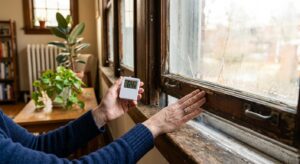
- On a cold or windy day, walk slowly along the base of all exterior walls with a stick of incense or a damp hand. Smoke disturbance or a cool sensation indicates air infiltration at sill plates, outlets, and pipe penetrations.
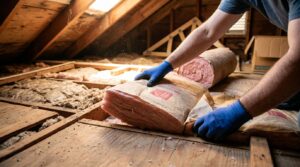
- Check your attic access panel or hatch for insulation depth. Use a ruler to measure. Recommended depth is R-38 to R-60 depending on your climate zone, which translates to roughly 10 to 15 inches of blown cellulose or fiberglass. Note the actual measurement.
- Inspect the water heater, furnace, and ductwork in unconditioned spaces for visible gaps, disconnected joints, or damaged insulation. Photograph anything that looks loose or corroded to show the auditor.
- Review 12 months of utility bills and calculate your home’s energy use intensity by dividing annual kWh by your home’s square footage. A typical home uses 5 to 8 kWh per square foot per year. Numbers above 10 indicate significant efficiency opportunities.
- Make a written list of comfort complaints by room, approximate ages of appliances and HVAC equipment, and any known moisture or condensation issues. Hand this list to the auditor at the start of the visit so they can tailor their assessment.
- After the audit, use the written report to prioritize improvements by simple payback period. Tackle anything with a payback under 3 years first, which typically includes air sealing, attic insulation top-ups, and thermostat programming.
- Determine eligibility: households at or below 200% of the federal poverty level qualify for WAP. Many state programs extend eligibility to 250 to 300% of the poverty level. Search ‘weatherization assistance program’ plus your state name or visit energy.gov/eere/wap.
- Contact your local Community Action Agency, which administers WAP funds at the local level. Find yours using the CSBG agency locator at communityactionpartnership.com or by calling 211.
- Submit your application with proof of income (tax return or pay stubs), a recent utility bill, and proof of residence. Wait times vary from a few weeks to several months depending on your state’s funding and backlog.
- A WAP-certified auditor visits your home and performs a full diagnostic audit including blower door and combustion safety testing at no charge.
- Approved weatherization work, which commonly includes attic insulation, air sealing, duct sealing, water heater insulation, and furnace tune-ups or replacement, is completed by certified contractors at zero cost to you.
Why It Works: The Benefits
Homes that complete audit-recommended improvements save an average of 15 to 30% on annual energy bills. On a $2,200 annual spend, that is $330 to $660 back in your pocket every year.
A utility-sponsored audit typically costs $300 to $500 if purchased privately. Getting it free means every dollar of savings from improvements is pure return with no diagnostic cost to recover.
Auditors flag utility rebates, state incentives, and federal tax credits you may not know about. The federal Energy Efficient Home Improvement Credit (25C) covers 30% of costs on insulation, air sealing, and heat pumps up to $3,200 per year.
Sealing air leaks and adding insulation eliminates cold drafts, hot spots, and humidity swings. Most homeowners report noticeably more even temperatures room-to-room within weeks of completing the recommended work.
Rather than guessing which project to tackle first, you get a ranked list based on your specific home’s performance. This prevents spending money on upgrades with poor payback while skipping ones that would pay back in under two years.
💰 Savings Impact by Action
Sealing attic bypasses, sill plates, and penetrations reduces infiltration-driven energy loss by up to 25% in leaky homes.
Upgrading attic insulation to R-38 or R-60 reduces heating and cooling load by 10 to 15% in most U.S. climate zones.
Sealing leaky ducts in unconditioned spaces recovers 20 to 30% of conditioned air that would otherwise be lost before reaching living areas.
Programming setbacks of 7 to 10 degrees for 8 hours per day saves approximately 10% annually on heating and cooling costs per DOE data.
Lowering water heater temperature to 120 degrees and insulating the first 6 feet of hot water pipes reduces water heating energy use by 6 to 10%.
🏠 Key Concepts Explained
The Science Behind It
A home loses and gains heat through three mechanisms: conduction through solid materials like walls and roofs, convection through air movement and infiltration, and radiation from warm surfaces to cooler ones. Most homeowners focus on insulation, which addresses conduction, but research from Lawrence Berkeley National Laboratory consistently shows that air infiltration accounts for 25 to 40% of total heating and cooling energy loss in a typical U.S. home. This makes air sealing the highest-return efficiency measure in most houses, with costs of $0.25 to $0.75 per square foot treated and paybacks under two years.
The blower door test quantifies air leakage by measuring the airflow required to maintain a 50 Pascal pressure difference between inside and outside the home. This result, expressed as CFM50 (cubic feet per minute at 50 Pascals), is used to calculate the home’s air changes per hour (ACH50). Typical existing homes measure between 5 and 15 ACH50. ENERGY STAR certified new construction requires under 3 ACH50, and Passive House standard is 0.6 ACH50. Knowing your number tells the auditor exactly how much room for improvement exists and allows them to estimate heating and cooling savings from air sealing in dollar terms specific to your home.
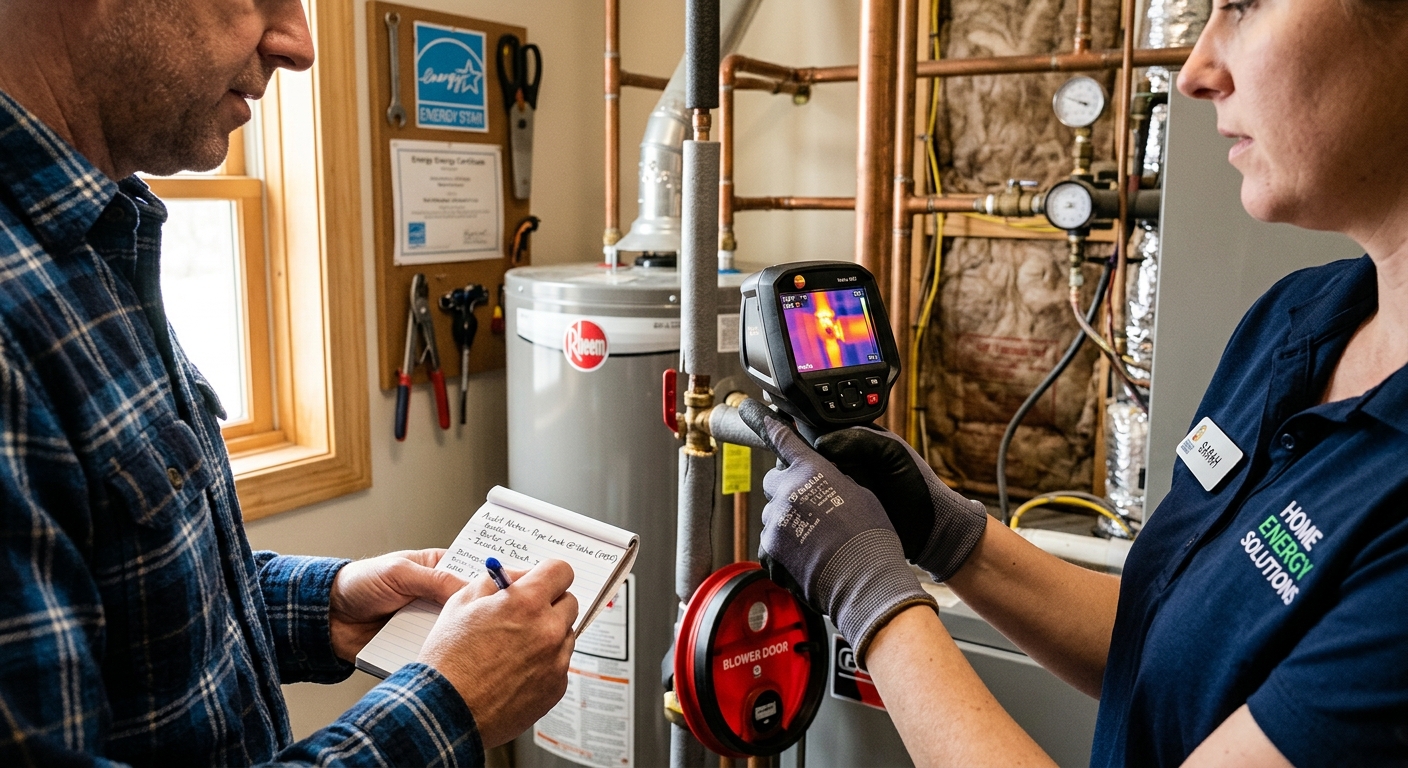
Infrared thermography works because all surfaces emit thermal radiation proportional to their temperature. An infrared camera converts these invisible emissions into a color-mapped image where temperature differences of less than 0.5 degrees Fahrenheit are visible. When combined with the blower door to create deliberate pressure-driven airflow, cold air infiltrating through a wall cavity or ceiling penetration shows up as a distinct blue streak against a warmer background. This allows the auditor to locate and document specific leak sites rather than making general recommendations, giving you and any contractor a precise map of where to apply caulk, foam, or weatherstripping.
Frequently Asked Questions
▼ My utility says they don’t offer free energy audits. What do I do?
First, ask specifically about ‘home energy assessments,’ ‘efficiency programs,’ or ‘weatherization rebates,’ as different utilities use different terminology. If none exist through your utility, check your state energy office website and the ENERGY STAR Rebate Finder at energystar.gov, which aggregates programs by ZIP code. You can also contact your local Community Action Agency about federal Weatherization Assistance Program eligibility, which bypasses your utility entirely.
▼ The auditor gave me a list of 15 things to fix. Where do I start?
Sort the recommendations by simple payback period and start with anything under three years. Air sealing and attic insulation top-ups typically pay back in one to three years and should come before window replacements, which often have paybacks of 20 or more years. If your report does not include payback periods, ask the auditor directly or use the DOE’s Home Energy Saver tool at homeenergysaver.lbl.gov to estimate them for your climate.
▼ Can renters request a utility energy audit for a rental property?
Yes, renters can often request an audit and some utilities allow the tenant to be the primary contact. However, the landlord typically must consent to the visit and any physical improvements. Use the audit report as a documented, data-backed conversation with your landlord, since upgrades like air sealing and insulation reduce their maintenance costs and protect the property. Some states have renter energy efficiency laws that give tenants additional leverage.
▼ How long after the audit will I actually see savings on my bill?
Free weatherization materials installed during the audit, like LED bulbs and faucet aerators, produce savings on your very next bill. Air sealing and insulation improvements show up within one to two billing cycles following the work, typically reducing heating or cooling bills by 15 to 25% compared to the same period the prior year. Compare year-over-year for the same month rather than month-to-month to account for weather variation.
▼ My home is older than 1980. Will the audit work differently for me?
Older homes almost always show larger opportunities and higher potential savings since they were built before modern energy codes. The auditor will pay extra attention to attic bypasses, which are open cavities through the top plate where interior walls meet the attic, as well as knob-and-tube wiring that limits insulation options. Make sure to disclose the age of your home and any known knob-and-tube wiring when scheduling so the auditor brings the right equipment and expertise.
Quick Tips
- Schedule your audit during heating season if possible. Cold outdoor temperatures make thermal differences more visible on infrared cameras and make air leaks easier to feel during the walk-through.
- Ask your utility if the audit report includes estimated savings in dollars per year for each recommendation, not just a list of things to fix. The best programs provide a simple payback period for each measure.
- If your utility does not offer a free audit, check with the other utility serving your home. Electric and gas utilities often have separate programs, and you may qualify for both.
- After receiving your report, get contractor bids only for measures with a payback under five years and apply every available rebate before paying out of pocket. Stack federal tax credits on top of utility rebates for maximum return.
Variations for Your Situation
- Apartment or Renter: Request the audit through your utility account and invite your landlord to attend the visit. Focus your follow-up on portable improvements you control, such as interior window insulation film ($15 to $30 per window), door draft snakes, and smart plugs to eliminate phantom loads. Use the audit report to formally request landlord upgrades in writing, citing the documented savings and available rebates that reduce their cost.
- Tight Budget (under $50): Even without any follow-up spending, the audit itself is free and gives you a prioritized to-do list for DIY air sealing. A $12 can of spray foam and a $6 tube of caulk address the most common leaks around pipes, wires, and sill plates. Many utilities also mail free weatherization kits with LED bulbs and aerators after the audit at no additional cost. Focus entirely on air sealing and thermostat setbacks before spending anything on materials or equipment.
- Older Home (pre-1980): Request that the auditor specifically test for combustion safety and check for vermiculite insulation (which may contain asbestos) in the attic before any insulation work begins. Older homes typically have ACH50 readings above 10, meaning air sealing alone can cut heating bills by 20 to 35%. Budget $500 to $1,500 for professional air sealing of the attic floor plane after the audit, as this single measure delivers the fastest payback in leaky older construction.