The average American household uses about 82 gallons of water per person per day, according to the EPA, and a significant chunk of that goes straight down the drain unused. Whether your bill has been creeping up quietly or you just got a shocking statement, the good news is that water waste follows predictable patterns, and most of them are surprisingly easy to fix. Leaky toilets, outdated showerheads, and irrigation habits alone can account for more than half your monthly consumption.
What makes water waste so frustrating is that it’s largely invisible. A running toilet can silently dump 200 gallons a day into the sewer, adding up to $70 or more per month on a typical utility rate of $0.01 per gallon. A dripping faucet doesn’t seem like much, but at 10 drips per minute it wastes over 500 gallons per year. These aren’t hypothetical numbers, they’re documented averages from EPA WaterSense data, and they mean that fixing a handful of small problems can produce real, measurable savings on your very next bill.
This post walks you through the five highest-impact fixes for a high water bill, from free zero-tool changes you can make in the next ten minutes to smart upgrades that pay for themselves in a few months. You’ll also find troubleshooting guidance, savings breakdowns by category, and tips for renters and older homes where standard advice often falls short.
What You’ll Need
Click on an item below to shop for the recommended items for this recipe on Amazon.
As an Amazon Associate, we earn from qualifying purchases.
How to Do It
- Perform the toilet dye test: drop 5 to 10 drops of food coloring into each toilet tank, wait 10 minutes without flushing, and check the bowl. If color appears in the bowl, the flapper is leaking and needs replacing.
- Check your water meter: turn off all water in the house, read the meter, wait 30 minutes without using any water, then read it again. Any movement confirms a hidden leak somewhere in the system.
- Time your showers and set a household goal of 5 minutes or less. A 10-minute shower at 2.5 GPM uses 25 gallons. Cutting to 5 minutes cuts that to 12.5 gallons, a 50% reduction with zero hardware cost.
- Stop pre-rinsing dishes before the dishwasher. Modern dishwashers are designed to handle food particles, and pre-rinsing wastes 6,000 to 10,000 gallons per year. Scrape plates instead.
- Shift outdoor watering to 5 to 9 AM. This single timing change reduces evaporative loss by up to 30%, meaning your lawn gets the same benefit from 30% less water.
- Replace toilet flappers on any toilet that failed the dye test. A universal flapper costs $5 to $10 at any hardware store, installs in under 10 minutes with no tools, and immediately stops a leak wasting up to 200 gallons per day.
- Install WaterSense-certified showerheads (1.5 to 2.0 GPM) in each bathroom. Use adjustable pliers and plumber’s tape to seal the connection. A family of four saves 2,900 to 7,000 gallons per month from this one change alone.
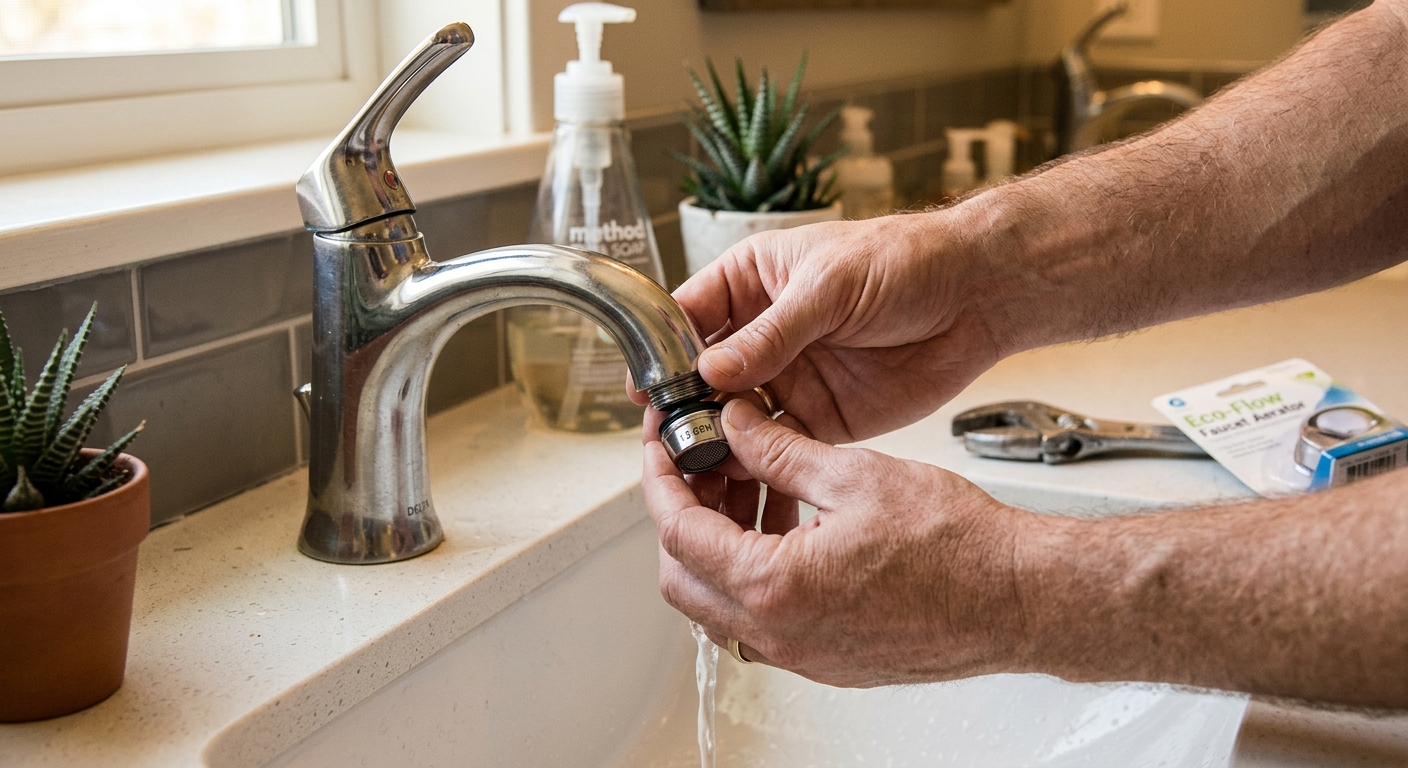
- Add faucet aerators to kitchen and bathroom sinks. Standard aerators restrict flow to 1.0 to 1.5 GPM from the old 2.2 GPM standard. Aerators cost $3 to $8 each and screw on by hand in under two minutes.
- Replace or adjust the toilet fill valve if the tank is slow to fill or runs intermittently. A fill valve kit costs $10 to $15 and a misadjusted float can cause the tank to overfill and constantly drain into the overflow tube.
- Inspect all visible supply lines under sinks, behind toilets, and at the washing machine for drips, corrosion, or mineral buildup. Tighten loose connections by hand first, then a quarter-turn with a wrench. Replace braided lines showing cracks or bulging for $8 to $15 each.
- If you have an irrigation system, install a rain sensor shutoff ($20 to $35) that prevents sprinklers from running during or after rainfall. The EPA estimates smart irrigation controls cut outdoor water use by 15% on average.
- Install a smart irrigation controller (such as Rachio or RainBird ST8I) that uses local weather data and soil type to water only when needed. These systems reduce outdoor water use by 30 to 50% and pay back their $150 to $250 cost within one to two irrigation seasons in most climates.
- Have a licensed plumber check and adjust your home’s water pressure regulator. Ideal pressure is 50 to 60 PSI. If yours is above 80 PSI, reducing it cuts water throughput at every fixture simultaneously and extends the life of all valves and supply lines.
- Replace a standard toilet (3.5 to 5 gallons per flush) with a WaterSense-certified dual-flush model (0.8 to 1.28 gallons per flush). A family of four flushing 15 times per day saves roughly 10,000 gallons per year per toilet replaced.
- Install a hot water recirculation pump with a timer or motion sensor on your water heater. This eliminates the wait for hot water at distant fixtures, stopping the 5 to 15 gallons wasted per shower before hot water arrives.
- Consider a whole-home leak detection device (such as Flo by Moen or Phyn Plus) that monitors flow 24 hours a day and auto-shuts water off during detected leaks. These devices cost $300 to $500 installed and can prevent the average $11,000 in water damage from undetected leaks.
Why It Works: The Benefits
Fixing the top five waste sources, including toilet leaks, showerheads, and irrigation, can reduce the average household water bill by 30 to 50%, saving $200 to $600 per year depending on local rates and family size.
Roughly 17% of a home’s energy bill goes toward heating water. Installing a 1.8 GPM showerhead instead of a 2.5 GPM model reduces hot water demand by 28%, trimming both the water bill and the gas or electric water heater bill simultaneously.
Most municipalities charge sewer fees based on incoming water volume, often at a 1:1 ratio. Every gallon saved on water is also a gallon deducted from the sewer charge, effectively doubling the financial impact of each fix.
U.S. water rates have increased an average of 5.5% per year over the last decade. Reducing consumption now locks in a lower baseline so each future rate hike hits a smaller volume, compounding your savings over time.
Silent leaks at supply lines, toilet flappers, and under-sink connections don’t just waste water. Left undetected, they can cause mold growth, subfloor damage, and insurance claims averaging $11,000 per incident according to the Insurance Information Institute.
💰 Savings Impact by Action
A leaking flapper wasting 200 gallons per day accounts for up to 30% of total household water use and is eliminated with a $5 to $10 part.
Replacing a 2.5 GPM showerhead with a 1.5 GPM WaterSense model cuts shower water use by 40%, typically saving 10 to 20% of total household consumption.
Smart irrigation controllers and early-morning watering timing reduce outdoor water use by 30 to 50%, which dominates total consumption in warm-climate homes.
Aerators cut kitchen and bathroom faucet flow from 2.2 GPM to 1.0 GPM, reducing faucet-related consumption by up to 50% and total home use by 6 to 10%.
Eliminating pre-rinsing, shortening showers by 5 minutes, and running full appliance loads reduces total consumption by 10 to 15% with no hardware cost.
🏠 Key Concepts Explained
The Science Behind It
Water waste in homes is almost always a flow and pressure problem. Every fixture in your house has a rated flow in gallons per minute, and every leak is essentially an uncontrolled fixture running 24 hours a day. The math is simple: a toilet flapper leaking at just 1 gallon per minute wastes 1,440 gallons per day, roughly what a typical household uses in two weeks. This is why a single faulty $5 part can account for more than 30% of a home’s entire monthly water consumption.
Pressure amplifies everything. Water flowing through a pipe exerts force on every joint, valve seat, and washer in the system. When residential pressure exceeds 80 PSI, the volume delivered per unit time at each fixture increases beyond the fixture’s rated output, meaning you’re using more water per second than the manufacturer’s efficiency rating assumed. A pressure regulator set to 55 PSI reduces that throughput proportionally, cutting consumption at every fixture simultaneously without any perceptible change in performance for the user.
Outdoor water waste is governed by evapotranspiration, the combined rate at which soil and plants release moisture to the atmosphere. During midday in summer, surface temperatures and solar radiation drive evaporation rates to 0.2 to 0.3 inches of water per hour. Irrigation water applied at this time loses 30 to 50% to the air before reaching roots. Shifting watering to early morning, when temperatures are lowest and wind is calm, means nearly 100% of applied water reaches the root zone. Smart irrigation controllers automate this by pulling local evapotranspiration data daily and adjusting run times accordingly, which is why they consistently outperform manual schedules by 30 to 50% in water savings.
Frequently Asked Questions
▼ My water bill is high but I can’t find any leaks. What am I missing?
The most commonly missed culprits are toilet flappers (run the dye test on every toilet, not just the ones you suspect) and irrigation systems with cracked drip lines or stuck solenoid valves. Also check your water softener if you have one. A malfunctioning softener can cycle continuously and dump hundreds of gallons per regeneration cycle. If the meter test confirms a leak but you cannot locate it visually, call a plumber for a pressure decay test, which can isolate a hidden leak in the main line under your slab.
▼ I replaced my showerhead and flapper but my bill barely moved. Why?
Check when the bill was generated relative to when you made the fixes. Water utility billing periods often lag by 30 to 45 days, so changes made mid-cycle won’t show up until the following statement. Also verify your shower flow rate by filling a one-gallon bucket under the new head and timing it. If it fills in less than 30 seconds, the showerhead flow restrictor may have been removed by a previous occupant. Finally, look at your irrigation: outdoor watering often accounts for 30 to 50% of total use and overshadows indoor fixture savings.
▼ Can renters do any of these fixes without landlord permission?
Yes, several fixes require no landlord involvement at all. Faucet aerators screw on and off by hand and can be swapped back when you move out. Low-flow showerheads replace existing ones in minutes and are fully reversible. Behavioral changes like shorter showers and full dishwasher loads are entirely within your control. For flapper replacements or supply line issues, document the problem with photos and report it in writing to your landlord, since leaks are typically a maintenance obligation on their end.
▼ How much can I realistically save if I rent and can’t upgrade appliances?
Renters who focus on behavioral changes and swap-out fixtures (showerheads, aerators) can reasonably cut personal water use by 15 to 25%. If your unit has an identifiable leak like a running toilet, report it immediately because the landlord is typically financially responsible for that waste. In states where renters pay individual water bills, documenting and fixing leaks can save $20 to $60 per month without any landlord conflict.
▼ My home is 40 years old. Are these fixes still worth doing or is the plumbing too old to bother?
The fixture-level fixes (showerheads, aerators, flappers) work regardless of home age and carry no risk. The caution with older homes is in the supply lines. Galvanized steel pipes common before the 1980s corrode from the inside out, restricting flow and becoming brittle. Before tightening or replacing any fitting connected to galvanized pipe, probe the exterior with a magnet. If it’s magnetic and shows orange rust staining, have a plumber assess the pipe condition before you attempt DIY repairs, since cracking an old joint can turn a simple upgrade into an emergency.
Quick Tips
- Check your water bill for a ‘leak indicator’ or ‘continuous use’ flag. Many utilities now print this alert automatically when usage patterns suggest a running fixture.
- Insulating hot water pipes with foam pipe wrap ($0.50 per foot) reduces heat loss in transit, so hot water arrives faster and you waste fewer gallons waiting at the tap.
- Run only full loads in the dishwasher and washing machine. A modern dishwasher uses 3 to 5 gallons per cycle regardless of load size. Skipping a half-load saves the full cycle’s worth of water.
- Fix outdoor hose bib drips immediately. A single dripping outdoor faucet at 10 drips per minute wastes over 500 gallons per year, and outdoor leaks are frequently overlooked because no one walks past them daily.
Variations for Your Situation
- Apartment or Rental: Focus on the three no-permission fixes: swap the showerhead to a WaterSense model (1.8 GPM, $15 to $30), add aerators to every faucet ($3 to $8 each), and run the toilet dye test. If dye appears in the bowl, photograph it and submit a written maintenance request. Together these changes can cut personal water use by 15 to 25% with zero landlord friction and full reversibility when you move.
- Tight Budget (under $50): Start with the meter test and food coloring dye test at zero cost to identify whether you have a leak. If you do, a flapper kit is $5 to $10 and the highest ROI fix in plumbing. Add a $4 faucet aerator to the kitchen sink and a $15 to $25 WaterSense showerhead. These three items total under $40 and address the three largest indoor water waste sources for most households.
- Older Home (pre-1980): Prioritize the dye test and meter test first since older homes have had more years for small leaks to develop. Avoid aggressive DIY work on galvanized supply lines or original shutoff valves, which may not have been operated in decades and can fail when turned. Budget $100 to $200 for a licensed plumber to inspect supply lines, check pressure, and replace any questionable shutoff valves before you tackle fixture swaps yourself.