You’ve caulked around windows, weather-stripped the front door, and maybe even added insulation to the attic. But there’s a draft source most homeowners never think to check: the electrical outlets and switch plates on your exterior walls. Each one of these is essentially a small hole punched through your wall, connecting your warm living space directly to the cold air lurking inside your wall cavities. On a windy day, you can sometimes feel the chill just by holding your hand near an outlet.
The good news is this is one of the easiest and most affordable air-sealing fixes you can make. Pre-cut foam gaskets cost about $5 to $10 for a pack of 25, they install in minutes with no tools required, and they’re available at every hardware store. The Department of Energy identifies air infiltration through outlets, pipes, and wall penetrations as responsible for up to 20% of a home’s total heat loss, and while outlets alone won’t account for all of that, they’re a meaningful and often overlooked piece of the puzzle.
In this post, we’ll walk you through exactly how to identify which outlets and switches are leaking air, how to seal them with foam gaskets, and how to take the fix a step further with a full air-sealing approach for maximum winter comfort and savings.
What You’ll Need
Click on an item below to shop for the recommended items for this recipe on Amazon.
As an Amazon Associate, we earn from qualifying purchases.
How to Do It
- Turn off the circuit breaker for any outlet or switch you plan to work on. Verify power is off with a non-contact voltage tester before touching anything.
- Walk your home’s exterior-facing walls and identify all outlets, switches, and phone or cable plates. These are your targets. Interior walls are not a priority.
- Purchase pre-cut foam outlet gaskets from any hardware store. They come in packs labeled for single or duplex outlets and single or double switches. Make sure you buy the right shape for each plate style.
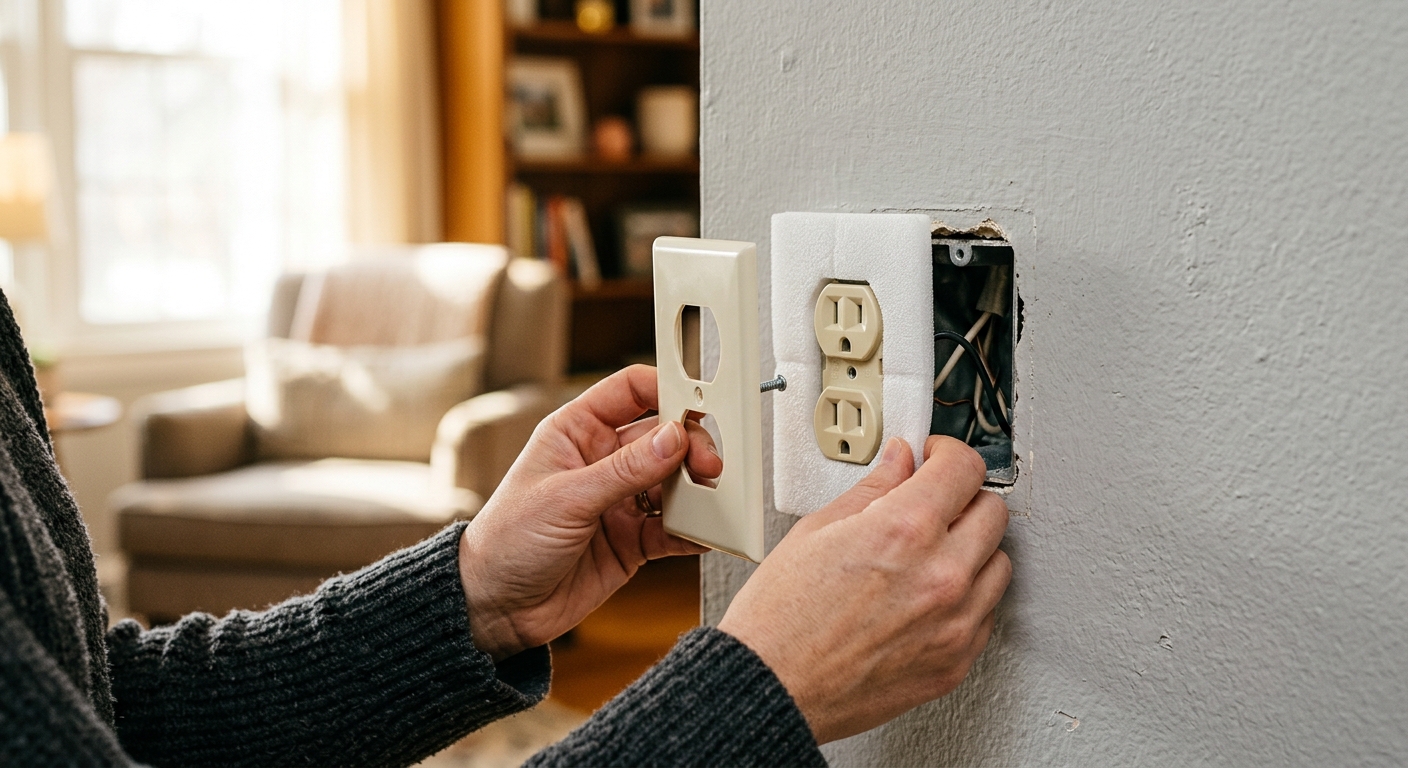
- Remove the outlet or switch cover plate by unscrewing the single center screw. Set the screw aside carefully.
- Place the foam gasket flat against the electrical box with the cutouts aligned over the outlet slots or switch toggle. It should sit flush with no bunching.
- Replace the cover plate over the gasket and tighten the screw snugly. Restore power and test the outlet. Repeat for every exterior-wall plate in your home.
- Turn off the circuit at the breaker and confirm power is off with a non-contact voltage tester. Remove the cover plate and set it aside.
- Carefully pull the outlet or switch slightly out of the box to inspect the back and sides of the electrical box for visible gaps where wiring enters and where the box meets the drywall.
- Use low-expansion fire-rated foam sealant or non-hardening acoustical sealant to fill any gaps around wire entry points at the back of the electrical box. Do not spray foam directly onto wiring. Keep foam away from any live components.
- If there is a visible gap between the edge of the electrical box and the drywall, apply a thin bead of paintable latex caulk around the perimeter of the box where it meets the wall surface. Smooth with a damp finger.
- Allow sealant to cure per manufacturer instructions (typically 1 hour for caulk, 2 hours for foam). Then install a foam gasket as described in the Quick Fix approach.
- Replace the cover plate, restore power, and test. Consider adding a child-safety outlet plug or tamper-resistant cover as a secondary draft reducer on outlets not in frequent use.
Why It Works: The Benefits
Sealing outlets and switches is one component of whole-home air sealing, which the DOE estimates can reduce heating and cooling costs by 10 to 20% annually. Even addressing only outlets typically recovers a few percentage points of that savings with almost zero investment.
Eliminating cold air infiltration at outlets on exterior walls reduces cold spots along those walls, making rooms feel warmer at the same thermostat setting. This is especially noticeable in bedrooms and living rooms with outlet-heavy exterior walls.
Air coming through wall cavities carries dust, insulation fibers, and outdoor allergens. Sealing outlets reduces this pathway, which can improve indoor air quality and reduce how often you need to dust surfaces near exterior walls.
A full pack of foam gaskets covering 25 outlets costs $5 to $10 and takes under an hour to install. Even a conservative 3 to 5% reduction in heating costs for a home with a $150 monthly heating bill returns the investment in the first month of winter.
The same gaps that let cold air in during winter allow conditioned air to escape in summer, increasing cooling loads. Sealing outlets now delivers benefit in both heating and cooling seasons, making the annual value even greater.
💰 Savings Impact by Action
Sealing outlets and switch plates on exterior walls can reduce localized air infiltration at those points by up to 10%, contributing to overall envelope tightness.
Whole-home air sealing including outlets, attic bypasses, and penetrations reduces heating and cooling costs by 10 to 20% according to DOE estimates.
Adding fire-rated sealant around the electrical box itself, beyond just the gasket, reduces residual air movement through the box by an additional estimated 5%.
Reducing cold-air infiltration at exterior walls can lower perceived cold-spot intensity by 15% or more, allowing thermostat setpoints to be reduced by 1 to 2 degrees without discomfort.
🏠 Key Concepts Explained
The Science Behind It
Your home’s exterior walls are supposed to function as a continuous air barrier, slowing the movement of outside air into your conditioned living space. In practice, every penetration through that wall, including electrical boxes, creates a weak point. Standard electrical boxes are not designed to be airtight. They have open knockouts in the back and sides for wiring, and they’re often installed with gaps between the box flange and the drywall. All of this connects your living room directly to the cold, unconditioned air inside your wall cavity.
Wall cavities in exterior walls are essentially in contact with outdoor conditions. Even when packed with fiberglass batt insulation, those cavities still contain air that cycles toward outdoor temperatures. Fiberglass insulation slows conductive heat transfer well, but it does almost nothing to stop air movement. When wind pressurizes one side of the house, air is pushed through every available gap, and outlets are prime candidates. Research from Lawrence Berkeley National Laboratory has shown that electrical outlets can contribute meaningfully to a home’s overall air leakage rate, particularly in homes built before 1980 when air sealing standards were nonexistent.
Foam polyethylene gaskets work by creating a physical barrier that closes off the space between the cover plate and the wall surface. They don’t seal the electrical box itself perfectly, which is why the full DIY approach also addresses the back and sides of the box with fire-rated sealant. Together, these two layers of protection interrupt the air pathway at both the box-to-wall interface and the wall-to-room interface, giving you a genuinely tighter envelope at minimal cost.
Frequently Asked Questions
▼ How do I know which outlets are on exterior walls vs interior walls?
Stand inside the room and look at which walls face the outside of the house. Outlets on those walls are your targets. You can also check from outside: exterior walls are the ones you see when walking around the home’s perimeter. In two-story homes, the exterior walls extend up through both floors, so check all floors.
▼ I installed the gaskets but can still feel a draft. What am I missing?
Gaskets seal the plate-to-wall gap but don’t fully seal the electrical box itself. Move to the full DIY approach and use fire-rated foam sealant around wire entry points at the back of the box. Also double-check that the gasket is the right size and seated flat with no gaps around the edges, and that the cover plate is screwed down snugly.
▼ Can renters do this without landlord permission?
Foam outlet gaskets are a completely reversible, tool-minimal change that most landlords would have no objection to. The gasket is hidden under the cover plate and leaves no marks. That said, if your lease requires approval for any modifications, a quick email to your landlord describing what a foam gasket is will almost certainly get a yes. Skip the caulk and sealant steps if you want to stay fully reversible.
▼ Will adding gaskets cause any electrical problems or code violations?
No. Pre-cut foam outlet gaskets are a standard, code-compliant product sold specifically for this purpose and found in every major hardware store. They don’t interfere with outlet function, don’t affect circuit capacity, and don’t create any heat buildup risk when installed correctly. Just make sure you’re using a gasket rated for the outlet type you have.
▼ How long before I actually see savings on my energy bill?
Because heating bills fluctuate with weather, you’ll get the clearest picture by comparing this January’s bill to last January’s, adjusting for any especially cold or warm spells. Many homeowners notice the comfort improvement, less noticeable cold spots near exterior walls, within the first cold day after installation. The bill savings show up cumulatively over the heating season rather than as a single dramatic drop.
Quick Tips
- Focus your effort on outlets and switches on north-facing and west-facing exterior walls first, since these typically face the prevailing winter winds and show the most infiltration.
- Don’t overlook cable TV, phone, and ethernet wall plates. These often have larger open gaps behind them and no internal mechanism to partially block airflow the way an outlet does.
- After sealing, keep a list of which breakers control which exterior outlets so future work is faster and safer.
- If you’re doing this project in fall before heating season, pair it with a full weatherstripping check on doors and windows the same day to maximize your pre-winter efficiency gains.
Variations for Your Situation
- Apartment/Rental: Foam gaskets are your best friend here because they require no landlord approval, cost under $10, and come out cleanly when you move. Focus on any exterior-facing outlets in your unit, which in apartments are most common on the outermost wall of the building. Skip all sealant steps and stick to gaskets only for a fully reversible fix.
- Tight Budget (under $50): A single pack of foam gaskets covering 25 outlets runs $5 to $8 and is your entire investment for the quick fix approach. Prioritize the three to five outlets and switches on your coldest exterior wall first. The incense or tissue test costs nothing and helps you find the worst offenders so every dollar of gasket goes to the highest-impact spot.
- Older Home (pre-1980): Homes built before modern energy codes often have larger gaps around electrical boxes, older single-gang steel boxes with more open knockouts, and less insulation in wall cavities overall. In these homes, do both the gasket and the full sealant approach on every exterior outlet, and strongly consider a blower door test from a local energy auditor to identify additional major air leakage points that outlets alone won’t fix.