Your windows are one of the most powerful tools in your home’s cooling arsenal, yet most people either keep them shut all summer or open them randomly without a strategy. The truth is that window placement, orientation, and timing work together with natural airflow physics to either help your AC or replace it entirely on mild days. Getting this wrong means you’re letting hot air in when the house is cool, or missing free cooling opportunities when outdoor temps drop at night.
Natural ventilation through smart window use can reduce indoor temperatures by 5 to 15 degrees Fahrenheit on mild days, and in dry climates or during shoulder seasons, it can eliminate the need for mechanical cooling altogether. The Department of Energy estimates that strategic natural ventilation can cut cooling energy use by 10 to 30% in climates where nights cool below 68 degrees Fahrenheit. That translates to real dollars: in a home spending $150 per month on summer cooling, that’s $15 to $45 back in your pocket every month.
This post covers how air actually moves through windows, how to read your home’s layout for cross-ventilation opportunities, and two practical approaches you can start using today, from a zero-cost behavioral strategy to a weekend DIY upgrade that improves airflow for years to come.
What You’ll Need
Click on an item below to shop for the recommended items for this recipe on Amazon.
As an Amazon Associate, we earn from qualifying purchases.
How to Do It
- Check your local forecast each evening. If overnight lows will drop below 68 degrees Fahrenheit, plan to open windows after sunset and close them before 9 AM the next morning.
- Identify your home’s shaded side, typically the north and east faces. Open windows on that side first to bring in cooler air as your inlet.
- Open a window or interior door on the opposite side of the home to create a cross-ventilation path. If you have a second floor, open a high window up there as your outlet to harness the stack effect.
- Keep south and west-facing windows closed and covered with blinds or shades from 10 AM to 6 PM. Direct afternoon sun through unshaded glass can add 200 to 400 BTUs per square foot of window, overwhelming the cooling benefit of open windows.
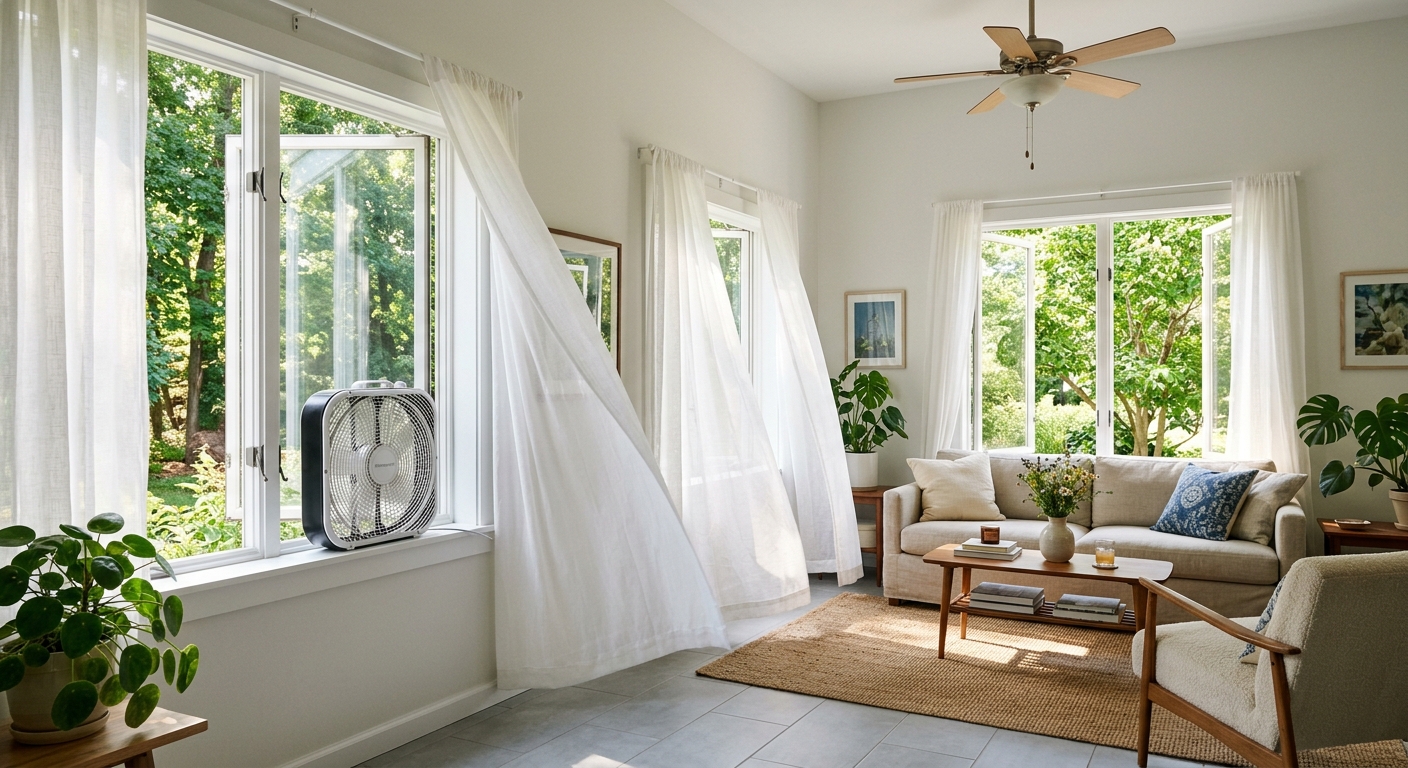
- Use box fans in outlet windows facing outward to actively exhaust warm air and pull the cross-ventilation flow through faster. This can increase air changes per hour by 2 to 3 times compared to passive ventilation alone.
- Close all windows once outdoor temperature exceeds indoor temperature, usually by mid-morning. Keeping a cheap indoor-outdoor thermometer visible near your main living area makes this decision effortless.
- Map your home’s airflow paths by holding a lit incense stick near window frames on a breezy day. Watch where smoke goes to identify your prevailing wind direction and any gaps or obstructions in your ventilation path.
- Install window insect screens with high open-area mesh (look for screens labeled 18×14 or 18×16 mesh) on your primary inlet windows. Standard screens block 20 to 30% of airflow, while high-flow screens reduce that to under 10%.
- Add window fans with reversible airflow to your primary outlet windows. A quality 20-inch window fan moves 2,000 to 3,000 cubic feet per minute and costs $40 to $80. Set inlet-side fans to pull air in and outlet-side fans to push air out for maximum throughput.
- Install adjustable window vent stops or chain locks that let you secure windows at a fixed 4 to 6 inch opening safely. This lets you leave windows open at night without a full security or bug risk, maintaining airflow while you sleep.
- Add interior window shades rated for solar reflectance on south and west-facing windows. Cellular honeycomb shades with an R-value of 3 to 5 reduce heat gain through glass by 40 to 60% when closed during peak sun hours, keeping the home cooler so natural ventilation is more effective.
- Consider adding a whole-house or attic fan if your home has good cross-ventilation paths. A whole-house fan sized at 1.5 to 2 CFM per square foot of living area can cool an entire home in 15 to 30 minutes of operation on a mild evening, using about one-tenth the electricity of central AC.
Why It Works: The Benefits
Homes using strategic natural ventilation consistently report 10 to 30% reductions in cooling energy use. On a $150 monthly summer cooling bill, that saves $15 to $45 every month from June through September.
Every hour your AC stays off because natural ventilation is handling the load extends the life of your compressor and reduces maintenance costs. A system that runs 20% less accumulates wear significantly more slowly, potentially adding years to its service life.
Flushing stale indoor air with fresh outdoor air dilutes VOCs from furniture, cleaning products, and building materials. Studies show indoor air can be 2 to 5 times more polluted than outdoor air, and regular ventilation is one of the most effective ways to address that.
Moving air at 1 to 2 mph across skin creates a wind-chill effect that makes 78 to 80 degrees Fahrenheit feel like 74 to 76 degrees. On mild days, this can make the home feel comfortable without any AC at all.
Opening windows when outdoor temps drop below 68 degrees Fahrenheit at night flushes stored heat from walls, floors, and furnishings. This can delay the need to run AC by 2 to 4 hours the following morning, reducing peak-hour energy demand.
💰 Savings Impact by Action
Pre-cooling thermal mass with night ventilation delays AC startup by 2 to 4 hours, reducing daily cooling energy use by up to 20% on eligible nights.
Keeping south and west windows shaded during peak hours reduces solar heat gain by up to 65%, cutting overall cooling load by 20 to 30%.
Proper cross-ventilation with fans on mild days can replace mechanical cooling entirely, saving 100% of AC energy on those days and averaging 10 to 15% monthly.
Installing cellular honeycomb shades on high-gain windows reduces heat transmission through glass by 40 to 60%, lowering total cooling load by 8 to 12%.
🏠 Key Concepts Explained
The Science Behind It
Natural ventilation works because air moves from high pressure to low pressure, and because warm air is less dense than cool air. When you open windows on opposite sides of a home, wind pressure on the windward side pushes air in, and the lower pressure on the leeward side pulls it out. This pressure-driven flow is what creates the cross-ventilation effect, and its volume depends on wind speed, window size, and whether there are obstructions in the flow path like closed interior doors.
The stack effect adds a thermal dimension to this. Inside a home, air near the floor tends to be cooler and denser, while air near the ceiling is warmer and less dense. When a high outlet like a clerestory window or ridge vent is opened, warm buoyant air escapes upward, and its departure creates a slight negative pressure that draws cooler air in through lower openings. This effect works even on still days with no wind, making it especially valuable during calm, hot summer nights. The taller the home and the greater the temperature differential between inside and outside, the stronger the stack-driven flow.
Thermal mass is the third piece of the puzzle. Dense materials like concrete, brick, and tile have high heat capacity, meaning they can absorb large amounts of heat energy with only a modest rise in surface temperature. When you flush cool night air through the home, these materials absorb that coolness. The next day, as temperatures rise, the thermal mass resists heating up by absorbing heat from the air, acting as a passive thermal battery. This is why homes with tile floors and masonry walls stay cooler longer into the afternoon than lightweight wood-frame homes with carpet, and why night-flushing is far more effective in those homes.
Frequently Asked Questions
▼ I open my windows at night but the house still feels warm in the morning. What am I doing wrong?
The most common cause is not enough airflow volume or not flushing the home long enough. Try running a box fan in the outlet window and make sure interior doors are open to create a clear path from inlet to outlet. Aim for at least 4 to 6 hours of active ventilation. Also confirm outdoor temps are actually dropping below 68 degrees Fahrenheit in your area before opening up.
▼ My windows only open on one side of the room. Can I still get cross-ventilation?
Yes, but you need to create an outlet elsewhere. Open interior doors to adjacent rooms that have windows on different walls, or use a window fan exhausting into the hallway to pull air through your single-window room. You can also crack a skylight or bathroom exhaust fan cover on the opposite side to create a pressure difference.
▼ Does this work in a humid climate like Florida or Houston?
Natural ventilation is much less effective in high-humidity climates because bringing in outdoor air at high relative humidity makes the home feel hotter and stickier, and can exceed your AC’s dehumidification capacity. In these climates, focus on the quick_fix approach only on the rare dry, mild days, and prioritize exterior shading and tight building envelope improvements over ventilation strategies.
▼ How do I find my prevailing wind direction without a weather station?
Check your local National Weather Service office website, which publishes prevailing summer wind data by city. Alternatively, watch flags, wind chimes, or trees for a few evenings in a row at sunset when sea breezes or drainage winds are most consistent. In most of the continental US, summer winds come from the south or southwest.
▼ Will opening windows at night during pollen season make my allergies worse?
Yes, night ventilation during high pollen periods can significantly worsen indoor allergen levels. Check your local pollen count via weather apps or pollen.com before opening windows. On high pollen nights, keep windows closed and use your AC’s recirculate mode instead. Consider a whole-house fan with a MERV-8 filter attachment as an alternative that ventilates while filtering out most pollen.
Quick Tips
- Use a weather app that shows hourly temperature forecasts to plan your open-and-close schedule the evening before, rather than guessing in the morning.
- Place a box fan in a hallway pointing toward an upper-floor outlet window to create a chimney effect that pulls cool air through the entire vertical height of the home.
- Exterior awnings over south and west windows reduce solar heat gain by up to 65% while still allowing windows below them to be opened for ventilation, unlike interior blinds that trap heat inside the glass.
- On humid days above 70% relative humidity outdoors, keep windows closed and rely on AC. Humid air negates the evaporative cooling effect on skin and can introduce moisture that raises cooling loads.
Variations for Your Situation
- Apartment or Rental: Renters cannot install whole-house fans or replace screens, but the behavioral strategy is completely free and effective. Use a reversible window fan ($40 to $80) placed in a window on the warmer side of your unit to exhaust hot air, and open a window on the opposite wall or a door to a cooler hallway as your inlet. Add tension-mounted blackout cellular shades ($30 to $60 per window) on south and west windows to reduce heat gain without any permanent installation.
- Tight Budget Under $50: Start with the zero-cost scheduling strategy and a $15 indoor-outdoor thermometer to guide your open-and-close decisions precisely. Add one quality box fan ($25 to $35) placed in your home’s highest outlet window, facing outward, to exhaust warm air. This combination alone can reduce AC runtime by 10 to 20% on eligible days with no other investment.
- Older Home Pre-1980: Older homes typically have single-pane windows with high solar heat gain and drafty frames that undermine the thermal separation needed for effective natural ventilation. Before relying on window scheduling, weatherstrip and caulk all window frames to stop uncontrolled infiltration, which wastes AC energy all day. Add exterior storm windows or low-e window films ($3 to $8 per square foot) before investing in ventilation improvements, as reducing solar gain through glass is more impactful than airflow in leaky older construction.