Most homeowners scan their electricity bill looking at one number: the kilowatt-hour total. But a growing number of utilities, especially those serving residential customers in the Southwest, Midwest, and parts of the Southeast, have added a second charge that can make up 10 to 30% of your total bill. It’s called a peak demand charge, and it’s based not on how much electricity you use, but on the highest 15 or 30-minute burst of power you draw during the month, typically between 3 PM and 9 PM on weekdays.
Here’s why that matters: running your dishwasher, dryer, electric oven, and air conditioner at the same time for even one 15-minute window can trigger a demand spike that sets your charge for the entire billing month. That single overlap could cost you $15 to $50 in fees regardless of how efficiently you live the rest of the month. Utilities use these charges to recover the cost of maintaining grid capacity for everyone’s worst-case simultaneous use moment, but that doesn’t mean you have to pay more than your share.
This guide breaks down exactly how peak demand pricing works, which appliances cause the biggest spikes, and how to stagger your usage so you keep your monthly demand baseline as low as possible. Whether you want a zero-cost behavioral fix or a smart home upgrade that manages it automatically, you’ll find a clear path forward here.
What You’ll Need
Click on an item below to shop for the recommended items for this recipe on Amazon.
As an Amazon Associate, we earn from qualifying purchases.
How to Do It
- Check your utility’s website or your paper bill to confirm whether you are on a demand rate plan or time-of-use plan. Look for terms like ‘demand charge,’ ‘peak demand,’ or ‘TOU’ in the rate schedule section. If unsure, call customer service and ask which rate class applies to your account.
- Identify your top five load contributors: central air conditioner (2,500 to 5,000 watts), electric dryer (4,000 to 6,000 watts), electric oven or range (2,000 to 5,000 watts), dishwasher (1,200 to 2,400 watts), and electric water heater (3,000 to 4,500 watts). These are the appliances that trigger spikes when they overlap.
- Write out your current weekday evening routine and mark any window where two or more of the above appliances run at the same time. This is your demand spike window. Common culprits are starting the dishwasher right after cooking dinner while the AC is running and laundry is in the dryer.
- Reschedule one anchor task at a time. Move dishwasher cycles to after 9 PM or before 7 AM. Move laundry to early morning. Use the oven’s delay-start feature to begin cooking at 5 PM rather than 6 PM so it’s done and off before the dinner rush overlaps with AC peak.
- Pre-cool your home by setting the thermostat 2 to 3 degrees lower than your comfort target between 11 AM and 2 PM, then letting the AC coast with minimal runtime from 3 PM to 8 PM. This one habit can reduce AC demand contribution by 30 to 50% during the billing window.
- Review your utility’s online portal or app after the next billing cycle to compare your peak demand reading to the prior month. Many utilities show a demand graph. Confirm your spike has moved out of the on-peak window.
- Purchase a whole-home energy monitor such as a Sense, Emporia Vue, or Ting device ($80 to $200). These install in your main electrical panel and track real-time wattage by circuit or by inferred appliance signature. Installation takes 20 to 30 minutes and requires turning off the main breaker. If you are not comfortable working in your panel, hire an electrician for a 1-hour service call.
- After one week of monitoring, use the app to identify your personal demand spike pattern. The monitor will show you which specific times your household load peaks above your comfort threshold, typically anything above 4,000 watts for a medium-sized home.
- Add smart plugs (models such as Kasa EP25 or Emporia smart plug, $15 to $25 each) to your dishwasher, electric dryer outlet if 15-amp, and any window AC units. Program them with hard off-windows during your on-peak hours, typically 3 PM to 9 PM weekdays, so they cannot accidentally run during that time even if you forget.
- Install a smart thermostat (Ecobee, Nest, or Honeywell T6 Pro, $80 to $180) if you don’t already have one. Program a pre-cool cycle from 11 AM to 2 PM at 71 to 72 degrees Fahrenheit, then a setback to 76 to 78 degrees from 3 PM to 8 PM. The smart thermostat’s ‘away’ or ‘eco’ settings can handle this automatically.
- Enable any demand-response or utility integration features in your smart thermostat app. Ecobee and Nest both support direct utility programs in many states that pay you $50 to $150 per year to allow brief setbacks during grid emergencies while you retain override capability.
- After 60 days, compare your utility bills. Most homeowners see their recorded peak demand drop by 20 to 40% once smart scheduling eliminates accidental overlap. Adjust smart plug schedules seasonally since on-peak windows sometimes shift in winter versus summer tariffs.
- Consult with a licensed electrician or solar installer to evaluate your panel capacity and load profile. Bring 12 months of utility bills showing your demand charge history so the installer can size the battery appropriately.
- Choose a battery system sized to cover your peak demand gap. A 10 to 13.5 kWh battery such as the Tesla Powerwall 2 can carry a typical home through a 4 to 6 hour peak window without drawing from the grid, effectively zeroing out your demand charge for those hours.
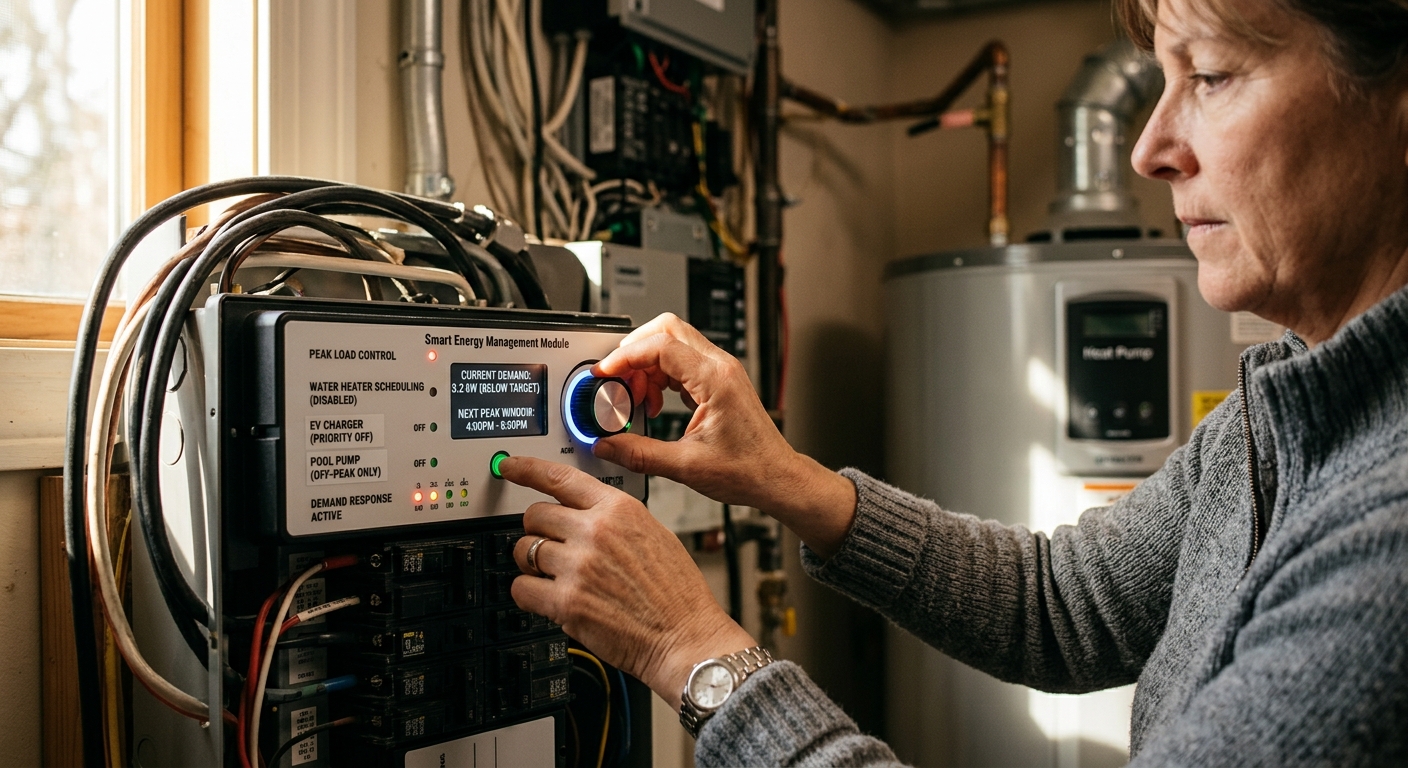
- Have the system installed with a gateway or energy management system that monitors grid pricing in real time and automatically charges the battery from the grid during off-peak hours, then discharges during on-peak hours.
- Apply for available incentives before finalizing the purchase. The federal Investment Tax Credit covers 30% of home battery costs through 2032. Many states and utilities add additional rebates of $1,000 to $5,000, which can bring the effective payback period down to 4 to 8 years in high-demand-charge markets.
- After installation, verify the system’s demand-shaving logic is active by checking the first full billing cycle. Confirm your utility’s meter reads a lower peak demand value than before installation. Some utilities require notification when adding battery storage to ensure the meter reads correctly.
Why It Works: The Benefits
Homeowners on residential demand rate plans who shift just three to four appliances out of peak overlap can reduce their demand charge by 20 to 40%, which often translates to $15 to $75 in monthly savings depending on utility and home size.
Flattening your personal load curve contributes to overall grid stability, which can reduce the likelihood of brownouts in your area and can qualify households for utility demand-response rebates worth $50 to $200 per year in many states.
Scheduling heavy appliances to run during cooler overnight hours reduces thermal stress on motors and compressors, potentially adding 1 to 3 years of service life to appliances like dryers and dishwashers that run hot.
Many utilities pair demand charges with time-of-use rates. Off-peak electricity can cost 30 to 50% less per kWh than peak-hour rates, so shifting usage captures a dual savings benefit on both the demand charge and the energy charge.
Residential demand pricing is expanding across the US. Building load-shifting habits now means you’re already adapted if your utility rolls out demand charges or expands TOU pricing to your rate class in the next 1 to 3 years.
💰 Savings Impact by Action
Staggering high-draw appliances to avoid peak-hour overlap reduces recorded demand by 20 to 40% in the first billing cycle.
Pre-cooling the home 2 to 3 degrees before peak hours reduces AC compressor runtime during the 3 PM to 9 PM window by up to 30 to 50%.
Automated smart plug and thermostat scheduling eliminates accidental peak-hour overlaps and sustains a 20 to 30% demand reduction without ongoing behavior change.
A properly sized home battery system can reduce grid-drawn peak demand by up to 80 to 100% during on-peak hours by discharging stored energy instead.
Shifting Level 2 EV charging from peak to overnight hours eliminates the single largest residential demand contributor, reducing peak load by 7,200 to 9,600 watts.
🏠 Key Concepts Explained
The Science Behind It
Your utility doesn’t just care how many kilowatt-hours you consume; it cares about the rate at which you draw power because that rate determines how much generation and transmission infrastructure must be available to serve you in any given moment. Generating capacity is expensive to build and maintain, so utilities price demand charges to incentivize customers to flatten their load curves. A home that draws a steady 2 kW for 10 hours costs the grid far less to serve than a home that draws 10 kW for 2 hours, even though both consume 20 kWh total. Demand charges capture that difference in grid stress.
The physics of electrical load aggregation explain why overlapping appliances are so much worse than running them sequentially. Power is measured in watts, which is voltage multiplied by current (P = V x I). When you run a 5,000-watt dryer and a 3,500-watt air conditioner simultaneously, both draw current through your service entrance at the same time, and the utility meter records the combined instantaneous wattage. The meter samples this value every 15 minutes and stores the highest reading. A central air conditioner compressor also adds a startup inrush current of 2 to 3 times its running wattage for 1 to 3 seconds during the startup cycle, which means an AC that normally draws 3,500 watts briefly draws 7,000 to 10,500 watts when it kicks on, and if that coincides with a dryer cycle, the demand spike is even larger than the nameplate ratings suggest.
Pre-cooling leverages the thermal mass principle to reduce AC runtime during peak windows. Dense materials in your home including concrete floors, drywall, furniture, and water in plumbing absorb heat slowly. If you cool the home below your normal setpoint before peak hours begin, those materials act as a thermal battery, absorbing the incoming heat gain over the next 3 to 5 hours before the indoor temperature rises enough to trigger the AC compressor. The result is that the compressor runs significantly less during the 3 PM to 9 PM window, reducing your demand contribution from HVAC by 30 to 50% with no hardware investment at all.
Frequently Asked Questions
▼ How do I know if my utility even charges me a peak demand fee?
Look at your most recent bill for a line item labeled ‘demand charge,’ ‘peak demand,’ ‘kW charge,’ or similar. It will typically be listed separately from your kWh energy charge and may show a measured value in kilowatts. If you can’t find it on the bill, call your utility and ask which rate schedule you’re on and whether it includes a demand component. Utilities are required to explain your rate class upon request.
▼ I shifted my appliances but my demand charge didn’t drop. What went wrong?
The most common cause is a single appliance overlap you didn’t account for, often the electric water heater, which can cycle on automatically at any time and add 3,000 to 4,500 watts to your load without any action on your part. Install a $25 to $40 outlet timer or smart water heater controller to lock out water heater operation from 3 PM to 9 PM. Also verify your changes took effect before the billing cycle’s worst spike, since it only takes one 15-minute overlap in the entire month to set your demand charge.
▼ Can renters reduce demand charges in their apartment?
Renters are rarely on individual demand rate plans since most apartment buildings have a single commercial meter. However, if you have an individual meter and are billed directly by the utility, all behavioral steps apply. Focus on staggering your window AC units, avoiding running the microwave, toaster oven, and hair dryer at the same time, and shifting laundry to off-peak hours if you have in-unit machines. Smart plugs with scheduling are fully renter-safe and require no modifications.
▼ How long before I see the savings on my bill?
Behavioral changes take effect in the very next billing cycle since demand charges reset monthly. If you successfully avoid creating a peak spike during that month, you’ll see the demand charge drop or disappear on the next statement. Smart thermostat pre-cooling shows results within the first 30 days. Battery storage systems typically take one full billing cycle after installation to verify the demand reading changed, and you should compare against the same month from the prior year to account for seasonal variation.
▼ My home has an electric vehicle charger. Does that make demand charges worse?
Yes, significantly. A Level 2 EV charger draws 7,200 to 9,600 watts, which is often the single largest load in the home. Charging during peak hours can more than double your recorded demand. Schedule charging to begin after 9 PM or use your EV’s built-in scheduled charging feature to start automatically after midnight. Many utilities also offer EV-specific rate plans with very low overnight rates, which compounds the savings of off-peak charging.
Quick Tips
- Check your utility rate tariff name on your bill, then search your utility’s website for that specific rate schedule to see if a demand charge applies. Many homeowners don’t know they’re on a demand rate until they look it up.
- Set your dishwasher’s delay-start timer before bed so it runs at 1 AM to 3 AM when grid demand is at its lowest. This avoids both demand charges and typically the most expensive per-kWh TOU rate.
- In summer, shift outdoor grilling or microwave meals a couple of nights per week to avoid running the oven during peak hours. The oven alone can add 2,000 to 5,000 watts to your coincident load.
- Contact your utility’s energy efficiency department and ask specifically about residential demand charge avoidance programs. Some utilities offer free smart thermostats, bill credits, or even free energy audits to customers willing to participate in load-shifting programs.
Variations for Your Situation
- Apartment or Renter: If you are billed directly by the utility and on a demand or TOU rate, focus entirely on zero-hardware steps. Stagger your window AC units by 15 minutes using outlet timers ($10 to $15 each at hardware stores) so they don’t all start simultaneously. Avoid running the microwave, toaster oven, coffee maker, and hair dryer in overlapping 15-minute windows during the 3 PM to 9 PM period. Smart plugs with scheduling are fully permitted in most leases since they require no installation.
- Tight Budget (under $50): Spend $0 on behavioral shifts first: reschedule dishwasher, laundry, and oven use to before 3 PM or after 9 PM. Buy one $10 to $15 mechanical outlet timer and put it on your electric water heater’s 120V control outlet or your largest window AC to enforce an off-peak blackout window automatically. These two steps alone can reduce your recorded demand by 15 to 25% with no other investment.
- Older Home (pre-1980): Older homes often have resistance electric heat, older less efficient appliances, and no delay-start features on dishwashers or ovens. Start with an appliance inventory and replace the worst offenders during natural end-of-life cycles with ENERGY STAR models that have built-in scheduling. In the meantime, use plug-in mechanical timers to enforce off-peak schedules on any controllable loads. Pre-cooling is especially impactful in older homes because their lower insulation levels mean the AC runs longer and contributes more to peak demand, but even a modest 2-degree pre-cool setpoint can shave 20 to 30 minutes of compressor runtime from the peak window.