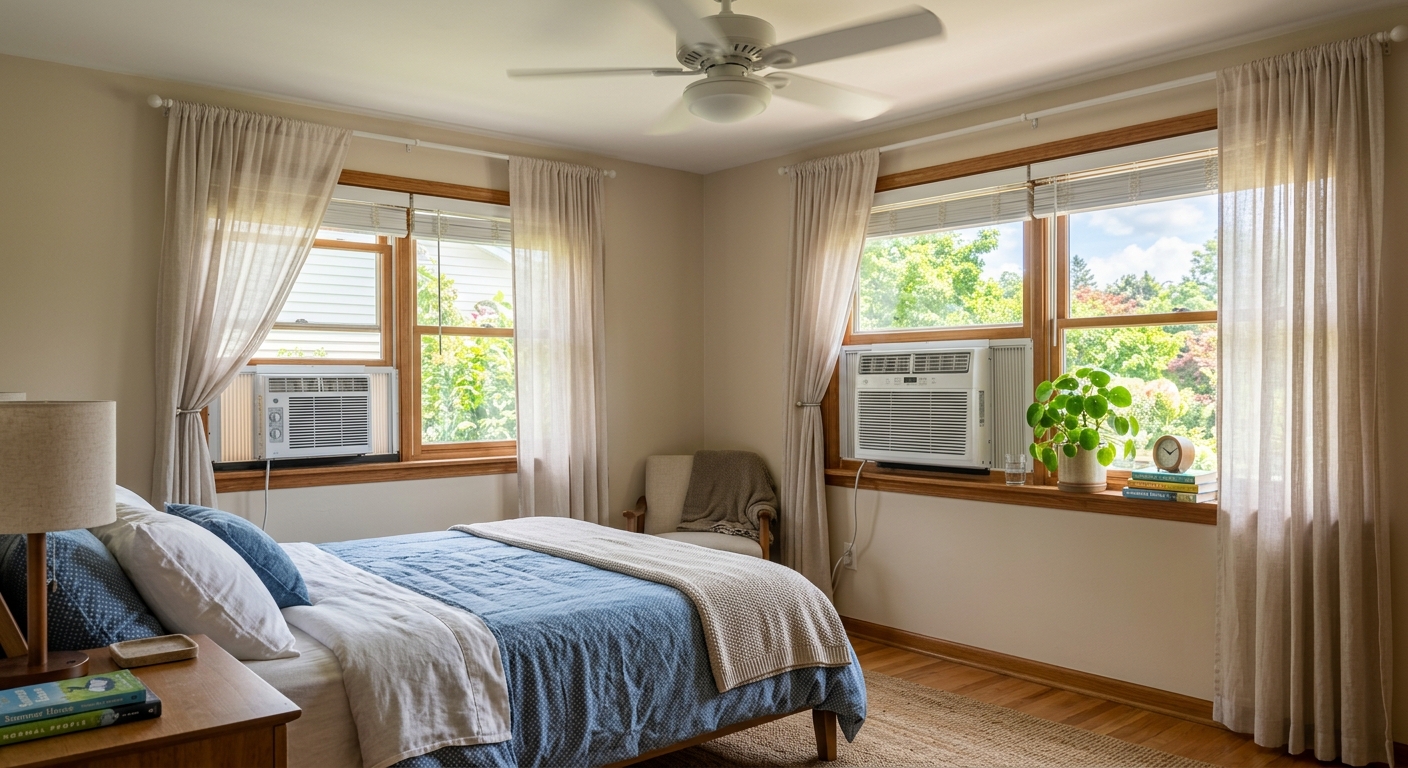
That window AC unit humming in your bedroom feels like a lifesaver in July, but have you ever stopped to calculate what it actually costs to run all summer? Most homeowners have no idea their unit is adding $30 to $80 per month to their electric bill, and many are running inefficient models that cost twice as much to operate as a modern ENERGY STAR unit of the same size. The difference between a careless setup and an optimized one can easily be $100 to $200 over a single cooling season.
The math is simpler than you might expect. A typical 8,000 BTU window AC draws around 700 watts. Run it 8 hours a day for 120 days at the U.S. average electricity rate of $0.16 per kWh, and you are looking at roughly $108 for the summer. Scale up to a 12,000 BTU unit running 10 hours a day, and that number climbs past $230. Older, inefficient units with low EER ratings can push those figures 30 to 50 percent higher, meaning some homeowners are spending $300 to $400 without realizing it.
This post breaks down exactly how to calculate your real running cost, identifies the biggest factors that drive that number up, and gives you two practical approaches to cut your summer cooling bill significantly. Whether you want fast free wins or are ready to invest a little time and money, there is a clear path to spending less while staying just as cool.
What You’ll Need
Click on an item below to shop for the recommended items for this recipe on Amazon.
As an Amazon Associate, we earn from qualifying purchases.
How to Do It
- Find the wattage label on your unit (usually on the back sticker or in the manual). If it only lists amps, multiply amps by 120 volts to get watts. A typical 8,000 BTU unit draws 650 to 750 watts.
- Calculate your daily cost: watts divided by 1,000 equals kWh per hour. Multiply by your daily runtime hours, then multiply by your utility rate (check your electric bill for the per-kWh charge). Example: 700 watts divided by 1,000 equals 0.7 kWh per hour, times 8 hours equals 5.6 kWh per day, times $0.16 equals $0.90 per day.
- Multiply your daily cost by 120 days (a typical June through September cooling season) to get your summer total. This is your baseline number.
- Set the thermostat on the unit to 78 degrees Fahrenheit instead of the lowest setting. Each degree higher reduces runtime and saves roughly 3% on cooling cost.
- Close blinds or curtains on windows that receive direct afternoon sun. South and west-facing windows are the biggest heat sources. This single step can cut room heat gain by up to 30%, reducing how often the compressor kicks on.
- Clean or rinse the foam air filter under the sink, let it dry, and reinstall. This takes 10 minutes and immediately restores full airflow and rated efficiency.
- Pull the unit out slightly and inspect all four sides of the window frame for gaps. Use self-adhesive foam weatherstripping tape (3/8-inch works for most gaps) to seal the perimeter where the window sash meets the unit. This stops warm humid air infiltration and is one of the highest-impact steps you can take.
- Seal the accordion side panels with foam tape or a purpose-made window AC insulating panel kit ($15 to $25 at hardware stores). These thin plastic panels are notorious for bowing and leaking air on both sides.
- Install a 24-hour mechanical outlet timer or a smart plug ($12 to $25) to program the unit to shut off 30 minutes after you typically fall asleep and turn on 20 minutes before you wake up. Eliminating 1.5 unnecessary hours daily saves roughly $20 to $40 over a summer.
- Install a white or reflective window film on south and west-facing windows in the room ($20 to $40 for a standard window). These films block 50 to 70% of solar heat gain while maintaining visibility, directly reducing the room’s cooling load.
- If your unit is in a room with a ceiling fan, set the fan to rotate counterclockwise (summer mode) at low speed. The wind-chill effect lets you raise the AC setpoint by 4 degrees, cutting compressor runtime significantly without feeling warmer.
- After the season, measure your new summer cost using the same formula from Step 2 of the quick fix and compare to your baseline. Most households who complete these steps see 25 to 45% lower operating costs.
Why It Works: The Benefits
Knowing your exact running cost, calculated as watts divided by 1,000 times hours times your kWh rate, lets you make smart decisions about runtime, setpoint, and whether upgrading makes financial sense.
Combining smart thermostat use, shading, and air sealing can realistically cut window AC operating costs by 30 to 50%, saving $40 to $150 over a summer depending on your unit size and local rates.
A unit that runs fewer hours per day under less load lasts significantly longer. Reducing runtime by 2 hours daily over a 4-month summer saves 240 hours of compressor wear per year, which translates to years of added lifespan.
Sealing air leaks and managing solar gain keeps the room cooler and more stable, reducing the sweaty spikes that happen when hot air infiltrates around a poorly sealed unit.
A clean filter and sealed perimeter allow the unit to reach its rated BTU output. Many homeowners running units at full blast are getting 15 to 20% less cooling than the spec sheet promises due to neglected maintenance.
💰 Savings Impact by Action
Raising the setpoint from 72 to 78 degrees Fahrenheit reduces compressor runtime enough to save approximately 18% on cooling electricity with no other changes.
Sealing gaps around the unit’s perimeter and accordion panels reduces warm air infiltration, cutting effective cooling load by 10 to 15%.
Closing blinds or installing reflective window film on sun-facing windows reduces solar heat gain by up to 30%, cutting cooling runtime by roughly 15 to 20%.
Using a timer or smart plug to eliminate 2 unnecessary daily runtime hours saves 20% on operating cost compared to leaving the unit running all day.
Cleaning a clogged filter monthly restores rated airflow and recovers 5 to 15% of lost cooling efficiency caused by restricted airflow across the evaporator coil.
🏠 Key Concepts Explained
The Science Behind It
Window air conditioners work by moving heat from inside your room to the outdoors using a refrigerant cycle. The compressor pressurizes refrigerant, which releases heat through the outdoor condenser coils. That cooled refrigerant then expands through an evaporator coil inside the room, absorbing heat from indoor air. The fan circulates room air across the cold evaporator, cooling it before blowing it back into the space. The critical efficiency insight is that this cycle uses electricity only to move heat, not to generate cold, making it far more efficient than electric resistance heating in reverse. The ratio of heat removed (in BTUs) to electricity used (in watts) is the EER, and every point of improvement means measurably less money spent.
The biggest hidden cost driver is thermal load, which is the total rate at which heat enters the room. Heat moves from hot to cold through three mechanisms: conduction through walls and windows, radiation from sunlight, and infiltration of hot outdoor air through gaps. The AC must remove all of this heat continuously to maintain your setpoint. Reducing solar gain with blinds cuts the radiation component. Sealing gaps cuts infiltration. Together, these reduce the thermal load, which means the compressor runs fewer minutes per hour, which directly maps to lower electricity consumption. This is why behavioral and building changes often outperform thermostat adjustments alone.
Electricity cost follows a simple linear formula: kilowatt-hours consumed equals watts divided by 1,000 times hours of runtime. Doubling the runtime doubles the cost. Raising the setpoint from 72 to 78 degrees Fahrenheit reduces temperature differential between indoors and outdoors, which lowers the rate of heat gain into the room and shortens compressor runtime. The commonly cited 3% savings per degree of setpoint increase is a rule of thumb derived from this relationship. In humid climates, the AC also dehumidifies, which adds latent load to the equation. A well-sealed room stays dryer, so the unit handles less latent load and cycles off sooner, compounding the savings from air sealing beyond what simple conduction math would predict.
Frequently Asked Questions
▼ How do I calculate exactly what my window AC costs per month?
Find the wattage on the unit’s label (or multiply listed amps by 120). Divide watts by 1,000 to get kW, multiply by daily runtime hours to get daily kWh, then multiply by your utility rate per kWh from your electric bill. Multiply that daily cost by 30 for a monthly estimate. A 700-watt unit running 10 hours at $0.16 per kWh costs about $33.60 per month.
▼ My window AC runs constantly and never shuts off. Is something wrong?
A unit that runs continuously is either undersized for the room, fighting excessive heat gain from unshaded windows or air leaks, or has a dirty filter restricting airflow. Start by cleaning the filter and sealing gaps around the unit. If it still runs nonstop, check whether the unit is rated for the room size (roughly 20 BTUs per square foot is a common starting point). A unit more than 25% undersized for the space will never adequately cool the room.
▼ Is it cheaper to leave the AC on all day or turn it off and cool down in the evening?
For a well-sealed room, turning the unit off while you are away and cooling back down before you return is almost always cheaper. The energy to cool a room from 85 to 72 degrees is less than running the AC all day to maintain 72. The exception is extremely humid climates where indoor humidity climbs rapidly when the AC is off, making the evening cooling cycle much longer and harder. In that case, setting the thermostat to 80 to 82 while away is a reasonable compromise.
▼ Will a bigger window AC cool the room faster and save money?
No. An oversized unit cools the air quickly but shuts off before removing enough humidity, leaving the room feeling clammy. It also short-cycles, meaning the compressor starts and stops frequently, which wears it out faster and uses more energy than a properly sized unit running longer cycles. Match the unit’s BTU rating to the room size using the manufacturer’s coverage chart.
▼ Can I use a smart thermostat with a window AC?
Standard smart thermostats do not work with window AC units, but smart plugs with scheduling (like Kasa EP25 or Amazon Smart Plug) can turn the unit on and off on a schedule. For full temperature-based control, look for window AC units with built-in Wi-Fi and app control, or units compatible with Sensibo or Cielo smart AC controllers, which plug into the unit’s IR receiver and allow thermostat-style scheduling for $50 to $100.
Quick Tips
- Place the unit on the shaded side of the house if you have a choice. A unit sitting in direct afternoon sun has to reject heat against a hotter outdoor temperature, reducing its efficiency by up to 10%.
- Pre-cool the room to your target temperature before peak afternoon heat (around 2 to 5 PM) rather than trying to cool it down during the hottest part of the day when the unit works hardest.
- Use a dehumidifier in tandem if you live in a humid climate. Removing humidity lets you set the AC 2 to 3 degrees higher while feeling equally comfortable, cutting compressor runtime significantly.
- Replace a unit older than 10 years that has an EER below 9.5. ENERGY STAR certified window ACs require a minimum EER of 12, meaning they use 20 to 25% less electricity than older models for the same cooling output.
Variations for Your Situation
- Apartment/Rental: Renters cannot modify windows permanently, but foam weatherstripping tape and removable window film are both renter-safe (they peel off cleanly). A smart plug for scheduling costs under $20 and is completely portable. Focus on these three steps alone and expect 15 to 25% savings with zero landlord permission required.
- Tight Budget (under $50): Prioritize in this order: clean the filter (free), close afternoon blinds (free), set the thermostat to 78 degrees (free), buy a $12 mechanical outlet timer for scheduling, and use $6 to $8 of foam tape to seal the perimeter. These five steps cost under $25 and can cut operating costs by 20 to 35%.
- Older Home (pre-1980): Older homes have more air leakage through walls and around window frames, which adds significant infiltration load on top of the unit’s gaps. Before sealing around the AC, use a stick of incense or a candle near the window frame edges on a windy day to locate drafts. Seal both the AC perimeter and the window frame itself with rope caulk (removable and renter-safe). Also check whether the window’s weatherstripping is intact, as a drafty window frame undermines any sealing done around the unit itself.