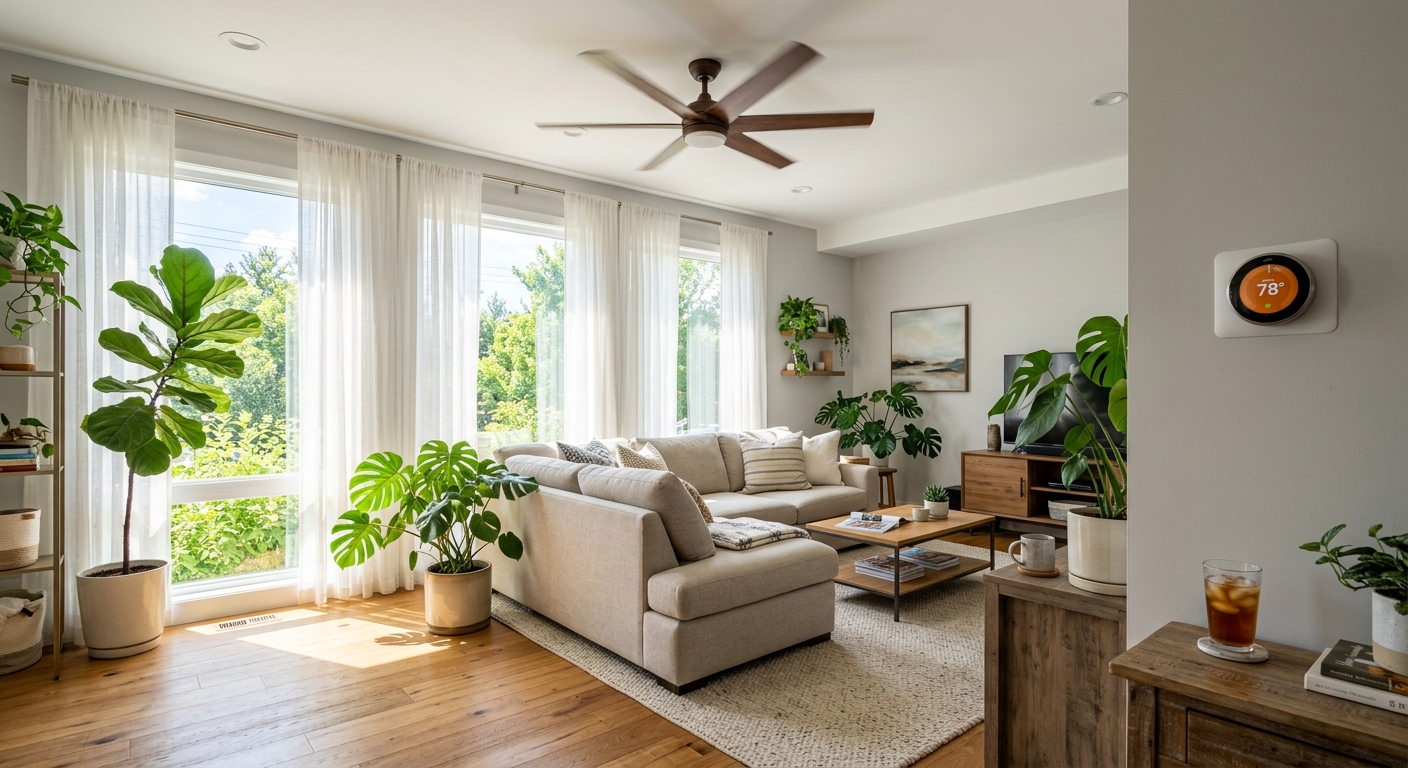
Here is a question most homeowners cannot answer confidently: which direction should your ceiling fan spin in summer? If you guessed clockwise, you have the most common ceiling fan mistake in America. Running your fan the wrong way does not just fail to cool you, it can actually make a room feel warmer by pushing hot air that has pooled at the ceiling back down into your living space. The good news is that fixing it takes about 30 seconds and costs absolutely nothing.
Ceiling fans work on a simple principle called the wind chill effect. They do not lower the air temperature in a room, but they make you feel cooler by accelerating the evaporation of moisture from your skin. For that to work, the fan must push air downward in a column directly below the blades. In summer, that means counterclockwise rotation when viewed from below. Clockwise rotation, which is the correct winter setting, pulls air upward and recirculates warm air from the ceiling down the walls, which is the opposite of what you want on a hot day.
This post covers exactly how to check and correct your fan direction, how to use that change to actually raise your thermostat setpoint and save money on your cooling bill, and what to do if your fan does not have an obvious direction switch. Whether you have one fan or a dozen, getting this right is one of the fastest, highest-return adjustments you can make in your home this summer.
What You’ll Need
Click on an item below to shop for the recommended items for this recipe on Amazon.
As an Amazon Associate, we earn from qualifying purchases.
How to Do It
- Turn the fan off completely and wait for the blades to stop spinning. Never reach for or touch a moving fan.
- Look at the side of the motor housing (the central cylinder above the blades). Find the small slide switch, typically labeled with arrows or the words ‘Summer’ and ‘Winter’.
- Slide the switch to the Summer position (or toward the setting that shows counterclockwise arrows). On most fans this means sliding the switch toward the left when facing the front of the motor.
- Turn the fan back on and stand beneath it. You should feel a direct downward airflow on your face and arms at all but the lowest speed setting. If the air seems to flow outward along the ceiling rather than down at you, the fan is still in winter mode.
- Raise your thermostat setpoint by 3 to 4 degrees Fahrenheit to capture real energy savings. The room will feel equally comfortable due to the wind chill effect.
- Turn off any fans in unoccupied rooms immediately. Running them in empty spaces wastes energy with no benefit.
- Turn off power to the fan at the circuit breaker. Confirm power is off with a non-contact voltage tester before touching any wiring.
- Remove the canopy (the dome at the ceiling that hides the mounting bracket) by unscrewing the small screws around its base. Let it slide down the downrod to expose the wiring.
- Purchase a universal ceiling fan remote receiver kit compatible with your fan’s wattage. Popular options include the Hampton Bay or Hunter universal kits, available for $15 to $40 at home improvement stores.
- Follow the kit instructions to connect the receiver inline between the ceiling wiring and the fan wiring. Most kits require connecting matching wire colors with the provided wire nuts. Take a photo of the original wiring before disconnecting anything.
- Tuck the receiver into the canopy, replace the canopy, and restore power at the breaker.
- Use the remote to set the fan to counterclockwise (summer) rotation and program a schedule or simply make direction changes easy from the couch. Some smart fan receivers integrate with Google Home or Amazon Alexa for voice control.
Why It Works: The Benefits
Using the correct fan direction allows you to raise your thermostat by 4 degrees Fahrenheit, saving approximately 12% on cooling costs according to DOE estimates. On a $150 monthly summer electricity bill with 60% attributed to cooling, that is roughly $11 saved per month.
The wind chill effect from a properly directed fan makes 78 degrees Fahrenheit feel equivalent to 74 degrees, letting you stay comfortable while running your AC less. This is comfort gain with zero additional cost or equipment.
Raising the thermostat setpoint by 4 degrees reduces how often your compressor cycles on. Less runtime means less mechanical wear on your HVAC system and potentially extends its service life, reducing maintenance and replacement costs over time.
Unlike most home efficiency upgrades, correcting fan direction has zero cost, zero installation time (under 5 minutes), and is fully reversible when the seasons change. There is no payback period because the benefit is immediate from the first use.
💰 Savings Impact by Action
Correct direction alone does not save energy but enables the thermostat increase that does; the switch flip itself is the prerequisite step.
Raising the thermostat setpoint 4 degrees Fahrenheit while using ceiling fans correctly saves approximately 12% on cooling costs based on DOE estimates of 3% per degree.
Turning off fans in unoccupied rooms eliminates wasted fan electricity and removes any phantom cooling incentive that delays thermostat raises, saving up to 8% depending on household habits.
Running fans at medium rather than high speed reduces fan wattage by 40 to 60% while delivering adequate wind chill, saving roughly 5% on total fan electricity costs over a season.
🏠 Key Concepts Explained
The Science Behind It
Ceiling fans exploit a well-documented thermodynamic principle: evaporative cooling. Your skin is constantly releasing moisture, and when air moves across it quickly, that moisture evaporates faster, carrying heat away from your body. This is the same mechanism that makes a breeze feel refreshing on a hot day even when the air temperature is identical. A ceiling fan moving air at 1 to 2 miles per hour across your skin can reduce your perceived temperature by 4 to 8 degrees Fahrenheit, even though the thermometer in the room reads exactly the same as before the fan turned on.
The direction of blade rotation determines whether that airflow reaches you at all. Ceiling fan blades are pitched at an angle, typically 12 to 15 degrees. When the fan spins counterclockwise (viewed from below), the leading edge of each blade slices downward, creating a downdraft column directly beneath the fan. That column is what produces the wind chill effect on occupants below. When the fan spins clockwise, the same blade pitch pushes air upward toward the ceiling, which is useful in winter for redistributing warm stratified air but completely useless in summer for anyone sitting or standing in the room.
Thermal stratification amplifies why the wrong direction is actively counterproductive in summer. Hot air rises due to its lower density, and in a typical room with 8-foot ceilings, the air near the ceiling can be 5 to 10 degrees Fahrenheit warmer than air at the 5-foot breathing zone. Running a fan in clockwise mode pulls that hot ceiling air down the walls and into the occupied space, slightly raising the effective temperature in the room. It is the opposite of what you want, which is why the correct summer setting is not just a minor improvement but a meaningful reversal of a thermodynamic mistake.
Frequently Asked Questions
▼ I switched my fan to counterclockwise but I still cannot feel any air movement below it. What is wrong?
First confirm the fan is actually spinning counterclockwise by standing below it and looking up: the blades should move left at the front edge. If it is counterclockwise but you feel no airflow, the fan is likely mounted too close to the ceiling, the blades have too shallow a pitch, or the fan is too small for the room. A fan in a room larger than 400 square feet should be at least 52 inches in blade span, and the blade tips should be at least 8 to 10 inches below the ceiling for proper airflow.
▼ My ceiling fan does not have a direction switch anywhere on the motor. How do I reverse it?
Some older fans and lower-cost models have the direction controlled by an internal wiring configuration rather than an external switch. Turn off the breaker, remove the canopy, and look for a pull chain or small toggle inside the motor housing. If there is truly no switch, a universal remote receiver kit ($15 to $40) can add direction control without replacing the whole fan. As a last resort, swapping the blade irons from one side to the other physically reverses the blade pitch, but this is tedious and not recommended.
▼ Will running my ceiling fan actually save me money, or does it just move the electricity cost from AC to the fan?
A ceiling fan uses 15 to 75 watts depending on size and speed. A central air conditioner uses 1,000 to 5,000 watts. The trade-off is strongly in favor of the fan if you raise your thermostat when using it. Raising the thermostat 4 degrees and running the fan saves far more in compressor energy than the fan itself costs to operate. The only scenario where it does not pay off is running fans in empty rooms, which adds fan electricity without reducing AC runtime.
▼ How long before I see the savings on my electricity bill?
You should see a measurable difference on your next monthly bill if you consistently raise your thermostat setpoint by 3 to 4 degrees whenever the fans are running. For a home spending $90 to $150 per month on summer cooling, a 10 to 12% reduction means $9 to $18 saved in the first full billing cycle. The effect is most pronounced in hot climates where the AC runs for extended hours each day.
▼ What if my home has very high vaulted ceilings? Does fan direction still matter?
Yes, but placement becomes even more critical. On ceilings above 10 feet, the fan should be on a longer downrod so the blades are positioned 8 to 9 feet above the floor. Without this, the fan may be too far above the occupied zone for the wind chill effect to reach people below. In rooms with very high ceilings, running at medium-high speed and ensuring counterclockwise rotation is especially important to drive air all the way down to the living zone.
Quick Tips
- Run the fan only on the speed needed to feel air movement. Higher speeds use significantly more electricity (a fan on high can use 3 to 4 times the wattage of low) and the additional wind chill benefit above medium speed is minimal for most people.
- In rooms with very high ceilings (above 9 feet), use a longer downrod to position the fan 8 to 9 feet above the floor. A fan too close to the ceiling pushes air sideways rather than down, reducing the wind chill effect significantly.
- If you cannot find the direction switch on the motor housing, check the owner’s manual or the model number on the label inside the canopy. Some fans have the switch hidden under a decorative cover or inside the canopy itself.
- Bathroom exhaust fans and ceiling fans serve completely different functions. Do not confuse direction switching advice for ceiling fans with exhaust fan operation, which always pulls air out regardless of season.
Variations for Your Situation
- Apartment/Rental: Most ceiling fans in apartments have accessible direction switches on the motor housing that require no tools and no landlord approval to flip. Check for the slide switch on the side of the motor drum before requesting any changes. If the fan is wired to a wall switch with no separate speed or direction control, a universal remote receiver kit is a renter-friendly upgrade that installs in about 30 minutes and can be removed when you move out. Cost is $15 to $40 per fan.
- Tight Budget (under $50): The direction switch flip itself costs nothing and is the single highest-return action in this post. Pair it with a $10 to $15 programmable outlet timer to automatically cut power to floor or table fans when you leave the house, eliminating the habit of leaving fans running in empty rooms. No smart home devices, no electrician, no tools required beyond a step ladder.
- Older Home (pre-1980): Older ceiling fans may lack an external direction switch entirely, or the switch may be worn and difficult to toggle. Before climbing up, check if the fan has a pull chain that controls direction (uncommon but exists on some models). If the motor housing is inaccessible or corroded, replacing the fan entirely with a modern Energy Star model is worth considering. A new 52-inch Energy Star ceiling fan costs $80 to $200, uses 60 to 70% less energy than older models, and comes with remote direction control as a standard feature.