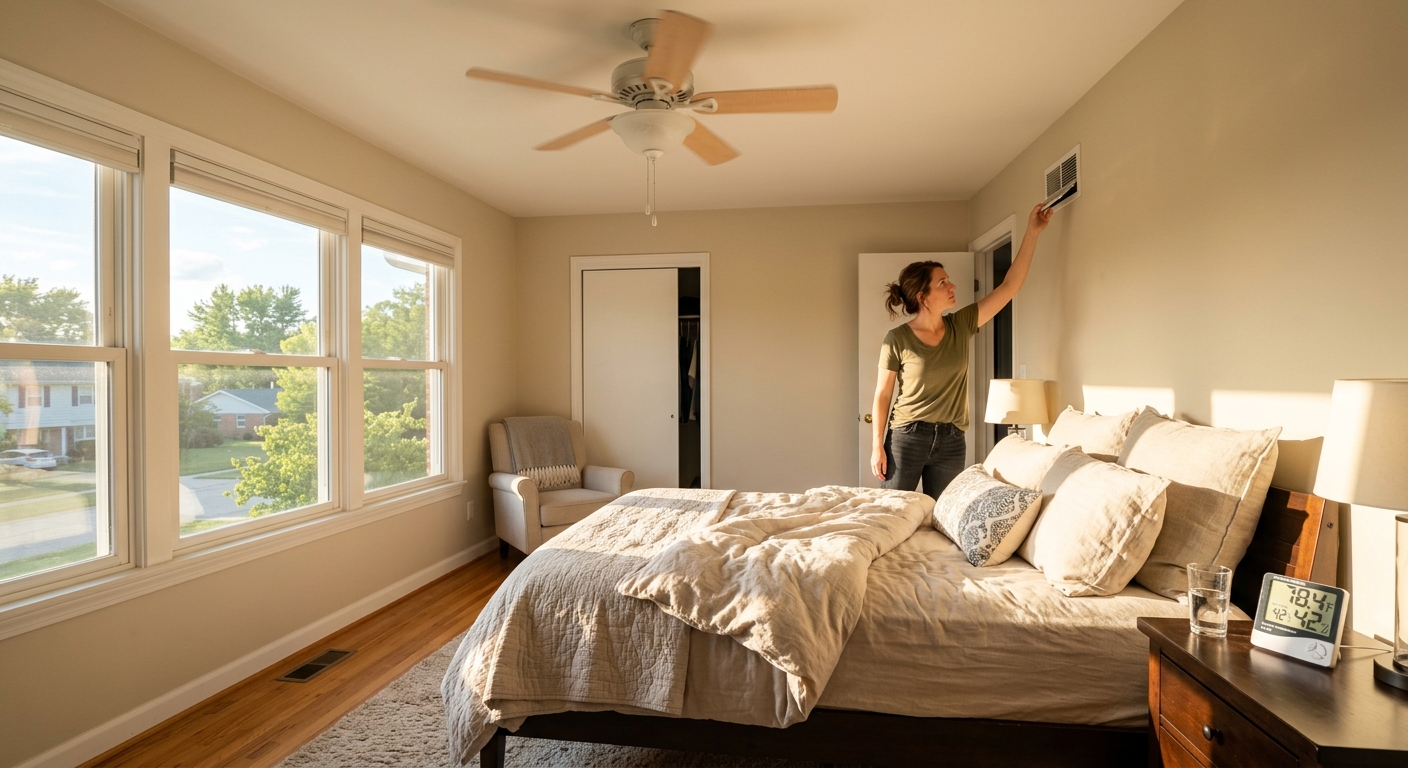
Every homeowner knows the feeling: the living room is perfectly comfortable, but the moment you step into the back bedroom or upstairs office, it feels like a different climate zone. You crank the thermostat down, the AC runs longer, and your energy bill creeps up while that one stubborn room stays miserable. It is one of the most common comfort complaints in American homes, and it rarely means your air conditioner is broken.
Hot spots happen for a specific set of reasons rooted in building science: duct imbalances, insulation gaps, solar heat gain, and airflow restrictions that quietly sabotage your HVAC system’s ability to cool evenly. Understanding which cause applies to your room is the key to fixing it without guesswork or expensive service calls.
In this post, we will walk you through how to diagnose your hot room, explain the science behind why it happens, and give you a clear action plan from free fixes you can do in 15 minutes to upgrades that pay for themselves within a season. Most homeowners can resolve the problem, or dramatically improve it, without hiring anyone.
What You’ll Need
Click on an item below to shop for the recommended items for this recipe on Amazon.
As an Amazon Associate, we earn from qualifying purchases.
How to Do It
- Check every supply register in the hot room: hold a tissue near the vent while the AC is running. If airflow is weak or the register is barely cool, you have a distribution problem, not an insulation problem.
- Open all supply registers fully in the hot room and close them 25 to 50% in the rooms closest to the air handler. This redirects more airflow toward the problem area without any hardware changes.
- Check the return air situation: if the hot room has a door that is usually closed and no return register on the wall, leave the door open or crack it 1 to 2 inches while the AC runs. This alone can drop room temperature by 3 to 5 degrees F.
- Inspect your air filter and replace it if it has been more than 60 days. A clogged filter reduces total system airflow by up to 15%, which hits the farthest rooms hardest.
- Close window coverings on south and west-facing windows in the hot room between 11 AM and 5 PM. Blocking direct sun can reduce solar heat gain by 40 to 70% and drop indoor surface temperatures by 5 to 8 degrees F.
- Install a door undercut or transfer grille in the hot room door to create a return air path even when the door is closed. A 1-inch door undercut or a 6×12 inch transfer grille costs $10 to $25 and can improve airflow by 30 to 40% in a closed room.
- Add insulating cellular shades or solar shading film to south and west-facing windows. Cellular shades run $30 to $80 per window and reduce solar heat gain by 40 to 60%, cutting the room’s peak cooling load significantly.
- Check the attic access hatch above or near the hot room. Most hatches have zero insulation. Cut rigid foam board (R-15 to R-21) to fit the hatch lid and glue it in place. This $15 to $25 fix often produces noticeable results in rooms directly below attic hatches.
- Inspect exposed duct segments in the attic or crawlspace serving the hot room. Wrap any uninsulated ducts with R-6 duct wrap insulation ($30 to $60 per 25-foot roll) to prevent conditioned air from gaining heat before it reaches the register.
- Seal duct connections near the air handler using UL 181-rated foil tape (not standard duct tape, which fails within a year). Focus on joints and seams at the plenum and first two duct branches, where leakage is highest. Each properly sealed joint recovers 2 to 5% of lost airflow.
- If the hot room is on an upper floor, add a ceiling fan rated for the room size and run it counterclockwise in summer. A ceiling fan can make a room feel 4 to 6 degrees F cooler through the wind chill effect, allowing you to raise the thermostat setpoint without sacrificing comfort.
- Schedule a Manual J load calculation with an HVAC contractor or home performance auditor. This calculation determines whether your duct system is properly sized for the hot room or fundamentally undersized, which no amount of sealing will fix.
- Request a duct blaster test to quantify total duct leakage. If leakage exceeds 15% of system airflow, professional duct sealing (Aeroseal or mastic) is the most cost-effective next step and typically costs $800 to $1,500 with payback in 3 to 5 seasons.
- Ask your HVAC technician about adding a booster fan or supplemental duct branch to the hot room if the existing branch is undersized. A duct booster fan costs $40 to $150 installed and is appropriate for rooms at the end of long duct runs.
- Have your attic insulation depth measured by an energy auditor. If you have less than R-30 above the hot room, adding blown-in insulation to R-38 to R-49 costs $1,500 to $3,000 for an average attic but reduces cooling loads by 15 to 25% and qualifies for a 30% federal tax credit through 2032.
- Consider a ductless mini-split for a chronically problematic room, especially a home office or addition. A single-zone mini-split costs $1,500 to $3,500 installed, operates at 20 to 40% greater efficiency than a ducted system, and gives you independent temperature control with payback in 4 to 7 years on energy savings alone.
Why It Works: The Benefits
Fixing the root cause of a hot room eliminates the need to set your thermostat lower just to compensate for one space, creating more even temperatures across every room.
Homeowners who resolve duct imbalance or add attic insulation typically see cooling bill reductions of 15 to 30%, because the AC system no longer runs extended cycles trying to satisfy a thermostat that cannot feel the hot room.
An AC that runs longer to compensate for a hot room accumulates extra run hours, shortening compressor life. Fixing distribution problems can meaningfully extend system lifespan and reduce maintenance costs.
Improved airflow circulation means air passes through your filter more frequently, reducing dust, humidity, and allergens in the previously stagnant hot room.
Many hot room fixes cost under $50 and work the same day, meaning you do not need to replace your AC system to get results you can feel tonight.
💰 Savings Impact by Action
Restoring proper return airflow to a closed room by installing a transfer grille or door undercut can reduce that room’s cooling demand by up to 12% by allowing the AC system to circulate air efficiently.
Blocking direct solar gain on south and west windows with cellular shades or solar film reduces the room’s peak cooling load by 40 to 70%, translating to roughly 18% lower cooling energy for that space.
Sealing leaky duct joints recovers 20 to 30% of conditioned air that would otherwise be lost to unconditioned spaces, directly increasing the airflow delivered to problem rooms.
Upgrading attic insulation from R-11 to R-38 above a hot room reduces conducted heat gain through the ceiling by up to 60%, cutting the room’s cooling load by an estimated 15 to 25%.
Once the hot room is resolved and comfort is even, raising the thermostat setpoint by just 2 degrees F saves approximately 8% on total cooling costs for the season.
🏠 Key Concepts Explained
The Science Behind It
Your central AC system is essentially a pump that moves heat from inside your home to outside. It works by circulating a fixed volume of air, typically 400 cubic feet per minute per ton of cooling capacity, through a loop: cool air out through supply registers, warm air back through return registers, over the evaporator coil, and out again. When one room gets hotter than the rest, it almost always means that loop is broken or unbalanced for that specific space.
The physics of heat transfer explain why certain rooms are vulnerable. Rooms with large south or west-facing glass areas absorb radiant solar energy at a rate that can exceed 5,000 BTUs per hour during peak afternoon hours. A typical bedroom might have a cooling capacity of only 3,000 to 4,000 BTUs delivered through its supply duct, meaning the sun is adding heat faster than the system can remove it regardless of how well the AC is working. Meanwhile, attic temperatures of 140 to 150 degrees F create a powerful conductive heat flow through any ceiling with less than R-30 insulation, adding a steady background load that compounds throughout the afternoon.
Airflow physics add the final layer. Because supply air must push against the air already in the room, any restriction on the return path creates back-pressure that physically reduces how much cool air can enter. Studies by Lawrence Berkeley National Laboratory found that closing interior doors in homes without room-level return registers reduces airflow to those rooms by 40 to 60%. This is why a bedroom that feels fine with the door open becomes stuffy and warm with it closed, and why opening the door is sometimes the only fix you need.
Frequently Asked Questions
▼ Why is one room always hotter even though all the vents seem to be open and blowing air?
Airflow volume matters more than whether the vent is open. Hold a tissue at the register: if it barely moves, the duct serving that room is either undersized, leaking, or has too many bends reducing flow. Start by sealing any visible duct joints with foil tape and verify the return air path is open, then reassess before calling a technician.
▼ My upstairs is always 5 to 8 degrees hotter than downstairs. Is my AC too small?
Not necessarily. Upper floors are hotter due to the stack effect, heat gain through the roof assembly, and the fact that many homes have inadequate return air capacity on the upper level. Before assuming the system is undersized, check attic insulation depth (it should be R-38 to R-49), seal any attic bypass leaks around light fixtures and plumbing chases, and confirm there is a return register on the upper floor. These steps alone often close a 5-degree gap without any HVAC changes.
▼ Can a portable AC unit fix a chronically hot room?
A portable AC can provide relief but is not an efficient long-term solution. Most portable units exhaust hot air through a single hose, which creates negative pressure that pulls unconditioned air into the home through gaps and actually increases overall cooling load by 10 to 15%. A window air conditioner or a ductless mini-split is significantly more efficient for a room that your central system cannot adequately cool.
▼ My home is only 10 years old. Why would it already have these problems?
Duct installation quality varies widely regardless of home age. Builder-grade duct systems often use flexible duct with too many bends, inadequate insulation, and poorly sealed joints from day one. A 10-year-old home can have duct leakage rates of 20 to 25% because mastic sealant was never applied to joints at the factory. Have a contractor perform a duct blaster test, which typically costs $150 to $300, to get a baseline measurement before deciding on repairs.
▼ How do I know if the problem is insulation versus ductwork?
Check the timing of the hot room problem. If the room is hottest in the afternoon and cools down quickly after sunset, solar heat gain through windows or radiant heat from the attic is the primary driver, pointing to insulation or shading as the fix. If the room is consistently warm throughout the day and night whenever the AC is running, weak airflow from the duct system is the more likely cause. Use a thermometer to measure the air coming from the register: it should be 15 to 20 degrees F cooler than room temperature if the duct is performing correctly.
Quick Tips
- Run your ceiling fan counterclockwise (when viewed from below) in summer to create a direct downdraft wind-chill effect. This allows you to raise the thermostat by 4 degrees F without any loss of comfort, saving roughly 8% on cooling costs per degree raised.
- Place a digital thermometer in the hot room and check the temperature difference from your thermostat location at 4 PM, the typical daily peak. A gap of more than 4 degrees F confirms a structural problem worth investigating beyond just airflow tweaks.
- If your home has a two-speed or variable-speed air handler, switch it to a lower continuous fan speed during the hottest hours. Slower airflow stays in the ducts longer and absorbs more heat from the air handler coil, delivering slightly cooler air to distant rooms.
- Check whether any supply duct boot (the metal box where the duct connects to the register) has pulled away from the drywall. Even a small gap dumps conditioned air into the wall or ceiling cavity instead of the room. Resealing with foil tape takes five minutes and can recover several percentage points of lost airflow.
Variations for Your Situation
- Apartment/Rental: Renters cannot modify ductwork or add insulation, but can take meaningful action within their unit. Install removable solar shading film on south and west windows ($20 to $40 per window) and use a freestanding tower fan to move conditioned air from a cooler room into the hot one. A window AC unit in the problem room is often the most effective renter-friendly solution, costing $150 to $350 and providing independent temperature control without any permanent modifications.
- Tight Budget (under $50): Focus entirely on free and near-free steps: open the hot room door, adjust register dampers to redirect airflow, replace a clogged air filter ($10 to $20), and close window coverings during peak afternoon hours. Add a $15 to $25 door transfer grille if the room must stay closed. These steps alone address the two most common causes (return air restriction and solar gain) and can reduce the temperature gap by 3 to 5 degrees F at zero to minimal cost.
- Older Home (pre-1980): Homes built before 1980 often have minimal attic insulation (R-11 or less), single-pane windows, and ductwork with no insulation at all. The hot room problem is almost certainly multifactorial. Prioritize attic insulation first since it delivers the largest and most consistent return, targeting R-38 to R-49 above the problem room. Then address window solar gain with low-e film or exterior shading. Expect to invest $1,500 to $4,000 in attic insulation and air sealing combined, but federal tax credits currently cover 30% of this cost through 2032.