If you live in one of the 26 U.S. states with a deregulated electricity market, you have a choice that most people never use: the ability to shop for a better electricity rate just like you shop for car insurance or internet service. Yet the vast majority of homeowners stay on their utility’s default rate plan for years, sometimes decades, while cheaper options sit one comparison website away.
The average U.S. household spends about $1,500 per year on electricity, according to the U.S. Energy Information Administration. Even a 20 to 30 percent rate reduction, which is entirely achievable in competitive markets, translates to $300 to $450 in annual savings without changing a single lightbulb or appliance. Add in time-of-use plan optimization and you can push that figure well past $500 in year one.
This guide walks you through exactly how to compare electricity providers, what numbers to look at (and which to ignore), how to avoid common contract traps, and how to complete a switch without any service interruption. Whether you are in a fully deregulated state or a regulated market with limited plan options, there are steps here that will lower your bill.
What You’ll Need
Click on an item below to shop for the recommended items for this recipe on Amazon.
As an Amazon Associate, we earn from qualifying purchases.
How to Do It
- Pull your last 12 months of electricity bills and note your total annual kWh usage and your current rate in cents per kWh, including all supply and delivery charges. This is your baseline.
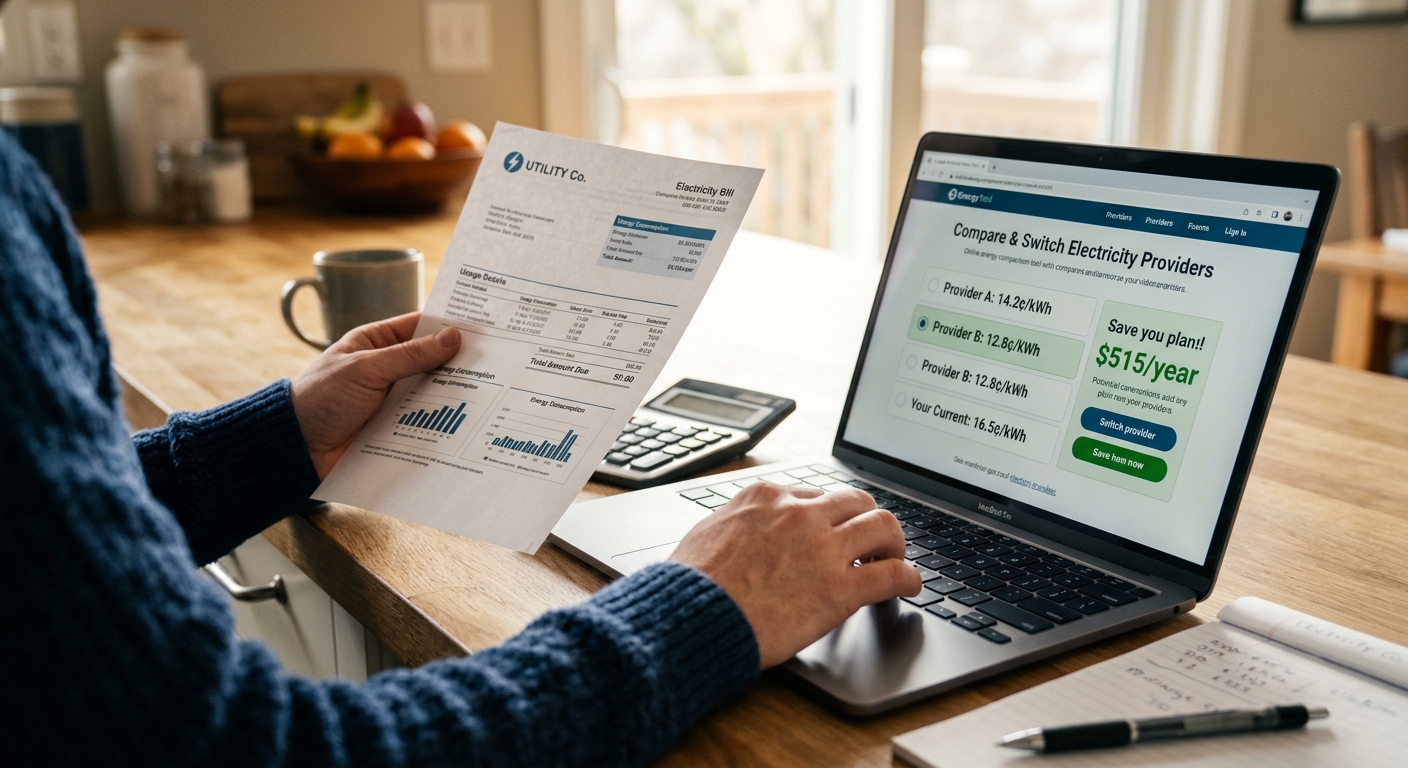
- Go to your state’s official utility commission website or a neutral comparison tool such as PowerToChoose.org (Texas), EnergyShopper.com, or your state’s own shopping portal to search plans using your actual zip code.
- Filter results by fixed-rate plans only and sort by the effective rate at your specific monthly kWh usage level, not the advertised headline rate, which may only apply at higher usage tiers.
- Read the Electricity Facts Label or plan disclosure document for any plan you are considering. Confirm the contract length, early termination fee amount, and what rate you move to after any promotional period.
- Select a plan that beats your current effective rate by at least 15 percent to ensure savings survive any small fluctuation in your usage. Submit the enrollment form online. You will need your utility account number from your current bill.
- Mark your calendar for 30 days before your contract end date to re-shop. Do not let a fixed-rate plan expire onto a variable rate without actively choosing what comes next.
- Log in to your utility’s online account portal and download your hourly or 15-minute interval usage data if your home has a smart meter. Most utilities provide this in CSV format under a usage history or Green Button download section.
- Map your usage across a typical weekday and weekend. Identify your three biggest consumption windows. Common culprits are the 4 to 9 PM peak window (HVAC, cooking, lighting all running simultaneously) and morning shower and breakfast hours.
- Contact your utility or log in to your account to review available time-of-use, tiered, or demand rate plans. Ask specifically for the rate schedule document, not a marketing summary, so you can see exact peak and off-peak rates.
- Model the savings by multiplying your identified peak-hour kWh by the difference between peak and off-peak rates. For example, if you use 8 kWh daily during peak hours and the peak rate is 22 cents versus 11 cents off-peak, shifting those hours saves roughly $320 per year.
- Set smart appliance schedules or use outlet timers for dishwashers, washing machines, and dryers to run between 9 PM and 6 AM. If you charge an EV, program charging to begin after 10 PM.
- Switch to the time-of-use plan and monitor your first two bills carefully. If your peak usage crept back up due to behavior drift, use your utility’s usage alerts to get notified when you approach daily peak spending thresholds.
- Complete the quick comparison switch from Approach 1 first to lock in a lower supply rate immediately. This is your foundation.
- Purchase and install a smart thermostat such as the Ecobee or Google Nest if you do not already have one. Program it with a schedule that reduces HVAC load during peak rate hours (typically 4 to 9 PM on weekdays) by setting the temperature 4 degrees warmer in summer or cooler in winter during that window.
- Set up smart plug schedules for your top three non-time-sensitive appliances: dishwasher, dryer, and any plug-in space heaters or window AC units. Smart plugs with energy monitoring cost $15 to $30 each and let you confirm actual kWh shifted.
- Enroll in your utility’s budget billing or average payment plan after you have optimized your usage for one full billing cycle. This smooths payments across the year so your summer peak bill does not derail your monthly budget.
- Sign up for a free bill monitoring tool such as Arcadia, Bidgee, or your utility’s own energy dashboard. Set a monthly kWh alert 10 percent above your new target baseline so you catch usage spikes before they hit your bill.
- Re-shop your electricity supply rate every 12 months, at least 60 days before your contract renewal date, using the same comparison process from Step 1. Markets shift and a better rate is often available by the time your contract expires.
Why It Works: The Benefits
Switching to a lower fixed rate in a deregulated market can reduce your electricity supply charge by 15 to 35 percent starting with your very next billing cycle, with no equipment purchase or home modification required.
Locking into a fixed-rate plan for 12 to 24 months shields you from seasonal price spikes and wholesale market volatility, making household budgeting significantly more reliable.
Many competitive suppliers offer 100 percent renewable energy plans at rates competitive with or lower than standard utility rates, allowing you to reduce your carbon footprint with no premium and sometimes at a discount.
Households with flexible load, including EV owners, can save an additional $200 to $400 per year by shifting high-consumption tasks to off-peak hours on a time-of-use plan, where rates can be 50 percent lower than peak pricing.
Switching electricity suppliers in a deregulated market involves zero physical changes. Your local utility continues delivering power over the same lines. The only change is which company appears on the supply portion of your bill.
💰 Savings Impact by Action
Switching from a default utility rate to a competitive fixed-rate plan in a deregulated market reduces the supply portion of your bill by 15 to 35 percent, averaging around 25 percent for households that comparison shop carefully.
Moving high-consumption tasks like laundry, dishwashing, and EV charging to off-peak hours on a time-of-use plan reduces your effective blended rate by 10 to 20 percent depending on how much load you can shift.
A smart thermostat programmed to reduce HVAC load during peak rate hours (typically 4 to 9 PM weekdays) saves 8 to 12 percent on heating and cooling costs according to ENERGY STAR data.
Proactively re-shopping at contract renewal prevents automatic rollover onto variable rates, which historically run 10 to 15 percent higher than available fixed-rate alternatives in competitive markets.
While budget billing does not directly lower your rate, it prevents overpayment in peak months by spreading costs evenly, allowing more precise tracking of savings from other optimization steps.
🏠 Key Concepts Explained
The Science Behind It
Electricity pricing in a deregulated market separates two fundamentally different services: the cost of generating and supplying the power (the supply or commodity charge) and the cost of physically moving that power through wires and infrastructure to your home (the delivery or distribution charge). Only the supply charge changes when you switch providers. The delivery charge is set by your local regulated utility and remains identical regardless of who you buy power from. This is why switching providers never affects the reliability or quality of your electricity service.
Time-of-use pricing reflects the actual economics of electricity generation. Power plants that can ramp up quickly to meet afternoon demand spikes, called peaker plants, are expensive to operate and often run on natural gas. Grid operators pay premium prices for this capacity during peak demand windows, which is directly reflected in higher consumer rates during those hours. By shifting your consumption to overnight hours when large baseload plants, often nuclear or hydro, are running at steady output with surplus capacity, you pay rates that reflect the true lower cost of that electricity.
The compounding effect of combining a lower supply rate with time-of-use shifting is where the largest savings emerge. If you reduce your per-kWh supply rate from 12 cents to 9 cents through provider comparison (a 25 percent reduction) and then shift 30 percent of your usage to off-peak hours where the rate drops to 7 cents, your blended effective rate can fall from 12 cents to below 8.5 cents per kWh. On a household using 12,000 kWh per year, that difference is worth more than $420 annually with no change in comfort or consumption volume.
Frequently Asked Questions
▼ I switched providers but my bill did not go down. What went wrong?
First, check whether the switch has fully taken effect. It can take one to two full billing cycles before your new supplier appears on your bill. If the switch is confirmed active, pull your current Electricity Facts Label and verify your actual effective rate at your recent kWh usage level, including all fees and taxes. In some cases a base charge or minimum usage fee that was not obvious during comparison is offsetting the rate savings.
▼ How do I know if my state is deregulated for electricity?
Visit the U.S. Energy Information Administration website at eia.gov and search for electricity retail choice, or go directly to your state’s public utility commission website. As of 2024, states with full or partial retail electricity choice include Texas, Pennsylvania, Ohio, Illinois, New York, New Jersey, Maryland, Connecticut, Massachusetts, Michigan, and others. If your state is regulated, your focus should be on plan optimization with your existing utility rather than switching suppliers.
▼ What happens to my electricity service during the switch?
Absolutely nothing changes physically. Your local utility continues delivering power through the same lines with the same reliability. The only change is which company bills you for the supply portion of your electricity. There is no technician visit, no outage, and no hardware change required. Most switches are fully completed within one to two billing cycles.
▼ Can I switch if I am renting an apartment?
In most cases yes, as long as the electric account is in your name. If your landlord pays electricity and bundles it into rent, you cannot switch suppliers directly, but you can still advocate for a utility plan change and apply behavioral strategies like time-shifting appliance use. Check your lease before enrolling to confirm the account holder status.
▼ What if rates go even lower after I lock into a fixed contract?
This is the trade-off with fixed-rate plans. If market rates fall significantly during your contract term, you will not automatically benefit. Calculate whether the early termination fee is smaller than the projected savings from switching to the lower rate. If your ETF is $100 and you would save $30 per month on a new plan, breaking the contract after month four makes financial sense.
Quick Tips
- Always compare plans at two usage levels: your summer peak month and your lowest winter month. A plan that looks great at high usage can flip expensive at low usage due to minimum charges.
- Set a calendar reminder 60 days before your contract end date. Most suppliers auto-renew you onto a variable rate if you do nothing, which is almost always more expensive.
- If you are on a variable rate right now, check today’s rate on your bill and compare it against fixed offers immediately. Variable rates frequently run 20 to 40 percent higher than available fixed-rate alternatives in competitive periods.
- Ask your utility directly whether they offer a budget or levelized billing plan. It does not lower your rate but eliminates bill shock in July and January, making it much easier to track whether your optimization efforts are actually working.
- For EV owners, time-of-use plans almost always offer better value than flat-rate plans. Charging overnight at 8 to 10 cents per kWh instead of peak rates of 20 to 25 cents can save $400 to $700 per year on EV charging alone at average annual driving distances.
Variations for Your Situation
- Apartment/Rental: If electricity is in your name, you have full access to provider switching and time-of-use plans regardless of whether you rent. Use the same state comparison portal approach. Focus especially on zero-cost steps like time-shifting your laundry and dishwasher to off-peak hours, setting smart schedules on window AC units using a $15 outlet timer, and enrolling in your utility’s budget alerts. Renters in MDU buildings where the landlord controls the master account should request the utility contact information and ask the property manager to explore a lower-rate commercial plan.
- Tight Budget (under $50): Start with the free rate comparison and switch in Approach 1. This costs nothing and can save $25 to $45 per month immediately. Then focus on zero-cost time-shifting: run your dishwasher on delay start overnight, move laundry to after 9 PM, and adjust your thermostat manually to ease off during 4 to 9 PM weekday peak hours. These steps together can deliver $300 to $500 in annual savings before you spend a single dollar on equipment.
- Older Home (pre-1980): Older homes typically use 20 to 40 percent more electricity than newer construction due to lower insulation levels and older appliances, which actually amplifies the savings from a rate switch because you are applying a lower rate to a higher consumption baseline. A home using 15,000 kWh per year instead of 10,000 kWh saves $450 instead of $300 on the same 3-cent-per-kWh rate reduction. Pair your provider switch with an audit of older appliances: a refrigerator from before 2001 can use three times the electricity of a current ENERGY STAR model, costing an extra $100 to $150 per year on its own.