When outdoor temperatures drop below 80 degrees Fahrenheit, your air conditioner is working harder than it needs to. Most homeowners flip on the AC the moment they feel warm, without realizing that a well-placed box fan setup can drop indoor temperatures by 5 to 10 degrees in under an hour, at roughly 1/50th the operating cost of central air conditioning. A typical central AC unit draws 3,000 to 5,000 watts, while a box fan uses just 50 to 100 watts. That difference adds up fast over a summer.
The secret is not just pointing a fan at yourself. True cross-ventilation uses pressure differences to pull cool air in on one side of your home and push hot air out the other, mimicking the way professional building engineers design airflow in commercial spaces. Done correctly, this approach can keep most rooms comfortable through spring and fall entirely without AC, and handle mild summer evenings without it too.
This post walks you through exactly how to set up cross-ventilation using box fans you may already own, from a quick five-minute setup to a more strategic whole-home approach. You will get the real building science behind why it works, common mistakes to avoid, and honest numbers on how much you can save.
What You’ll Need
Click on an item below to shop for the recommended items for this recipe on Amazon.
As an Amazon Associate, we earn from qualifying purchases.
How to Do It
- Check outdoor conditions first. Look up the current dew point for your area using a weather app. If the dew point is below 60 degrees Fahrenheit and the outdoor temperature is lower than your indoor temperature, conditions are right to ventilate.
- Identify your intake and exhaust sides. Find the window on the shaded, cooler side of your home, typically the north or east side in the afternoon. This becomes your intake. The opposite side of the home, ideally upwind or on the south or west wall, becomes your exhaust.
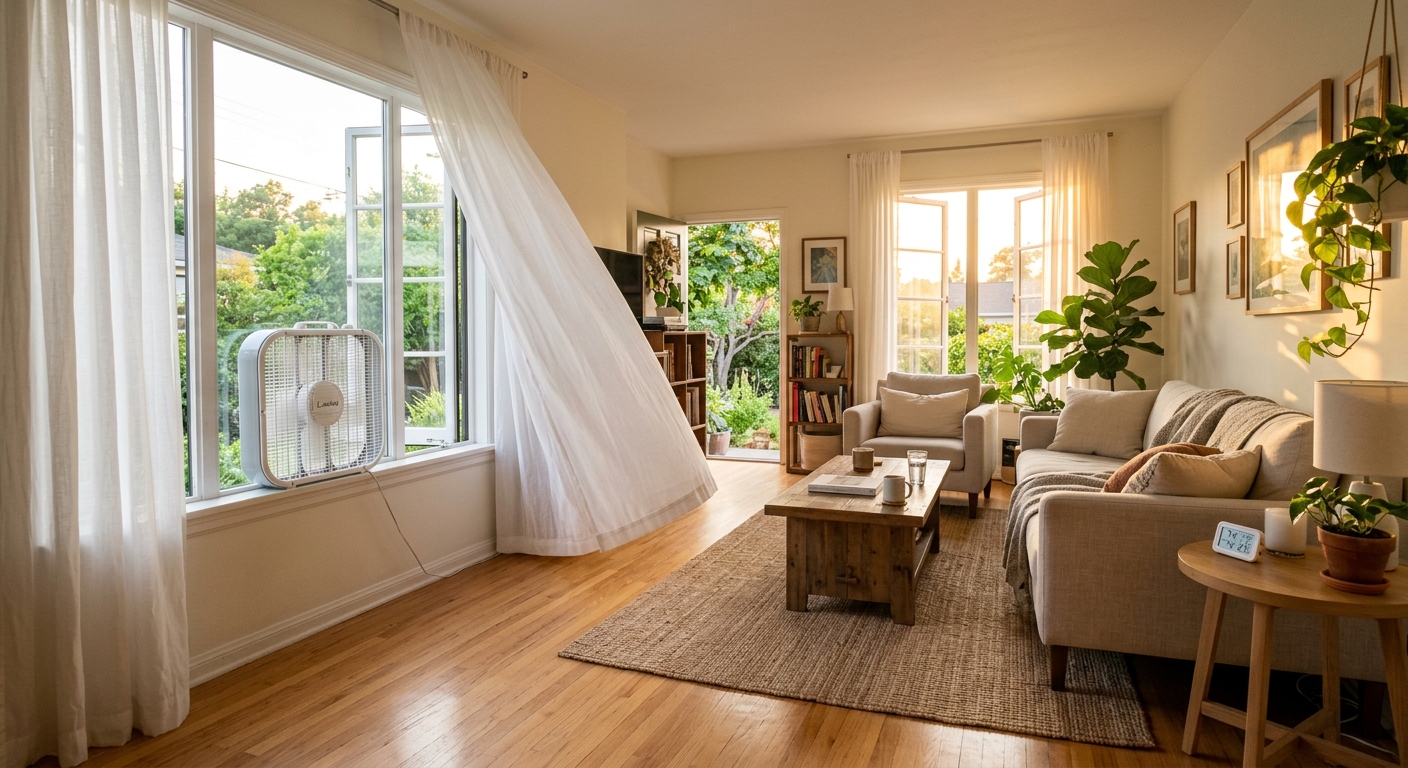
- Place the exhaust fan in the hottest room or the room farthest from the intake window. Face the fan blades outward so it is blowing air out of the home. Seat the fan firmly in the window frame and use a window fan insert or cardboard to block the gaps around it so air is forced through the fan blades.
- Open the intake window fully on the opposite side of the home. You do not need a fan here since the exhaust fan will pull air through naturally. Opening a second intake window increases airflow volume.
- Close interior doors selectively to direct airflow. Leaving a path of open doors from intake to exhaust forces air to travel through the rooms you want to cool rather than taking shortcuts through hallways.
- Run the setup for 45 to 60 minutes and then check indoor temperature with a thermometer. Once indoor and outdoor temperatures equalize, close windows and turn off fans to trap the cool air inside before outdoor temperatures rise again in the morning.
- Map your home’s airflow zones. Walk through every room and note which windows face north, south, east, and west. Sketch a rough floor plan showing the natural diagonal path air would travel from the coolest exposure to the warmest. In a two-story home, ground-floor north windows are typically best for intake and upper-floor south or west windows for exhaust.
- Install window fan inserts or cut rigid foam board to fill the gaps around each fan window. Seal gaps with inexpensive foam weatherstripping tape. This forces all air movement through the fan instead of leaking around it, increasing effective airflow by 20 to 30%.
- Set up a dedicated exhaust fan on the upper floor or in the attic stairwell if accessible. Position it facing outward. A second exhaust fan in a west-facing bedroom amplifies the stack effect by removing the hottest air from the highest point.
- Place intake fans in ground-floor north or east windows facing inward to supplement natural draw. Run intake fans at lower speed and exhaust fans at higher speed to maintain negative pressure in the home, which draws air in through all open lower openings.
- Plug exhaust fans into a mechanical outlet timer set to turn on automatically at the time outdoor temperatures drop below indoor temperatures, typically 9 to 11 PM in most climates. Set the timer to shut off fans one hour before sunrise to trap cool air inside before daytime heat builds.
- In the morning, close all windows and pull blinds or curtains on south and west exposures before 8 AM. The cool thermal mass your home absorbed overnight will buffer heat gain for several hours, often delaying AC turn-on until mid to late afternoon or eliminating it entirely on days under 88 degrees Fahrenheit.
Why It Works: The Benefits
Running two box fans at 100 watts each costs roughly $0.05 per hour at average U.S. electricity rates, compared to $0.36 to $0.60 per hour for a 3,000-watt central AC system. On mild days in spring and fall, this swap can cut cooling costs by 80 to 90%.
A properly configured cross-ventilation setup with two or more fans on opposite sides of the home can reduce indoor air temperature by 5 to 10 degrees Fahrenheit within 45 to 60 minutes when outdoor air is cooler than inside.
Homes that stay sealed with recirculated AC air accumulate CO2, VOCs from furniture and paint, and humidity. Flushing the home with outdoor air through cross-ventilation refreshes oxygen levels and dilutes indoor pollutants, which improves comfort and sleep quality.
Every hour your AC compressor does not run is an hour of mechanical wear it avoids. Replacing AC run time with fan ventilation on moderate days reduces total compressor cycles, which can extend the unit’s service life and reduce maintenance costs over time.
Unlike whole-house fans or mini-split systems, box fan cross-ventilation requires zero installation, no permits, and no permanent modifications. Renters and homeowners alike can implement a full setup in under 30 minutes.
💰 Savings Impact by Action
Running two box fans instead of central AC on a mild day reduces hourly cooling energy cost by roughly 85%, from about $0.48 per hour to under $0.07.
A full night flush cycle in a climate with a 20-degree diurnal temperature swing reduces daytime peak indoor temperatures by up to 30% of that swing, delaying or eliminating AC use the next morning.
Sealing gaps around window fans with foam board and tape increases effective airflow volume by 20 to 30% compared to an unsealed fan placement.
Homeowners in climates with cool nights who consistently use night flush ventilation report reducing AC runtime by 35 to 45% over a full cooling season compared to AC-only operation.
🏠 Key Concepts Explained
The Science Behind It
The physics behind cross-ventilation is rooted in Bernoulli’s principle and basic pressure mechanics. When a box fan exhausts air from one side of a sealed room, it removes air molecules faster than they are replaced, creating a small but meaningful zone of lower pressure. That pressure difference relative to the outdoors causes air to be pushed in through any opening on the opposite side. The greater the pressure difference and the larger the intake opening, the higher the volume of air moved per minute. A single 20-inch box fan on high can move 2,500 to 3,000 cubic feet of air per minute, which is enough to completely exchange the air in a 1,200 square foot, 8-foot ceiling home in under four minutes.
The stack effect adds a second natural force to the system. Because hot air is less dense than cool air, it rises and accumulates near ceilings and on upper floors. When you exhaust this hot upper air out through a high window, cooler replacement air flows in naturally from lower openings. This is the same principle used in passive house design and ancient vernacular architecture from the Middle East and Mediterranean, where buildings were designed with high exhaust vents and low shaded intakes to stay cool without any mechanical systems. By mimicking this geometry with fan placement, you amplify what nature already wants to do.
The night flush strategy works by targeting the thermal mass of your home. During a hot day, walls, floors, ceilings, and furniture absorb heat energy and their surface temperature climbs. Overnight ventilation removes this stored heat from surfaces by passing cooler air across them continuously. By morning, the thermal mass of the home is at a lower starting temperature, and since heat transfer from outdoors into the home depends on the difference between indoor and outdoor surface temperatures, a cooler starting point means slower heat gain the following day. Studies from Lawrence Berkeley National Laboratory show that in climates with a 20-degree or greater diurnal temperature swing, night flush ventilation can reduce daytime peak indoor temperatures by 4 to 8 degrees Fahrenheit compared to a sealed home.
Frequently Asked Questions
▼ Why does my home feel humid and sticky after running box fans all night?
Outdoor air carries moisture, and when the dew point is above 60 degrees Fahrenheit, bringing in outside air adds more humidity than the temperature drop is worth. Check the dew point in your weather app before opening windows. If it is above 60, keep windows closed and run the AC or a dehumidifier instead. This is particularly common in Gulf Coast, Southeastern, and Mid-Atlantic states from June through September.
▼ My fan is running but I cannot feel any airflow in the rooms I want to cool. What am I doing wrong?
The most common cause is air short-circuiting, where air travels the shortest path between intake and exhaust rather than through the rooms you want. Check that interior doors along the intended airflow path are open and that doors to rooms off the main path are closed. Also verify the exhaust fan gaps are sealed, since air leaking back around the fan frame kills the pressure differential that drives flow through the home.
▼ Can I run cross-ventilation and air conditioning at the same time to save energy?
No, running both simultaneously wastes energy and fights itself. When windows are open and fans are running, your AC is conditioning outdoor air indefinitely rather than recycling indoor air, which drives up runtime and cost significantly. Choose one mode based on outdoor conditions. Use cross-ventilation when outdoor temps are below about 78 degrees Fahrenheit with a dew point under 60, and switch to AC when conditions exceed those thresholds.
▼ How do I know if cross-ventilation is actually working and saving me money?
Place an indoor thermometer in the center of your main living area and note the temperature when you start the fans. Check it again after 60 minutes. If indoor temperature has dropped by at least 3 degrees and is within 2 to 3 degrees of outdoor temperature, the system is working. For savings confirmation, compare your electricity bill for a month when you actively used fan ventilation versus the same month the previous year, adjusting for any unusual heat events.
▼ What if my home has an open floor plan with very few interior doors? Will cross-ventilation still work?
Open floor plans actually assist cross-ventilation because there are fewer obstacles for air to navigate. The trade-off is that you have less ability to direct airflow to specific rooms. In an open plan home, focus on maximizing the distance and diagonal angle between intake and exhaust windows, and use furniture or temporary partitions to gently guide airflow toward occupied areas. The overall cooling effect will still be effective.
Quick Tips
- Check your weather app’s hourly forecast the night before to find the exact hour outdoor temperatures drop below your indoor temperature. Start your fans at that precise moment to maximize the cooling window.
- Add a damp towel or a bowl of ice in front of an intake fan to boost cooling effect by 2 to 4 degrees through evaporative cooling, most effective in dry climates with humidity below 50%.
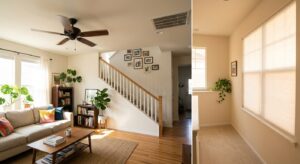
- In a two-story home, keep the stairwell door open when running cross-ventilation. The stairwell acts as a natural chimney, accelerating upward hot air movement toward your exhaust windows.
- Use blackout curtains or reflective window film on south and west windows during the day. Reducing solar heat gain means your home starts the evening flush at a lower indoor temperature, which means the fans reach equilibrium faster and cool the thermal mass more deeply.
Variations for Your Situation
- Apartment or Rental: Renters with windows on only one side of the unit face a real challenge since true cross-ventilation requires openings on opposite sides. Compensate by placing a box fan exhausting out one window and a second fan in a nearby window facing inward, creating a small pressure loop within the apartment. You can also leave the front door open to a common hallway with a fan blowing inward if the hallway is cooler, using the hallway as your intake path. Spend $20 to $40 on a window fan with reversible airflow so you can switch modes as outdoor conditions change.
- Tight Budget (Under $50): You do not need multiple fans to get results. Start with one box fan ($20 to $30) placed in the hottest room exhausting outward, and rely on natural draw through open windows on the opposite side. Seal the gaps around the single fan using cardboard cut from a cereal box and taped into place. This zero-waste approach captures 70% of the benefit of a full two-fan setup. Time your single fan to run during the overnight coolest hours using a $10 mechanical outlet timer for maximum impact with minimum spend.
- Older Home (Pre-1980): Older homes often have more natural air leakage through gaps in the building envelope, which reduces the pressure differential a box fan can create. Counter this by sealing the most obvious leaks around window frames and door sweeps before setting up cross-ventilation, a step that pays double dividends by also reducing AC energy use in hot weather. Older homes also tend to have smaller windows, so prioritize maximizing the size of the intake opening by opening multiple windows on the cool side rather than relying on a single large opening. Homes built before 1970 may also have original single-pane windows that transfer outdoor heat quickly, so the morning window-closing routine is especially critical to preserve overnight cooling gains.