You walk past your air conditioner and notice ice forming on the refrigerant lines or the indoor unit. It seems counterintuitive – how can something that cools your home freeze up in the middle of summer? The short answer is that ice on your AC is never normal, and ignoring it can turn a $20 fix into a compressor replacement costing $1,500 to $2,500 or more.
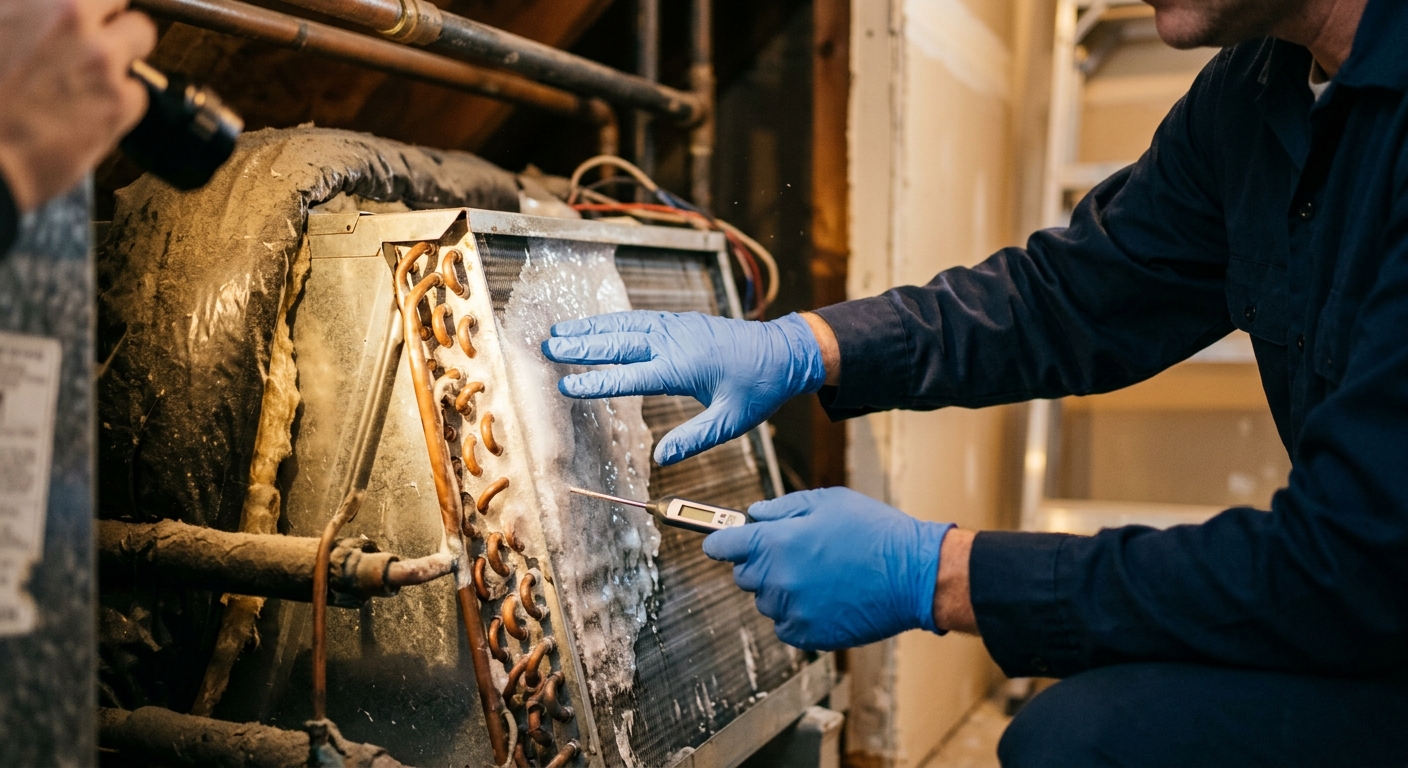
A frozen AC coil is a symptom, not a problem on its own. Something is preventing the refrigerant from absorbing heat the way it should, which causes the coil temperature to drop below 32°F and moisture in the air to freeze on contact. The two most common culprits are restricted airflow and low refrigerant, and each one stresses your system in ways that compound over time. Running a frozen AC doesn’t just fail to cool your home – it actively damages components and drives up your energy bill by 20 to 40% while the system struggles.
This guide walks you through exactly how to identify why your AC is freezing, how to thaw it safely without causing more damage, and what steps to take to prevent it from happening again. Whether it’s a clogged filter you can fix in five minutes or a refrigerant leak that needs a licensed technician, you’ll know what you’re dealing with and what it should cost to fix it.
What You’ll Need
Click on an item below to shop for the recommended items for this recipe on Amazon.
As an Amazon Associate, we earn from qualifying purchases.
How to Do It
- Turn the thermostat from Cool to Fan Only or switch the system completely Off. Never run the AC with a frozen coil – this risks compressor damage from liquid refrigerant slugging.
- Place towels around the indoor air handler to catch dripping water as the ice melts. Open the access panel if accessible and verify ice is present on the evaporator coil or refrigerant lines.
- Check and replace your air filter. Hold it up to a light – if you cannot see light through it, replace it immediately. A MERV 8 to 11 filter replaced every 60 to 90 days costs $10 to $20 and is the most common fix.
- Walk through every room and verify all supply and return vents are fully open and unblocked by furniture, rugs, or curtains. Closing more than 20% of your vents can restrict airflow enough to cause freezing.
- Allow 2 to 6 hours for the coil to thaw completely. Do not use a heat gun or hair dryer on the coil – let it melt naturally to avoid damaging delicate aluminum fins.
- Once fully thawed, switch back to Cool mode and monitor for 30 minutes. If ice begins forming again within a few hours, the cause is not airflow and you need a professional refrigerant check.
- After fully thawing the coil, shut off power to the air handler at the breaker before opening the access panel for inspection.
- Inspect the evaporator coil surface for dust, debris, or biological growth. A visibly dirty coil restricts airflow almost as much as a clogged filter and insulates the coil surface, reducing heat transfer efficiency by 15 to 25%.
- Apply a no-rinse evaporator coil cleaner spray (available at hardware stores for $15 to $25) following label directions. The foam lifts debris and drains into the condensate pan. Allow 20 to 30 minutes before restoring power.
- Check the condensate drain pan and drain line for standing water or algae buildup. A clogged drain causes overflow and contributes to high indoor humidity, which worsens coil icing. Flush the line with a cup of diluted bleach solution (1 part bleach to 16 parts water).
- Inspect accessible ductwork near the air handler for disconnected joints, crushed flex duct, or undersized returns. A single disconnected duct section can reduce airflow by 20 to 30%, which a filter change will never fix.
- Restore power, return to Cool mode, and use a thermometer to check supply air temperature at a vent closest to the air handler. It should read 15 to 20°F below your return air temperature. A smaller split after cleaning suggests a refrigerant issue requiring a technician.
- After completing the thaw and ruling out airflow issues, call a licensed HVAC technician and describe the freeze-up, how often it recurs, and the age of your system. This helps them arrive with the right equipment and refrigerant type.
- The technician will connect manifold gauges to the service ports to measure suction and discharge pressures. Low suction pressure, typically below 60 PSI for R-410A systems, confirms refrigerant undercharge.
- Request a leak search before any refrigerant is added. Adding refrigerant to a leaking system is a temporary fix that costs $100 to $300 in refrigerant and delays finding the real problem. Leak detection with dye or electronic sniffers typically adds $50 to $100 to the service call.
- If a leak is found, get a written estimate for repair. Small leaks at Schrader valves or flare fittings cost $75 to $200 to fix. Coil leaks are more serious and can cost $600 to $1,500 or more depending on whether the coil needs replacement.
- Ask the technician to verify correct refrigerant charge by superheat or subcooling method after any repair, not just by pressure alone. Proper charging ensures the system runs at rated SEER efficiency and prevents repeat freeze-ups.
- Request documentation of the refrigerant type, amount added, and pressures recorded. This gives you a baseline for future service calls and helps identify if the system is leaking again at the next tune-up.
Why It Works: The Benefits
Catching and fixing a freeze-up before the compressor is damaged avoids the single most expensive AC repair, which typically runs $1,500 to $2,500 for replacement or $800 to $1,200 for remanufactured units.
A system struggling with a frozen coil can consume 20 to 40% more electricity while delivering less cooling. Fixing the root cause brings energy use back to the rated SEER efficiency your system was designed for.
A properly charged, unobstructed AC system operating at rated efficiency can save $30 to $80 per month during peak cooling season compared to a system running degraded from restricted airflow or low refrigerant.
Repeated freeze-thaw cycles stress refrigerant lines, coil fins, and the compressor. Resolving the underlying cause can add 3 to 5 years to the usable life of the system, deferring a $4,000 to $8,000 replacement.
A frozen coil cannot dehumidify or cool air effectively. Fixing the issue restores proper latent heat removal, dropping humidity by 10 to 20% relative humidity in some homes and making the space feel noticeably more comfortable even at the same thermostat setting.
💰 Savings Impact by Action
Replacing a severely clogged filter restores full airflow and can reduce energy consumption by 10 to 15% by allowing the system to operate at its designed efficiency.
A dirty evaporator coil reduces heat transfer efficiency by 15 to 25%, and cleaning it restores that capacity without any refrigerant work.
A 10% refrigerant undercharge reduces system efficiency by approximately 20%, and properly recharging the system returns cooling output to rated SEER performance.
Catching a freeze-up before compressor slugging occurs avoids a $1,500 to $2,500 replacement that effectively totals many older systems.
🏠 Key Concepts Explained
The Science Behind It
Your AC’s evaporator coil is designed to operate within a specific temperature range, typically between 40°F and 55°F on the coil surface. At this range, refrigerant absorbs latent and sensible heat from the warm air passing over the coil efficiently. When that heat transfer is disrupted – by restricted airflow or insufficient refrigerant – the coil temperature drops below 32°F and moisture in the passing air freezes on contact. Once a layer of ice forms, it acts as an insulating barrier, reducing heat transfer further and causing the freeze to spread and thicken in a self-reinforcing cycle.
The refrigerant charge issue works through pressure and temperature relationships described by refrigerant pressure-enthalpy curves. When refrigerant leaks from the system, the pressure on the low side (suction side) drops. Lower pressure means a lower boiling point for the refrigerant, so it evaporates at a colder temperature inside the coil than the system was designed for. An R-410A system with a suction pressure of 100 PSI operates normally, but at 60 PSI the corresponding saturation temperature drops from around 40°F to below 20°F – well into ice-forming territory even with normal airflow.
Airflow restriction drives the same result through a different mechanism. The refrigerant entering the coil has a set amount of heat it needs to absorb before leaving as a vapor. If the airflow volume across the coil is reduced by 30 to 50% due to a blocked filter or closed vents, there simply isn’t enough warm air to provide that heat. The refrigerant stays in the coil longer, continues dropping in temperature, and the coil surface dips below freezing. This is why something as simple as a $15 air filter swap can completely resolve a freeze-up – the fix addresses the root thermodynamic imbalance without any refrigerant work at all.
Frequently Asked Questions
▼ My AC keeps freezing up even after I changed the filter. What else should I check?
A new filter rules out the most common cause, but coil freezing can also result from a dirty evaporator coil, blocked or collapsed ductwork, closed supply vents, or low refrigerant from a leak. Try the DIY coil cleaning approach first, which costs $15 to $30. If the system freezes again within a few days after that, call a licensed HVAC technician to check refrigerant pressures – that’s the likely culprit at that point.
▼ How long does it take for a frozen AC coil to thaw on its own?
Most systems thaw completely within 2 to 6 hours when switched to Fan Only mode, which blows room-temperature air across the coil to speed melting. Switching the system completely off extends thaw time to 6 to 24 hours depending on how much ice built up. Never try to speed up the process with a heat gun or hair dryer – the aluminum fins can warp or melt, and you risk creating a refrigerant leak.
▼ Can I add refrigerant to my AC myself to fix a freeze-up?
No, and it’s actually illegal to purchase or handle refrigerants without EPA Section 608 certification. Beyond the legal issue, adding refrigerant without finding and fixing the underlying leak is at best a temporary fix that delays proper diagnosis and can result in overcharging the system, which also causes damage. A licensed HVAC technician with the right gauges can identify the exact charge needed and inspect for leaks in the same visit for $150 to $300.
▼ My AC froze up overnight but seemed fine during the day. Why does this happen?
This pattern almost always points to a borderline refrigerant charge or a system that’s slightly undersized for the home. During the day, the high heat load keeps the coil temperature in the safe range. At night, outdoor temps drop, the heat load falls, and the system runs at reduced capacity – exposing the marginal refrigerant charge or airflow issue that wasn’t noticeable before. Have a technician check refrigerant pressures and verify the system’s capacity matches the home’s cooling load.
▼ Is it safe to run my AC on Fan Only while waiting for a technician?
Yes, Fan Only mode is safe and actually helpful – it circulates air without running the compressor, which allows the coil to thaw while keeping some air moving in your home. Just make sure you have switched out of Cool mode completely so the compressor does not cycle on. Place towels around the air handler to catch runoff and check the condensate drain pan every hour to prevent overflow.
Quick Tips
- Set a recurring calendar reminder to check your air filter every 30 days during cooling season. A filter that looks fine in April can be completely clogged by June in homes with pets or dusty conditions.
- Keep all supply and return vents open, even in rooms you rarely use. Closing vents increases static pressure in the duct system, which reduces total airflow and can trigger coil freezing within 24 to 48 hours.
- Schedule annual AC tune-ups in April or early May before cooling season peaks. A technician checking refrigerant pressures and cleaning coils proactively costs $80 to $150 and prevents the $300 to $600 emergency service call in July.
- If your system freezes repeatedly after new filters and coil cleaning, photograph the ice location before thawing. Ice forming primarily on the refrigerant lines near the air handler rather than on the coil itself is a stronger indicator of refrigerant issues than airflow problems.
Variations for Your Situation
- Apartment/Rental: Renters should first check and replace the air filter, which is typically the tenant’s responsibility under most leases and costs $10 to $20. Document the freeze-up with photos and report it to your landlord or property manager in writing immediately – refrigerant leaks and coil cleaning are almost always the building owner’s legal responsibility. Do not turn the system off without notifying management, as prolonged shutdown in summer heat can cause other issues in the unit.
- Tight Budget (under $50): Start with the zero-cost steps: thaw the system, open all vents, remove any furniture blocking returns, and run on Fan Only. Replace the air filter for $10 to $20. If the freeze-up returns after that, a $15 to $25 can of no-rinse coil cleaner is the next logical spend. If the problem persists after both steps, the issue almost certainly requires a technician and continuing to delay increases the risk of compressor damage, which costs far more than the service call.
- Older Home (pre-1990): Homes this age often have original ductwork with significant air leakage, undersized return vents, and potentially R-22 refrigerant systems. Check whether your system label says R-22 or R-410A before calling a technician, since R-22 recharging costs $50 to $100 per pound versus $10 to $20 for R-410A. If your R-22 system needs more than one pound of refrigerant, get a replacement estimate at the same time – a new R-410A system often pays for itself within 3 to 5 years through efficiency gains alone compared to a degraded older unit.