You set the thermostat to 72 degrees, the AC runs all evening, and the rest of the house feels fine. But the moment you close your bedroom door and try to sleep, the room turns into a sauna. By 2 AM you are kicking off the covers and wondering why you paid for central air conditioning at all. This is one of the most common comfort complaints among homeowners, and the good news is that a failing AC system is rarely to blame.
Master bedrooms sit at the end of supply ducts, are often located on upper floors directly beneath the attic, and tend to have larger windows facing west or south. Each of those factors stacks heat against you in ways that no thermostat setting alone can overcome. Radiant heat from the roof, duct pressure imbalances, poor return airflow, and even your own body heat all contribute to a room that stays 5 to 10 degrees warmer than the rest of the house.
This post breaks down exactly why your bedroom holds heat overnight and walks you through a series of fixes, from free adjustments you can make in the next 15 minutes to targeted upgrades that can permanently solve the problem. You do not need a new HVAC system. You need to address the actual causes.
What You’ll Need
Click on an item below to shop for the recommended items for this recipe on Amazon.
As an Amazon Associate, we earn from qualifying purchases.
How to Do It
- Check that all supply vents in the bedroom are fully open and not blocked by furniture, curtains, or bedding. Even partially blocked vents reduce airflow by 20 to 40%.
- Open the bedroom door or crack it one to two inches. This relieves the pressure imbalance that slows supply air delivery when the door is closed. If privacy is a concern, this one step alone often drops the room temperature by 2 to 3 degrees.
- Close blinds or curtains on west and south-facing windows before 3 PM to block the most intense afternoon solar gain before it heats the room’s surfaces.
- Unplug televisions, gaming consoles, and unused chargers before bed. Devices in standby mode collectively generate 50 to 150 watts of steady heat in a closed room.
- Set a ceiling fan to run counterclockwise on medium speed. This creates a wind-chill effect and can make the room feel 3 to 4 degrees cooler without changing the actual air temperature.
- Pre-cool the bedroom by setting the thermostat 2 degrees lower starting at 7 PM, then returning to your normal setpoint before bed. This drives heat out of the walls and furniture before you try to sleep.
- Install a door undercut or interior door grille (cost $10 to $25) to allow return airflow from the bedroom back into the hallway when the door is closed. This alone can increase conditioned airflow into the room by 15 to 30%.
- Apply a window film rated for solar heat rejection on west and south-facing windows. Quality films like 3M Thinsulate or Gila heat control block 50 to 70% of solar heat gain and cost $25 to $60 per window. Installation takes about 30 minutes per window.
- Add blackout cellular shades or thermal curtains rated for heat blocking. These add an insulating air gap at the window and can reduce solar gain by an additional 20 to 33% on top of any film you apply.
- Seal attic access hatches, can lights, and any gaps in the bedroom ceiling with fireproof caulk or spray foam. These are major pathways for attic heat to bleed into the room. A poorly sealed attic hatch can leak as much heat as a small open window.
- Add attic insulation directly above the bedroom to at least R-38 if it is currently below that threshold. This is the single most impactful fix for radiant ceiling heat. A 10×12 foot section costs $40 to $80 in blown-in insulation and can be a Saturday afternoon project.
- Install a smart plug or outlet timer on the bedroom mini-split or window AC if your central system is undersized, and pre-cool the room for 45 minutes before bedtime using a supplemental unit.
- Hire an HVAC contractor or energy auditor to perform a duct leakage test and airflow measurement. This identifies whether the bedroom supply duct is undersized, kinked, or losing conditioned air before it reaches the room.
- Request duct balancing, where the technician adjusts dampers and registers throughout the house to redirect more airflow to the master bedroom. This is often a two-hour adjustment that costs $150 to $300.
- Ask about adding a dedicated return air duct in the master bedroom. Many homes have only one or two central returns, which creates the pressure imbalance problem. A new return duct typically costs $300 to $700 installed.
- Consider having a radiant barrier installed in the attic above the bedroom. A professional installation costs $1,000 to $2,500 for a full attic but can reduce attic air temperatures by 20 to 30 degrees, which significantly reduces ceiling heat radiation.
- If the ductwork is in good shape but the room still runs hot, ask about a mini-split zoned addition for the master suite. A single-zone mini-split typically costs $2,000 to $4,500 installed and provides independent temperature control with no duct losses.
Why It Works: The Benefits
Addressing radiant gain and airflow issues typically drops the bedroom temperature by 3 to 8 degrees Fahrenheit compared to doing nothing, which moves the room from uncomfortably warm into the ideal sleep temperature range of 65 to 68 degrees.
Fixing duct pressure imbalances and adding window coverings reduces how long the AC runs overall. Homeowners who address these issues together commonly see 10 to 25% reductions in summer cooling costs, which translates to $30 to $120 per summer depending on home size and climate.
Research consistently shows that core body temperature must drop 1 to 2 degrees for deep sleep to occur. A bedroom even 4 degrees cooler than before significantly improves sleep onset speed and time spent in restorative sleep stages.
When a bedroom traps heat and the thermostat reads a false comfortable average, the AC cycles inefficiently. Fixing the root causes means shorter, more effective run cycles, which reduces compressor wear and can extend system life by several years.
Solving bedroom heat problems often improves comfort throughout the house by correcting duct pressure imbalances and reducing the total heat load the system has to fight.
💰 Savings Impact by Action
Restoring return airflow from a closed bedroom can increase conditioned air delivery to the room by up to 20% with no equipment changes.
Quality solar control window film blocks 50 to 70% of solar heat gain through glass, reducing room cooling load by up to 30% in west-facing bedrooms.
Adding insulation above the bedroom to R-38 reduces heat conduction through the ceiling by 15 to 25%, which is the largest single heat source in most upper-floor rooms.
Using a ceiling fan allows the thermostat to be set 3 to 4 degrees higher with equivalent comfort, saving 6 to 8% per degree on cooling costs.
Pre-cooling the bedroom before peak sleep hours reduces total overnight AC runtime by up to 10% compared to letting the room heat up and trying to recover.
🏠 Key Concepts Explained
The Science Behind It
The master bedroom heat problem is rarely about the AC system itself. It is about heat load exceeding the room’s ability to reject it. Every room has a cooling load, measured in BTUs per hour, that represents the total heat entering the space from all sources: the sun through windows, heat conducted through the ceiling from the attic, heat radiating from walls, and heat generated inside the room by people and electronics. When that load exceeds the amount of cooling the supply duct delivers to the room, the room gets warmer. The thermostat in the hallway may be satisfied, but the bedroom never catches up.
The ceiling is often the biggest hidden culprit. Attic air temperatures regularly exceed 130 degrees on summer afternoons. Even with R-30 insulation, heat flows continuously from hot to cold, pushing thermal energy down through the ceiling assembly into the room below. This process continues for four to six hours after sunset because the roof deck and attic framing hold enormous amounts of stored thermal energy. This is called thermal mass and thermal lag. Meanwhile, a closed bedroom door creates a positive pressure zone because supply air is being pushed in but has no path back to the return. That pressure literally pushes back against the supply vent, reducing air delivery by 15 to 30% in some tested homes.
Window solar gain is equally important to understand. Glass has almost no insulating value (R-1 for a single pane, R-2 for double-pane). West-facing glass in the late afternoon receives solar radiation at a low angle, maximizing the amount of energy entering the room. Solar heat gain coefficient (SHGC) ratings on windows describe how much of that energy passes through. A window with an SHGC of 0.6, which is common in older homes, transmits 60% of incident solar radiation directly into the room as heat. Low-E coatings and quality window films can cut that to 0.2 to 0.3, reducing solar heat gain by 50 to 65% with no change to visible light levels.
Frequently Asked Questions
▼ My bedroom door is already open and the room is still 6 degrees hotter than the hallway. What is wrong?
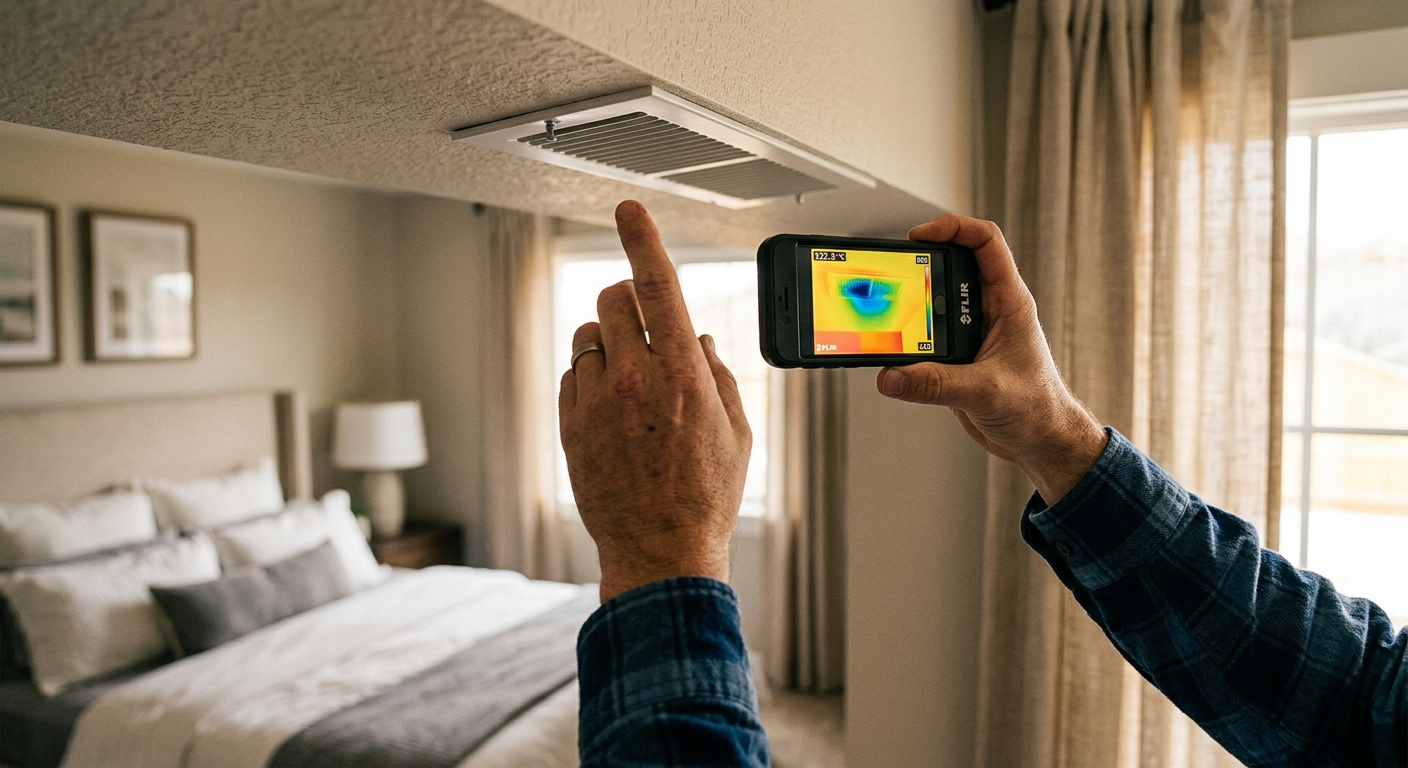
With the door open, the pressure problem is ruled out, which means you have a heat load problem rather than an airflow delivery problem. Measure the ceiling temperature with an infrared thermometer. If it reads more than 5 degrees above the air temperature, attic heat conduction is the primary cause. Focus your energy on attic insulation above that room, a radiant barrier, or both before trying other fixes.
▼ Why does the bedroom feel fine when I first go in but get hot after an hour of sleeping?
This is almost always thermal mass releasing stored heat combined with occupant body heat. The room may start at a reasonable temperature, but the walls, ceiling, and furniture continue radiating absorbed daytime heat for hours, and two people sleeping add roughly 250 BTUs per hour. Pre-cooling the room aggressively for 60 to 90 minutes before sleep is the most effective immediate fix, along with addressing the insulation and window issues that allow daytime heat to accumulate in the first place.
▼ I added a window AC unit to the bedroom but it still struggles on hot nights. Did I buy the wrong size?
Possibly, but also check for heat sources the unit is fighting. An undersized window AC is commonly blamed, but a 5,000 BTU unit that runs constantly while the room stays warm usually means the room has an excessive heat load from a poorly insulated ceiling or unshaded windows. Fix the solar gain and ceiling insulation first, then reassess. As a rough guide, a 12×14 foot bedroom with good insulation needs roughly 6,000 to 8,000 BTUs of cooling capacity.
▼ Can I fix this without touching the ductwork or attic?
Yes, and the free and low-cost fixes described here, including window film, thermal curtains, door undercutting, ceiling fan use, and pre-cooling, can realistically reduce the temperature gap by 3 to 5 degrees in most homes. That may not completely close a 7 or 8 degree gap, but it makes the room genuinely comfortable for most people. Full resolution of a severe problem usually does require addressing the ceiling insulation or duct balance.
▼ My AC was serviced recently and the technician said everything is fine. Why is the bedroom still hot?
HVAC technicians confirm that the equipment is operating correctly, not that it is delivering the right amount of air to every room. A well-functioning system can still be the wrong match for a specific room’s heat load or duct configuration. Ask specifically for an airflow measurement at the bedroom supply vent and a Manual J load calculation for that room, which will show whether the system is sized appropriately for the room’s actual cooling load.
Quick Tips
- Run your ceiling fan all night, not just when you first feel hot. The continuous wind-chill effect means you can set the thermostat 3 to 4 degrees higher and still sleep comfortably, saving 6 to 8% per degree on cooling costs.
- Close interior doors in unused rooms and redirect supply airflow by partially closing their vents. This sends more conditioned air toward the bedroom without changing any ductwork.
- Use a mattress cooling pad rather than lowering the thermostat at night. Devices like BedJet or ChiliPad target body heat directly and consume far less energy than running the whole-house AC cooler.
- Check your attic insulation depth above the master bedroom specifically. Insulation sometimes shifts or compresses over the years, and the area directly above bedrooms is often thinner than the rest of the attic.
Variations for Your Situation
- Apartment or Rental: Renters cannot modify ductwork or attic insulation, but window film, blackout curtains, ceiling fan installation (if permitted), and a portable or window AC unit are all landlord-friendly options. A window AC rated at 8,000 BTUs for a typical master bedroom costs $200 to $350 and can be taken when you move. Door draft stoppers and removable window film require no tools and leave no damage. Start there.
- Tight Budget Under $50: Focus exclusively on the free fixes first, then add a can of foam weatherstrip for ceiling penetrations ($6) and reflective window film for the worst window ($15 to $25). These three steps together can reduce the room temperature by 3 to 5 degrees at virtually no cost. A $12 box fan in the doorway pulling air out of the hallway into the room also improves circulation significantly.
- Older Home Pre-1980: Homes built before 1980 often have minimal or no attic insulation above bedroom ceilings, single-pane windows, and no vapor barrier. The heat gain in these homes is substantially higher than in modern construction. Prioritize attic insulation above the bedroom to at least R-38 as the single most impactful upgrade, expect to spend $300 to $600 for a contractor to do it properly, and consider interior storm window inserts ($75 to $150 per window) as a cost-effective alternative to full window replacement.