Every fall, thousands of homeowners skip winterizing their sprinkler systems, figuring the pipes will be fine. Then spring arrives and so does the plumber, along with a bill that often runs $300 to $600 for cracked pipes, blown manifolds, and damaged valve boxes. Water expands by about 9% when it freezes, and that pressure has nowhere to go inside a sealed irrigation line except outward through the weakest point, which is usually a fitting, valve, or sprinkler head.
The good news is that winterizing your irrigation system is one of the most straightforward seasonal home tasks you can do, and it pays for itself immediately. Whether you tackle it yourself with a compressor or hire a pro for a one-time blowout, the cost is a fraction of what you’d pay for freeze damage repairs. This post walks you through exactly what to do, how long it takes, and what each approach costs so you can make the right call for your setup.
We’ll cover the manual drain method for simple systems, the compressed air blowout method for more complex layouts, and when it makes sense to call a licensed irrigator. By the end, you’ll know precisely how to get your system safely through winter and ready to run perfectly when the grass wakes up in spring.
What You’ll Need
Click on an item below to shop for the recommended items for this recipe on Amazon.
As an Amazon Associate, we earn from qualifying purchases.
How to Do It
- Shut off the main irrigation water supply valve, usually located in the basement, utility room, or near the meter. Turn it fully clockwise until it stops.
- Turn off the irrigation controller by switching it to the off or rain mode. Do not just turn the screen off, make sure it will not send a signal to the valves.
- Locate the manual drain valves at the lowest points of each zone, typically small valves at the end of lateral lines or at low spots in the yard. Open each one slowly by turning counterclockwise.
- Open all the sprinkler heads manually if your heads have a manual bleed screw, to allow air in and speed drainage. This takes about 60 seconds per head.
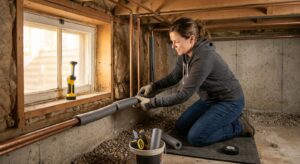
- Drain and insulate the backflow preventer by closing its two shutoff handles, opening the small test cocks to relieve pressure, and wrapping the unit with foam pipe insulation secured with outdoor tape.
- Leave drain valves open until spring, then close them before restoring pressure. Mark their locations with a small stake so you can find them easily in March.
- Rent or borrow a compressor capable of at least 20 CFM for poly pipe systems or 50 CFM for PVC systems. Standard small shop compressors at 5 to 10 CFM are not adequate for most residential systems.
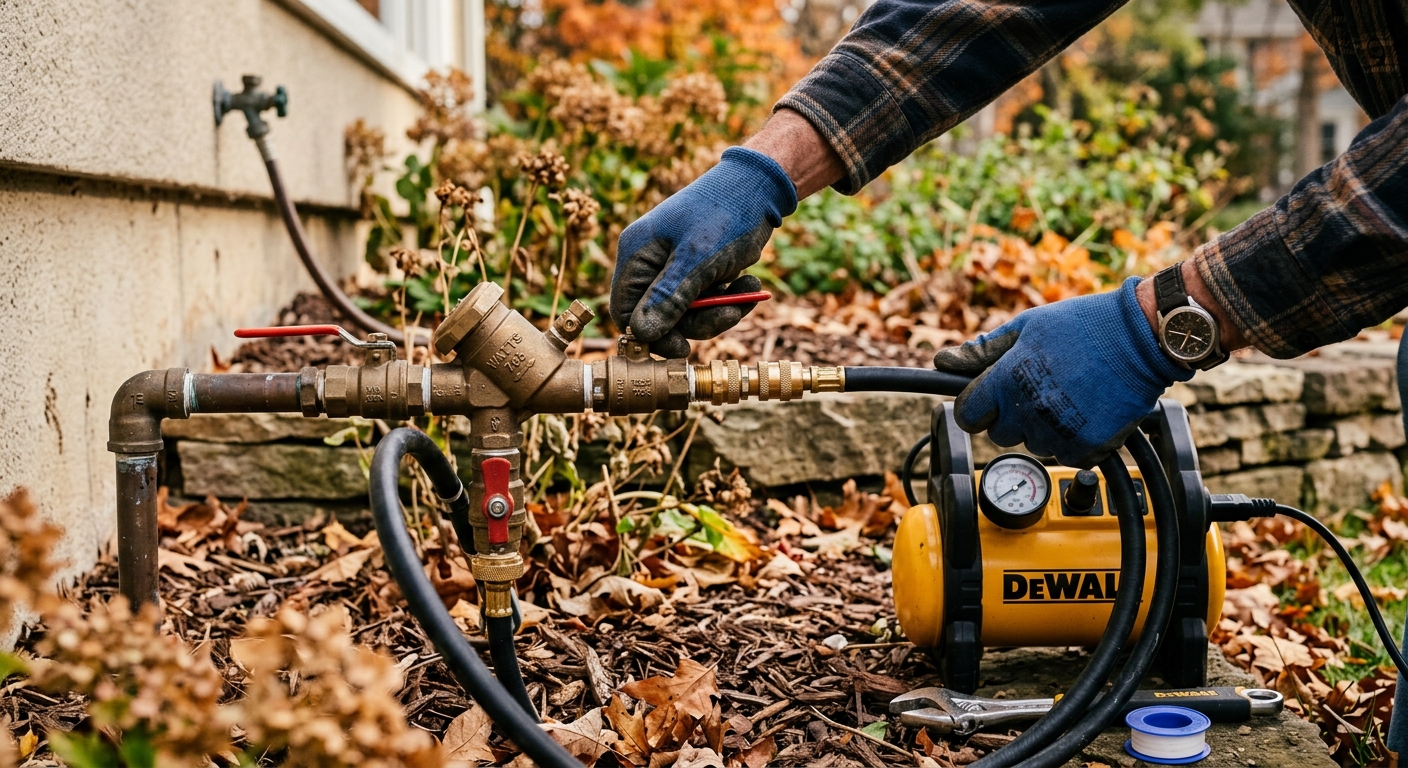
- Shut off the main irrigation water supply valve completely, then connect the compressor to the blow-out port or quick-connect fitting near the backflow preventer using an appropriate adapter fitting.
- Put on safety glasses. Never stand over or near a sprinkler head during the blowout because heads and debris can eject with significant force.
- Activate Zone 1 manually from the controller or valve box, then open the compressor valve slowly. Run compressed air through each zone for 2 to 3 minutes or until no water spray is visible, only dry air mist.
- Repeat for each zone in sequence, working from the farthest zone from the compressor back toward the supply. Run each zone 2 to 3 times to ensure all water is cleared from low spots.
- Shut off and isolate the backflow preventer by closing both handles to 45 degrees, open the test cocks to drain residual water, and wrap the entire unit with foam pipe insulation secured with outdoor tape or a purpose-made backflow insulation bag.
- Call a licensed irrigation contractor in early to mid-October, before the first hard freeze, as their schedules fill quickly in northern climates. Many offer combined spring-and-fall service packages for $100 to $180 total.
- Ask specifically whether they perform a full zone-by-zone blowout and inspect the backflow preventer, because some low-cost services only blow the main line.
- Be present or have someone available to point out any recently added zones, drip lines, or zones with known issues like poor coverage or a stuck head.
- Request a written zone check report noting any heads that need replacement or adjustments so you have a punch list ready for spring startup.
- After the technician leaves, confirm the controller is set to off or rain mode, the backflow preventer is insulated, and all valve boxes are closed and marked.
Why It Works: The Benefits
Cracked pipes, blown backflow preventers, and shattered heads from a single hard freeze typically cost $300 to $600 to repair, and complex systems can run over $1,000. A $0 to $75 winterization eliminates that risk entirely.
A properly winterized system starts up in spring with a simple pressure test and zone check, taking 20 to 30 minutes versus a half-day repair visit. Many irrigation companies charge $75 to $150 for spring startup, which goes smoothly only if the system was correctly shut down.
Repeated freeze-thaw cycles stress fittings, valve seats, and sprinkler head mechanisms. Consistent winterization can extend the usable life of plastic components by 5 to 10 years, delaying full system replacement.
Cracked lines from freeze damage often leak slowly underground, wasting hundreds of gallons before the damage is detected. Winterizing eliminates that hidden water loss and keeps your utility bill predictable in spring.
💰 Savings Impact by Action
Proper winterization eliminates virtually all risk of freeze-related pipe and fitting damage, which averages $300 to $600 per incident.
Insulating and isolating the backflow preventer reduces freeze failure risk by 95%, protecting a component that costs $150 to $350 to replace.
Homeowners who winterize consistently spend 80% less on irrigation repairs in the following spring startup compared to those who skip winterization.
Eliminating slow leaks from freeze-cracked lateral lines prevents an estimated 20 to 30% increase in spring water bills that goes undetected until the first high utility statement.
🏠 Key Concepts Explained
The Science Behind It
The physics behind freeze damage is straightforward but unforgiving. Water reaches its maximum density at 39 degrees Fahrenheit, then begins expanding as it cools further toward 32 degrees. By the time it fully freezes, it has increased in volume by about 9%. Inside a sealed irrigation pipe, that expansion has nowhere to go. The pressure generated by freezing water can exceed 25,000 PSI locally at a crack tip, which is more than enough to split PVC fittings, crack the brass bodies of backflow preventers, and fracture the plastic housings of valve solenoids.
The most vulnerable components are those above ground or at shallow depth. Buried pipes in most of the continental United States sit at 6 to 12 inches, well above the frost depth in zone 5 and colder climates where the ground can freeze to 36 inches or more. Lateral lines near the surface are particularly at risk during extended cold snaps when air temperature stays below 25 degrees Fahrenheit for more than 12 consecutive hours. Backflow preventers are above ground by code in most jurisdictions, making them almost always the first casualty of a hard freeze.
The compressed air blowout works by replacing the liquid water in each lateral line with compressible air. Unlike water, air has no meaningful expansion coefficient at freezing temperatures, so whatever small amount of moisture remains as vapor or thin film after a proper blowout cannot generate damaging pressure. Running each zone two to three times ensures that water trapped in low points and elbow fittings is fully evacuated. The physics of airflow through small-diameter pipe requires adequate CFM, not just PSI, because it is the volume of air moving through the pipe that pushes water out of low spots, not just the pressure behind it.
Frequently Asked Questions
▼ How do I know if my sprinkler pipes already froze and cracked?
Turn the system on briefly in spring after the ground has fully thawed and walk each zone while it runs. Signs of a cracked pipe include unusually wet or sunken areas of lawn, reduced pressure at heads in one zone, or a head that won’t pop up at normal pressure. If you suspect a break, shut the zone off and call an irrigation contractor for a pressure test before running the system further.
▼ Can I use my small shop compressor for a blowout?
Most small shop compressors produce 3 to 8 CFM, which is not enough for a proper zone blowout on a typical residential system. Running an undersized compressor will push some water out but leave pockets in low spots and elbow fittings that can still freeze. Rent a high-volume compressor from a tool rental shop for $40 to $60 per day, or hire a professional who brings commercial equipment.
▼ What if I already had a freeze and my system ran this fall?
Shut off the main irrigation water supply immediately. Do not run the system until you have done a full pressure test in spring because a cracked line can wash away soil and damage landscaping over winter. Mark any valve boxes so you can find them in spring, and call a licensed irrigator as soon as the ground thaws for a damage assessment before restoring pressure.
▼ My backflow preventer has no insulation. Is one cold night going to ruin it?
A single night at 28 to 30 degrees Fahrenheit with the system properly shut off poses lower risk than a prolonged cold snap, but you should not leave it exposed. Wrap it immediately with foam pipe insulation, which costs under $10 at any hardware store. For better protection, add a purpose-made insulated backflow cover bag over the foam.
▼ Do I need to winterize a drip irrigation system too?
Yes, drip systems also trap water in their supply lines, filters, and pressure regulators. Before blowing out a drip zone, remove the filter screen and pressure regulator because high-pressure air will destroy them. Blow the zone at reduced pressure, around 25 to 30 PSI, and then reinstall the components in spring.
Quick Tips
- Schedule your winterization for when overnight lows are consistently dropping below 40 degrees Fahrenheit but before the first forecast hard freeze below 32 degrees, typically October in zones 5 to 7.
- Take a short video walkthrough of your valve box locations and zone layout each fall. This saves 20 minutes of searching in spring and helps any contractor who services your system.
- If your controller has a seasonal adjust or water budget feature, set it to 0% in late October as a backup so even if you forget to switch it off, it will not run the system.
- Check your valve boxes for water infiltration while you are winterizing. Standing water in a valve box accelerates corrosion and can freeze around the valve body itself. Add drain holes with a drill if needed.
Variations for Your Situation
- Apartment or Rental with Shared Irrigation: You likely have no access to the irrigation main shutoff or controller, which means winterization is the property manager’s responsibility. Contact your landlord or HOA in writing by early October requesting confirmation that winterization is scheduled. Keep a copy of that request because if pipes freeze due to their failure to act, your documentation supports any damage claim.
- Tight Budget (under $25): Skip the compressor rental and use the manual drain method if your system has low-point drain valves. Focus your spending on a quality backflow insulation bag ($15 to $25), which protects the single most expensive component. Shut the controller off completely, close the main valve, and open all manual drains. This will not be as thorough as a blowout but is far better than doing nothing at all.
- Older Home with Unknown Pipe Type or Layout: Pre-1990 systems frequently used galvanized steel fittings or thin-wall PVC that is more brittle under pressure. If you do not have an as-built diagram of your system, do not attempt a DIY blowout at full pressure. Hire a licensed irrigator who can do a low-pressure zone test first to identify any already-weakened sections before applying compressed air. The $75 to $125 service fee is cheap insurance against bursting an unknown weak fitting.