If you work from home, you have probably noticed it: by late morning, your home office starts feeling thick and airless. Your eyes get heavy, your concentration drifts, and cranking the thermostat down a few degrees does not really help. The problem is not just temperature. It is a combination of rising CO2 levels, moisture from your breath, heat radiating off electronics, and a room with very little air movement designed primarily for sleeping, not eight hours of focused work.
Research from Harvard’s T.H. Chan School of Public Health found that cognitive scores dropped by 15% in environments with elevated CO2, and by 50% in poorly ventilated spaces. That is not a minor annoyance. That is real productivity loss happening every day inside your own home. The good news is that the root causes are well understood, and most of the fixes cost under $50 and take less than an afternoon to implement.
This guide breaks down exactly why your home office turns stuffy by noon, the building science behind it, and a set of approaches ranging from free adjustments you can make right now to a weekend DIY upgrade that will transform the room. Whether you rent or own, work in a converted bedroom or a basement, there is a workable solution here for your setup.
What You’ll Need
Click on an item below to shop for the recommended items for this recipe on Amazon.
As an Amazon Associate, we earn from qualifying purchases.
How to Do It
- Open your office window 3 to 4 inches and crack a window or door in an adjacent room on the opposite side of the house. This cross-ventilation creates a pressure difference that pulls fresh air through the office rather than just letting it sit.
- Reverse your ceiling fan direction if you have one: counterclockwise in summer pushes air down and creates a wind-chill effect, making the room feel 3 to 4 degrees cooler without lowering the thermostat.
- Close your office door and windows between 10 AM and 2 PM on hot sunny days to trap the cool morning air, then reopen after 4 PM when outdoor temps drop. This passive thermal strategy works best in climates with cooler mornings.
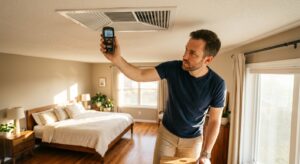
- Reposition your supply vent if it is pointed directly at a wall. Aim it toward the center of the room at a 45-degree angle using the adjustable louvers so conditioned air mixes into the full room volume instead of short-circuiting to the return.
- Take a 10-minute break outside or in a different part of the house at mid-morning. CO2 drops rapidly when the source (you) leaves the room, and it resets the air quality for the rest of your workday.
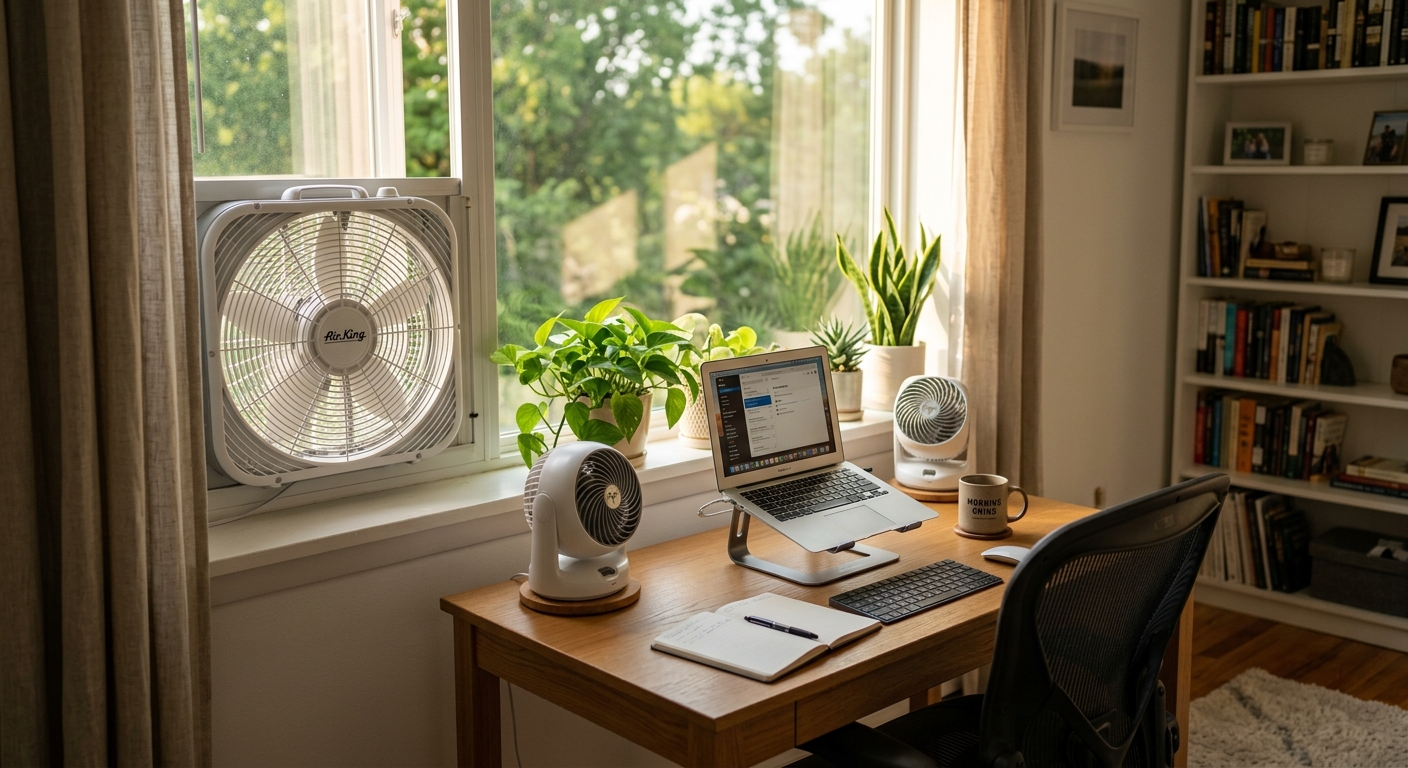
- Install a small window fan ($25 to $45) in exhaust mode in your office window. Set it to run on low from 9 AM onward. This actively pulls stale, CO2-rich, humid air out of the room and draws fresh air in through the door gap or another opening, achieving a full air change every 20 to 30 minutes.
- Add a CO2 monitor ($35 to $80, models like Aranet4 or Inkbird) to your desk. Use it for one week to identify when your room crosses 1,000 ppm. This tells you exactly when to intervene with a fan boost or window opening, turning guesswork into data.
- Apply removable solar control window film ($15 to $30 for one window) to south or west-facing glass. These films block 40 to 70% of solar heat while maintaining visibility, reducing the room’s peak heat gain by up to 30% without blocking light.
- Place a small 6-inch USB desk fan ($10 to $20) at desk height angled slightly upward toward your face. Even a gentle 2 mph airflow increases evaporative cooling from your skin and can make the room feel 3 degrees cooler with no thermostat change.
- Seal the gap under your office door with a door sweep ($8 to $15) if your HVAC is running. This keeps the conditioned air in the room longer, prevents return-air pressure imbalances, and reduces the chance of dusty hallway air infiltrating when the fan is off.
- Have an HVAC technician balance your duct system by adjusting the office supply vent damper. Many home offices, originally designed as bedrooms with low occupancy, receive too little conditioned airflow for all-day work. A technician can increase CFM to the room in under an hour for $75 to $150.
- Install a through-wall or in-window energy recovery ventilator (ERV) designed for single rooms, such as the Lunos e2 or Prana 150 ($200 to $400 installed). These units exchange stale indoor air with fresh outdoor air while recovering 70 to 80% of the conditioned air’s energy, keeping CO2 low without wasting heating or cooling.
- Add a smart thermostat zone sensor in the office ($35 to $50 for Ecobee or Nest sensor). This tells your central system to prioritize cooling the office when it detects occupancy and temperature rise, rather than averaging across the whole house.
- Install cellular shades or exterior solar shades on south and west windows ($80 to $200 per window). Exterior shading blocks solar heat before it enters the glass, which is 40% more effective than interior blinds at the same cost over time.
- Consider a mini-split head for the office if it is a room addition or far from the air handler. A 6,000 to 9,000 BTU mini-split ($700 to $1,500 installed) gives full independent temperature and humidity control, pays back in 3 to 5 years through reduced whole-home conditioning costs.
Why It Works: The Benefits
Keeping CO2 below 800 ppm through ventilation restores cognitive performance by 15 to 50% compared to a closed, stagnant room, according to Harvard research. Most people notice the difference in mental clarity within the first working day after improving airflow.
Blocking solar heat gain with interior blinds or external shading can reduce cooling load in the office by 20 to 30%, and managing internal electronics heat can shave another 10 to 15% off the room’s share of your cooling bill during summer months.
A small desk fan or correctly aimed ceiling fan breaks up air stratification and can make a room feel 3 to 4 degrees Fahrenheit cooler without changing the thermostat setting at all, reducing reliance on air conditioning.
Better ventilation dilutes dust, VOCs from furniture and electronics, and dry heat from equipment. Many remote workers report that headaches and dry eyes, often blamed on screens, improve significantly when the room’s air quality is addressed.
Consistent fresh air exchange reduces mold risk, limits dust mite activity, and keeps humidity in the healthy 30 to 50% range. This protects both the room’s finishes and the health of the person spending 8 or more hours in it daily.
💰 Savings Impact by Action
Applying solar control film or exterior shades reduces solar heat gain through windows by up to 28%, directly cutting the cooling load your AC must overcome each afternoon.
Professionally balancing duct airflow to the office ensures the room receives its design CFM, reducing the runtime needed to reach setpoint by roughly 15%.
A desk or ceiling fan creates a wind-chill effect worth 3 to 4 degrees Fahrenheit, allowing a thermostat setpoint increase of 2 to 3 degrees that saves roughly 10% on cooling per degree raised.
A single-room energy recovery ventilator recovers 70 to 80% of the conditioned air’s thermal energy while still delivering full fresh air exchange, versus an open window which recovers zero percent.
Enabling sleep mode on monitors and switching to a laptop instead of a desktop reduces continuous heat output by 60 to 80 watts, cutting the room’s internal heat gain by up to 12%.
🏠 Key Concepts Explained
The Science Behind It
The stuffiness you feel by noon is a convergence of three separate physical processes happening simultaneously. First, you are the room’s primary CO2 source. A person at rest or doing light desk work exhales roughly 200 milliliters of CO2 per minute. In a 120 square foot office with 8-foot ceilings (about 960 cubic feet of air), it takes only 90 to 120 minutes of normal occupancy to push CO2 from the ambient 400 ppm to over 1,000 ppm if there is no fresh air exchange. At 1,000 ppm, research consistently shows measurable declines in response time, focus, and decision-making. By 1,500 ppm, those effects are significant enough to impact professional work quality.
Second, heat is stacking up from multiple sources at once. Solar heat enters through glass at a rate proportional to the window’s solar heat gain coefficient (SHGC) and the sun angle, which peaks between 10 AM and 3 PM on west-facing windows. Meanwhile, your electronics are continuously converting electrical energy into heat at roughly 3.4 BTUs per watt. A 200-watt workstation running all day adds 680 BTUs per hour to the room, and because this heat is continuous and at low levels, your HVAC thermostat (which averages across the whole house) rarely triggers a cooling cycle specifically for your office.
Third, because warm air is less dense than cool air, it rises and pools near the ceiling in a layer called thermal stratification. In a room with a standard 8-foot ceiling and no active mixing, the air at ceiling level can be 6 to 8 degrees Fahrenheit warmer than at floor level. Since your head is roughly 4 to 5 feet off the ground when seated, you are sitting in the middle of this gradient, in air that is warmer and more CO2-rich than the thermostat’s sensor location in the hallway or living room. Solving all three problems, ventilation, heat gain, and stratification, is what transforms the office from a productivity drain back into a comfortable workspace.
Frequently Asked Questions
▼ I opened the window and turned on a fan but my office still feels stuffy by noon. What am I missing?
Opening one window with a fan creates airflow but does not guarantee fresh air exchange if there is no exit point for stale air. Make sure you have an exhaust path, either the fan blowing outward or a door or second window open on the opposite side of the room. Also check that your CO2 monitor confirms the levels are actually dropping; if they are and you still feel uncomfortable, the issue may be humidity or heat rather than CO2.
▼ Can renters make these changes without landlord permission?
Most of the quick-fix and DIY steps are fully renter-safe: window fans, desk fans, CO2 monitors, removable window film, and door sweeps all leave no permanent marks and can be removed on move-out. Avoid drilling holes in walls or modifying ductwork without written permission. A window fan in exhaust mode is arguably the single highest-impact renter-friendly fix available and costs under $40.
▼ My office is in the basement and there are no windows. What can I do?
A windowless basement office needs a mechanical ventilation solution since natural cross-ventilation is not possible. Install a bathroom-style exhaust fan vented to the outside ($40 to $80 plus a duct run) to continuously exhaust stale air, and crack a door to the upper floor to provide a fresh air makeup path. A single-room ERV unit is the premium solution here as it provides both supply and exhaust in one unit through a small wall penetration.
▼ How quickly will I actually notice a difference after making these changes?
The cognitive and comfort benefits of lower CO2 are noticeable within 20 to 30 minutes of improving ventilation, as levels drop back toward 600 to 800 ppm. Heat reduction from solar film and adjusted vents takes one to two full hot days to benchmark. Most people working from home report a clear difference in afternoon energy and focus within the first week of consistent ventilation improvements.
▼ My HVAC runs constantly but the office is still 4 to 5 degrees warmer than the rest of the house. Is something wrong?
A persistent temperature differential usually means one of three things: the supply vent to that room is undersized or partially closed, the room has significant uncontrolled heat gain (solar or electronics) that the single vent cannot overcome, or the room lacks a return air path so conditioned air builds pressure and stops flowing in. Check that the vent is fully open, that there is at least a half-inch gap under the door for return air, and if both check out, call an HVAC technician to measure the CFM to that room and compare it to Manual J calculations for the space.
Quick Tips
- Run your window fan in exhaust mode during the first hour of your workday to flush overnight-accumulated CO2 and any VOCs released by furniture and electronics warming up.
- Position your computer tower or desktop unit on the floor or on a stand away from your legs. Equipment heat rises directly into your breathing zone when it is on the desk surface beside you.
- Set a recurring 90-minute reminder to stand, open the door for 5 minutes, or step outside briefly. This behavioral reset costs nothing and prevents CO2 from reaching cognitively impairing levels.
- If you have a portable air conditioner with an exhaust hose, it is actively depressurizing your room and pulling unconditioned air in through gaps. Seal the window kit around the hose tightly with foam tape to minimize this effect.
Variations for Your Situation
- Apartment or Rental: Skip any modifications that require drilling or ductwork. Focus on a window exhaust fan ($25 to $45), a desk fan at breathing height, and removable static-cling solar film on problem windows. A CO2 monitor ($35 to $80) lets you manage ventilation with real data rather than guessing, and a door sweep with adhesive backing adds air retention without any tools.
- Tight Budget (under $50): Start with the free airflow adjustments (cross-ventilation, ceiling fan direction, vent repositioning) and add a single $25 window fan in exhaust mode. Together these address CO2 and stratification at essentially no cost. Avoid buying a CO2 monitor first; use the 90-minute break rule as your proxy until you can invest more.
- Older Home (pre-1980): Older homes often have higher natural air infiltration rates, which can help with CO2 but also allow unfiltered dusty air and humidity to enter. Prioritize solar control on single-pane windows (interior film pays back fastest here) and add a small dehumidifier ($120 to $180) if humidity consistently reads above 55% in the office. Duct systems in older homes are frequently unbalanced, so a professional HVAC assessment is worth the investment if temperature differentials persist after basic fixes.