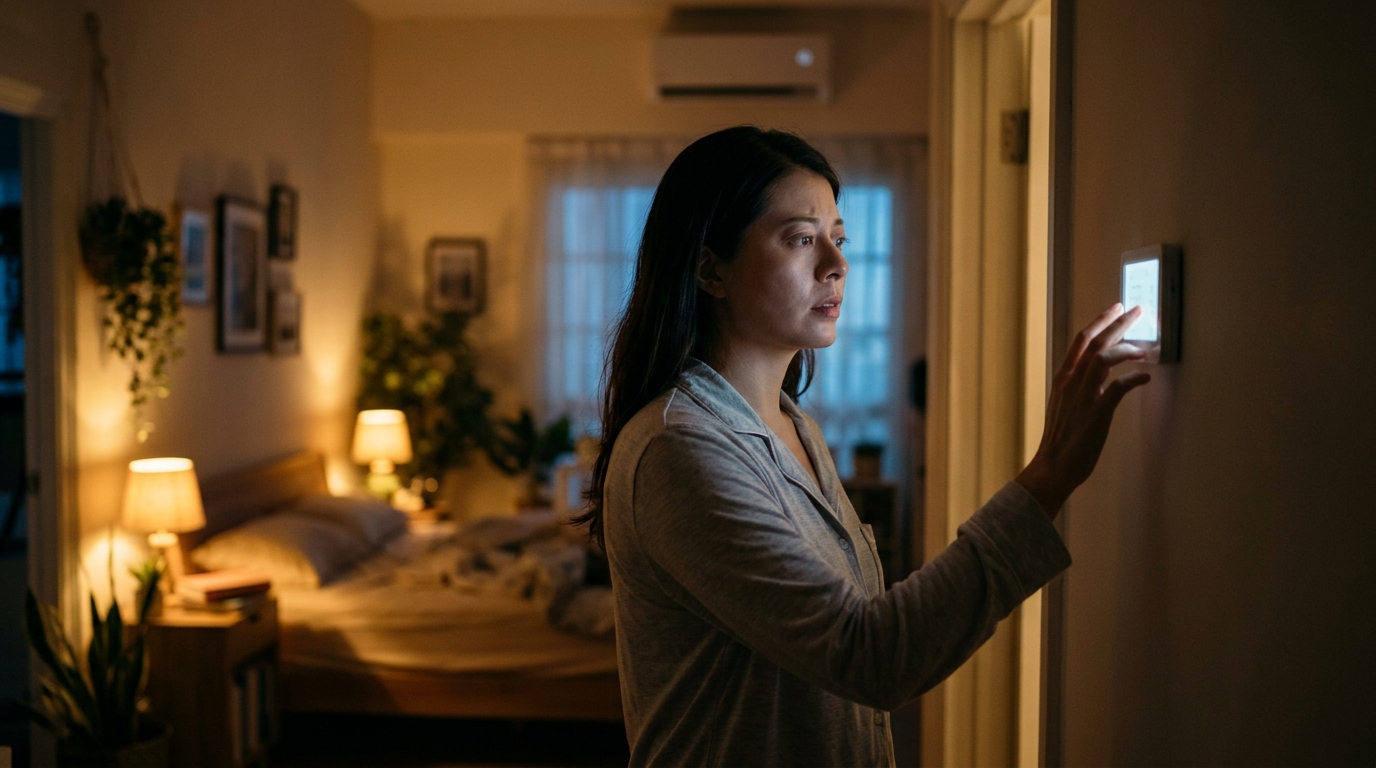
It sounds like a smart energy-saving trick: when the house is already comfortable at bedtime, flip the thermostat fan switch from Auto to On, or set the system to Fan Only, and let the blower circulate air without running the compressor. No cooling means no big electric draw, right? The compressor and outdoor unit do account for roughly 70 to 80% of a central AC system’s power use, so the logic seems solid.
The problem is that your air conditioner does two jobs, not one: it lowers temperature and it removes moisture. When the fan runs continuously with no active cooling, the wet evaporator coil is still sitting in the airstream, covered in condensation from the last cooling cycle. That water gets blown right back into your home as vapor, especially in humid climates. Indoor relative humidity can climb from a comfortable 45% to 60% or higher in just a few hours, and a clammy bedroom at 60% humidity feels warmer than the same room at 45%.
This post breaks down exactly why overnight fan-only operation backfires, who it can actually work for, and what to do instead. You will get a free quick fix you can apply tonight, a more thorough DIY upgrade to dial in your system, and answers to the questions homeowners ask most often.
What You’ll Need
Click on an item below to shop for the recommended items for this recipe on Amazon.
As an Amazon Associate, we earn from qualifying purchases.
How to Do It
- Set your thermostat fan switch from On (or Fan Only mode) back to Auto so the blower only runs during a cooling call.
- Set the nighttime cooling setpoint to 74 to 78°F instead of relying on air movement alone. A small, steady cooling call keeps the compressor removing moisture without overcooling.
- Add a ceiling fan or small box fan in the bedroom for air movement. A ceiling fan uses only 15 to 75 watts and can make a room feel 4°F cooler.
- Check your thermostat or a $10 to $15 hygrometer after a few nights. Aim for 40 to 50% relative humidity in the bedroom.
- If humidity still reads above 55%, lower the setpoint by 1°F at a time until moisture stays under control.
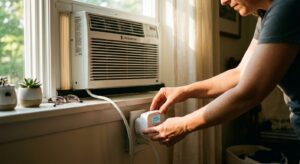
- Install a plug-in hygrometer or smart humidity sensor in the bedroom and one in the main living area ($10 to $30 each) to see actual overnight humidity trends.
- If your thermostat has a circulation or fan schedule feature (most Ecobee, Nest, and Honeywell models do), set the fan to run only 10 to 20 minutes per hour during the day, not continuously overnight.
- Enable dehumidify-on-cooling or overcooling-for-humidity settings if available, so the AC runs slightly longer to wring out moisture on muggy nights.
- Replace a clogged air filter with a clean MERV 8 to 11 filter. A dirty filter reduces airflow across the coil and worsens both cooling and moisture removal.
- Check that the condensate drain line is clear by pouring a cup of distilled white vinegar into the access port. A clogged drain can cause water to back up and raise indoor humidity.
- If humidity stays high despite proper cooling, consider a whole-home dehumidifier ($1,000 to $2,500 installed) or a portable 35 to 50 pint unit ($150 to $250) for the bedroom.
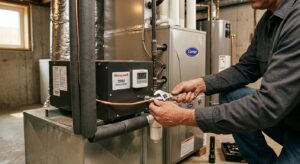
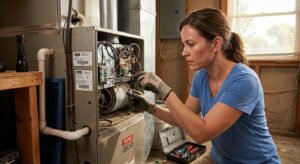
- Schedule an HVAC tune-up that includes checking refrigerant charge, coil cleanliness, and blower speed settings.
- Ask the technician to measure temperature drop across the coil. A healthy system shows roughly 16 to 22°F; a poor reading can mean low airflow or an oversized unit.
- Request a duct leakage test. Sealing ducts with mastic (not tape) can cut leakage from 25% to under 10% and often improves humidity control noticeably.
- Ask about lowering the blower speed on cooling mode. Slower airflow gives the coil more time to remove moisture, a common fix for clammy homes.
- If you have a PSC blower, ask for a quote on an ECM or variable-speed upgrade ($500 to $1,200), which can cut blower energy use by 50 to 75%.
Why It Works: The Benefits
Switching back to Auto lets the coil drain and the compressor remove moisture, typically holding bedrooms at 40 to 50% relative humidity instead of drifting to 60% or more.
Eliminating 8 hours of nightly blower operation on a PSC motor saves roughly $10 to $20 per month, and drier air lets you raise your thermostat setpoint 2 to 3°F while feeling equally comfortable, saving another 6 to 9% on cooling.
Keeping indoor humidity under 50% starves mold spores and dust mites of the moisture they need, which also protects wood furniture, flooring, and stored clothing.
Continuous operation adds 3,000 or more extra run hours per year to the blower motor, which can shorten its lifespan and bring forward a $400 to $900 replacement.
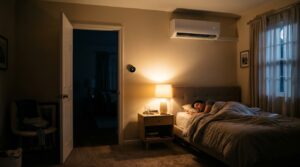
Sleep research generally points to bedroom temperatures of 65 to 72°F as ideal, and drier air makes those temperatures feel noticeably more comfortable without extra cooling.
💰 Savings Impact by Action
Cutting 8 hours of nightly PSC blower operation can trim cooling-related electricity use by roughly 10 to 15%.
Drier air lets you raise the setpoint 2 to 3°F at the same comfort level, saving about 3% per degree on cooling.
Sealing leaky ducts can recover up to 20% of conditioned airflow and improve dehumidification.
Replacing a PSC blower with an ECM variable-speed motor can cut blower energy use by 50 to 75%.
🏠 Key Concepts Explained
The Science Behind It
Your air conditioner removes moisture through condensation. Warm, humid air passes over a cold evaporator coil (typically 40 to 45°F), water vapor condenses into liquid on the coil’s surface, and gravity carries it down to the drain pan and out of your home. That process only happens while refrigerant is actively cooling the coil. Once the compressor shuts off, the coil starts warming up, but it is still dripping wet.
If the blower keeps running at that moment, every cubic foot of air that crosses the wet coil can pick up moisture again. The air is warmer than the coil and drier than saturated, so evaporation happens easily, especially during the first 10 to 15 minutes after the compressor stops. In a humid climate, this effect can erase a large portion of the dehumidification your system accomplished earlier. Field studies of continuous-fan operation in the Southeast U.S. have shown measurable indoor humidity increases compared to Auto mode.
Comfort works the same way. Sensible temperature is only part of how warm you feel. At 78°F and 45% relative humidity, most people feel comfortable. At 78°F and 65% relative humidity, the heat index is closer to 80 to 82°F, and the room feels sticky because your sweat cannot evaporate efficiently. That is why fan-only nights often lead people to lower the thermostat at 2 a.m., burning more energy than they tried to save.
Frequently Asked Questions
▼ Why is my bedroom still humid even after I switched the fan back to Auto?
Your AC may be oversized and short-cycling, meaning it cools the air fast but shuts off before removing much moisture. Try lowering the setpoint by 1 to 2°F to force longer run times, and ask an HVAC pro to check your blower speed and refrigerant charge. A bedroom dehumidifier ($150 to $250) is a good stopgap in the meantime.
▼ Can renters do this without landlord permission?
Yes. Switching the thermostat fan setting to Auto and adding a portable fan, hygrometer, or dehumidifier requires no modifications to the home. Avoid altering the HVAC equipment or ductwork, and report persistent humidity or mold concerns to your landlord in writing.
▼ How long before I notice savings on my bill?
You will see humidity and comfort improvements within 2 to 3 nights. Bill savings typically show up on the next full billing cycle, usually 5 to 15% lower on the cooling portion depending on your blower motor type and local electricity rates.
▼ Is fan-only ever a good idea?
In dry climates (outdoor humidity under 40%) or during mild shoulder-season nights when the outdoor air is cooler than indoors, circulating air can help even out temperatures. It also works in short bursts to distribute air between rooms. The risk is mainly in humid regions during cooling season.
▼ What if my home is older than 30 years?
Older homes often have leakier ducts, PSC blower motors, and less effective insulation, which makes fan-only humidity problems worse. Start with the quick fix, then prioritize duct sealing and an HVAC tune-up, which often deliver the best return in older homes.
Quick Tips
- Use ceiling fans for air movement instead of the HVAC blower. A ceiling fan costs roughly 1 to 2 cents per night to run versus 40 to 80 cents for a PSC blower.
- Set ceiling fans to counterclockwise in summer, and turn them off when you leave the room since they cool people, not air.
- Pre-cool the house in the evening to 74 to 76°F, then let the thermostat coast up to 78°F overnight with fresh humidity control from Auto mode.
- Close bedroom doors only if the room has a return vent or door undercut. Sealed rooms without returns can pressurize and pull in humid air from leaks.
- Replace your air filter every 1 to 3 months during cooling season to protect airflow and coil performance.
Variations for Your Situation
- Apartment/Rental: Switch the fan to Auto, add a $15 to $25 oscillating tower or box fan in the bedroom for airflow, and use a $12 hygrometer to monitor humidity. If readings stay above 55%, a 20 to 35 pint portable dehumidifier ($130 to $200) is a renter-safe fix that needs no landlord approval.
- Tight Budget (under $50): Set the fan to Auto, raise the setpoint to 76 to 78°F, and use an existing fan for airflow. Buy one $10 to $15 hygrometer to confirm humidity stays under 50%. Replace a dirty filter ($8 to $15) and pour vinegar down the condensate line. Total cost: under $40 for real, measurable results.
- Older Home (pre-1980): Expect leakier ducts and less insulation, so prioritize sealing visible duct joints with foil-backed mastic tape or mastic paste ($15 to $30), and keep fan on Auto. Consider a professional duct leakage test ($150 to $300), since sealing 20% leakage down to under 10% often pays back in 1 to 3 years.
- Dry Climate (Southwest/Mountain West): Outdoor humidity is often low, so fan-only operation poses less moisture risk. Still, check bedroom humidity with a hygrometer. If it stays under 45% overnight, a limited fan schedule (10 to 20 minutes per hour) can safely even out temperatures between floors.