Almost every homeowner has heard the advice: open the windows at night, let the cool air in, and close everything up in the morning to save on air conditioning. It sounds like free cooling, and in the right place it is. In Denver, Salt Lake City, or the high deserts of the Southwest, a well-run night flush routine can delay the first AC call of the day by several hours.
But in Houston, Atlanta, or Miami, the same routine can quietly work against you. Night air in humid regions often stays in the mid 70s with dew points well above 65 degrees, which means you are pulling moisture into your home along with whatever cooling you gain. That moisture soaks into drywall, fabrics, and furniture, then forces your air conditioner to work harder the next day to pull it back out.
This post explains the two numbers that decide whether night ventilation helps or hurts, gives you a zero-cost quick fix to test it in your own home, and walks through a DIY fan-powered setup that makes the technique far more effective. You will also find savings estimates, troubleshooting answers, and variations for renters, tight budgets, and older homes.
What You’ll Need
Click on an item below to shop for the recommended items for this recipe on Amazon.
As an Amazon Associate, we earn from qualifying purchases.
How to Do It
- Check tonight’s forecast low and dew point on a weather app. If the low is at least 20 degrees below today’s high and the dew point is under 60 degrees, night ventilation is a good bet.
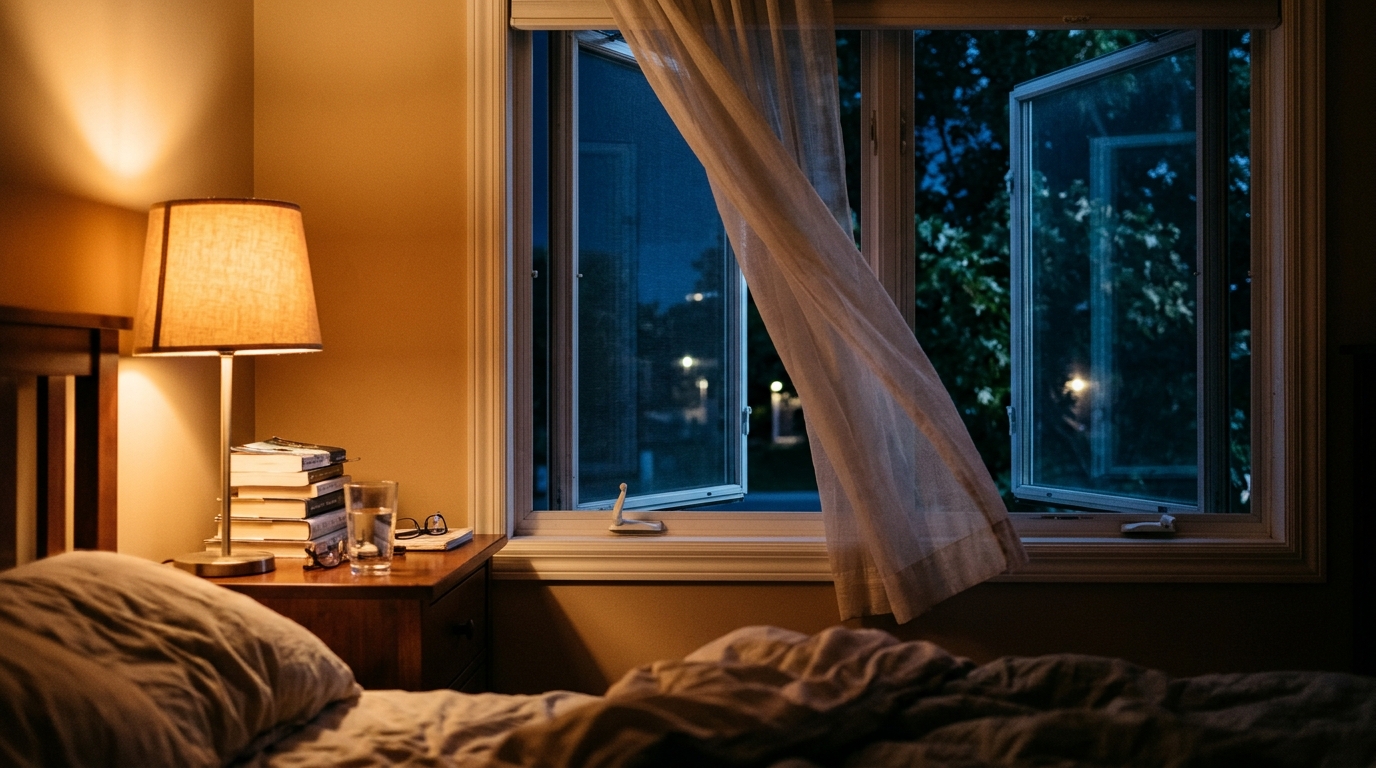
- Around sunset, open windows on opposite sides of the house or on different floors to create cross-ventilation. Open lower windows on the cooler, shaded side and upper windows on the other side to encourage stack effect.
- Turn on any ceiling fans in your home to pull air across your living spaces and speed up the cooling of walls, floors, and furniture.
- Check an indoor thermometer before bed. If indoor temperature is dropping and indoor humidity stays under about 60 percent, keep windows open overnight. If humidity climbs, close up and run the AC.
- Close all windows, blinds, and curtains by 8 to 9 AM, or whenever outdoor temperature rises above your indoor temperature, to lock in the cool air.
- Keep a simple log for one week noting overnight low, indoor humidity, and how many hours your AC stayed off the next day.
- Choose your fan. A box or window fan ($40 to $100) is enough for apartments and small homes. A whole-house attic fan ($300 to $400 for the unit, more with installation) can change the air in a home 20 to 30 times per hour.
- Place a box fan in a window on the upper floor facing outward to exhaust hot air, and open windows on the lower floor to supply cool air. Leaving other windows closed forces air to travel through the home rather than short-circuiting.
- Seal gaps around the fan with weatherstripping, foam board, or a rolled towel so exhausted air is not pulled back in around the edges.
- Plug the fan into a programmable outlet timer ($10 to $15) set to turn on at sunset and off around 6 AM, so you do not have to remember to run it.
- If installing a whole-house fan, make sure your attic has adequate vent area, typically 1 square foot of net free vent area per 750 CFM of fan capacity, so the fan does not backdraft combustion appliances.
- Add a $15 digital hygrometer in the main living area to track indoor humidity. If it climbs above 60 percent overnight, shut the windows and switch back to AC.
Why It Works: The Benefits
Homes in high-desert and mountain regions can reduce AC runtime by 10 to 30 percent during shoulder and summer months by pre-cooling the structure overnight.
A well-pre-cooled home can often go 3 to 6 hours into the day before the thermostat calls for cooling, shifting your usage away from peak-rate hours.
Flushing the house with outdoor air dilutes indoor pollutants like VOCs and cooking odors, giving you a modest indoor air quality boost at no cost.
Fewer and shorter run cycles on your AC compressor can extend equipment life and reduce wear, especially during heat waves.
Moving air across your body at night feels 3 to 5 degrees cooler than still air at the same temperature, which can help you sleep without running the AC at all.
💰 Savings Impact by Action
Homes with 25 degree or larger day-night swings can cut cooling energy by up to 25 percent with consistent night flushing.
Adding a whole-house or window fan can boost savings to as much as 30 percent by moving 5 to 10 times more air than passive windows.
Areas with 15 to 20 degree swings typically see around 12 percent savings, mostly during spring and fall.
Where dew points stay above 65 degrees, added latent load usually cancels out any savings from night ventilation.
Raising your thermostat setpoint 2 to 3 degrees after a good flush adds roughly 8 percent more savings.
🏠 Key Concepts Explained
The Science Behind It
Night ventilation works because of two simple physical principles: heat flows from warm to cool, and materials store heat. During the day, your home’s walls, floors, and furniture absorb heat from the sun and from warm indoor air. At night, if the outdoor air is meaningfully cooler than your indoor surfaces, bringing it inside pulls heat out of those materials through convection. By morning, you have effectively lowered the starting temperature of the whole structure.
The catch is moisture. Warm air holds more water vapor than cool air, and in humid regions the overnight air is cooler but still carries a lot of water. When that air enters your home, the moisture adsorbs into porous materials like drywall, wood, and upholstery. The next day, when your AC kicks on, it has to condense that moisture back out of the air, which uses significant energy. In a place like Houston, where dew points regularly stay in the 70s, the latent load can erase the sensible cooling gains and even exceed them.
That is why the dew point, not the temperature alone, is the deciding factor. Dry climates with large temperature swings, like much of the Mountain West, the Southwest interior, and parts of the Pacific coast, are ideal. Humid and coastal climates with small overnight temperature drops are poor candidates, and for them a well-sealed home with an efficient dehumidifying AC is almost always the better strategy.
Frequently Asked Questions
▼ Why is my AC still running all day even after I tried night ventilation?
Check your overnight dew point first. If it stayed above 60 degrees, you probably brought in moisture that your AC is now removing. Also confirm you closed windows and blinds before outdoor temperatures passed your indoor temperature, and make sure a poorly insulated attic or west-facing windows are not simply overwhelming the stored coolness.
▼ Can renters do this without landlord permission?
Yes. Opening windows and placing a box fan in a window requires no modifications, and a $15 outlet timer adds automation. Avoid anything that requires drilling, cutting screens, or modifying the unit, and always keep security and fire egress in mind for ground-floor and bedroom windows.
▼ How long before I actually notice savings on my bill?
In a good climate you will see lower AC runtime within the first week, but the bill impact shows up over a full billing cycle. Expect 10 to 30 percent lower cooling costs in dry, high-swing climates during peak months. Compare your kilowatt-hour use to the same month last year, adjusting for weather, to see the real change.
▼ What if my home is older than 30 years?
Older homes often have more leaky envelopes and less insulation, which makes night ventilation less effective because stored coolness escapes faster. Pair the technique with attic insulation up to R-38 and basic air sealing, and prioritize heavy interior materials like brick or plaster, which hold coolness well.
▼ Is it ever worth it in a humid climate?
Rarely, but it can work in shoulder seasons such as spring or fall when dew points drop below 55 degrees. Use your hygrometer as the guide: if indoor humidity rises while windows are open, close up and switch to AC or a dehumidifier.
Quick Tips
- Use the 20/60 rule of thumb: night ventilation is worthwhile when the overnight low is 20 or more degrees below the daytime high and the dew point stays under 60 degrees.
- Open windows slowly on the first nights of the season and monitor indoor humidity; a $15 hygrometer pays for itself in avoided mistakes.
- Close curtains and blinds on south and west windows during the day so your thermal mass does not absorb extra solar heat that your night flush has to remove.
- Clean window screens before the season starts; clogged screens can cut airflow by 30 percent or more.
Variations for Your Situation
- Apartment/Rental: Use a $40 to $80 box fan in one window as an exhaust and open a window on the opposite side for supply air. Add a $10 outlet timer, skip anything permanent, and keep ground-floor windows locked in the open position with a window security bar or stop if safety is a concern.
- Tight Budget (under $50): Skip the fan and just open windows on opposite sides at sunset, run any existing ceiling fans, and close everything by 8 AM. Add a $15 hygrometer to avoid humid-night mistakes and close blinds on south and west windows during the day for free.
- Older Home (pre-1980): Take advantage of heavy masonry, plaster walls, and large windows that favor cross-ventilation, but plan to air seal attic bypasses and upgrade insulation to R-38 first so your stored coolness lasts. Check that old double-hung windows open fully and have intact screens before relying on them.