That window AC unit humming in your bedroom feels like a lifesaver in July, but have you ever stopped to wonder what it’s actually costing you each month? A typical 8,000 BTU window unit running 8 hours a day can add $30 to $60 to your monthly electric bill, and a larger 12,000 BTU unit running all day in a hot climate can push $150 or more per month. Over a full summer, that adds up fast, and most homeowners have no idea the number is that high until the bill arrives.
The good news is that window AC operating costs are highly controllable. Unlike central HVAC systems that require professional tuning, window units respond immediately to simple behavioral changes and low-cost upgrades. The difference between an inefficient setup and an optimized one can be 30 to 40% in real savings, often hundreds of dollars over a single summer.
This post walks you through the actual cost math using real electricity rates and unit specs, identifies the biggest factors driving your bill, and gives you two practical approaches to cut costs starting today, whether you want a zero-dollar fix or are willing to invest a small amount for bigger long-term savings.
What You’ll Need
Click on an item below to shop for the recommended items for this recipe on Amazon.
As an Amazon Associate, we earn from qualifying purchases.
How to Do It
- Calculate your unit’s actual monthly cost: find the wattage on the unit’s label or manual, then multiply (watts / 1,000) x daily hours x 30 x your per-kWh rate from your electric bill. Most homeowners are surprised the number is 30 to 50% higher than they assumed.
- Raise your thermostat setpoint to 78 degrees Fahrenheit when you are home and active. Each degree increase above 72 saves approximately 3%, so moving from 72 to 78 cuts cooling energy by roughly 18% with no comfort sacrifice when paired with a ceiling or box fan.
- Set the unit to its highest fan speed while cooling. Higher fan speed moves more air across the evaporator coil, improving heat exchange efficiency and allowing the compressor to meet setpoint faster and shut off sooner.
- Turn the unit off or set it to fan-only mode when leaving the room for more than 30 minutes. Window AC units cool small spaces quickly, typically within 15 to 20 minutes, so pre-cooling before you return is more efficient than continuous operation.
- Close the room door to isolate the space being cooled. Allowing cool air to bleed into hallways or adjacent rooms forces the unit to run significantly longer to satisfy the thermostat sensor.
- Seal all gaps around the window AC unit using foam weatherstripping tape on the window sashes and self-adhesive foam rope caulk around the perimeter where the unit meets the window frame. Pay special attention to the accordion side panels, which are notoriously leaky and can be supplemented with rigid foam board cut to fit.
- Install a reflective window film or blackout cellular shade on the same window the AC unit occupies, and on any south or west-facing windows in the room. This can reduce solar heat gain by 40 to 70% and cut the room’s cooling load significantly during afternoon peak hours.
- Clean or replace the AC unit’s air filter. A clogged filter forces the fan motor to work harder and reduces airflow across the evaporator coil, dropping efficiency by 5 to 15%. Most filters should be rinsed monthly and replaced every 3 months during heavy use.
- Clean the condenser coils on the outdoor-facing side of the unit. Dust and debris on the condenser reduce heat rejection efficiency. With the unit unplugged, use a soft brush and coil cleaner spray to gently clean the fins, improving heat transfer and reducing compressor run time.
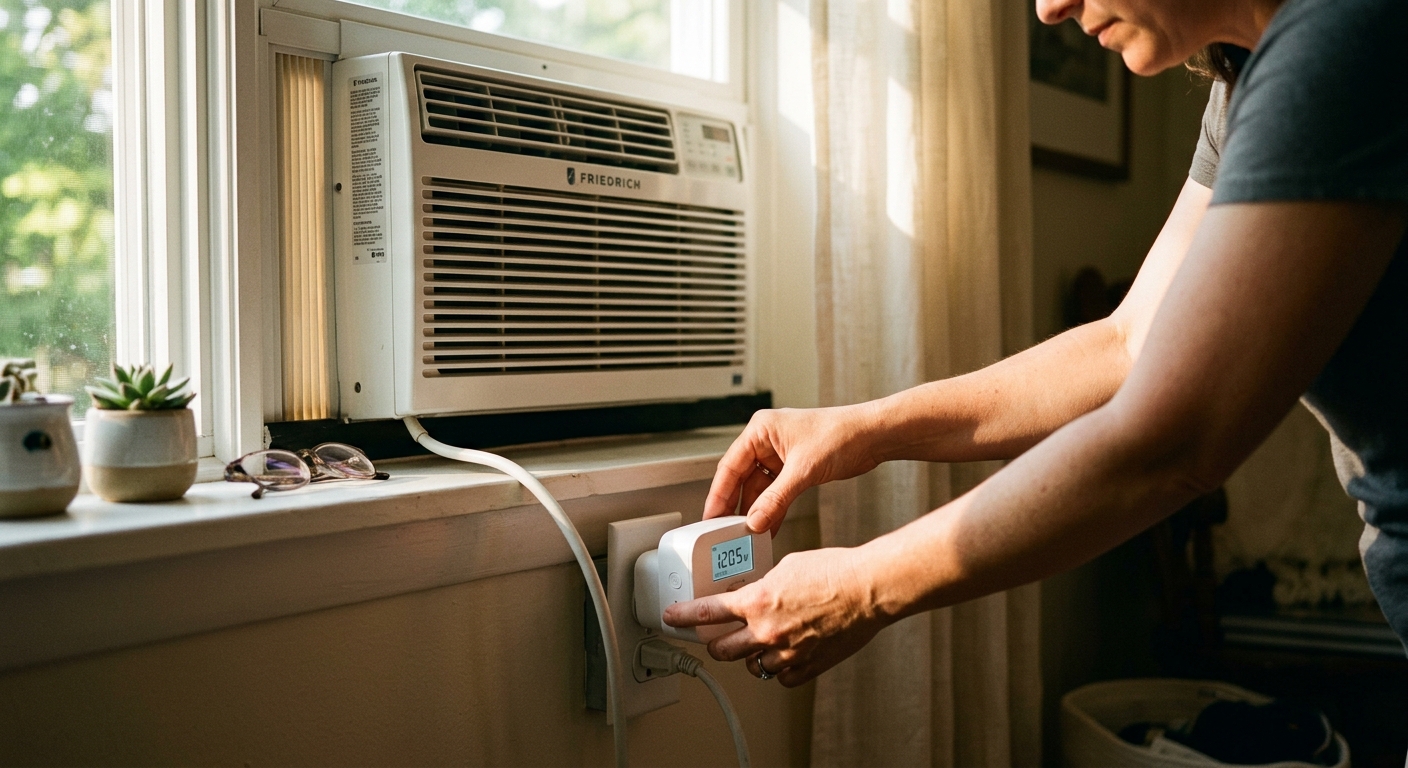
- Add a smart plug with energy monitoring to the unit’s outlet. This gives you real-time wattage data and actual kWh consumed per day, letting you verify savings after each change. Many smart plugs also allow scheduling so the unit shuts off automatically after a set time or turns on before you arrive home.
Why It Works: The Benefits
Using the formula (watts / 1,000) x hours x rate, a homeowner can calculate their unit’s exact monthly cost within minutes. Knowing you are spending $80 per month on a single room creates immediate motivation to act and a clear baseline to measure savings against.
Combining smart thermostat habits, proper sealing, and solar shading can reduce window AC operating costs by 30 to 40%, translating to $20 to $60 per month in savings for a typical unit depending on climate and usage hours.
A properly sized, well-sealed unit running optimized longer cycles removes more moisture from the air. At 50% relative humidity, 78 degrees feels equivalent to 74 degrees at 65% humidity, meaning you can be more comfortable at a higher setpoint when humidity is managed.
Reducing runtime and compressor short-cycling through proper sizing and sealing can extend a window AC unit’s life by 2 to 4 years beyond the typical 8 to 10 year average, delaying a $200 to $700 replacement cost.
Cutting 30% of a window AC unit’s energy use eliminates roughly 200 to 400 pounds of CO2 emissions per summer based on average U.S. grid emissions, the equivalent of not driving 200 to 400 miles.
💰 Savings Impact by Action
Raising the thermostat from 72 to 78 degrees saves approximately 3% per degree, totaling 18% in compressor energy without any hardware changes.
Sealing gaps around the window unit and side panels with foam tape reduces hot air infiltration and cuts AC runtime by 10 to 15% in humid climates.
Blocking direct sun with blackout curtains or reflective window film reduces solar heat gain by 40 to 70%, cutting the room cooling load by up to 20%.
A clean air filter restores proper airflow across the evaporator coil, recovering 5 to 15% of lost efficiency caused by restricted airflow.
Replacing a pre-2012 unit with EER 8 or lower with a modern ENERGY STAR unit at EER 12 reduces electricity consumption by 25 to 33% for identical cooling output.
🏠 Key Concepts Explained
The Science Behind It
Window air conditioners work through the refrigeration cycle: a refrigerant fluid absorbs heat from indoor air as it evaporates at low pressure inside the unit, then releases that heat to outdoor air as it condenses at high pressure on the outside. The compressor drives this cycle and accounts for roughly 85 to 90% of the unit’s total electricity consumption. Everything that forces the compressor to run longer directly increases your bill.
Heat flows from hot to cold according to the second law of thermodynamics, and the greater the temperature difference between your room and the outdoors, the harder the compressor must work to push heat in the wrong direction. This is why an 85-degree outdoor day might cost you $1.50 in electricity while a 100-degree day for the same setpoint might cost $2.80 or more. Reducing the heat entering your room through solar gain, air leakage, and conduction through walls directly reduces the temperature differential the compressor must overcome, cutting runtime and energy use proportionally.
Humidity plays a hidden but significant role in perceived comfort and AC runtime. Human comfort depends on both air temperature and relative humidity, measured together as the heat index. When your AC unit dehumidifies effectively by running in longer sustained cycles, the lower humidity allows you to feel comfortable at a higher temperature setpoint. A room at 78 degrees and 45% relative humidity feels cooler than 75 degrees at 65% humidity. Properly sealed, right-sized units that run longer cycles remove far more moisture per hour of operation than oversized units that short-cycle, making humidity management one of the most underappreciated levers in cooling efficiency.
Frequently Asked Questions
▼ How do I calculate exactly what my window AC costs per month?
Find the unit’s wattage on the label (commonly 500 to 1,500 watts for residential units). Use this formula: (watts divided by 1,000) multiplied by daily runtime hours multiplied by 30 multiplied by your per-kWh rate. For example, a 1,200-watt unit running 10 hours a day at $0.16 per kWh costs $57.60 per month. Your rate is on your electric bill, usually between $0.10 and $0.28 per kWh depending on state.
▼ My window AC runs constantly and never shuts off. Is something wrong?
Continuous running usually means one of three things: the unit is undersized for the room, the room has excessive heat gain through sun or air leaks, or the thermostat sensor is dirty or malfunctioning. Start by verifying the unit is properly sized (roughly 20 BTUs per square foot of room space), then seal gaps around the unit and block direct sun with curtains. If the unit still runs constantly on a mild day under 90 degrees, the thermostat sensor may need cleaning or the unit may need servicing.
▼ Is it cheaper to leave the AC on all day at a higher setting or turn it off and cool down when I get home?
For window units cooling a single room, it is almost always cheaper to turn the unit off when you leave and cool the room down when you return. Unlike whole-house HVAC systems that must manage thermal mass throughout a large structure, a window unit can cool a typical bedroom from 85 to 74 degrees in about 20 to 30 minutes. The energy spent running all day at a higher setpoint almost always exceeds the energy for that short recovery period.
▼ Can renters do these optimizations without landlord permission?
Yes, most of these steps are completely renter-safe. Behavioral changes, smart plugs, cleaning the filter, and using curtains or window film require no permanent modifications. Foam weatherstripping tape is removable and leaves no damage. Avoid making any permanent modifications to the window frame or the unit itself without written permission, as that could affect your deposit.
▼ How old is too old for a window AC unit? When should I replace instead of optimize?
Window AC units older than 10 years with EER ratings below 9 are strong replacement candidates. Modern ENERGY STAR units deliver EER 12 or higher, meaning a replacement unit uses 25 to 30% less electricity for the same cooling output. At $40 to $60 in annual savings, a $200 to $300 replacement unit pays back in 4 to 6 summers. If your unit uses R-22 refrigerant (check the label) and needs a recharge, replacement is almost always the more economical choice.
Quick Tips
- Use a ceiling fan or box fan in conjunction with your window AC to distribute cool air and allow a thermostat setpoint 4 degrees higher, saving roughly 12% on cooling costs with no comfort loss.
- If your window AC unit does not have a thermostat and simply runs continuously at a fixed speed, it is operating far less efficiently than a unit with cycling control. Even a basic programmable outlet timer ($10 to $15) can simulate cycling and reduce runtime by 20 to 30%.
- Position a box fan facing outward in an opposite window during the cooler morning hours (before 9 a.m.) to exhaust warm indoor air and pull in cooler outdoor air. This can delay the need to run the AC by 1 to 3 hours on mild days, saving significant runtime.
- When comparing replacement units, prioritize EER over BTU. A 10,000 BTU unit with EER 12 will cost about 25% less to operate than a 10,000 BTU unit with EER 9, saving roughly $20 to $40 per summer month in a hot climate.
Variations for Your Situation
- Apartment/Rental: Renters can capture 80% of the available savings without any permanent modifications. Focus on behavioral setpoint management, a smart plug with scheduling ($15 to $25), removable blackout curtains ($25 to $50), and removable foam tape sealing around the unit. These steps alone commonly save $15 to $40 per month and require no landlord approval. Document the unit’s condition with photos when you move in.
- Tight Budget (under $50): Start with zero-cost setpoint and runtime optimization, which alone can save 15 to 20% immediately. Add a $10 programmable outlet timer to automate shutoff at night, and a $5 foam weatherstripping roll to seal the unit’s gaps. Clean the filter with warm water at no cost. These three steps combined typically deliver 25 to 30% savings for under $20 total investment.
- Older Home (pre-1980): Older homes typically have lower insulation levels in walls and attics and more air infiltration overall, meaning the room the window AC serves is fighting a much larger heat load. Prioritize attic hatch insulation above the cooled room and door sweeps on the room door before optimizing the AC unit itself. Sealing air leaks around outlets and light switches in the cooled room with foam gaskets ($5 for a pack) can meaningfully reduce the cooling load in leaky older construction.