Vapor barriers are one of the most misunderstood components in home construction and renovation. Walk into any big-box hardware store and you’ll find plastic sheeting sold as a simple, universal fix for moisture problems. But slapping a vapor barrier in the wrong location doesn’t just fail to help, it can actively cause moisture to accumulate inside your walls, degrade your insulation’s R-value, and create conditions for mold and rot that cost tens of thousands of dollars to fix.
The confusion runs deep because the rules genuinely vary depending on where you live. A vapor barrier that’s correct for a Minnesota basement is a moisture disaster waiting to happen in a Houston wall assembly. Climate zone, wall construction type, and the specific insulation material all determine whether a vapor barrier helps or hurts. Most DIY guides skip this context entirely, which is why so many well-meaning homeowners end up with soggy fiberglass batts and moldy framing.
This post breaks down exactly what vapor barriers are supposed to do, the most common mistakes homeowners make, and how to audit and correct your home’s moisture control strategy whether you’re finishing a basement, upgrading attic insulation, or remodeling a wall assembly. We’ll give you real numbers on what proper moisture management means for your energy bills and your home’s longevity.
What You’ll Need
Click on an item below to shop for the recommended items for this recipe on Amazon.
As an Amazon Associate, we earn from qualifying purchases.
How to Do It
- Find your IECC climate zone by entering your zip code at energycodes.gov. Write it down because every decision depends on it.
- Go to your basement or crawl space and look at how any existing plastic sheeting is installed. On a basement wall, poly sheeting should be against the concrete on the interior side of the insulation in cold climates, not sandwiched between insulation layers.
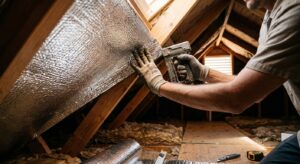
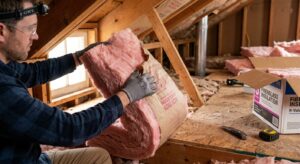
- Check your attic insulation: if you see kraft-faced batts installed with the paper facing down toward the living space in a cold climate, that is correct. If the paper faces up toward the cold attic, it is installed backwards.
- Look for any locations where two vapor barriers exist back to back, such as foil-faced foam board plus poly sheeting plus a kraft-faced batt. This double-barrier situation is a red flag.
- Note any visible discoloration, staining, or compressed insulation batts, which can indicate past or ongoing moisture problems in the assembly.
- Use your findings to determine whether a DIY correction or a professional assessment is the right next step before touching anything.
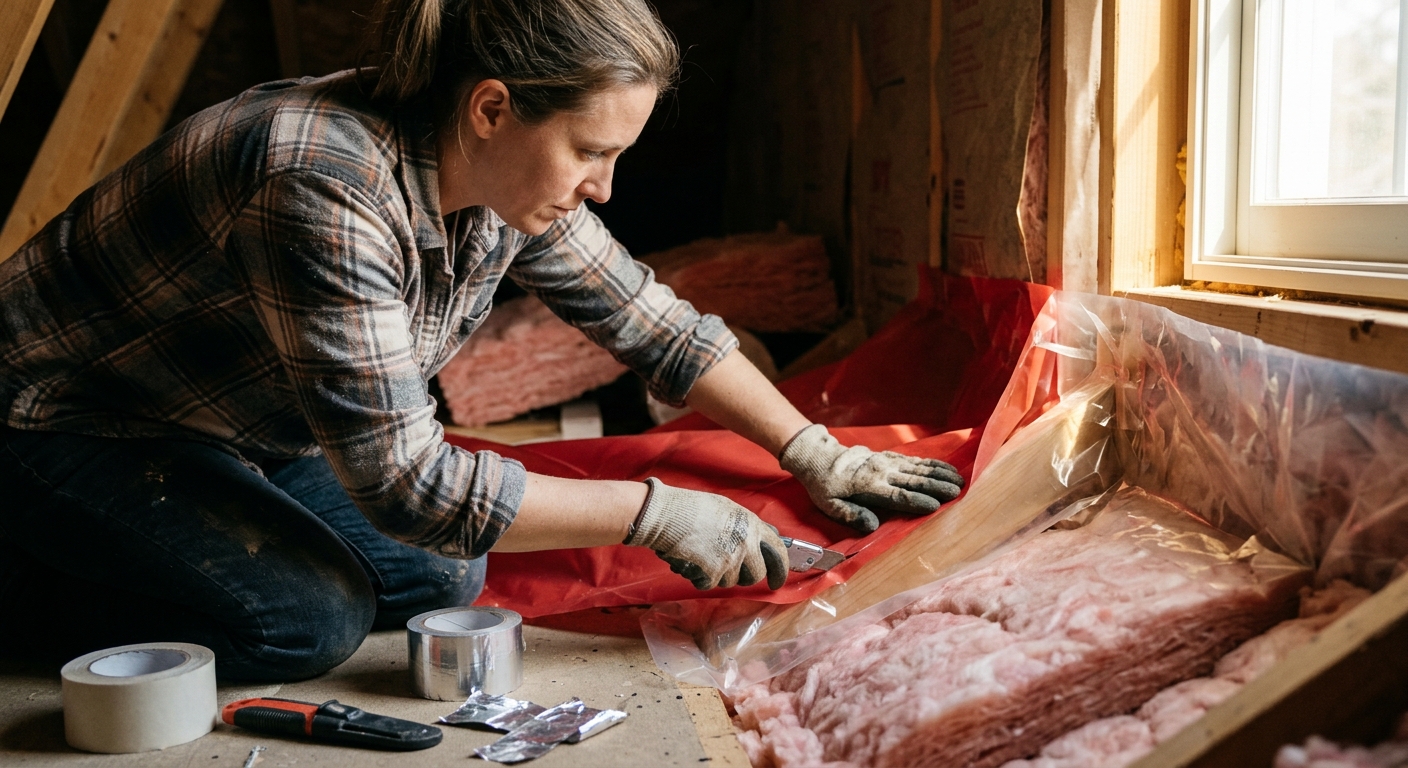
- In a basement in climate zones 4 through 8, install 6-mil poly sheeting directly against the concrete wall before adding any insulation. Secure the sheeting with concrete fasteners or construction adhesive and lap it at least 12 inches at seams.
- For a conditioned basement, use rigid foam board (XPS or EPS, minimum 1 inch) installed against the concrete wall as both insulation and vapor control, then frame a stud wall inward with unfaced or kraft-faced batts. Do not add additional poly sheeting on the warm side.
- In a vented crawl space in climate zones 3 through 8, cover the ground with a minimum 6-mil poly vapor barrier (10-mil or 20-mil reinforced is better). Overlap seams by 12 inches and tape them. Run the barrier 6 inches up the foundation walls and secure it.
- If you find existing insulation that is visibly wet, compressed, or moldy, remove and bag it before installing any new materials. Wet fiberglass batts cannot be dried and reused effectively.
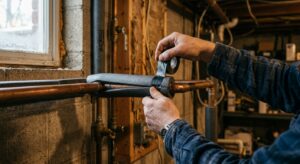
- Seal all penetrations (pipes, wires, rim joists) with canned spray foam before covering with the vapor barrier or insulation. Air sealing at the rim joist alone can reduce energy loss by 5 to 10% in older homes.
- For an unvented crawl space (increasingly recommended by building codes), install rigid foam against the foundation walls rather than batts in the floor above, and seal the crawl space from outside air entirely.
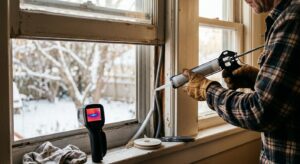
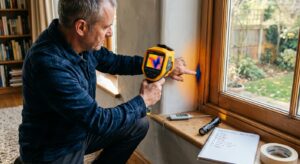
- Hire a certified building performance contractor (look for BPI certification or a RESNET HERS rater) to conduct a blower door test and infrared thermal scan of your walls and ceiling assemblies.
- Request a moisture content reading with a pin-type moisture meter on accessible framing. Readings above 19% indicate active moisture problems that need to be resolved before reinsulating.
- If walls are being opened for a remodel, have the contractor specify the correct vapor control class for your climate zone: Class I (poly or foil) is typically only appropriate in climate zones 7 and 8; Class II (kraft paper, certain foam boards) suits zones 5 and 6; Class III (latex paint, unfaced batts) is often sufficient in zones 1 through 4.
- Ask specifically about using a smart vapor retarder (such as MemBrain or Intello) in mixed climate zones 4 and 5, which becomes more permeable when humidity rises, allowing drying in both directions.
- Have the contractor air-seal all penetrations, top plates, and electrical boxes before closing walls, since air sealing delivers 3 to 5 times more moisture control benefit per dollar than upgrading vapor barrier class alone.
- Request a post-project blower door test to verify that air sealing work measurably reduced the home’s ACH50 rating, which is the most objective measure of whether the work was effective.
Why It Works: The Benefits
Dry insulation delivers its full rated R-value. Correcting vapor barrier placement and air sealing can restore 20 to 30% of lost thermal performance in assemblies where moisture has been degrading batts.
Chronic moisture trapped by a misplaced vapor barrier can begin growing mold within 48 to 72 hours of saturation and cause structural wood rot within 2 to 5 years, with remediation costs commonly running $10,000 to $30,000 or more.
Properly functioning insulation, freed from moisture degradation and supported by real air sealing, reduces heating and cooling loads by 10 to 20%, translating to $150 to $400 per year in savings for an average home.
Eliminating hidden moisture accumulation removes a primary driver of mold spores and musty odors that migrate into living spaces through small gaps in wall assemblies and HVAC systems.
Keeping framing lumber, sheathing, and insulation consistently dry can double or triple the service life of these components, protecting a significant portion of your home’s structural value.
💰 Savings Impact by Action
Restoring wet fiberglass batts to dry conditions can recover up to 20 to 30% of lost thermal performance as R-value returns to rated levels.
Sealing rim joists, top plates, and penetrations reduces air-transported moisture infiltration and cuts heating and cooling loads by 10 to 15%.
A properly installed ground cover vapor barrier in a vented crawl space reduces floor-level humidity and can improve whole-home comfort while cutting related energy use by up to 18% in humid climates.
Moving a misplaced vapor barrier to the correct side of a wall assembly restores drying potential and prevents R-value degradation worth 10 to 12% of annual conditioning costs.
🏠 Key Concepts Explained
The Science Behind It
Moisture moves through building materials in two distinct ways, and understanding both is essential to getting vapor control right. The first is vapor diffusion, the slow migration of water vapor molecules through solid materials driven by differences in vapor pressure. This is what vapor retarders are designed to slow. The second, and far more significant, is air transport, where moist air physically moves through gaps, cracks, and penetrations, carrying vastly more moisture than diffusion alone. Studies by the Building Science Corporation and Oak Ridge National Laboratory consistently show that air leakage transports 50 to 100 times more moisture than diffusion through the same area of wall, which is why air sealing always comes before vapor barrier selection in a properly prioritized building science approach.
The dew point concept explains why barrier placement is so critical. Inside a wall cavity in winter, there is a gradient from warm interior conditions to cold exterior conditions. At some point within that gradient, surfaces reach the dew point temperature and moisture begins to condense. Where you place your vapor retarder determines which side of the dew point the barrier sits on. In a cold climate, the vapor retarder on the warm interior side intercepts moisture before it reaches the cold zone where condensation would occur. Flip it to the exterior side and you have created a cold condensing surface right where the barrier collects moisture, with no way for that moisture to escape back into the house.
Drying potential is the third leg of the stool. Even a perfectly placed vapor retarder cannot prevent all moisture from entering an assembly, whether from construction moisture in the framing lumber, incidental air leaks, or seasonal vapor diffusion reversal (which occurs in hot-humid climates during summer when the drive is inward). The assembly needs the ability to dry out. This is why building codes increasingly favor smart vapor retarders and Class II retarders over impermeable poly sheeting in most climate zones. A smart retarder’s permeability increases as humidity rises, allowing moisture to escape in summer while still blocking diffusion in winter, giving the assembly a drying path in both directions across seasons.
Frequently Asked Questions
▼ I already installed poly sheeting in my walls. How do I know if it’s causing a problem?
Signs of a problem include musty odors in that room, paint peeling off interior walls without an obvious cause, or visible condensation on cold surfaces in winter. If you have access through an attic or basement, use a moisture meter on nearby framing and check for readings above 16 to 19 percent. If walls are closed and you suspect a problem, a building performance contractor with a thermal camera can identify moisture accumulation patterns without opening walls.
▼ My contractor says I need a vapor barrier in my crawl space but my neighbor says I don’t. Who’s right?
Both may be right depending on the crawl space type. A vented crawl space in most climates needs a ground cover vapor barrier (minimum 6-mil poly on the dirt floor) to prevent ground moisture from evaporating into the space and soaking the floor joists above. An unvented, conditioned crawl space uses a different strategy with insulation on the walls instead of the ceiling and no ground barrier is required by all codes, though many contractors still include one as an extra measure. Ask your contractor to specify which crawl space type they are designing for.
▼ How long before I see savings on my energy bill after fixing a vapor barrier issue?
If the fix involves restoring dry conditions to previously wet insulation, you will need one full heating or cooling season for insulation to dry out and return to near-rated performance. Energy savings of 10 to 20% are realistic once insulation is performing correctly, but the drying process takes months not weeks. Air sealing done at the same time delivers faster, more immediate bill reductions, often visible within 30 to 60 days.
▼ Can I just add more insulation on top of existing insulation that might have a moisture problem?
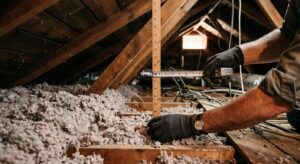
No, and this is one of the most common and costly mistakes in attic work. Adding new insulation over wet or moldy existing insulation traps the problem and accelerates the damage. Use a moisture meter to test the existing insulation and the framing beneath it before adding anything. If readings are above 16 percent or you see any discoloration, remove and replace the affected material first.
▼ What is a smart vapor retarder and do I actually need one?
A smart vapor retarder (brands include MemBrain by CertainTeed and Intello by Pro Clima) is a membrane whose permeability increases when surrounding humidity rises, allowing moisture to escape in both directions as conditions change seasonally. They are most valuable in climate zones 4 and 5 where the dominant moisture drive reverses between winter and summer. They cost $0.30 to $0.80 per square foot and are worth specifying when opening walls in mixed climates, but in strongly cold (zones 6 through 8) or strongly hot-humid (zones 1 through 2) climates, a conventional Class II kraft or Class I poly retarder on the correct side is simpler and sufficient.
Quick Tips
- Look up your IECC climate zone before buying any vapor barrier or insulation materials. What works in Wisconsin will cause problems in Virginia.
- Kraft-faced batts are a Class II vapor retarder. In most of the U.S., that is all the vapor control a wall assembly needs on the interior side when properly air sealed.
- In a basement, the concrete wall itself has some vapor control properties. Your goal is to prevent bulk water and manage the humidity gradient, not to create a perfectly impermeable seal.
- Do not confuse a vapor barrier with a housewrap. Housewraps like Tyvek are designed to be vapor-permeable while blocking liquid water and air, and they belong on the exterior of the sheathing, not inside wall cavities.
Variations for Your Situation
- Apartment/Rental: Renters cannot modify wall or crawl space assemblies, but can address humidity management indirectly. Run bathroom and kitchen exhaust fans for at least 15 minutes after use, use a dehumidifier set to 50 percent relative humidity in damp basements or ground-floor units, and report any persistent condensation on interior walls or musty odors to your landlord in writing. These conditions may indicate a vapor control problem in the building envelope that is the landlord’s responsibility to address.
- Tight Budget (under $50): Focus entirely on the ground cover vapor barrier in any vented crawl space, which is the highest-impact moisture fix in most homes and costs $20 to $40 in 6-mil poly sheeting. Also check that bathroom and kitchen exhaust fans vent to the outside and not into the attic, which is a free fix that eliminates a major source of attic moisture. These two steps address the most common and serious moisture pathways without requiring any wall work.
- Older Home (pre-1980): Homes built before modern vapor barrier awareness often have no vapor control at all in walls, which in most climates is actually safer than a misplaced barrier because the assembly can dry freely in both directions. Before adding any vapor control to an older home’s walls, have a building performance contractor evaluate the existing assembly. In many cases, air sealing the top plates and rim joists with spray foam while leaving walls alone is the correct and most cost-effective approach, delivering 10 to 15% energy savings without disturbing an assembly that has been drying successfully for decades.