When your air conditioner finally gives out in July, the last thing you want to do is research efficiency ratings. But that split-second decision to just grab the cheapest unit can cost you significantly more over the life of the system. The SEER rating on every central AC and heat pump is the single most important efficiency number on the spec sheet, and most homeowners walk right past it.
SEER stands for Seasonal Energy Efficiency Ratio. In plain terms, it measures how much cooling your system delivers per dollar of electricity it consumes over an entire cooling season. A higher SEER rating means the system does the same cooling job while using less electricity. The difference between a minimum-code SEER 14 unit and a high-efficiency SEER 20 unit can translate to 30% lower cooling bills every summer for the next 15 to 20 years.
This post walks you through exactly what SEER ratings mean, how to calculate your real-world savings potential, what to look for when comparing quotes, and how to decide whether a premium-efficiency unit is worth the upfront cost for your home and climate. Whether you are replacing a dying system or planning ahead, these numbers will help you make a confident, informed decision.
What You’ll Need
Click on an item below to shop for the recommended items for this recipe on Amazon.
As an Amazon Associate, we earn from qualifying purchases.
How to Do It
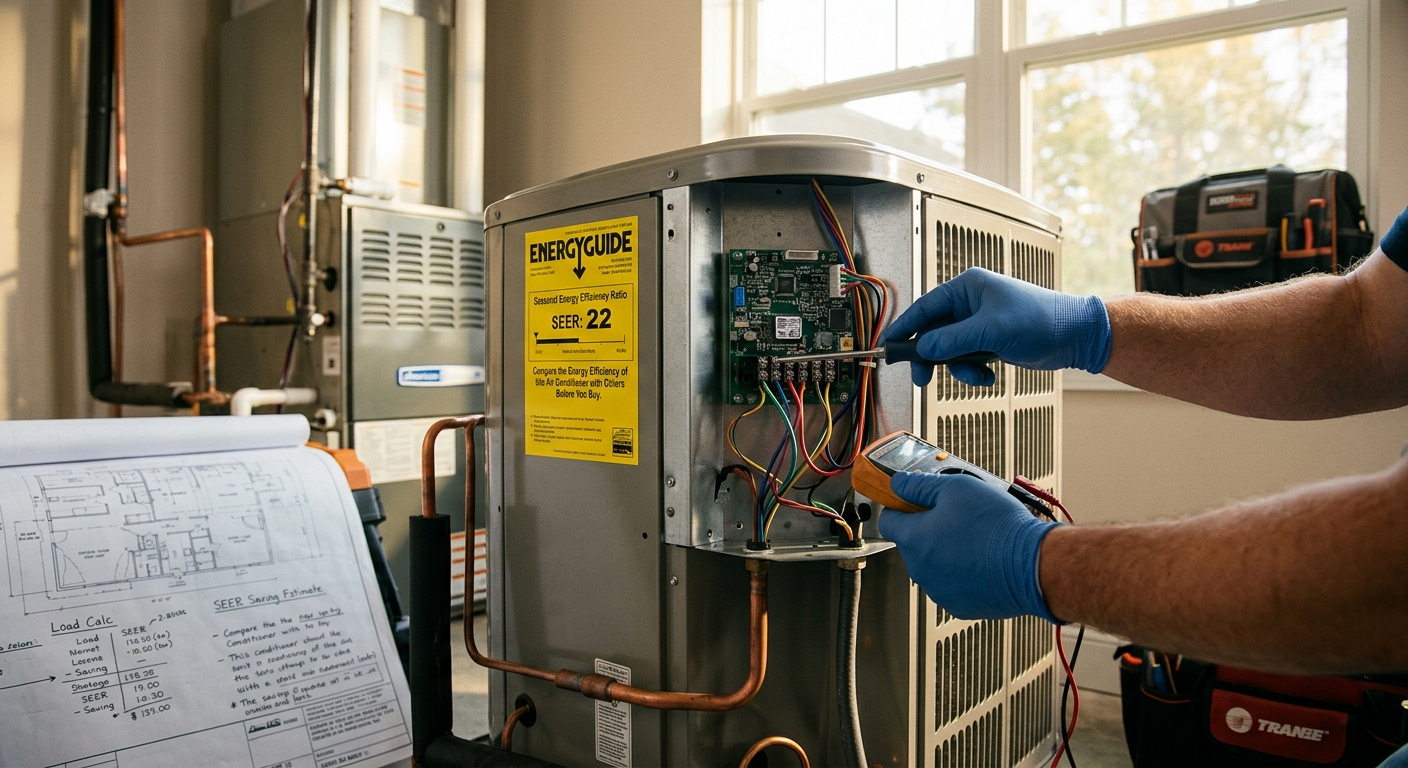
- Find your current system’s SEER rating on the yellow EnergyGuide label on the outdoor unit, or look up the model number on the manufacturer’s website. Note the SEER and the system’s age.
- Calculate your current cooling cost baseline: pull three summer electric bills, estimate that 40 to 60% of summer usage is AC, and note the dollar amount.
- Use the DOE SEER savings formula to estimate savings: divide your current SEER by the prospective new SEER, subtract from 1, then multiply by your annual cooling cost. Example: current SEER 10, new SEER 18: (1 – 10/18) x $900/year = $400 annual savings.
- Check your utility company’s rebate portal (search your utility name plus ‘rebate’ or ‘HVAC incentive’) and the ENERGY STAR rebate finder at energystar.gov to identify incentives before you call contractors.
- Request that every contractor include the SEER rating prominently on their written quote, along with the system brand, model number, and whether it includes a two-stage or variable-speed compressor.
- Inspect all accessible duct connections in your attic, basement, or crawlspace. Seal any gaps, loose joints, or disconnected sections with UL 181-rated foil tape or mastic sealant. Do not use standard cloth duct tape, which fails within a few years.
- Check attic insulation depth. The DOE recommends R-38 to R-60 in most U.S. climate zones for attics. If you can see the tops of floor joists, insulation is critically low. Adding blown-in insulation to R-49 is a $500 to $1,500 project that reduces your new AC’s cooling load by 15 to 25%.
- Replace your air filter with a MERV 8 to 11 filter and note the replacement date on the filter frame. A clogged filter reduces airflow, forcing even a high-SEER system to work harder and potentially damaging the new compressor.
- Walk the perimeter of your home and caulk any visible gaps around window frames, door frames, pipe penetrations, and electrical outlets on exterior walls. Air sealing reduces the load your new system must handle on peak days.
- Verify that all supply and return vents are open and unobstructed by furniture or rugs. Closing vents to unused rooms does not save energy on central systems and can cause the new unit to overpressurize the duct system, reducing efficiency and lifespan.
- Require every contractor to perform a Manual J load calculation before sizing the replacement unit. Reject any contractor who sizes the new system based purely on the old unit’s tonnage without measuring your home. Oversizing is the most common and costly installation mistake.
- Compare quotes at three SEER tiers: the code minimum (SEER 14 to 15), a mid-efficiency option (SEER 16 to 18), and a high-efficiency option (SEER 19 to 22+). Ask each contractor to show you the installed cost, estimated annual energy cost, and payback period so you can compare apples to apples.
- For climates with more than 1,200 cooling hours per year (roughly the Southeast, Southwest, and Texas), prioritize SEER 18 or above with a variable-speed or two-stage compressor. In northern climates with fewer than 900 cooling hours, a SEER 16 mid-efficiency unit often offers the best value.
- Ask the contractor to perform a duct leakage test (blower door or duct blaster) as part of installation. Many utilities require this for rebate qualification, and it identifies losses that would undermine your new system’s efficiency from day one.
- After installation, confirm the contractor commissions the system by checking refrigerant charge and airflow against manufacturer specs. An improperly charged system loses 5 to 20% efficiency immediately and degrades faster. Ask for a written commissioning report.
- File for your federal tax credit using IRS Form 5695 and submit utility rebate paperwork within 30 days of installation while documentation is fresh.
Why It Works: The Benefits
Replacing a SEER 10 unit (common in homes built before 2006) with a SEER 18 unit cuts cooling energy use by roughly 44%. For a household spending $150 per month on summer cooling, that is $66 back in your pocket every month of the cooling season.
High-SEER variable-speed systems run longer at lower capacity, giving the evaporator coil more time to pull moisture from the air. This reduces indoor humidity by 10 to 15 percentage points compared to single-stage systems, making 76 degrees feel as comfortable as 72 degrees on a conventional unit.
Variable-speed compressors and multi-speed blowers operate at lower decibel levels, often 15 to 20 dB quieter than single-stage units during low-demand periods. Most homeowners with SEER 18 and above units report barely noticing when the system is running.
Under the Inflation Reduction Act, central ACs and heat pumps meeting ENERGY STAR Most Efficient criteria (typically SEER 16 or above) qualify for a federal tax credit of up to $600 per year. Many utilities stack additional rebates of $100 to $500, substantially reducing net upfront cost.
Variable-speed systems that modulate output experience less mechanical wear than single-stage units that hard-start at full load repeatedly. High-efficiency units commonly last 18 to 22 years versus 12 to 15 years for entry-level systems, stretching your replacement investment further.
💰 Savings Impact by Action
Replacing a SEER 10 unit with a SEER 18 unit reduces cooling electricity consumption by 44% for the same amount of cooling delivered.
Sealing leaky ducts eliminates 20 to 30% of conditioned air loss before it reaches living spaces, directly reducing runtime on any AC system.
A 4-degree setback during unoccupied hours saves approximately 10% on annual cooling costs regardless of equipment efficiency.
Upgrading attic insulation to R-49 reduces heat gain through the ceiling by 15 to 25%, lowering peak cooling load and compressor runtime.
Comprehensive air sealing of the building envelope reduces infiltration-driven cooling load by up to 15%, compounding savings from a higher-SEER system.
🏠 Key Concepts Explained
The Science Behind It
The SEER formula is straightforward: divide total BTUs of cooling delivered over a season by total watt-hours of electricity consumed. A SEER 16 system delivers 16 BTUs of cooling per watt-hour of electricity. A SEER 8 system delivers only 8. Because energy savings scale proportionally, upgrading from SEER 8 to SEER 16 literally cuts the electricity required to deliver the same cooling in half. This is the same efficiency gain you would get from doubling your insulation, except the payoff compounds every single cooling season for 15 to 20 years.
Variable-speed compressors achieve high SEER ratings by exploiting a fundamental thermodynamic principle: it takes disproportionately more energy to compress refrigerant at full capacity than at partial capacity. Running a compressor at 50% output does not consume 50% of full-load energy; it typically consumes 30 to 35%. Inverter-driven compressors modulate speed continuously using a variable frequency drive, matching output precisely to the building’s real-time heat load rather than binary on-off switching. This is why a well-matched SEER 20 inverter system in a well-insulated home can feel dramatically more comfortable and cost less to run than an oversized SEER 16 single-stage unit.
Duct losses interact directly with your SEER investment. When supply ducts run through a 130-degree attic and leak conditioned 55-degree air into that attic space, your 20 SEER equipment is delivering heat-exchange losses that never appear in the manufacturer’s test data. The DOE estimates that homes with average duct systems effectively lose 20 to 30% of system capacity to leakage and thermal loss. Sealing and insulating ducts is essentially a multiplier on any efficiency investment in the central air system itself.
Frequently Asked Questions
▼ What is a good SEER rating for a new AC in 2024?
For most homeowners in moderate climates, SEER 16 to 18 represents the best value sweet spot: meaningfully better than code minimum with a payback period of 5 to 7 years. In hot climates like the Southeast, Texas, or Arizona where cooling bills top $150 per month in summer, SEER 18 to 22 with a variable-speed compressor can pay back in 4 to 6 years and delivers noticeably better comfort. In northern states with fewer than 900 annual cooling hours, SEER 14 to 16 is often the most cost-effective choice.
▼ How much more does a high-SEER AC cost versus a standard unit?
Expect to pay $500 to $1,500 more in installed cost for a SEER 18 to 20 unit versus a code-minimum SEER 14 unit of the same capacity. A full SEER 20 to 22 inverter system can run $1,500 to $2,500 more than the entry-level alternative. Factor in federal tax credits of up to $600 and utility rebates of $100 to $500, which can cut the premium by 30 to 50%, making the payback math significantly more attractive.
▼ My contractor says all AC units are basically the same at the same price. Is that true?
No, and that is a red flag. SEER ratings vary dramatically at similar price points depending on whether the unit has a single-stage, two-stage, or variable-speed compressor. Two different 3-ton units at the same installed price can have SEER ratings of 14 and 18, translating to a $200 to $400 per year difference in operating cost over a 20-year lifespan. Always ask for the model number and look up the SEER2 rating independently on the manufacturer’s website or the AHRI directory before agreeing.
▼ Can I just replace the outdoor condenser unit to get a higher SEER rating?
Rarely, and usually not advisably. SEER ratings are certified for matched systems: the outdoor condenser, indoor evaporator coil, and air handler must be paired correctly to achieve the rated efficiency. Installing a high-SEER condenser on an old mismatched coil typically achieves only the SEER of the older component and may void both warranties. If your indoor coil and air handler are more than 10 years old, replacing the full system almost always delivers better long-term value.
▼ How long until I actually see savings on my electric bill after upgrading?
You will see the difference on your first full summer bill after installation. If you replaced a SEER 10 unit with SEER 18, expect cooling costs to drop by 35 to 45% compared to the same period the prior year, adjusted for weather differences. Keep your first two or three summer bills after installation to track actual versus projected savings, and use that data to verify the system was commissioned correctly.
Quick Tips
- In hot climates (more than 1,500 cooling hours per year), every 2-point SEER increase above the minimum saves roughly 10 to 12% on cooling costs annually, compounding over 15 to 20 years of equipment life.
- Ask for the AHRI Certificate of Certified Product Performance, which confirms the matched outdoor unit, indoor coil, and air handler together achieve the rated SEER. Mismatched components can reduce real-world efficiency by 10 to 15%.
- Set your programmable or smart thermostat to raise the setpoint by 4 degrees when the home is unoccupied. On a new high-SEER system, this adds another 10% reduction in annual cooling cost on top of the efficiency gain from the unit itself.
- If your home has single-pane windows on south or west exposures, adding solar shades or low-E window film before installing a new AC can reduce peak cooling load by 10 to 20%, potentially allowing you to downsize one ton of capacity and reduce equipment cost.
- Schedule new AC installation in fall or winter when HVAC contractors have lighter workloads. Off-season installation often comes with negotiated pricing of 5 to 15% below peak summer rates and faster installation timelines.
Variations for Your Situation
- Apartment/Rental: Central AC replacement is your landlord’s decision, but you can still influence comfort and cost. Ask your landlord about the SEER rating of the building’s system and point to available utility rebates they can capture. For window or through-wall units you control, look for ENERGY STAR certified room ACs with an EER of 12 or above, which use 10 to 15% less energy than standard models at similar price points.
- Tight Budget (under $50): If full replacement is not yet possible, focus on reducing the load on your existing system. Add a programmable thermostat ($25 to $50) and set a 4-degree setback when away. Seal the five or six most obvious air leaks (attic hatch, around window AC units, and at plumbing penetrations) with foam and caulk for under $20. These steps can reduce cooling energy use by 10 to 18% without touching the equipment.
- Older Home (pre-1980): Homes built before 1980 typically have duct systems with 25 to 40% leakage rates and minimal wall insulation. Before investing in a high-SEER unit, get a home energy audit (often $100 to $400, sometimes subsidized by utilities) to identify the biggest losses. In many pre-1980 homes, sealing ducts and air-sealing the attic floor delivers more dollar-for-dollar savings than upgrading from SEER 16 to SEER 20, and both upgrades together create a dramatically more efficient and comfortable home.