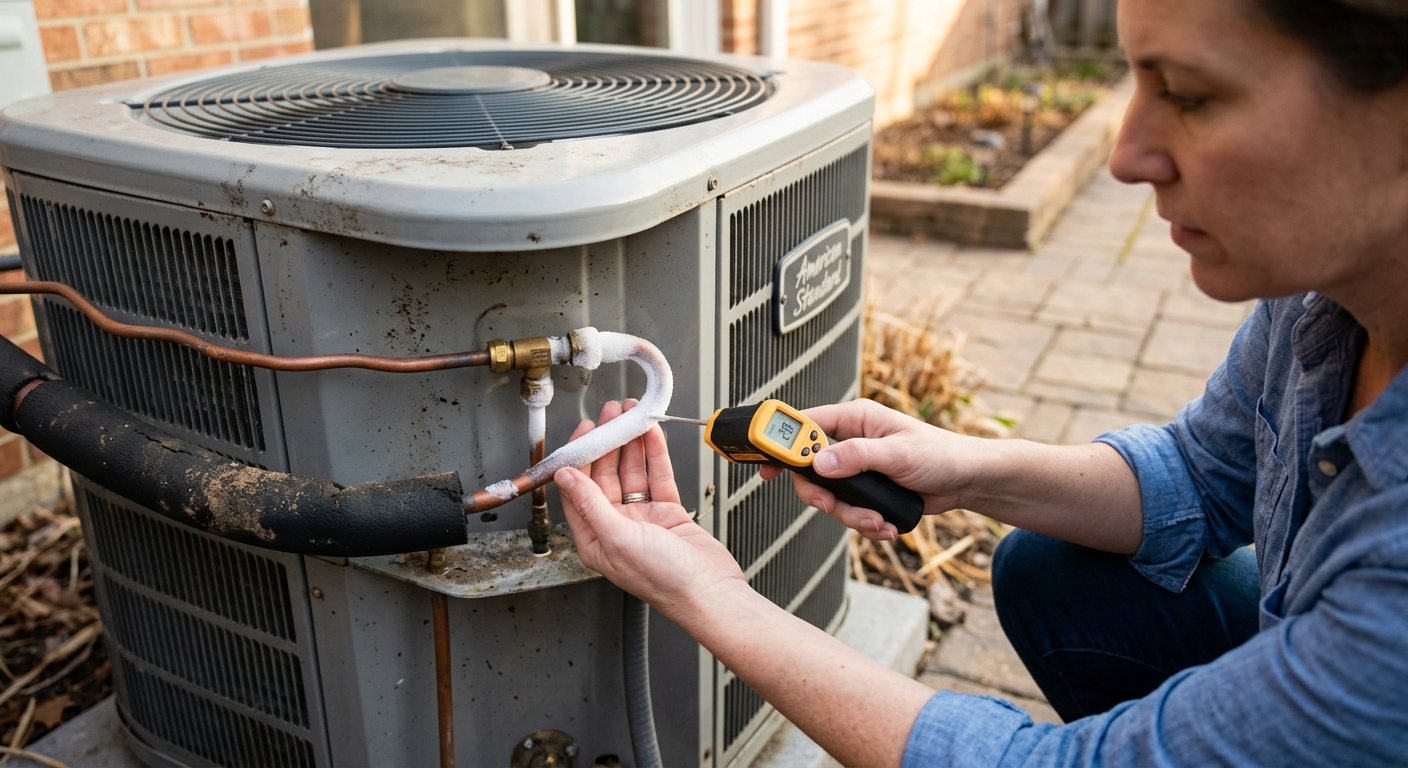
Your air conditioner is blowing, the thermostat is set to 72°F, but the house just will not cool down. Before you assume the worst and call for an emergency HVAC visit, it is worth checking whether low refrigerant is the culprit. Refrigerant, often called by the brand name Freon, is the lifeblood of your AC system. It absorbs heat from inside your home and releases it outside. When the level drops, the entire heat-transfer process becomes less efficient, and your system starts showing very specific, recognizable symptoms.
Low refrigerant is almost always caused by a leak, not by normal consumption. Unlike motor oil, refrigerant does not get used up over time. If your system is low, something is wrong, and simply topping it off without finding the leak is a temporary fix at best. That said, knowing the warning signs before you call a technician puts you in control. You can describe the problem accurately, avoid unnecessary service calls, and avoid being upsold on repairs you do not need.
This guide walks you through every symptom of low refrigerant you can diagnose yourself at home, the simple checks any homeowner can do safely, and what to expect when a certified HVAC technician does get involved. We will also cover real costs, realistic timelines, and how a properly charged system can cut your cooling bills by 15 to 30 percent compared to a system running low.
What You’ll Need
Click on an item below to shop for the recommended items for this recipe on Amazon.
As an Amazon Associate, we earn from qualifying purchases.
How to Do It
- Set your thermostat 5°F below the current indoor temperature and let the system run for 15 minutes. A system low on refrigerant will struggle to reach setpoint and may run continuously without getting there.
- Go to your indoor air handler and feel the large insulated copper pipe (the suction line) coming out of the evaporator coil. It should feel cold and slightly sweaty, like a cold drink on a humid day. If it is frozen solid or covered in ice, low refrigerant is the leading suspect.
- Check the supply vents with your hand or a cheap indoor thermometer. Supply air should be 15 to 20°F cooler than the return air temperature. If the split is less than 12°F, your system is not transferring heat effectively.
- Listen for hissing or bubbling sounds near the indoor air handler or outdoor condenser unit. These sounds can indicate refrigerant escaping from a leak point.
- Check your recent electric bills. If your cooling costs have crept up 15 to 25% compared to the same month last year with similar outdoor temperatures, declining efficiency from low refrigerant is a plausible cause.
- Document all symptoms with notes or photos before calling a technician. Mention specifically whether you saw ice on the coil, the temperature split you measured, and any sounds you heard. This helps the technician diagnose faster and more accurately.
- Turn off the system at the thermostat and let any ice on the evaporator coil melt completely, which takes 1 to 4 hours. Running a frozen coil damages the compressor and prevents accurate diagnosis. Use a flashlight to check the coil through the air handler access panel.
- Replace or inspect the air filter. A severely clogged filter mimics refrigerant symptoms by restricting airflow over the coil. Install a clean MERV 8 filter, run the system for 30 minutes, and recheck the temperature split at vents.
- Inspect all accessible refrigerant line insulation on the suction line running from your outdoor unit to indoors. Deteriorated foam insulation causes condensation and reduces efficiency. Replace any crumbling sections with closed-cell foam pipe insulation from a hardware store, which costs about $8 to $15.
- Purchase an inexpensive HVAC manifold gauge set (available for $30 to $50 at hardware stores or online) to read system pressures. For R-410A systems, normal low-side pressure is 115 to 125 psi at 75°F outdoor temperature. Readings significantly below this range confirm low charge. Note: this step is for information gathering only, not for adding refrigerant.
- Check all accessible line set fittings and connections at the indoor and outdoor units for oily residue. Refrigerant carries compressor oil, so an oily film around a fitting is a strong visual indicator of a leak point. Photograph any suspect areas to show your technician.
- Call a certified HVAC technician with your documented findings. Request that they perform a proper leak search before adding refrigerant. A system that is only recharged without leak repair will be low again within one to two seasons.
- Request that the technician measure both superheat and subcooling with calibrated manifold gauges before adding any refrigerant. Superheat should typically be 10 to 18°F and subcooling 10 to 15°F for a properly charged fixed-orifice system. If the tech skips this step, ask why.
- Ask for an electronic leak search or UV dye injection before any refrigerant is added. Electronic leak detectors can find leaks as small as 0.1 oz per year. UV dye costs about $20 to $30 extra and leaves a traceable marker for future checks.
- Get a written quote for refrigerant cost per pound before authorizing the recharge. R-410A runs $10 to $25 per pound at retail. R-22 costs $50 to $150 per pound due to phase-out restrictions. Most systems need 2 to 4 pounds when significantly low.
- Ensure the technician repairs or seals the confirmed leak source before recharging. Common leak points include Schrader valves ($10 to $30 fix), flare fittings ($50 to $150), and evaporator coil pinhole leaks ($400 to $1,500 or more for coil replacement).
- After recharge, ask the technician to record the final system pressures, superheat, and subcooling values on the invoice. These numbers serve as your baseline for future service calls and confirm the work was done correctly.
Why It Works: The Benefits
A properly charged AC system can be 15 to 30% more efficient than one running with a low refrigerant charge, translating to $50 to $150 in savings over a single cooling season for an average home.
Catching low refrigerant early prevents the compressor from overheating and failing. Compressor replacement typically costs $1,200 to $2,800 installed, making a $150 to $400 recharge repair a very worthwhile investment.
A fully charged system reaches setpoint temperatures faster and maintains them more evenly throughout the home, eliminating hot spots that form when the system cannot keep up.
Homeowners who arrive at a service call knowing the symptoms can verify that the technician actually measures superheat and subcooling rather than adding refrigerant by guesswork, avoiding unnecessary charges.
Refrigerant leaks release potent greenhouse gases. R-410A has a global warming potential 2,088 times that of CO2. Identifying and fixing leaks promptly reduces your household environmental footprint.
💰 Savings Impact by Action
Restoring correct refrigerant charge can improve system efficiency by 15 to 30%, cutting cooling energy costs by up to 25% compared to a significantly undercharged system.
Fixing the source leak prevents the efficiency loss from recurring, saving the full cost of another recharge service call within one to two seasons.
Cleaning dirty evaporator and condenser coils alongside a recharge restores heat transfer efficiency and can reduce runtime by an additional 10 to 15%.
Early detection and repair of low refrigerant reduces compressor failure risk, avoiding a $1,200 to $2,800 replacement that would otherwise offset years of energy savings.
🏠 Key Concepts Explained
The Science Behind It
Refrigerant works by exploiting a fundamental property of matter: substances absorb energy when they change from liquid to gas, and release energy when they change back to liquid. Inside your evaporator coil, refrigerant arrives as a cool, low-pressure liquid and absorbs heat from your indoor air as it evaporates. Outside at the condenser coil, that same refrigerant is compressed back into a hot, high-pressure gas and releases its heat to the outdoor air. Your house cools because heat is continuously moved from inside to outside by this phase-change cycle.
When the refrigerant charge is low, the pressure throughout the system drops. Lower pressure means lower boiling point. The refrigerant begins evaporating earlier and at a colder temperature than it should. The evaporator coil can drop below 32°F, causing moisture to freeze onto the coil surface instead of draining away as condensate. This ice layer acts as insulation between the refrigerant and the air you are trying to cool, drastically reducing heat transfer and making the system work even harder for less result. Meanwhile, the compressor, designed to compress gas, receives liquid refrigerant mixed with gas, a condition called slugging that causes severe mechanical wear.
The coefficient of performance (COP) of a refrigeration system is essentially the ratio of cooling produced to electrical energy consumed. A properly charged residential central AC system typically achieves a COP of 2.5 to 3.5, meaning it moves 2.5 to 3.5 BTUs of heat for every BTU of electricity used. When the charge is 20% low, real-world studies show COP can drop by 25 to 40%, meaning you are paying full electricity rates for significantly less cooling. This is why a $300 recharge repair can pay for itself within a single cooling season through reduced energy bills.
Frequently Asked Questions
▼ Why is my AC freezing up even though I just replaced the filter?
Low refrigerant is the second most common cause of a frozen evaporator coil after restricted airflow. Turn the system off and let the coil thaw completely (1 to 4 hours with the fan on), then check the temperature split at your vents. If supply air is less than 12°F cooler than return air after the coil clears, call an HVAC technician for a refrigerant check and leak search.
▼ My AC runs all day but barely cools the house. Could it really just be refrigerant?
Yes, but rule out the simpler causes first. Check that the filter is clean, the condenser unit outside has clear airflow on all sides, and the outdoor temperature is not above 95°F, at which point many systems struggle regardless of charge. If those check out and your supply-to-return temperature split is under 12°F, low refrigerant is a strong candidate.
▼ How much does a refrigerant recharge typically cost in 2024?
For R-410A systems (most homes built after 2010), expect to pay $150 to $400 total including labor for a recharge plus a basic leak check. R-22 systems are far more expensive at $300 to $800 or more depending on how much refrigerant is needed, since R-22 now costs $50 to $150 per pound. Always get the leak repaired at the same visit to avoid paying again next season.
▼ Can a homeowner legally buy and add refrigerant themselves?
You cannot legally purchase or handle most HVAC refrigerants without EPA 608 certification. Small cans of R-134a for car AC are an exception, but residential AC refrigerants (R-22 and R-410A) are restricted to certified technicians. Attempting to self-service carries heavy fines and can void your equipment warranty.
▼ How do I know if the technician actually fixed the leak or just topped off the refrigerant?
A proper repair includes a documented leak search (electronic detector or UV dye), written identification of the leak source on the invoice, and a repair or replacement of the faulty component before recharging. Ask to see the before and after pressure readings on the invoice. If a system needs recharging again within one to two seasons with no documented leak repair, you were not given a complete fix.
Quick Tips
- Check your outdoor condenser unit for debris, bent fins, and blocked airflow before assuming refrigerant is the issue. A dirty condenser can mimic low-refrigerant symptoms and is a free fix.
- Note the model and serial number of your outdoor unit before calling a technician. These tell you the system age, refrigerant type, and original factory charge in ounces, all useful diagnostic information.
- If your system is more than 15 years old and uses R-22, get a full system replacement quote alongside a recharge quote. R-22 phase-out means recharge costs will keep rising.
- Schedule refrigerant leak checks as part of your annual AC tune-up every spring before cooling season. Early detection prevents compressor damage and keeps efficiency high all summer.
Variations for Your Situation
- Apartment/Rental: Renters cannot authorize HVAC repairs but can document symptoms thoroughly and report them in writing to property management. Take photos of any ice on the indoor unit, record the supply vent temperature with a $10 thermometer, and note the date the problem started. Written documentation creates a paper trail and can accelerate landlord response. In most states, landlords are legally required to maintain functional cooling systems if they are provided as part of the lease.
- Tight Budget (under $50): Focus on the free symptom checklist and a $10 to $15 digital thermometer to measure your supply-to-return temperature split. Documenting symptoms thoroughly before calling a technician reduces billable diagnosis time and helps you avoid paying for unnecessary add-on services. Also clean the outdoor condenser coils with a garden hose (free) since a dirty condenser mimics low-charge symptoms and is a free fix.
- Older Home (pre-1995): Systems this age almost certainly use R-22 refrigerant, which is now extremely expensive due to EPA phase-out restrictions. Before authorizing any R-22 recharge, get a written estimate for a full system replacement using modern R-410A equipment. A new 14-SEER R-410A system costs $3,500 to $6,000 installed but operates 20 to 40% more efficiently and avoids future R-22 price shocks. Compare that against paying $300 to $800 per recharge on an aging system.