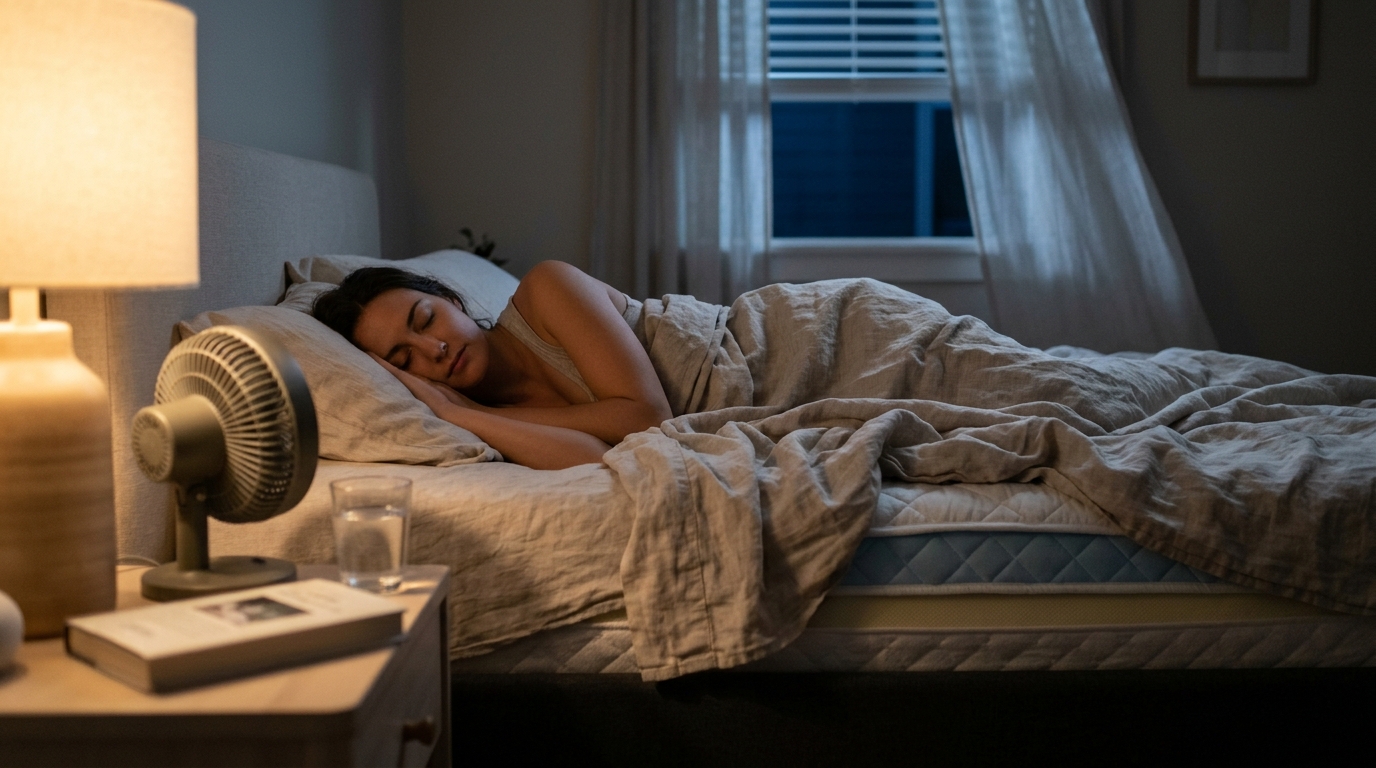
You bought a memory foam mattress for the pressure relief, but around 2 a.m. you wake up sweating, flip the pillow to the cool side, and eventually pad down the hall to drop the thermostat to 66 degrees. If that sounds familiar, you have run into the memory foam heat retention problem, and it may be quietly adding to your electric bill.
Standard memory foam is a dense, closed-cell polyurethane material that responds to body heat by softening and conforming around you. That same density limits airflow, so the heat your body gives off at night (roughly 70 to 100 watts at rest) has nowhere to go. Your body ends up wrapped in a slow-warming insulator while the AC works overtime to compensate for a problem that lives in the mattress, not the room.
This post breaks down why memory foam sleeps hot, what actually helps versus what is marketing hype, and how to fix it with options ranging from free changes you can make tonight to a full sleep surface upgrade. You will also see how fixing the problem at the bed can let you run the thermostat a few degrees warmer overnight and save real money.
What You’ll Need
Click on an item below to shop for the recommended items for this recipe on Amazon.
As an Amazon Associate, we earn from qualifying purchases.
How to Do It
- Strip off thick, layered bedding and swap to breathable natural fabrics like cotton percale, linen, or bamboo-viscose sheets. Avoid microfiber and flannel, which trap heat.
- Replace a polyester or foam-filled mattress protector with a thin, breathable cotton or Tencel protector that wicks moisture instead of sealing it in.
- Raise your bed off the floor on a slatted frame or bed risers, or check that your platform has open slats. Foam directly on a solid surface cannot breathe from below.
- Point a quiet fan across the foot of the bed or set a ceiling fan to run counterclockwise on medium, which gives roughly a 4 degree wind-chill effect on skin.
- Pull the mattress out of direct sunlight and flip or rotate it so you are not sleeping in a deeply worn body impression, which traps even more heat.
- Add a 2 to 3 inch breathable topper made of gel-infused open-cell foam, latex, or wool. Latex and wool allow far more airflow than standard memory foam and add a cooler top layer.
- Choose a topper with perforations or a ventilated design, and confirm it sits on top of your mattress without sealing the sides, so air can circulate.
- Layer a cooling mattress pad containing phase-change material or a water-channel system if you sleep very hot. Water-based pads typically add 40 to 80 watts of draw but can allow a 4 to 6 degree warmer room.
- Dial in your bedroom: run the AC to 72 to 74 degrees at night, use blackout curtains to keep the room from heating during the day, and run a ceiling fan for added cooling.
- Track results for 7 to 10 nights, adjusting one variable at a time, then raise your thermostat setback 1 degree at a time until you reach the warmest comfortable setpoint.
- Shop for mattresses labeled open-cell, ventilated, or hybrid, which pair a pocketed coil base with a thin foam comfort layer. Coils allow far more airflow than all-foam designs.
- Look for a trial period of 90 to 120 nights with free returns so you can test it through different seasons.
- Compare cover materials, since Tencel, wool, and cotton blends sleep cooler than polyester knit covers.
- Install on a ventilated base or adjustable frame, and use a breathable protector to preserve the cooling design.
Why It Works: The Benefits
Raising your bedroom setpoint from 68 to 72 degrees for 8 hours a night can trim cooling energy by roughly 10 to 15% during the cooling season, assuming you stay comfortable.
Sleep research suggests the ideal surface temperature is around 88 to 90 degrees at the skin. Keeping heat from building up helps you stay in deeper sleep stages longer.
Breathable layers and a protector reduce moisture and body oil buildup in the foam, helping a quality mattress last the typical 8 to 10 years.
You do not have to abandon pressure relief. Most fixes add cooling around the foam instead of replacing it.
A cooler bed means you can skip the extra box fan or window AC, saving 50 to 100 watts per hour of runtime.
💰 Savings Impact by Action
Raising the overnight setpoint 3 to 4 degrees can reduce cooling energy by roughly 10 to 15% during summer months.
Running a fan lets you feel 4 degrees cooler, allowing a warmer thermostat without losing comfort.
Cotton and linen sheets improve moisture wicking and reduce the need for extra cooling by a few percent.
Open-cell or latex toppers release body heat that would otherwise build up and push you to lower the AC.
Insulated curtains can reduce solar heat gain through bedroom windows by up to 20 to 30%, cutting room cooling load.
🏠 Key Concepts Explained
The Science Behind It
Your body is a heat engine, and at rest it sheds about 80 watts of heat, roughly like a bright incandescent bulb. To stay comfortable, that heat has to leave through conduction (into the mattress), convection (into moving air), radiation, and evaporation of sweat. Memory foam interferes with the first two: its low thermal conductivity means it stops absorbing heat once it warms up, and its dense structure blocks air from circulating underneath you.
Foam also becomes a better insulator as you sink into it. The more your body is surrounded by foam, the smaller the surface area exposed to room air, and the less heat can escape by convection. That is why many people feel fine for the first hour and then slowly overheat, while the foam keeps warming around them.
Fixes work by restoring one of those escape routes. Breathable sheets and open-cell toppers improve airflow and moisture wicking. Fans increase convective cooling and evaporation. Cooling pads actively pull heat away through conduction. Every degree of warmth you remove at the bed is a degree your AC does not have to remove from the whole room, which is where the energy savings come from.
Frequently Asked Questions
▼ Why is my bed still hot after I switched to cotton sheets?
The foam itself may be the main heat trap. Add a 2 to 3 inch open-cell latex or perforated gel topper and make sure the bed frame has airflow underneath. If that still does not help, a cooling pad or a hybrid mattress is the next step.
▼ Can renters do this without landlord permission?
Yes. Sheets, protectors, toppers, fans, and cooling pads are all removable and do not alter the property. Bed risers are fine too. Avoid anything that requires drilling or modifying the rental unit.
▼ How long before I actually notice savings on my bill?
Comfort improves the first night, but bill savings show up once you raise your thermostat setback. Expect to see a 5 to 10% drop in cooling costs on your next monthly bill if you can raise the nighttime setpoint by 2 to 3 degrees.
▼ Are cooling mattress pads worth the electricity they use?
Usually yes. Water-based pads draw about 40 to 80 watts, which costs roughly 5 to 10 cents per night. If the pad lets you raise your thermostat 4 degrees, you will typically save more on AC than you spend running the pad.
Quick Tips
- Switch to percale or linen sheets before you spend money on anything else. It is the cheapest, highest-impact change.
- Pre-cool the bedroom 30 minutes before bed using a fan or AC, then raise the setpoint once you are asleep.
- Wash bedding weekly in warm water, since body oils and sweat buildup in fabrics reduce breathability.
- Do not use more than one mattress topper at a time. Stacking layers recreates the insulation problem you are trying to solve.
Variations for Your Situation
- Apartment/Rental: Focus on removable fixes. Use a $30 to $60 breathable bamboo or Tencel sheet set, a $50 to $120 ventilated topper, and a quiet tower fan. These add no permanent changes and move with you.
- Tight Budget (under $50): Swap to a cotton percale sheet set ($30 to $40), remove the extra comforter, and run a box fan across the bed ($0 if you already own one). Lift the mattress off any solid surface for airflow. These steps alone often fix mild overheating.
- Older Home (pre-1980): Bedrooms in older homes often have poor insulation and leaky windows that drive up nighttime heat. Add blackout curtains, seal window gaps with weatherstripping, and consider a ceiling fan. Combine these with breathable bedding for the best results.
- Hot Climate (Southern or Southwestern U.S.): Prioritize a water-based or phase-change cooling system and a hybrid mattress. In 90 degree plus summers, bedding changes alone may not be enough, so combine them with blackout shades and a smart thermostat schedule.