If your home has forced-air heating or cooling, there is a good chance a significant portion of what you pay to condition that air never makes it to your living space. Ducts routed through unconditioned attics, crawlspaces, or garages pass through some of the most extreme temperature zones in a home. In summer, attic air can reach 130 to 150 degrees Fahrenheit. In winter, a vented crawlspace can hover near freezing. Every foot of duct running through those zones is losing energy, and costing you money, every single day your system runs.
The U.S. Department of Energy estimates that duct losses account for 20 to 30% of heating and cooling energy in a typical home. That means for every $100 you spend on your HVAC bill, up to $30 may be conditioning your attic or crawlspace instead of your living room. The fix is well within reach of most homeowners: adding or upgrading duct insulation dramatically reduces that heat transfer and brings more of your conditioned air to the rooms that need it.
This guide covers why duct insulation matters from a building science standpoint, how to assess what you have now, and two practical approaches for getting the job done, whether you want to tackle it yourself over a weekend or bring in a professional for a comprehensive solution. You will find real cost ranges, payback estimates, and the specific materials that make the biggest difference.
What You’ll Need
Click on an item below to shop for the recommended items for this recipe on Amazon.
As an Amazon Associate, we earn from qualifying purchases.
How to Do It
- Inspect all accessible ductwork and mark any gaps, separated joints, or disconnected sections with tape before doing anything else. Fix disconnected ducts first since a separated duct is a complete loss of conditioned air.
- Clean dust and debris from duct surfaces using a dry cloth or brush. Mastic, tape, and insulation all adhere better to a clean surface.
- Seal every joint, seam, and connection with water-based mastic sealant applied with a brush, covering at least 1 inch on each side of the joint. For larger gaps, embed fiberglass mesh tape in the mastic before it dries. Do not use standard gray cloth duct tape, which fails quickly at temperature extremes.
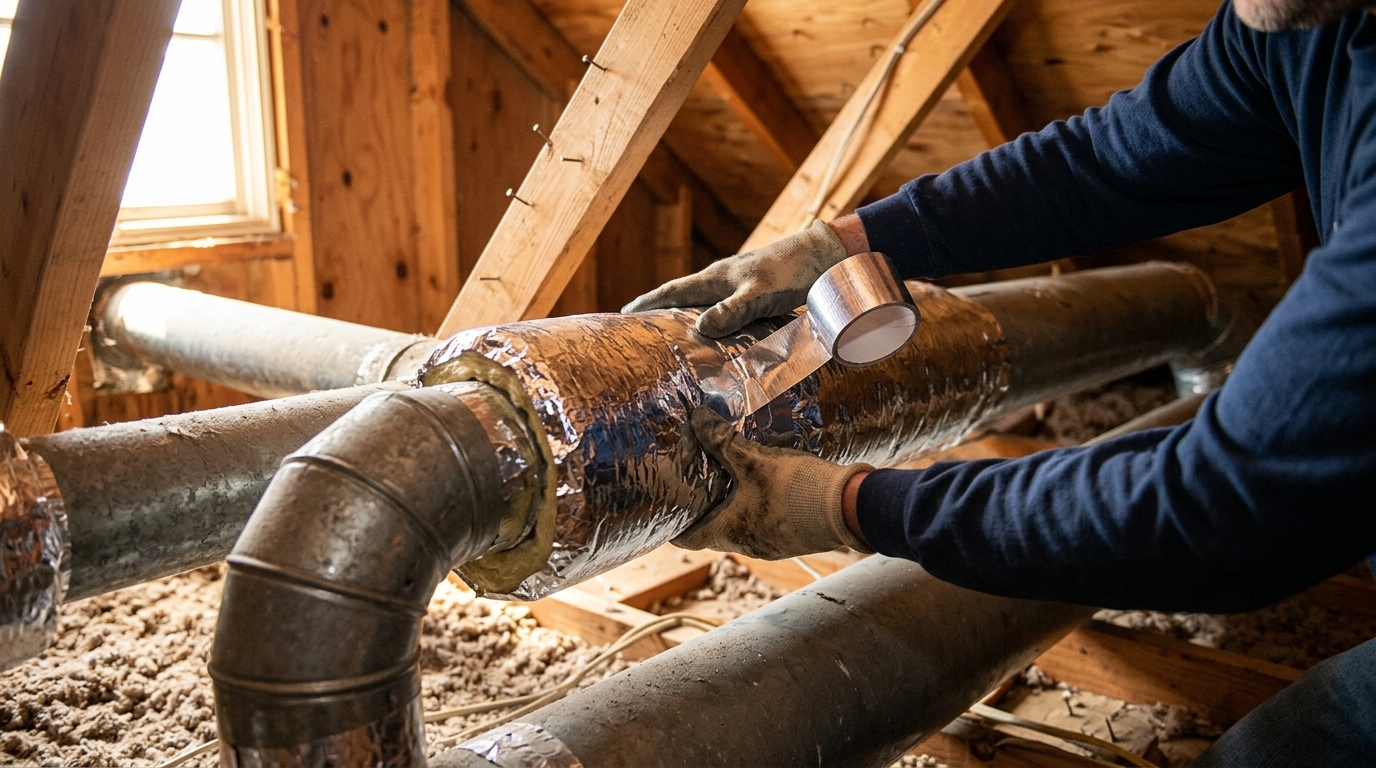
- Once mastic has dried (typically 1 to 2 hours), cut R-8 duct wrap insulation to length for each duct section. Wrap with the foil facing outward and butt seams tightly together so there are no gaps in coverage.
- Secure the wrap with metal-backed foil tape every 12 to 18 inches and at every seam. Pull the insulation snug around elbows and fittings but avoid compressing it, as compressed fiberglass loses R-value.
- After completing all runs, do a visual check from the air handler outward, confirming every inch of duct in the unconditioned zone is covered, including takeoffs, boots, and flex connections.
- Request a blower-door and duct blaster test from a certified energy auditor or HVAC contractor before any work begins. This gives you a baseline leakage number (expressed as CFM25) so you can measure improvement after the job.
- Ask the contractor to propose both mastic sealing and insulation in a single scope of work. Combining both in one visit is far more cost-effective than doing them separately.
- For severely leaky systems, ask about Aeroseal duct sealing, a process that injects pressurized aerosol sealant particles into the duct system from the inside, sealing leaks that are physically inaccessible. This typically adds $1,000 to $1,500 but can reduce leakage by 90% or more.
- Specify R-8 minimum insulation for attic ducts and R-6 for crawlspace ducts in the written contract. Confirm the contractor will use foil-faced fiberglass wrap or rigid foam board with a vapor-retarder facing, not standard batt insulation.
- Request a post-job duct blaster test to confirm leakage reduction. A well-sealed system should test at or below 4 CFM25 per 100 square feet of conditioned floor area, which is the Energy Star standard.
- File for any available utility rebates immediately after work is complete. Keep the post-test report, which most rebate programs require as documentation.
Why It Works: The Benefits
Properly insulated ducts can reduce HVAC energy use by 20 to 30% annually. On a $2,000 per year energy bill with forced air, that is $400 to $600 in potential savings every year.
Rooms at the end of long duct runs often feel too warm in summer or too cold in winter because supply air loses conditioning before arriving. Insulating and sealing ducts brings those rooms back into balance without adjusting the thermostat.
When ducts lose conditioned air to unconditioned spaces, the HVAC system runs longer cycles to compensate. Cutting those losses reduces compressor runtime, potentially adding years to the life of a system that costs $5,000 to $12,000 to replace.
Leaky ducts in crawlspaces and attics can draw in dust, mold spores, and humidity from those spaces and distribute them through the home. Sealing and insulating creates a cleaner, more controlled air delivery path.
Insulation with a proper vapor-retarder facing prevents condensation from forming on cold supply ducts in humid conditions, protecting both the duct system and surrounding framing or insulation from moisture damage over time.
💰 Savings Impact by Action
Upgrading bare or R-4 ducts to R-8 in an unconditioned attic reduces supply air heat gain by up to 25%, directly lowering system runtime.
Sealing leaky duct joints with mastic can recover 20% or more of conditioned air that was previously escaping into unconditioned space.
Homes with both poor sealing and inadequate insulation can see total HVAC energy savings of 20 to 30% when both are corrected in one project.
Professional Aeroseal duct sealing reduces duct leakage by up to 90%, translating to heating and cooling savings of 25 to 35% in leaky older homes.
🏠 Key Concepts Explained
The Science Behind It
Heat always moves from warmer areas to cooler areas, and it does not care which direction is more convenient for your comfort. In summer, your air handler cools supply air to around 55 degrees Fahrenheit before sending it through ducts. If those ducts pass through a 140-degree attic, the metal walls of the duct act as a radiator, absorbing heat from the surrounding air and dumping it into your supply stream. By the time that air reaches a register 30 feet away, it may arrive at 70 degrees instead of 55, a full 15-degree temperature rise that your system must compensate for by running longer and harder.
Insulation works by trapping still air in millions of tiny pockets within the fiberglass or foam matrix. Still air is an excellent insulator. Those tiny pockets dramatically slow the rate of heat conduction through the duct wall. R-8 insulation resists heat flow eight times better than an uninsulated duct wall. In practical terms, that means a supply duct losing 15 degrees of cooling in a hot attic might lose only 2 to 3 degrees after wrapping, which translates directly into fewer system run cycles and a more comfortable room at the end of the run.
Moisture is the other physics force at work here. Cold supply ducts in humid climates behave like a cold glass on a summer day: moisture in the warm surrounding air condenses on the cold surface. This condensation degrades fiberglass insulation over time, soaks wooden framing, and can support mold growth. A proper vapor-retarder facing, typically a reinforced foil or poly barrier on the outside of the insulation layer, blocks humid air from reaching the cold duct surface. This is why vapor-retarder-faced duct wrap is not optional in climates with hot, humid summers. Getting both the thermal and moisture control right is what makes duct insulation a durable long-term investment rather than just a short-term fix.
Frequently Asked Questions
▼ How do I know if my ducts are already insulated enough?
Check the R-value label on any existing duct wrap. If you see R-4 or lower, or if the existing wrap is thin, deteriorated, or falling off, it is undersized for an unconditioned space. Energy Star recommends R-8 minimum for attic ducts. You can also do a simple touch test: if an exposed supply duct in your attic feels warm to the touch in summer, heat is getting in and the insulation is inadequate or absent.
▼ Can I just use spray foam instead of duct wrap?
Spray foam is appropriate for sealing small gaps at duct penetrations through walls or floors, but it is not a good substitute for duct wrap insulation on long duct runs. It is expensive per R-value, difficult to apply evenly on cylindrical ducts, and can trap moisture if applied without a proper vapor barrier plan. Stick with rated duct wrap or rigid foam board for the main insulation job, and use spray foam or mastic only for air sealing at joints.
▼ My energy bills did not drop after I insulated the ducts. What went wrong?
The most common cause is that duct leakage was not addressed before insulating. Insulation slows heat transfer but does not stop air escaping through gaps. If conditioned air is leaking out of joints into the attic, you will see little improvement on your bill even with perfect insulation. Go back and seal every joint with mastic before the insulation and check that no sections were left uncovered, especially elbows, boots, and flex connections.
▼ Is it worth insulating ducts in a partially conditioned space like a finished basement?
If the basement is truly conditioned and maintains indoor temperatures year-round, the delta-T between the duct and surrounding air is low enough that additional duct insulation offers minimal return. Focus your effort on ducts in the attic, crawlspace, garage, or any zone that gets significantly hotter or colder than your living space. If your basement fluctuates widely in temperature, treat it as an unconditioned zone and insulate accordingly.
▼ Do I need a permit to insulate ductwork myself?
In most jurisdictions, insulating existing ductwork does not require a permit since you are not modifying the mechanical system. However, if you are replacing duct sections or rerouting ducts, local mechanical codes may apply and a permit could be required. When in doubt, check with your local building department. If you are hiring a contractor for a full duct sealing and insulation job, a reputable contractor will pull any required permits as part of the scope.
Quick Tips
- Insulate ducts from the air handler outward, starting with the sections closest to the unit where heat gain or loss is greatest.
- Use rigid foam board insulation (polyisocyanurate or extruded polystyrene) for rectangular sheet metal ducts. It conforms more cleanly than wrap and delivers higher R-value per inch.
- Do not forget boots and takeoffs where flex duct connects to branch runs. These fittings are often left bare and represent concentrated leakage and heat loss points.
- If your crawlspace has open vents, insulating the ducts there is important, but also consider whether encapsulating the crawlspace entirely would deliver greater overall benefit by eliminating the extreme temperature zone altogether.
- Check your utility company’s website before buying materials. Many offer rebates of $0.10 to $0.25 per square foot of duct insulation installed, which can meaningfully offset material costs.
Variations for Your Situation
- Apartment/Rental: Renters almost never have access to central ductwork, but if you have exposed duct runs in a basement unit or are in a building with exposed ceilings, speak with your landlord about adding insulation. Frame it as moisture damage prevention, not just efficiency. For individual room comfort, a window AC or portable unit with its own clean air path sidesteps leaky central duct problems entirely. Budget $150 to $400 for a quality portable unit if duct losses are making specific rooms uncomfortable.
- Tight Budget (under $50): Start with air sealing only using a $12 tub of water-based mastic and a cheap brush. Sealing the five to ten worst joints at the air handler plenum and main duct connections can deliver 50% or more of the benefit of a full duct seal-and-insulate job for almost no cost. This is because leakage is concentrated near the air handler where pressure is highest. Skip the insulation wrap for now and add it incrementally as budget allows, starting with the longest runs in the hottest or coldest spaces.
- Older Home (pre-1980): Homes built before 1980 frequently have asbestos-wrapped ducts, undersized duct systems, or ducts made of fibrous duct board that can crumble when disturbed. Before touching anything, photograph the existing wrap and have a sample tested by a certified lab if you are unsure of the material. Testing kits cost $30 to $50 and mail-in results typically arrive in 3 to 5 days. If the ducts are structurally sound and asbestos-free, follow the standard DIY approach. If the system is significantly undersized or in poor condition, a professional assessment is the right first step before spending money on insulation.