Most homeowners never think about water pressure until something goes wrong. A pipe bursts under the sink, a washing machine hose fails, or the water heater starts leaking years ahead of schedule. What these failures often have in common is chronically high water pressure quietly working against every joint, valve, and seal in the house. The sweet spot for residential water pressure is 40 to 60 PSI, yet municipal supplies routinely deliver 80 to 100 PSI or more to homes without a pressure reducing valve (PRV).
The good news is that testing your water pressure is one of the simplest diagnostic tasks a homeowner can do. A basic pressure gauge costs about $10 at any hardware store, screws onto an outdoor hose bib, and gives you a reading in seconds. That one number tells you whether your plumbing is living comfortably or under constant siege. It can also reveal hidden problems like a failing PRV, a partially closed municipal meter valve, or even a slow leak pulling pressure down when you are not watching.
This guide walks you through two levels of pressure testing: a quick five-minute check any homeowner can do, and a more thorough DIY diagnostic that maps pressure across multiple points and times of day. You will learn what the numbers mean, what to do if they are too high or too low, and when it is time to call a plumber before a small problem becomes an expensive one.
What You’ll Need
Click on an item below to shop for the recommended items for this recipe on Amazon.
As an Amazon Associate, we earn from qualifying purchases.
How to Do It
- Purchase a standard water pressure gauge with a female hose-thread fitting, available at any hardware store for $10 to $15. Make sure it reads at least 0 to 200 PSI.
- Choose an outdoor hose bib (spigot) or the washing machine cold-water supply valve as your test point. These give the most accurate whole-house readings.
- Turn off all faucets, showers, appliances, and the irrigation system so no water is flowing anywhere in the house. This ensures you are reading static pressure, not a demand-reduced number.
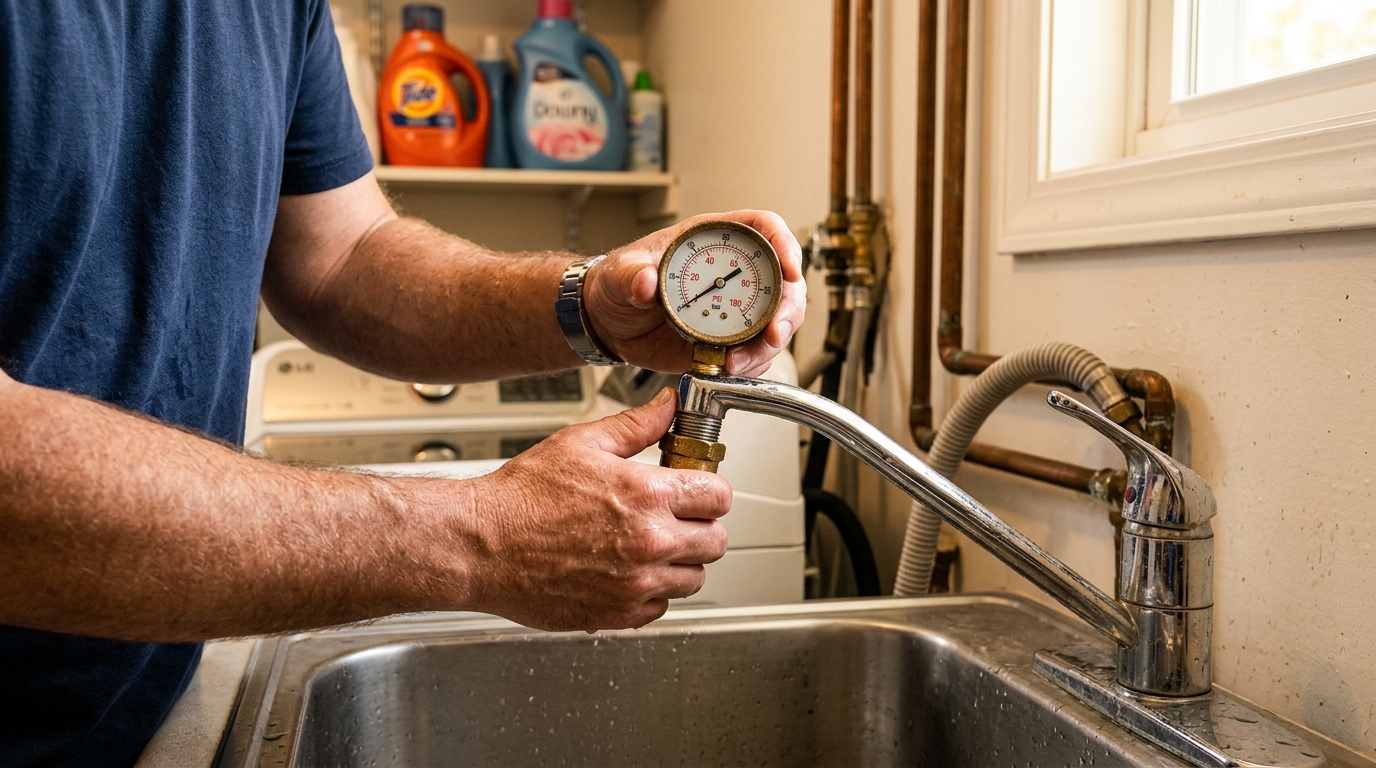
- Screw the gauge firmly onto the hose bib by hand. You do not need thread tape for a quick test, but snug it until there is no gap.
- Fully open the hose bib valve and read the gauge immediately. A healthy static pressure reading is 40 to 60 PSI. Readings above 80 PSI require action. Readings below 40 PSI warrant further investigation.
- Note the reading, the time of day, and whether it felt like water pressure was high or low in your home lately. Take a second reading at a different time of day to check for variation.
- Gather your tools: a quality glycerin-filled pressure gauge (more stable than dry gauges), thread seal tape, a notebook or phone for logging, and optionally a pressure logging gauge ($40 to $60) that records min and max pressure over 24 hours.
- Locate your PRV. It is typically a bell-shaped brass device on the main water line just inside where it enters the home, often near the water meter or in a basement. If you have no PRV and your pressure is above 80 PSI, skip to step 6.
- Test pressure at three points: the main hose bib nearest the meter, an indoor bathroom faucet supply stop, and a hose bib at the farthest point from the meter. Label each reading. A pressure drop of more than 10 PSI between the meter-side bib and indoor points suggests pipe restriction or a PRV set too low.
- Record readings at three times: early morning (5 to 7 AM) when municipal pressure peaks, midday, and evening. Log all readings in a table. If your morning static pressure exceeds 80 PSI, you need a PRV installed or your existing one adjusted.
- Perform a static leak test: close the main shutoff, mark the pressure gauge reading, wait 30 minutes with nothing running, and recheck. A pressure drop of more than 5 PSI with the main on and all fixtures off indicates a leak somewhere in the system.
- If pressure exceeds 80 PSI, locate the PRV adjustment screw under the locking nut on top of the valve. Turning it clockwise increases pressure, counterclockwise decreases it. Adjust in small quarter-turn increments and retest. Target 55 to 60 PSI. If the PRV does not respond or you cannot locate one, contact a licensed plumber for installation or replacement.
- Contact two or three licensed plumbers and share your pressure readings. Ask specifically for a PRV installation or replacement quote and confirm they will test pressure before and after the work.
- Ask the plumber whether your water heater is on a closed plumbing system. If it is, a PRV installation must be paired with a thermal expansion tank to prevent pressure buildup from heated water, which is required by code in most jurisdictions.
- Have the plumber install the PRV on the main supply line immediately after the main shutoff valve and before any branch lines. Confirm the target set point of 55 to 60 PSI in writing before work begins.
- After installation, ask the plumber to demonstrate how to adjust the PRV and provide the location of the adjustment screw for future tuning.
- Test pressure yourself with your gauge one week after installation, once at peak morning hours, to verify the PRV is holding the set point under real municipal pressure fluctuations.
Why It Works: The Benefits
Residential water damage claims average $11,000 per incident according to the Insurance Information Institute. Identifying and correcting high pressure before a failure is a $10 investment against a five-figure repair bill.
Reducing pressure from 100 PSI to 60 PSI can extend the service life of washing machines, dishwashers, and water heaters by 20 to 40%, deferring replacement costs of $600 to $1,500 per appliance.
Flow rate increases roughly in proportion to pressure. Dropping from 100 PSI to 60 PSI can reduce water consumption by 10 to 15%, translating to $50 to $150 per year for a typical household.
A pressure test done with all fixtures closed can reveal hidden leaks. If pressure drops steadily over 30 minutes with nothing running, water is escaping somewhere, allowing you to find and fix a small leak before it causes mold or structural damage.
Some home inspectors and insurers flag homes without a functional PRV as a liability. Documenting that your pressure is within the 40 to 80 PSI safe range can simplify inspections and protect your coverage.
💰 Savings Impact by Action
Reducing pressure from 100 PSI to 60 PSI cuts household water consumption by approximately 10 to 15% since flow rate scales with pressure at every fixture.
Operating appliances within their rated pressure range extends service life by up to 30%, deferring $600 to $1,500 replacement costs per major appliance.
Homes with regulated pressure below 60 PSI experience supply line and valve failures at roughly 40% lower rates than unregulated high-pressure homes according to plumbing industry data.
Proper pressure regulation reduces thermal expansion stress on water heater tanks and fittings, extending average water heater life by 2 to 4 years on a typical 8 to 12 year unit.
🏠 Key Concepts Explained
The Science Behind It
Water pressure in a municipal supply system is maintained by elevated storage tanks or pumping stations that must serve the highest-demand periods of the day. During off-peak hours, typically late night through early morning, those same pumps keep pushing against low demand, and pressure in the distribution pipes climbs. Your home sits at the end of that system and receives whatever pressure the street main delivers, minus losses from pipe friction and elevation. Without a PRV, that full fluctuating pressure is transmitted directly to every fitting, valve stem, and appliance connection in the house.
The physics of pressure stress on plumbing components follow a simple principle: stress is proportional to pressure. A braided stainless steel washing machine hose rated at 150 PSI burst pressure sounds robust, but repetitive cycling between 40 PSI and 100 PSI stresses the crimp fittings at each end through fatigue, not single-event failure. The same applies to the rubber washers in compression faucets and the solenoid valve seals in dishwashers. These components are designed around the assumption of normal operating pressure (40 to 60 PSI), and every PSI above that range accelerates the degradation curve. Studies of residential plumbing failures consistently show homes with unregulated pressure above 80 PSI have significantly higher rates of supply line and valve failures within 10 years.
Water hammer compounds the problem. When a solenoid valve in a washing machine or dishwasher snaps closed in milliseconds, the column of moving water behind it cannot stop instantly. The kinetic energy converts to a pressure spike at the valve, often measured at 3 to 5 times the static supply pressure. At 80 PSI static supply, that spike can briefly reach 240 to 400 PSI at the valve, well above the rated capacity of standard residential fittings. Installing water hammer arrestors at appliance connections and maintaining static pressure below 60 PSI together reduce these spikes to safe levels, protecting both the pipes and the appliances they serve.
Frequently Asked Questions
▼ My pressure reads over 100 PSI but I have never had any problems. Do I really need to fix this?
High pressure damage is cumulative and often invisible until something fails. At 100 PSI, your supply lines, valve seals, and appliance solenoids are under constant stress that shortens their usable life, even if nothing has visibly broken yet. The average washing machine hose failure causes $5,000 to $8,000 in water damage according to insurance industry data, so addressing pressure now is far cheaper than reacting to a failure later.
▼ My pressure gauge reads differently depending on the time of day. Which reading should I trust?
Trust the highest reading you capture, especially any early morning reading between 5 and 7 AM. That peak number is the maximum stress your pipes experience regularly, and it is the number that matters most for evaluating damage risk. Log readings at three different times over two days and use the highest value as your true baseline.
▼ I turned the PRV adjustment screw and nothing changed. What is wrong?
A PRV that does not respond to adjustment is likely worn out or internally corroded, which is common in valves older than 10 to 12 years. Do not force the adjustment screw further since you risk cracking the valve body. Call a licensed plumber to assess replacement. A new PRV typically costs $250 to $400 installed and will restore proper pressure control immediately.
▼ My pressure is low (below 40 PSI). Will a PRV make it worse?
Yes. A PRV is designed to reduce pressure, not increase it. If your static pressure is already below 40 PSI, the problem is a restriction or supply issue, not a regulation problem. Check that the main shutoff valve is fully open, verify the municipal meter valve is fully open, and look for signs of corroded galvanized pipes. A plumber can use a flow test to determine whether the restriction is on the street side or your side of the meter.
▼ Can I test water pressure in an apartment or condo?
Yes, with limitations. If you have an outdoor hose bib or a washing machine hookup, you can attach a gauge and test the pressure at your unit. However, you cannot adjust building-wide pressure since that is controlled by the building’s PRV, which is managed by property maintenance. If your reading exceeds 80 PSI, document it with photos and report it to building management in writing, as excessively high pressure in a multi-unit building is a code compliance issue and a shared liability.
Quick Tips
- Write your pressure reading and date on a piece of tape and stick it near the water meter or PRV so future owners or plumbers have a baseline.
- Check pressure again after any major plumbing work since new fixtures, repipes, or water softener installations can shift your baseline.
- A sudden drop in pressure compared to your baseline reading is often the first sign of a developing leak, even before you see any water damage.
- If you have a well and pressure tank instead of municipal water, your pressure gauge reading will cycle between your tank’s cut-in and cut-out settings, typically 40 to 60 PSI, which is normal behavior.
Variations for Your Situation
- Apartment or Condo: You can still test your unit’s water pressure using a washing machine cold-water valve or bathroom supply stop adapter. If pressure exceeds 80 PSI, report it in writing to building management with your gauge photo as documentation. You cannot legally adjust the building PRV yourself, but property managers are required to maintain safe pressure levels under most local plumbing codes. A point-of-use pressure reducing valve ($25 to $60) can be installed on a washing machine supply line by a handy renter, often without requiring landlord permission since it is not a permanent modification.
- Tight Budget (under $50): A basic dry-dial pressure gauge costs $10 to $12 and is all you need for an accurate static reading. Skip the logging gauge and instead take readings manually at 6 AM, noon, and 8 PM over two days and record them in your phone. If your readings are consistently above 80 PSI and you have a PRV, attempt a careful quarter-turn adjustment with a wrench (counterclockwise to reduce pressure) and retest. This zero-labor approach can bring you into the safe zone for the cost of a gauge alone.
- Older Home (pre-1980): Homes of this age frequently have galvanized steel supply pipes, original PRVs that have never been serviced, or no PRV at all. Start with a pressure test before doing anything else since high pressure in corroded pipes dramatically increases rupture risk. If pressure is high and you have galvanized pipes, prioritize a plumber consultation over DIY PRV adjustment, as agitating corroded fittings can cause immediate failures. Budget $400 to $800 for a PRV replacement and have the plumber inspect accessible pipe sections while they are on site.