Here is a feature built into nearly every ceiling fan ever made that most homeowners never use: a reverse switch. Flip it in winter, and your fan stops blowing a cooling breeze and starts gently redistributing the warm air that pools near your ceiling, right back down to where you actually live. It costs nothing to do and takes about 30 seconds per fan.
Heat rises. That is not just a saying, it is basic thermodynamics. In a room with 9-foot ceilings, the air near the ceiling can be 5 to 10 degrees Fahrenheit warmer than the air at floor level. Your furnace or heat pump is working hard to produce that warmth, and a significant portion of it is sitting useless above your head. A ceiling fan in winter mode acts like a gentle paddle, pushing that stratified warm air back down along the walls without creating a wind chill effect.
In this post, you will learn exactly how to reverse your ceiling fan, how to set the right speed for winter, what to expect in terms of savings, and how to troubleshoot fans that do not seem to be helping. Whether you have one fan in the bedroom or six fans throughout the house, this is one of the easiest wins in home efficiency.
What You’ll Need
Click on an item below to shop for the recommended items for this recipe on Amazon.
As an Amazon Associate, we earn from qualifying purchases.
How to Do It
- Turn the ceiling fan completely off and wait for the blades to stop spinning. Never switch direction while the fan is running, as this can damage the motor.
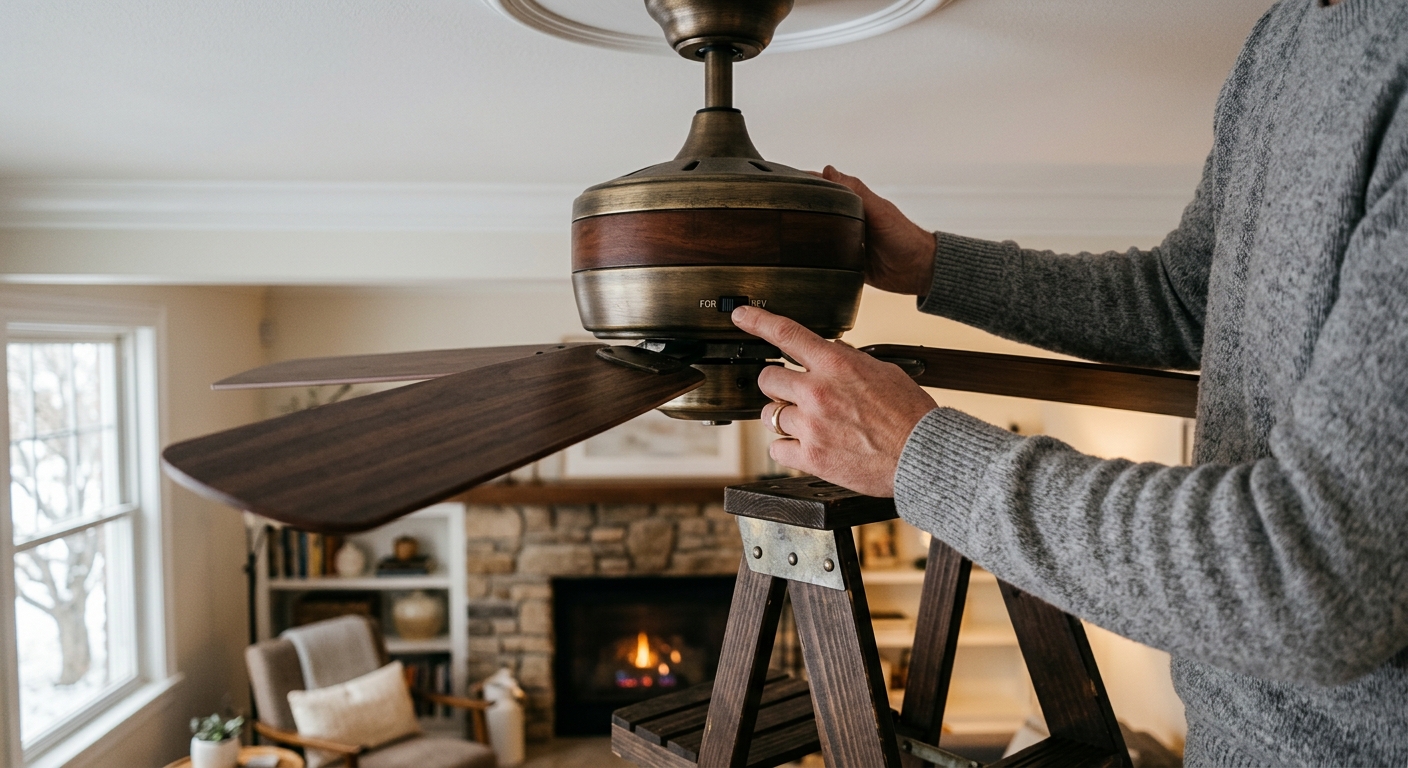
- Locate the small direction switch on the motor housing, the cylindrical body of the fan just above the blades. It is typically a small slide switch or toggle, often labeled with arrows or ‘Forward’ and ‘Reverse’.
- Slide or flip the switch to the opposite position from its current setting. On most fans, the winter (clockwise) position is marked or described in the owner’s manual.
- Turn the fan back on and set it to the lowest speed setting. From below, the blades should now appear to spin clockwise when you look up at the fan.
- Stand beneath the fan for 30 seconds. You should feel little to no direct breeze. If you feel a strong downward draft, the speed is too high or the fan may still be in summer mode.
- Repeat for every ceiling fan in the home. Rooms you occupy most often during winter will deliver the most noticeable comfort improvement.
- Turn off power to the ceiling fan at the circuit breaker, not just the wall switch. Verify power is off using a non-contact voltage tester before touching any wiring.
- Remove the existing wall switch or fan canopy cover (depending on your fan model) to access the wiring. Take a photo of existing wire connections before disconnecting anything.
- Install a compatible smart fan switch or universal ceiling fan remote receiver kit according to manufacturer instructions. Most kits include a receiver that mounts inside the fan canopy and pairs with a handheld remote or app.
- Restore power at the breaker and pair the remote or app with the receiver following the included instructions. Test all speed settings and confirm the reverse function works from the remote.
- Set a recurring reminder on your phone for early November and early April to switch fan direction seasonally. Label the fan direction in the app if your smart system supports it.
- Confirm winter operation by standing beneath each fan on low: air should circulate gently without a felt draft at face level. Adjust speed down if any breeze is detectable.
- Walk through every room and document each ceiling fan: note whether it has a reverse switch, its size relative to the room, and its ceiling height. Fans without a reverse switch cannot be used in winter mode and may need replacement.
- For rooms with vaulted or cathedral ceilings over 10 feet, prioritize fan reversal first since stratification is most severe there. These rooms have the highest savings potential.
- Reverse all fans that have a direction switch using the manual method in Approach 1. Mark each switch position with a small piece of labeled tape so the winter setting is clearly identified for future seasons.
- For any fans without a reverse function, budget $60 to $150 for a replacement fan that includes winter mode. In high-ceiling rooms, look for fans with a downrod length appropriate for your ceiling height so the blades sit 8 to 9 feet above the floor.
- After switching all fans to winter mode, wait two weeks and check your thermostat comfort level. If rooms feel warmer at seated height, try reducing your thermostat setpoint by 1 to 2 degrees and note the change in your heating bill.
- Log the date and fan settings in a notes app or home maintenance document so next season you can reverse all fans in one efficient pass.
Why It Works: The Benefits
The U.S. Department of Energy estimates that using ceiling fans in winter mode can reduce heating costs by up to 15%. In a home spending $150 per month on heating, that is a savings of up to $22 per month with no equipment purchase required.
Redistributing warm air from ceiling to floor level can raise floor and seated-height temperatures by 2 to 4 degrees Fahrenheit, making rooms feel noticeably warmer without turning up the thermostat.
Because rooms feel warmer at occupant level, most households can comfortably lower their thermostat by 2 to 3 degrees in rooms with active ceiling fans, amplifying fuel savings beyond the fan effect alone.
Whether you heat with a gas furnace, heat pump, electric baseboard, or wood stove, ceiling fan reversal reduces heat loss to the ceiling zone and improves heat distribution, benefiting all heating types equally.
Every ceiling fan with a reverse function already has this feature built in. The only cost is the minimal electricity to run the fan on low speed, typically less than $2 per month per fan.
💰 Savings Impact by Action
Switching fans to clockwise low-speed operation in winter can reduce heating bills by up to 15% by redistributing stratified warm air back to occupant level.
Lowering the thermostat setpoint by 2 degrees Fahrenheit (made comfortable by better air distribution) saves approximately 4 to 6% per degree, totaling about 10% for a 2-degree reduction.
Rooms with ceilings above 12 feet experience greater thermal stratification and can see heating energy reductions of up to 20% with consistent winter fan use.
A ceiling fan running on low speed consumes only 15 to 30 watts, adding roughly 2% or less to your electricity use while offsetting far more in heating costs.
🏠 Key Concepts Explained
The Science Behind It
The physics behind ceiling fan winter mode comes down to air density and convection. Warm air is less dense than cool air, so it rises to the top of any room regardless of how it was heated. This process, called thermal stratification, creates distinct temperature layers, with the warmest air near the ceiling and the coolest air near the floor. Your heating system’s thermostat is typically mounted at about 5 feet, measuring mid-room air, while the warmest air in the room sits 3 to 5 feet above that point doing nothing useful.
When a ceiling fan spins clockwise at low speed (viewed from below), it does not push air straight down the way counterclockwise summer operation does. Instead, it pulls air upward through the center of the fan and redirects it outward and downward along the walls. This creates a gentle circulation loop that continuously mixes ceiling-level warm air with floor-level cool air without producing a wind chill effect on occupants. The result is a more uniform temperature from floor to ceiling, often reducing the top-to-bottom differential from 8 or 10 degrees down to 2 or 3 degrees.
This destratification effect means the air at thermostat height becomes warmer, so the heating system satisfies its setpoint sooner and cycles off more quickly. Studies from the Florida Solar Energy Center and DOE modeling both support heating bill reductions of 5 to 15% when fans are used correctly in winter mode. The fan itself consumes only 15 to 30 watts on low speed, a negligible cost compared to the furnace or heat pump energy it offsets by shortening run times.
Frequently Asked Questions
▼ I reversed my ceiling fan but the room still feels cold near the floor. What am I doing wrong?
The most common cause is running the fan too fast, which creates a downdraft and wind chill that counteracts the destratification benefit. Switch to the lowest speed setting and give the fan 15 to 20 minutes to mix the room air before evaluating. If the room has poor insulation or significant drafts from windows or doors, the fan will help but cannot fully compensate for those heat losses.
▼ My ceiling fan does not have a reverse switch. Can I still use it in winter?
If there is no direction switch on the motor housing and no reverse option in the remote or app, the fan cannot be reversed and should be turned off in winter to avoid the cooling effect. Replacement fans with reverse functions start around $60 to $80 at home improvement stores and are worth the upgrade, especially in rooms with high ceilings where stratification is significant.
▼ How long before I see a difference on my heating bill?
You should notice a comfort improvement, specifically warmer air at seated and floor level, within 15 to 30 minutes of switching to winter mode on low speed. The savings on your heating bill will show up within one billing cycle, typically 30 days, and will be most apparent if you compare your usage against the same month last year while accounting for similar outdoor temperatures.
▼ Can I run ceiling fans in winter mode all night while sleeping?
Yes, and many homeowners find it helps maintain more even bedroom temperatures overnight, especially in rooms with vaulted ceilings. Keep the fan on the lowest speed to avoid any perceptible airflow on sleeping occupants. If anyone in the room is sensitive to air movement, position the bed away from directly below the fan.
▼ Does this work with a wood stove or fireplace that heats unevenly?
Yes, and it is especially effective in these situations. Wood stoves and fireplaces create intense heat near the source that rises sharply and pools at the ceiling. A ceiling fan in winter mode is one of the best ways to spread that heat more evenly through the room and into adjacent spaces. Run the fan in the same room as the stove on low speed for noticeably more even warmth distribution.
Quick Tips
- Set a phone reminder every November 1 and April 1 to switch all fan directions. It takes less than 10 minutes for an entire home and pays back immediately.
- In rooms with very high ceilings (over 12 feet), consider running the fan on the second-lowest speed instead of the absolute lowest. Greater ceiling height means more stratification to overcome.
- If you are unsure which direction is winter mode, hold a tissue or light piece of paper below the fan on low. If it blows directly down toward you, the fan is in summer mode. If the air movement is gentle and comes from the sides rather than straight down, you are in winter mode.
- Ceiling fans in rooms you do not occupy do not need to run. Fans move air, not heat. Only run fans in rooms where people are present.
Variations for Your Situation
- Apartment/Rental: Reversing a ceiling fan direction requires no modification and no landlord permission since it uses a built-in switch on the fan itself. If your apartment has ceiling fans, switch them to clockwise on low every winter at no cost. If you want remote control convenience, a plug-in universal remote receiver kit ($20 to $35) can be added without permanent wiring changes in most fan models.
- Tight Budget (under $50): The manual switch reversal costs absolutely nothing and delivers the full benefit. Focus on reversing every fan in rooms you heat and occupy, and combine this with lowering your thermostat 2 degrees to amplify savings. Total cost is zero, and the heating bill impact is measurable within a single billing cycle.
- Older Home (pre-1980): Older ceiling fans may lack a reverse switch entirely, or the switch may be worn and difficult to engage. If the fan predates 1990, check whether it wobbles or makes motor noise before using it in any mode. A loose or unbalanced older fan poses a safety hazard. Replacement fans with modern motors, reverse functions, and better energy efficiency start around $60 to $80 and are a worthwhile upgrade in rooms you heat regularly.