If your radiators are cold at the top but warm at the bottom, or you hear gurgling and banging sounds when the heat kicks on, trapped air is likely the culprit. Air naturally accumulates inside hydronic (hot water) radiators over time, creating air pockets that block hot water from circulating properly. The result is uneven heat, rooms that never quite warm up, and a boiler straining to compensate.
The fix is called bleeding, and it is one of the simplest, highest-payoff maintenance tasks a homeowner can do. By releasing that trapped air, you restore full water circulation through the radiator, letting it reach its full heat output. According to the UK Energy Saving Trust and various HVAC professionals, air-locked radiators can reduce system efficiency by 10 to 15%, which translates directly into higher gas or oil bills every single month.
This guide walks you through bleeding a radiator safely and correctly, whether you have a single problem unit or a whole house to service. You will also learn when bleeding alone is not enough and what signs point to a bigger system issue worth calling a professional about.
What You’ll Need
Click on an item below to shop for the recommended items for this recipe on Amazon.
As an Amazon Associate, we earn from qualifying purchases.
How to Do It
- Turn your heating system on and let it run for 10 to 15 minutes so you can identify which radiators are cold at the top or warm only at the bottom.
- Turn the heating OFF and let the system cool for 20 to 30 minutes. Never bleed a hot system as scalding water can spray from the valve.
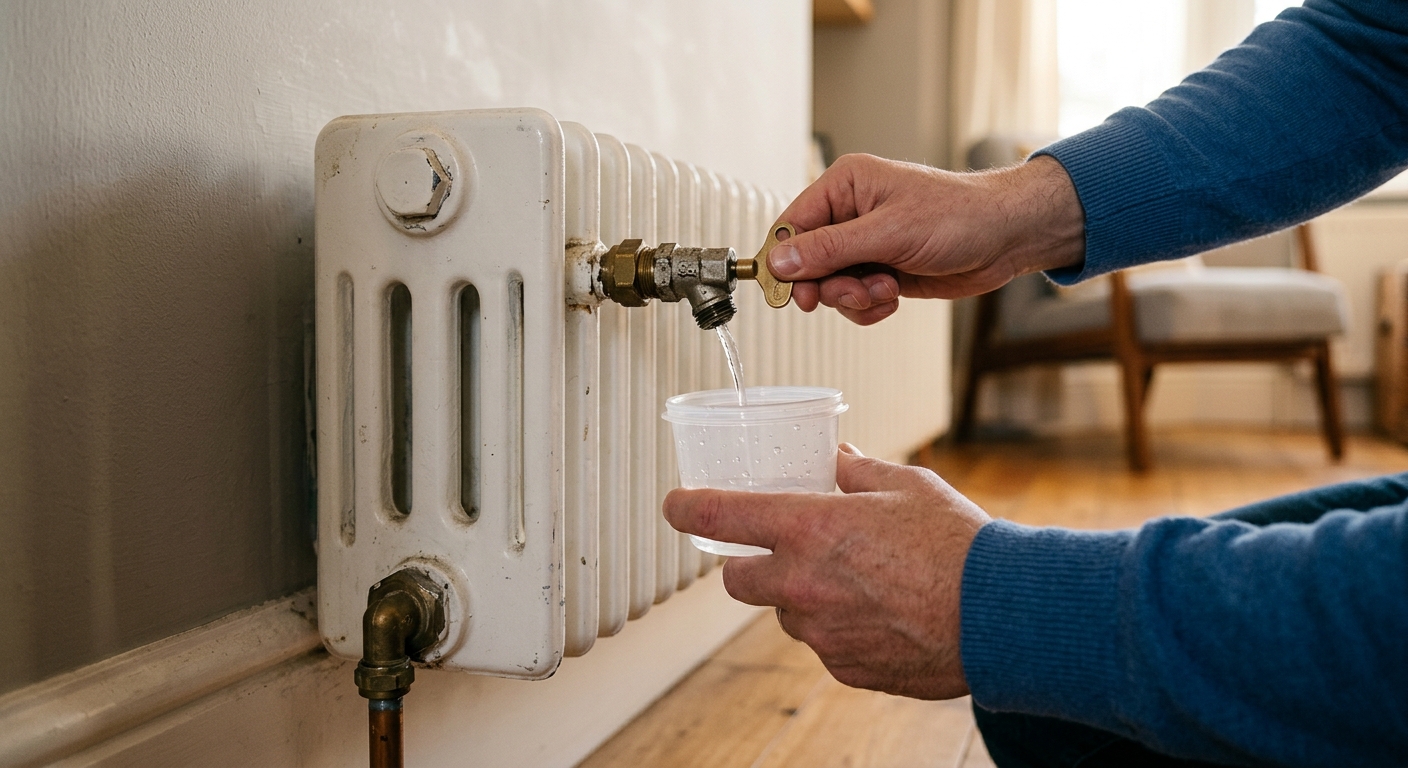
- Locate the bleed valve on the radiator, typically a small square or slotted valve at the top corner, and hold a cloth or small container underneath it to catch any water drips.
- Insert a radiator bleed key (or a flat-head screwdriver on some models) and turn counter-clockwise by one quarter turn only. You will hear a hissing sound as air escapes.
- Hold the cloth steady and wait until the hissing stops and a steady stream of water begins to trickle out. This means the air pocket is fully cleared. Close the valve by turning clockwise until snug but do not over-tighten.
- Restart the heating and check your boiler pressure gauge. If it has dropped below 1 bar, top up the system pressure using the boiler filling loop until it reads 1.0 to 1.5 bar.
- Purchase a radiator bleed key set and a small bottle of central heating inhibitor fluid (available at hardware stores for $10 to $20) before starting.
- Turn on the heating and note every radiator that feels cold at the top, makes noise, or heats unevenly. Write down the rooms so you work methodically.
- Turn the heating OFF and wait 30 minutes. Start on the ground floor and work your way up, as air migrates to the highest points in the system.
- Bleed each radiator in sequence: hold a cloth under the valve, open one quarter turn counter-clockwise, wait for hissing to stop and water to appear, then close the valve firmly.
- After bleeding all radiators, check the boiler pressure gauge. Re-pressurize via the filling loop if the pressure is below 1 bar, adding water slowly until the gauge reads 1.2 bar.
- Add the manufacturer-recommended dose of central heating inhibitor through the feed-and-expansion tank or a radiator bleed point to reduce future corrosion and air buildup. Restart the heating and verify all radiators warm evenly within 20 minutes.
- Call a licensed HVAC or plumbing technician and describe the symptoms: recurring air buildup, radiators that stay cold even after bleeding, or dark brown water when bleeding.
- The technician connects a power flushing machine to the system, which forces a high-velocity mix of water and chemical cleaner through each radiator to dislodge sludge and corrosion.
- Each radiator is isolated and flushed individually, then the entire loop is rinsed with clean water until it runs clear, typically taking 4 to 8 hours for a full home.
- The technician then refills the system with fresh water and adds a full dose of corrosion inhibitor and, if appropriate, a scale reducer for hard water areas.
- Request a written pressure and efficiency check before the technician leaves to confirm the system is operating at design specifications and document the baseline for future maintenance.
Why It Works: The Benefits
Restoring full radiator circulation can reduce heating energy consumption by 10 to 15%, with savings appearing on the very next monthly bill after the fix.
Once air locks are cleared, hot water reaches the entire radiator surface, eliminating cold spots and delivering consistent warmth from floor to ceiling.
A boiler no longer working against air resistance runs fewer unnecessary cycles, reducing wear on the pump, heat exchanger, and controls, which can extend service life by years.
Gurgling, banging, and knocking sounds caused by air and water turbulence disappear almost immediately after bleeding, making the heating system noticeably quieter.
A properly bled system allows the boiler to operate closer to its rated efficiency, which for modern condensing boilers is 90% or higher, instead of falling well below that due to circulation problems.
💰 Savings Impact by Action
Clearing air locks restores full radiator output, reducing boiler run time by 10 to 15% for the same room temperature.
Adding corrosion inhibitor slows internal sludge buildup, maintaining system efficiency and reducing annual heat loss by roughly 5%.
A professional power flush on a heavily sludged system can recover up to 25% of lost heating output compared to the degraded baseline.
Combining yearly bleeding, inhibitor top-up, and boiler servicing maintains near-design efficiency and avoids cumulative losses of 10% or more.
🏠 Key Concepts Explained
The Science Behind It
Hot water heating systems work by circulating water heated by a boiler through a closed loop of pipes and radiators. The radiator transfers that heat to the surrounding room air through a combination of radiation and convection. For this to work efficiently, every square inch of the radiator’s internal surface needs to be in contact with hot water. When air infiltrates the loop, it rises to the top of the radiator because air is roughly 800 times less dense than liquid water. That air pocket sits at the top of the radiator and acts as an insulating barrier, leaving that portion of the unit cold while water circulates only through the lower section.
The air does not appear out of nowhere. Some enters the system when it is first filled or re-pressurized. More is generated over time through corrosion: when oxygen in the water reacts with steel radiator panels and cast iron components, it produces iron oxide (rust) and hydrogen gas. This is why a well-maintained system with proper inhibitor levels generates far less air over time. The inhibitor creates a protective coating on metal surfaces that slows the corrosion reaction, reducing hydrogen production and extending the time between bleedings.
When air displaces water in the system, the boiler has to fire longer to compensate for reduced heat delivery to the room. Studies from the Chartered Institution of Building Services Engineers estimate that a system with significant air locking can lose 10 to 15% of its effective heating output, meaning the boiler burns that much more fuel to maintain the same thermostat setpoint. Bleeding restores full water contact with the radiator surface, recovering that lost output without burning any additional fuel.
Frequently Asked Questions
▼ I bled my radiator but it is still cold at the top. What is wrong?
If no air came out when you bled it, the bleed valve itself may be blocked with sludge or corrosion. Try gently probing the valve opening with a thin pin to clear the port. If the radiator is warm at the bottom but still cold at the top after a confirmed bleed, a heavy sludge deposit may be blocking internal circulation, which requires a power flush rather than bleeding.
▼ My boiler pressure keeps dropping after I bleed the radiators. Is something wrong?
A small pressure drop after bleeding is normal because you released water along with the air. Top up the system using the filling loop until the gauge reads 1.0 to 1.5 bar. If the pressure keeps dropping on its own over days or weeks without bleeding, you likely have a slow leak somewhere in the system or a faulty pressure relief valve, and you should call a plumber to locate it.
▼ How often should I bleed my radiators?
For most homes, once per year at the start of the heating season is sufficient. If your system has older steel radiators or you have recently had work done on the pipework that allowed air in, you may need to bleed twice a year. Needing to bleed more frequently than that suggests a corrosion or inhibitor problem worth investigating.
▼ Can I bleed a radiator if I have an older gravity-fed system with a header tank in the loft?
Yes, but gravity-fed open-vented systems work differently from pressurized sealed systems. You do not need to worry about re-pressurizing afterward since the header tank automatically refills the system. Check that the header tank in the loft has water in it after bleeding to confirm normal operation.
▼ Water came out black when I bled my radiator. Should I be worried?
Dark or black water indicates significant sludge and corrosion inside the system, which is a common issue in homes over 20 years old. Stop bleeding and do not force more of this water through the boiler, as it can clog the heat exchanger. Contact an HVAC technician to assess whether a power flush and inhibitor treatment are needed.
Quick Tips
- Check all radiators for uneven heating at the start of each heating season, typically in October, before you really need the heat.
- If the same radiator needs bleeding every few weeks, test your system’s inhibitor concentration with a cheap test strip kit available at plumbing supply stores.
- Thermostatic radiator valves (TRVs) do not affect bleeding but set them to maximum temporarily when testing if a radiator is heating fully after the bleed.
- Keep a bleed key taped to the back of each radiator with a small piece of electrical tape so it is always on hand when you need it.
Variations for Your Situation
- Apartment or Rental: If you have individual radiators in an apartment, check with your landlord or building manager before bleeding, as the system may be pressurized and centrally maintained. In many cases, property managers are required to handle this for you. If allowed, the quick bleed approach applies exactly the same way, but report any pressure drops or recurring issues to the building manager rather than attempting to re-pressurize a shared system yourself.
- Tight Budget (under $25): The only tool you truly need is a radiator bleed key, available for $3 to $5 at any hardware store. The entire quick bleed approach costs nothing beyond that. Skip the inhibitor for now but note that adding it (roughly $10 to $15 per bottle) once a year will reduce how often you need to bleed and protect your radiators from internal corrosion long-term.
- Older Home (pre-1980): Homes with original cast iron radiators often have bleed valves that have not been turned in decades and may be seized or corroded. Apply a small amount of penetrating oil around the valve the night before and attempt to open it very gently the next day. If the valve will not budge or begins to crack, stop immediately and call a plumber to replace just the valve, which typically costs $50 to $150, before attempting to bleed the radiator.