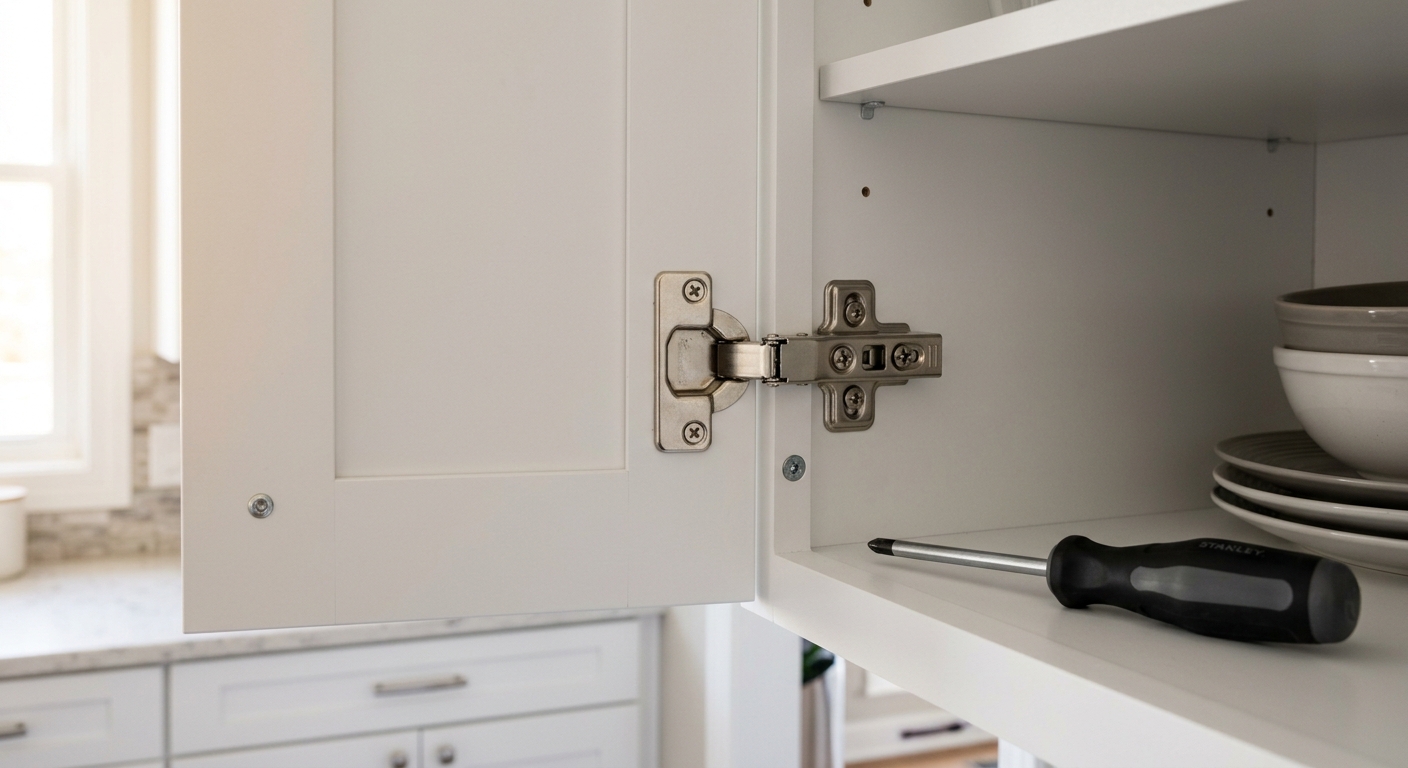
If your cabinet doors are crooked, won’t close all the way, or leave gaps that drive you crazy every time you open the kitchen, you are not alone. Cabinet hinges shift over time due to daily use, humidity changes that cause wood to expand and contract, and the simple physics of gravity pulling on door weight. What looks like a carpentry problem is almost always just a matter of turning a few screws.
The good news is that the vast majority of kitchen and bathroom cabinets installed in the last 30 years use adjustable European cup hinges, also called concealed hinges. These hinges are specifically designed to be fine-tuned after installation, and they allow movement in three directions: side to side, up and down, and in and out. No special tools, no cabinet removal, and no contractor needed.
This guide walks you through exactly how to identify your hinge type, which screw does what, and how to get every door on your cabinets hanging straight and closing cleanly. Whether you have one stubborn door or an entire kitchen that has drifted over the years, you will have everything dialed in within an afternoon.
What You’ll Need
Click on an item below to shop for the recommended items for this recipe on Amazon.
As an Amazon Associate, we earn from qualifying purchases.
How to Do It
- Open the cabinet door and locate the two hinges. Each hinge has a cup side mounted to the door and a mounting plate side attached to the cabinet frame. You will see two or three screws on the arm of the hinge.
- Identify the problem before touching anything. Close the door and look at the gap around it. A gap that is larger on one side than the other means the door needs lateral adjustment. A door sitting too high or too low compared to neighboring doors needs vertical adjustment. A door that sticks out or sits recessed at the front needs depth adjustment.
- For lateral adjustment (door too far left or right), use a Phillips screwdriver to turn the side adjustment screw, typically the middle screw on the hinge arm. Turn clockwise to move the door in one direction and counterclockwise for the other. Make a quarter-turn, close the door, and check. Repeat until the gap is even.
- For depth adjustment (door sticks out or sits inset), turn the screw closest to the cabinet frame, usually the rearmost screw on the arm. This moves the door in or out from the cabinet face. Again, work in quarter-turns and check after each adjustment.
- For vertical adjustment, slightly loosen both screws on the mounting plate attached to the cabinet frame, slide the entire hinge up or down along the slotted holes, and retighten. Most plates allow 2 to 4mm of travel this way.
- Once the door looks aligned, open and close it five times to confirm it swings smoothly, does not rub, and latches fully. Check the gap consistency around all four edges before moving to the next door.
- Buy a thin plastic or metal feeler gauge, or use three stacked business cards (approximately 1mm thick) as a consistent gap reference. A uniform gap of 1 to 2mm around every door is the target for full-overlay cabinets.
- Start at one end of the kitchen and work systematically across. Number your doors with small pieces of painter’s tape so you can track which ones you have finished and which still need work.
- Tighten all mounting plate screws first on every hinge throughout the kitchen before making any alignment adjustments. Loose mounting plates cause doors to drift, and tightening them may resolve some issues without further adjustment.
- Adjust each door using the three-screw method from the Quick Fix approach, but use your feeler gauge or card stack to verify consistent gaps rather than eyeballing it. Check the gap at the top, bottom, and both sides of each door.
- If a screw spins freely without gripping, the wood around it has stripped. Fill the hole with wooden toothpicks and a small amount of wood glue, let it dry for one hour, then retighten the screw. This restores a solid anchor point without replacing the hinge or cabinet.
- Once all doors are adjusted, check that adjacent door pairs meet evenly in the middle without overlapping or leaving a wide center gap. Make final micro-adjustments using the lateral screw on one or both doors until the pair looks symmetrical.
- Do a final walk-through one week later after normal use, since doors sometimes shift slightly once back in daily service. A quick five-minute re-check and tighten after the first week locks in the alignment reliably.
- Identify whether the hinge cup itself has torn out of the door face. This leaves a visible hole or crack in the door panel and cannot be fixed by screw adjustment alone. A pro will fill and redrill or replace the door panel.
- Check if the cabinet frame side is damaged by looking for cracks, delamination, or a mounting plate that tilts rather than sitting flat. Particleboard cabinet frames are especially prone to this, and repair requires wood hardener, epoxy filler, or a new mounting location.
- If doors are visibly bowed or warped rather than just shifted, no amount of hinge adjustment will create an even gap. A cabinet professional can assess whether the door can be replaced under warranty or at a reasonable parts cost, typically $40 to $150 per door.
- Request that the professional also check all soft-close mechanisms if present. Worn soft-close dampers can cause doors to bounce back instead of closing fully, mimicking a misalignment problem. Replacement dampers cost $3 to $8 each and take five minutes to swap.
- Ask for a written summary of every adjustment made and any hardware replaced so you have a record for future maintenance or a home sale disclosure.
Why It Works: The Benefits
Adjusting hinges yourself eliminates the need for a handyman visit, which typically costs $75 to $200 for a basic cabinet adjustment call, with no parts needed in most cases.
Doors that close properly put even stress on hinge hardware and reduce wear on door edges and frames. Misaligned doors that rub or slam can damage finish and cabinet boxes over time, leading to repairs costing $50 to $300 per cabinet.
Doors that close completely keep dust, grease, and cooking odors out of cabinet interiors, protecting stored items and reducing the frequency of interior cleaning.
Real estate professionals note that cosmetic details like crooked cabinet doors can reduce a buyer’s perceived value of a kitchen. Aligned cabinets contribute to the polished look that supports higher offers.
Once you understand the three-screw system, you can adjust any European hinge in your home in under 5 minutes, eliminating this recurring task from your handyman call list permanently.
💰 Savings Impact by Action
Doing this yourself eliminates a $75 to $200 handyman service call, saving 100% of that cost since no parts are needed in most cases.
Properly aligned doors reduce stress on hinge pivot points and door edges, extending hardware life by an estimated 30 to 40% compared to doors that rub or slam regularly.
Correcting misalignment prevents finish wear and frame damage that leads to cosmetic repairs costing $50 to $300 per cabinet, avoiding roughly 25% of typical cabinet maintenance costs over a decade.
🏠 Key Concepts Explained
The Science Behind It
European concealed hinges use a three-axis adjustment system rooted in simple mechanical engineering. The cup sits in a precisely drilled 35mm hole in the door, and the arm connects to a mounting plate on the cabinet frame via a pivot point. Each adjustment screw either shifts the arm laterally using an eccentric cam, changes the depth by moving the arm closer to or further from the hinge cup pivot, or allows vertical sliding via slotted mounting holes. Small rotations at the screw translate to precise, small movements at the door face, giving you millimeter-level control.
Wood’s hygroscopic nature is the main reason hinges drift in the first place. Wood absorbs and releases moisture based on indoor humidity, and in a typical home the relative humidity swings from around 25 to 30 percent in winter to 60 to 70 percent in summer. This causes cabinet frames and doors to expand and contract, sometimes by several millimeters across a full cabinet run. Over years of seasonal cycling, screws loosen slightly, wood fibers around anchor points compress, and doors gradually shift out of the alignment they had when the cabinets were installed.
The soft-close mechanism found on most modern cabinet hinges is a hydraulic or oil-filled damper built into the hinge arm. As the door approaches closed, the damper creates resistance that slows the door and prevents slamming. When this damper wears out, it either loses resistance (door slams again) or seizes (door feels stiff or stops short of fully closing). This is a separate component from the alignment screws, which is why a door can be perfectly aligned but still not close properly if the soft-close mechanism has failed.
Frequently Asked Questions
▼ I turned the adjustment screws but the door is not moving at all. What is wrong?
The screw may be stripped, or the cam mechanism inside the hinge may be worn out or seized. Try turning the screw in the opposite direction first to see if it engages. If the screw spins freely with no resistance in either direction, the hinge needs replacement. European hinges cost $3 to $8 each at any hardware store and swap out in about 10 minutes.
▼ My cabinet door closes but then swings back open on its own. How do I fix that?
This is almost always a worn or failed soft-close damper rather than a hinge alignment problem. Check whether the hinge arm has a small built-in damper cylinder, which is a standard feature on most hinges made after 2010. If the damper no longer creates resistance, replace the hinge or buy a separate add-on soft-close adapter for about $4 to $6 per hinge. Also check whether the magnetic or roller catch on the cabinet frame is missing or broken, as a missing catch on non-soft-close cabinets will cause the same symptom.
▼ My cabinet doors were fine and then all shifted at once after winter. Is something seriously wrong?
This is normal seasonal wood movement and not a structural issue. When your home’s humidity drops in winter, wood dries and shrinks, which can shift an entire cabinet run by 1 to 3mm. The fix is the same lateral and vertical hinge adjustment described in this guide. To reduce how much this happens year to year, maintain indoor relative humidity between 40 and 50 percent with a humidifier during heating season.
▼ Can renters adjust cabinet hinges without landlord permission?
Yes. Adjusting European hinges requires no drilling, no modification, and no permanent change to the cabinet. You are simply turning screws that are designed to be turned. This is routine maintenance that falls well within what renters can do in any rental agreement. If you improve the alignment, you are actually protecting the landlord’s property from wear caused by misaligned doors.
▼ One of my hinge mounting screws just spins and will not tighten. How do I fix a stripped screw hole?
Pack the stripped hole with two or three wooden toothpicks and a small drop of wood glue, snap them off flush, and let the glue cure for at least one hour. Once dry, drive the original screw back in and it will grip the new wood fibers solidly. This repair typically holds for years and costs almost nothing. If the cabinet frame material is severely damaged or crumbling particleboard, use a larger screw or call a professional to assess whether the cabinet box needs reinforcement.
Quick Tips
- Take a photo of each hinge before you start adjusting so you have a reference point and can return to the original position if needed.
- Work in good lighting. Use a flashlight or headlamp inside the cabinet to see hinge screws clearly without straining your neck.
- If you have a long run of cabinets, start by aligning the corner or anchor cabinet first, then work outward so adjacent doors are matched relative to a fixed reference point.
- Replace any hinge showing visible rust, cracked plastic components, or a bent arm rather than trying to adjust it. Replacement European hinges cost $3 to $8 each and install in about 10 minutes.
Variations for Your Situation
- Apartment/Rental: Renters can perform all hinge adjustments without permission since no modification is involved. Focus on the Quick Fix approach using just a Phillips screwdriver. If hinges are truly broken, document the damage with photos and notify your landlord in writing, since broken hardware is typically a landlord repair responsibility. Avoid replacing hinges without permission even though it is a simple swap.
- Tight Budget (under $50): The Quick Fix approach is completely free and handles the majority of misalignment issues. If screws are stripped, a box of toothpicks and a bottle of wood glue costs under $5 and fixes most stripped holes. The only spending needed is on replacement hinges if hardware is visibly broken, and a two-pack of quality European hinges costs $6 to $12 at any hardware or home improvement store.
- Older Home (pre-1990): Cabinets from this era often use non-adjustable butt hinges or older surface-mounted hinges with no cam adjustment system. Before attempting any adjustment, identify your hinge type. Butt hinges are flat, rectangular, and visible from the outside when the door is closed. If you have butt hinges, shimming the hinge mortise with thin cardboard or replacing with adjustable European hinges (requires drilling a 35mm cup hole) are your options. European hinge conversion kits are available for $15 to $40 per door and give you modern adjustability in older cabinets.