If you have noticed water pooling around the bottom of your toilet after flushing, or a faint sewage smell that just will not go away, your toilet’s wax ring seal has likely failed. This rubber and wax gasket sits between the toilet base and the floor drain flange, and it is the only thing preventing sewer gases and wastewater from escaping into your bathroom. Over time, the ring dries out, compresses, or shifts – especially if the toilet rocks even slightly – and water starts seeping out with every flush.
Most homeowners ignore this problem for weeks or months, assuming it is minor. It is not. Even a slow leak can saturate the subfloor, trigger mold growth inside the floor cavity, and eventually cause structural rot that turns a $10 repair into a $2,000 to $5,000 subfloor replacement. The EPA estimates that household leaks waste nearly 10,000 gallons of water per year on average, and a leaking toilet base is one of the most overlooked contributors.
The good news: replacing a wax ring is a genuine DIY repair that most homeowners can complete in under two hours with basic tools and about $5 to $15 in materials. This post walks you through diagnosing the problem, choosing the right fix, and doing it correctly the first time – plus what to do if the damage is already done.
What You’ll Need
Click on an item below to shop for the recommended items for this recipe on Amazon.
As an Amazon Associate, we earn from qualifying purchases.
How to Do It
- Dry the toilet base and surrounding floor completely with old towels. Place a few sheets of dry paper towel around the base and flush twice. If the paper towel gets wet, the leak is confirmed at the base seal.
- Try to rock the toilet side to side with your hands. Any movement indicates loose closet bolts, which is the most common cause of wax ring failure.
- Locate the two plastic bolt caps on either side of the toilet base. Pop them off with a flathead screwdriver and check whether the nuts underneath are loose. Tighten them hand-tight plus one quarter turn with an adjustable wrench. Do not overtighten – ceramic cracks.
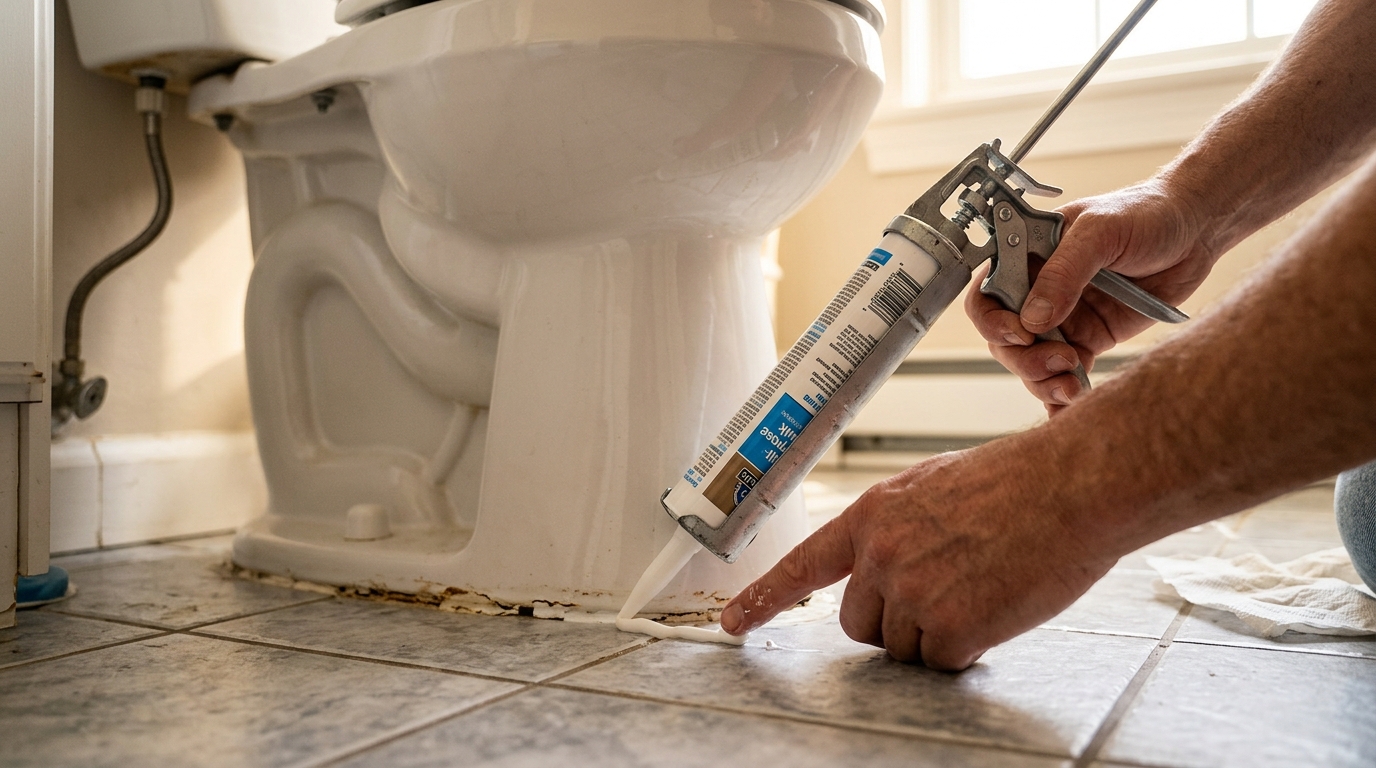
- If the toilet still rocks after tightening, slide plastic toilet shims under the base gap, tapping them gently until the toilet sits firmly. Score off the excess with a utility knife and caulk the base with silicone (leave a small gap at the back for drainage detection).
- Flush several times and recheck the paper towel test. If water still appears, the wax ring must be replaced – proceed to the DIY approach.
- Turn off the water supply valve at the wall behind the toilet. Flush to empty the tank and bowl, then use a sponge and bucket to remove remaining water from both. Disconnect the supply line from the tank.
- Pop off the bolt caps and remove the nuts from the closet bolts. Rock the toilet gently side to side to break the old wax seal, then lift straight up and set the toilet on its side on a towel or cardboard.
- Scrape all old wax from the floor flange and the bottom of the toilet horn using a putty knife. Inspect the flange carefully for cracks, corrosion, or a low-sitting rim. A flange more than 1/4 inch below finished floor level requires an extension ring before proceeding.
- Drop new closet bolts into the flange slots if the old ones are corroded or bent. Press the new wax ring onto the toilet horn (wax side facing away from the toilet) or set it centered over the flange – either method works.
- Lower the toilet straight down over the bolts, aligning the bolt holes in the base. Press down firmly and evenly with your body weight for 30 seconds to seat the wax. Do not lift or reposition the toilet after contact – this ruins the seal.
- Hand-tighten the nuts onto the bolts, alternating sides, then snug them with a wrench. Cut bolt shafts to length with a hacksaw if needed. Reconnect the supply line, turn the water on, flush three times, and check for leaks before replacing bolt caps and applying a thin bead of silicone around the base.
- Call a licensed plumber and describe the leak, any toilet rocking, and the flooring type (tile, vinyl, wood). Mention whether there is a crawl space or slab foundation.
- Ask the plumber to inspect the flange condition before quoting the job. A plastic flange repair ring costs $8 to $15 and takes 20 minutes; a full cast-iron flange replacement in concrete can run $200 to $400 in labor.
- While waiting for the appointment, keep the toilet usable but place towels around the base and check daily for water. Avoid allowing standing water to sit – use a fan to keep the area dry and reduce subfloor moisture absorption.
- After the repair, ask the plumber to confirm the flange height relative to finished floor level and whether a standard or thick wax ring was used. Document this for future reference when the ring eventually needs replacement in 20 to 30 years.
Why It Works: The Benefits
Catching the leak early costs $5 to $15 in parts. Waiting until the subfloor rots can cost $1,500 to $5,000 in flooring and structural repairs, plus potential mold remediation.
Stopping a leaking toilet base can save 500 to 1,000 gallons of water per month, reducing water bills by $5 to $20 monthly depending on local utility rates.
A fresh wax ring blocks sewer gases completely, eliminating the persistent sulfur smell that bathroom air fresheners can only mask temporarily.
Sealing the drain connection prevents methane and hydrogen sulfide infiltration, improving air quality in the bathroom and adjacent rooms.
The repair process involves re-securing the toilet bolts and shimming the base if needed, which eliminates the rocking motion that caused the original seal failure.
💰 Savings Impact by Action
A leaking toilet base can waste 500 to 1,000 gallons per month, representing up to 15% of a typical household’s monthly water consumption.
A $10 wax ring replacement prevents subfloor and mold repairs that average $2,000 to $5,000, avoiding up to 97% of potential damage costs.
Stopping base leakage reduces monthly water bills by $5 to $20, roughly 5 to 8% for an average household water bill of $70 to $100 per month.
A properly sealed wax ring eliminates 100% of sewer gas infiltration at the toilet drain, removing the source of bathroom odor rather than masking it.
🏠 Key Concepts Explained
The Science Behind It
The wax ring works on a simple principle: petroleum-based wax is soft, pliable, and completely waterproof. When the toilet is pressed down onto it, the wax deforms and fills the irregular gap between the toilet’s ceramic drain horn and the metal or plastic floor flange. Because wax does not cure or harden, it maintains a flexible seal that can accommodate minor movement. The problem is that this flexibility has limits – repeated side-to-side rocking applies shear force to the wax, gradually tearing it away from the flange surface and opening micro-gaps that grow larger with every flush.
Water in a flushing toilet moves with significant kinetic energy. Each flush pushes 1.28 to 1.6 gallons (for modern low-flow models) through the drain in about 6 seconds. When the wax seal fails, some of that water is forced sideways by pressure differential rather than downward into the drain pipe. It migrates under the toilet base and soaks into whatever flooring material surrounds the flange. Plywood subfloor, the most common material under bathroom tile or vinyl, is especially vulnerable because it absorbs water readily and loses structural integrity once the wood fibers swell and begin to separate.
Sewer gas infiltration is a secondary but serious consequence. The drain system in any home relies on water seals (in p-traps) and physical barriers (like the wax ring) to prevent methane and hydrogen sulfide from entering living spaces. Hydrogen sulfide is detectable by humans at concentrations as low as 0.5 parts per billion, which is why even a small wax ring gap produces a noticeable odor long before visible water damage appears. This odor is often the earliest warning sign that the seal has failed, and it should be treated as a prompt to inspect and repair rather than mask.
Frequently Asked Questions
▼ I replaced the wax ring but the toilet is still leaking at the base. What did I do wrong?
The most common cause is repositioning the toilet after the wax made contact with the flange. Once the wax touches, any lifting or shifting tears the seal. The fix is to remove the toilet and install a new wax ring, this time lowering it straight down without adjusting. Also check that the flange is not cracked or sitting more than 1/4 inch below floor level, which prevents a standard ring from sealing properly.
▼ There is water at the toilet base only sometimes, not after every flush. What causes that?
Intermittent leaking usually points to a partially failed wax ring or a toilet that only leaks under higher water pressure during a full flush cycle. It can also indicate a slow tank-to-bowl leak that eventually overflows the base – put food coloring in the tank and see if color appears in the bowl without flushing. If the bowl stays clear, the base seal is the culprit and needs replacement.
▼ My floor feels soft next to the toilet. Is it too late for a simple repair?
A spongy or soft floor means the subfloor has already absorbed significant moisture and may be rotting. Do not reinstall the toilet without having the subfloor assessed first. A contractor can probe the wood and determine whether a partial patch ($200 to $600) or a larger section replacement is needed. Ignoring soft subfloor and reinstalling over it will cause the toilet to sink and the new wax ring to fail within months.
▼ Can I use silicone caulk instead of a wax ring to seal the toilet base?
No. Silicone caulk is not a substitute for a wax ring and will not create a watertight seal at the drain connection. Caulk around the exterior base is cosmetic and meant to prevent surface water from getting under the toilet, not to seal the drain. Using caulk alone on the drain will result in sewer gas infiltration and continued water leakage under the base.
▼ How do I know if my flange needs to be replaced rather than just the wax ring?
After removing the toilet, visually inspect the flange for cracks, missing sections, or significant corrosion. Rock the flange by hand – it should be completely rigid. If the flange moves, is broken at the bolt slots, or sits more than 1/2 inch below the finished floor, a flange repair ring or full replacement is needed before the new wax ring will hold. Flange repair rings are a $10 to $20 DIY fix for minor damage on intact flanges.
Quick Tips
- Always replace the closet bolts when you replace the wax ring – they cost under $3 and corroded bolts are a leading cause of repeat toilet rocking.
- Take a photo of the flange condition before setting the new wax ring so you have a reference if problems recur.
- If your bathroom floor is tiled and the tile surface sits more than 1/2 inch above the original subfloor level, use a double-thick wax ring or a wax ring with a horn extension to bridge the gap.
- Run a bead of painter’s tape around the toilet base before applying silicone caulk to get a clean, professional-looking line without smearing grout or tile.
Variations for Your Situation
- Apartment/Rental: Report a leaking toilet base to your landlord or property manager in writing immediately – a photo timestamped on your phone is ideal. You are generally not liable for plumbing repairs, but you can be held responsible for damage caused by a leak you knew about and did not report. If management is slow to respond, send a follow-up in writing referencing your lease and local habitability codes. Do not attempt to replace the wax ring yourself in a rental without written permission, as this may void your lease protections.
- Tight Budget (under $10): A wax ring costs $5 to $8 at any hardware store and is the entire material cost for a DIY fix. If you already own basic tools, this repair is genuinely under $10. Skip the silicone caulk for now and focus entirely on the ring replacement. The one thing not to skip is new closet bolts if the old ones are visibly corroded – a $3 bolt kit prevents repeat failures.
- Older Home (pre-1980): Homes built before 1980 often have cast-iron floor flanges that corrode at the bolt slots over decades, making them unable to hold the toilet securely even with a new wax ring. After removing the toilet, inspect the flange carefully for rust holes or missing sections at the 3 and 9 o’clock bolt positions. A stainless steel repair ring ($12 to $18) can often be bolted over the old flange without cutting out the original. If the cast-iron flange is in a concrete slab and fully deteriorated, budget $250 to $400 for a licensed plumber to core the slab and install a new fitting.